
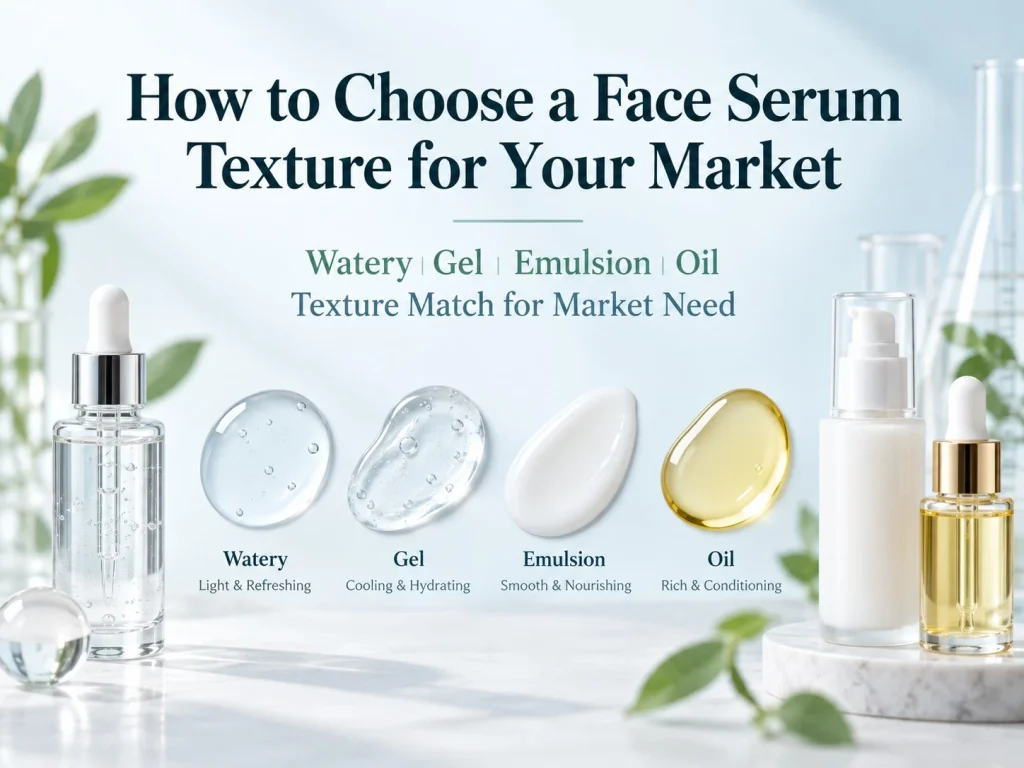

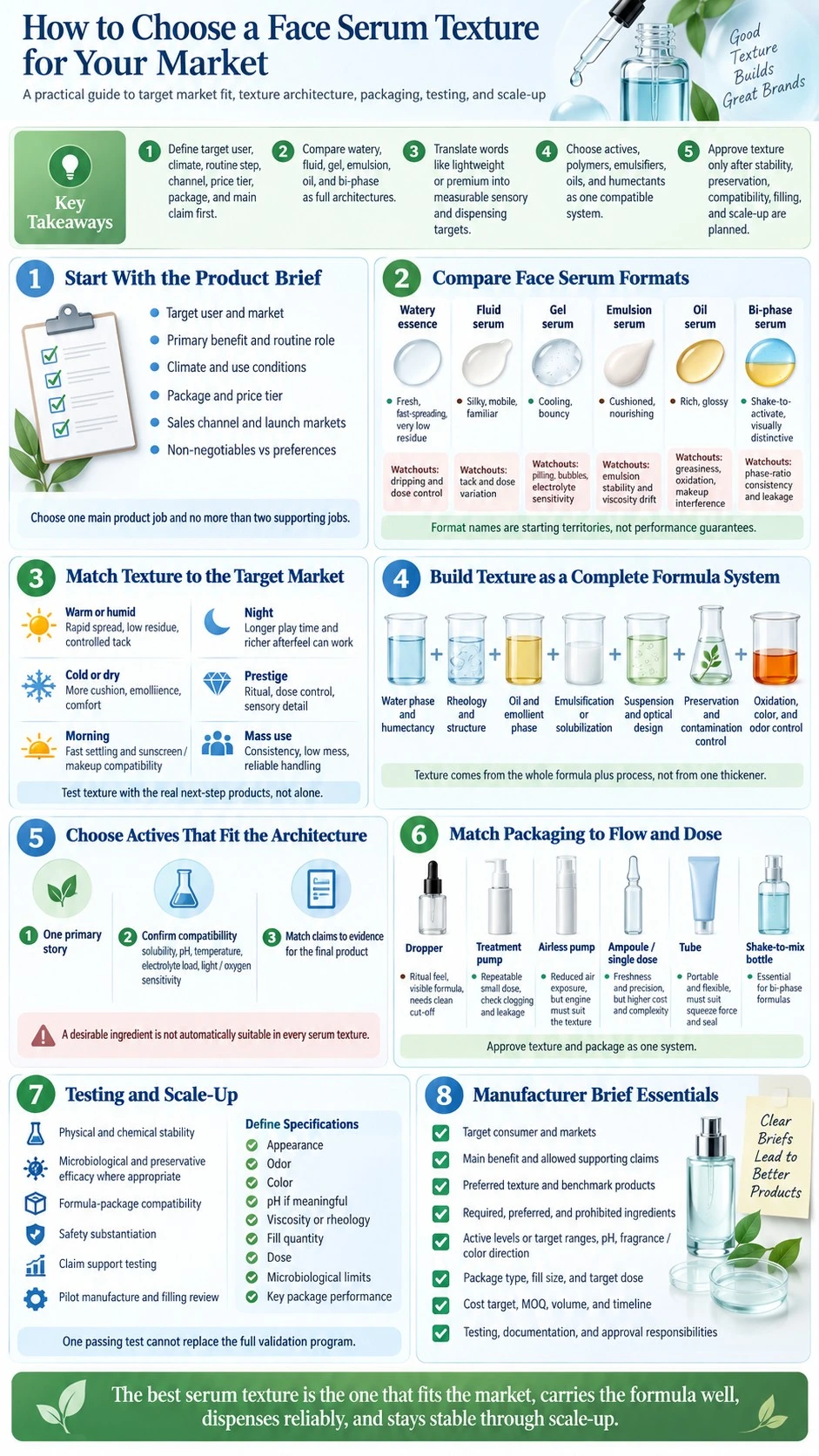
A face serum texture is not a decorative choice made after the active ingredients are selected. It affects dose, spread, layering, perceived absorption, package performance, stability, and whether the product feels credible for its market position.
For brand teams, the practical question is not “Should the serum be watery or thick?” It is “Which formula architecture can deliver the intended experience, active system, package performance, and commercial position under the target market’s real use conditions?”
Start With the Product Brief, Not a Texture Name
Begin by defining what the serum must do and how the consumer should experience it. “Lightweight anti-aging serum with peptides” is a marketing direction, not yet a development brief. The laboratory still needs the target user, primary cosmetic outcome, routine step, climate, sensory benchmark, package, price tier, sales channels, launch markets, cost target, and expected volume.
Choose one primary product job and no more than two supporting jobs. Hydration with comfortable makeup layering is coherent. Hydration, brightening, oil control, barrier repair, lifting, instant blur, exfoliation, pore care, and overnight nourishment can create competing active, texture, pH, and evidence demands.
A useful brief separates fixed requirements from preferences. A fragrance-free policy, target pH, pump package, specified market, and excluded ingredient may be non-negotiable. A translucent appearance, cooling feel, particular botanical, or exact benchmark viscosity may be flexible if it conflicts with stability, dispensing, cost, or claim support.
The brief should also state whether the project will customize an existing base or develop a more differentiated formula. That choice affects prototype freedom, sampling rounds, package options, testing, documentation, timing, and cost. A strong manufacturer should identify conflicts early rather than promise that every request can coexist unchanged.
Compare Face Serum Formats Before Formulation
The word “serum” does not define one technical structure. Two products marketed as gel serums can have different flow, elasticity, oil content, residue, and package needs. Use format names as starting territories, then translate them into measurable targets.
| Serum format | Typical structure | Sensory direction | Strong project fit | Main development watchouts | Packaging starting point |
|---|---|---|---|---|---|
| Watery essence | Low-viscosity water-continuous solution or dispersion | Fresh, fast-spreading, very low residue | Layering-led routines, humid conditions, minimalist hydration | Dripping, poor dose control, settling, weak suspension, splash during use | Controlled-orifice pump, treatment pump, or compatible dropper |
| Fluid serum | Low- to medium-viscosity water-based system | Silky, mobile, familiar serum feel | Broad daily-use concepts and flexible routine positioning | Tack, stringiness, dose variation, creaming if an oil phase is present | Dropper, treatment pump, or airless pack after flow testing |
| Gel serum | Polymer- or gum-structured aqueous system | Cooling, bouncy, visible body | Hydration, oil-free positioning, suspended visual elements | Pilling, roping, artificial break, bubbles, electrolyte or pH sensitivity | Treatment pump, airless pump, or compatible dropper |
| Emulsion serum | Light oil-in-water emulsion or gel-emulsion | Cushioned, silky, more nourishing | Barrier-support, dry-skin, premium, or multifunctional concepts | Emulsion stability, whitening, viscosity drift, heavier residue, pump recovery | Airless pump, treatment pump, or compatible tube |
| Oil serum | Anhydrous blend of oils, esters, silicones, or related lipids | Rich, lubricious, glossy, slow-absorbing | Glow, massage, minimalist water-free, and oil-soluble active concepts | Greasiness, oxidation, leakage, makeup interference, limited water-soluble actives | Dropper, pump, or narrow-orifice bottle after compatibility testing |
| Bi-phase serum | Intentionally separated aqueous and oil phases | Shake-to-activate, visually distinctive | Ritual-led launches and formulas designed for phase mixing at use | Dose inconsistency, incomplete shaking, phase-ratio drift, leakage, unclear directions | Bottle and closure designed for repeated shaking and controlled pouring or pumping |
No serum format is inherently more advanced or effective. The selected architecture must carry the intended ingredients, remain stable in its pH and temperature window, fill and dispense reliably, and create a sensory difference that the target consumer can recognize.
If two formats remain credible, prototype them as meaningfully different territories—for example, a fast-drying fluid and a cushioned emulsion serum—and compare them with one scorecard. Tiny viscosity variations rarely produce a useful commercial decision.
Match Texture to the Target Market and Routine
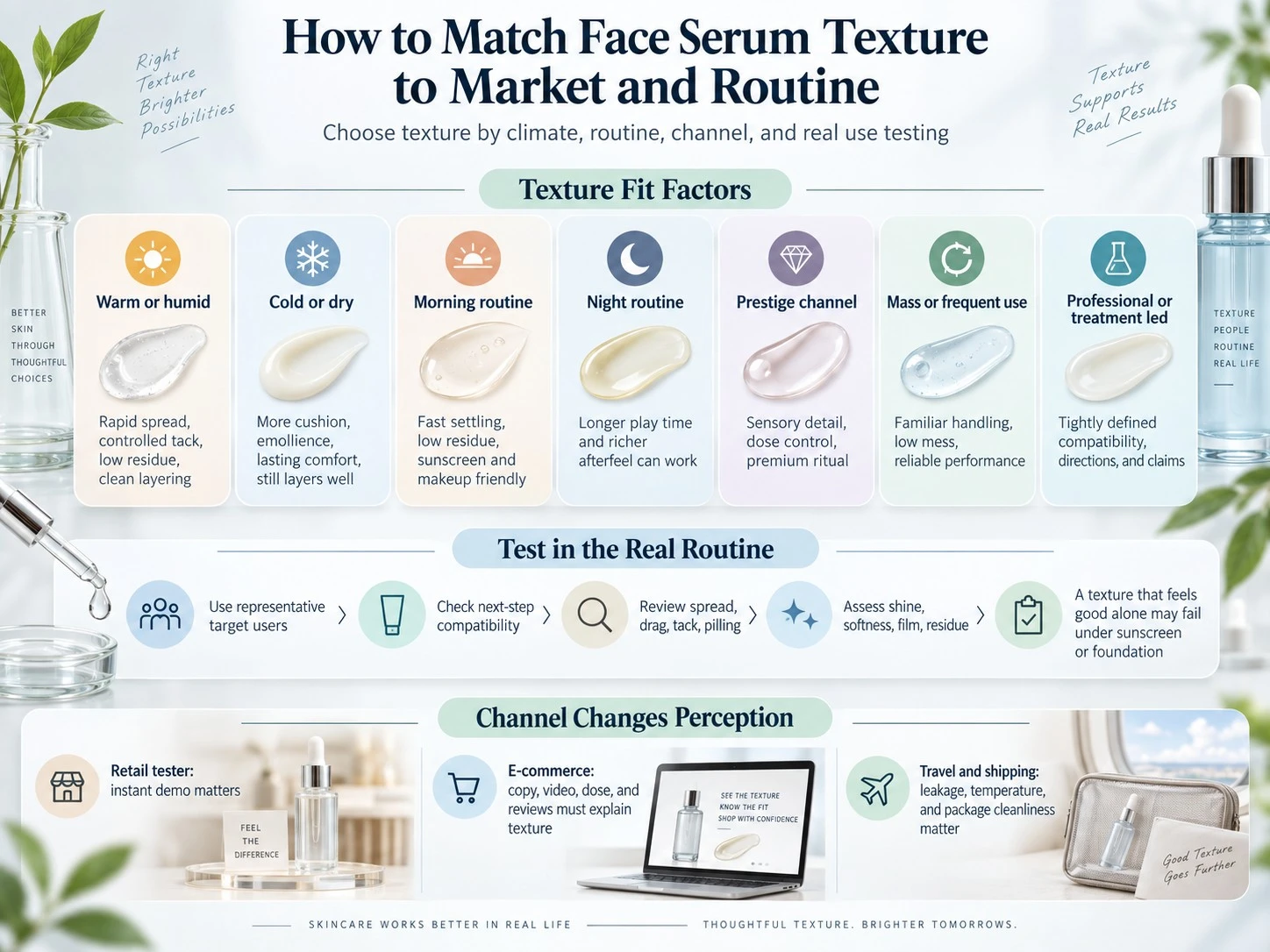
Market fit comes from a defined use scenario, not a stereotype about an entire country or skin type. Climate, indoor heating or air conditioning, routine complexity, local category expectations, price, channel, and packaging habits can all affect the preferred texture.
- Warm or humid use conditions: Consumers may value rapid spread, controlled tack, low oil residue, and clean layering. The formula still needs enough play time to distribute evenly.
- Cold or dry conditions: More cushion, emollience, and a persistent film may improve comfort, but a richer texture must still layer without rolling or feeling waxy.
- Morning routines: Fast settling, low residue, and compatibility with sunscreen and makeup usually matter more than a dramatic transforming texture.
- Night routines: A longer play time or richer afterfeel may be acceptable when the product is positioned for massage, barrier support, or overnight comfort.
- Prestige channels: Sensory detail, dose control, package interaction, and a distinctive application ritual can support value perception, but visual richness cannot compensate for poor stability or evacuation.
- Mass or high-frequency use: Familiar handling, consistent dose, low mess, and reliable performance across varied routines may matter more than novelty.
- Professional or treatment-adjacent channels: The serum may need tightly defined compatibility, directions, and claims. It should not be presented as appropriate after a procedure without product-specific safety and use support.
Test with representative target users and the actual routine rather than asking whether a sample simply feels “nice.” Define application amount, evaluation time points, next-step products, and attributes such as spread, drag, tack, pilling, shine, softness, film, and residue. A texture that scores well alone can fail beneath a polymer-rich sunscreen or long-wear foundation.
Channel changes how texture is understood. A retail tester can demonstrate a transforming gel in seconds. An e-commerce launch must communicate the same experience through accurate copy, video, pack design, dose, and reviews. Travel retail and direct shipping increase attention to leakage, temperature excursions, and package cleanliness.
Build Serum Texture as a Complete Formula System
Texture is produced by the entire formula and process. A serum does not become “premium” because one polymer raises viscosity, and increasing thickener is not a universal correction for instability or poor sensory performance.
- Water phase and humectancy: Water, glycerin, glycols, betaine, hyaluronic acid, and other humectants influence hydration positioning, tack, dry-down, freeze-thaw response, and preservative design. A high humectant load can feel sticky even in a thin serum.
- Rheology and structure: Polymers, gums, clays, associative thickeners, fatty alcohols, and other structurants control yield, flow, stringiness, suspension, recovery, and dispensing. One viscosity reading cannot describe all of these behaviors.
- Oil and emollient phase: Esters, hydrocarbons, silicones, oils, and related materials shape slip, cushion, gloss, spread, and residual film. Their polarity, oxidation profile, color, odor, and compatibility influence both sensory and stability.
- Emulsification and solubilization: A serum containing oils, oil-soluble actives, or fragrance needs an appropriate route. The system must match the oil phase, processing conditions, electrolyte load, pH, and target feel. ZICAIL’s cosmetic emulsifier guide explains why HLB or one emulsifier name is only a starting point.
- Suspension and optical design: Capsules, powders, pigments, pearls, and visual beads may require yield value or controlled density. A visually attractive suspension can add rubbing residue, settling risk, or pump blockage.
- Preservation and contamination control: Water-containing serums need a preservation strategy based on the complete formula, manufacturing hygiene, package, and foreseeable use. Chelators and multifunctional ingredients can support the system but do not prove finished-product protection.
- Oxidation, color, and odor control: Oils, botanical extracts, vitamins, and fragrance materials may react to oxygen, light, metals, heat, or package contact. Antioxidants address oxidation; they do not replace antimicrobial preservation.
Rheology should be measured with methods that reflect the product’s behavior. Many serums are shear-thinning: they retain body at rest but flow more easily through a pump or under rubbing. Yield stress can help suspend particles; thixotropic recovery affects whether the serum regains structure after pumping. These properties may explain consumer handling better than one viscosity value measured under one condition.
Control the process as part of the texture design. Polymer hydration, neutralization, phase temperature, shear, addition order, cooling rate, deaeration, hold time, and maturation can all change the final feel. Record the procedure used for every approved prototype; otherwise, a texture cannot be transferred reliably to pilot production.
Choose Actives by Architecture, Sensory, and Evidence
Start with the primary cosmetic claim, then select active systems that fit the intended architecture. A desirable ingredient is not automatically suitable in every serum texture.
Water-soluble actives usually fit most aqueous formats, but their salts, solvents, carrier systems, and required pH can change clarity and viscosity. Oil-soluble materials need a solubilized, emulsified, or anhydrous route. Powders and encapsulates may require suspension. Botanical extracts and ferments can introduce color, odor, electrolytes, or supplier-specific preservation and temperature limits.
Evaluate the commercial raw material, not only the highlighted INCI name. A peptide solution, vitamin dispersion, botanical blend, or encapsulated active may contain solvents, salts, surfactants, antioxidants, preservatives, or carriers that influence rheology and compatibility.
Use three selection rules:
- One primary story: Define the main cosmetic outcome first; add supporting ingredients only when they reinforce it.
- Architecture compatibility: Confirm solubility, pH, temperature, electrolyte contribution, light and oxygen sensitivity, and interactions with the complete base.
- Claim proportionality: Match the wording and test plan to the evidence available for the final product. Ingredient-level data do not automatically substantiate the same result for a different formula.
In the United States, intended use determines whether a product is regulated as a cosmetic, a drug, or both. Claims to beautify or alter appearance generally fall within cosmetic scope, while claims to treat disease or affect body structure or function may create drug status.[1] Review the product name, website, advertising, visuals, directions, and carton copy together. ZICAIL’s skincare product claims guide gives a broader planning framework.
Build and stabilize the base before filling it with optional claim ingredients. A coherent formula with a clear sensory identity is usually more defensible than a crowded active list that creates pH, color, odor, tack, stability, or sourcing conflicts.
Match Packaging to Flow, Dose, and Positioning
Select a packaging direction during the initial brief and introduce representative components before the texture is finalized. The dispenser controls dose, cut-off, exposure, evacuation, hygiene, filling, and part of the consumer’s sensory judgment.
- Dropper: Supports a clinical or ritual cue and shows the formula, but it needs controlled flow, clean cut-off, suitable bulb recovery, and attention to oxygen and repeated opening.
- Treatment pump: Can provide a repeatable small dose. Check actuator force, dip-tube reach, orifice, clogging, leakage, spring and gasket compatibility, and dose consistency.
- Airless pump: Can reduce repeated air exposure and improve evacuation, but stringy gels, very fluid serums, or high-viscosity emulsions may require a different engine or filling method.
- Ampoule or single-dose pack: Supports freshness and precise-use positioning but adds material, opening, breakage, fill, cost, and instruction considerations.
- Tube: Handles many viscosity ranges and offers good portability. Orifice size, squeeze force, suck-back, panel recovery, cap seal, and decoration must suit the bulk.
- Shake-to-mix bottle: Essential for intentional bi-phase concepts. The closure and dose path must deliver a representative mixture after realistic shaking.
Test the final bulk in production-representative components. Look for leakage, clogging, dose drift, evaporation, discoloration, swelling, cracking, corrosion, formula drying at the orifice, decoration damage, and incomplete evacuation. The face serum packaging guide compares format options, while the packaging compatibility testing guide covers the test relationship.
A package can change how the same formula feels. A dropper may encourage a larger, less consistent dose; a narrow pump can shear a structured gel; an airless engine can create a short, controlled ribbon. Approve the texture and package as one system rather than as two independent purchasing decisions.
Plan Testing, Specifications, and Scale-Up Together
There is no universal test package for every face serum. Formula architecture, water content, active system, package, claims, target markets, shelf-life goal, manufacturing process, and foreseeable use determine what needs to be justified. In the United States, manufacturers and distributors remain responsible for marketed cosmetic safety, and FDA does not prescribe one test list for every cosmetic.[2]
A serum development plan commonly covers:
- physical and chemical stability, including appearance, odor, color, pH where meaningful, viscosity or rheology, separation, precipitation, sedimentation, crystallization, oxidation indicators, and package function;
- microbiological specifications and preservative-efficacy testing where appropriate to the formula and risk assessment;
- formula-package compatibility using the intended bulk, contact materials, fill conditions, orientations, temperatures, and dispensing cycles;
- safety substantiation for the finished product and intended use;
- instrumental, clinical, consumer, or other substantiation proportionate to the exact claims; and
- pilot manufacture, transfer, filling, and finished-product checks before the master formula and process are locked.
Cosmetic stability testing cannot follow one universal method across all products; manufacturers should specify and justify the protocol, methods, conditions, and specifications for the particular product.[3] ISO 11930 provides a reference framework for preservation-efficacy testing and the overall antimicrobial protection evaluation of relevant cosmetics.[4] These tools answer different questions, so one passing result cannot replace the rest of the validation program.
Specifications must be measurable and reproducible. Define the methods and conditions for appearance, odor, color, pH, viscosity or rheology, density where relevant, fill quantity, dose, microbiological limits, and critical package performance. “Silky,” “fast-absorbing,” and “premium” belong in an approved sensory scorecard, not as the only manufacturing specifications.
During scale-up, review vessel geometry, circulation, shear, hydration time, phase combination, heating and cooling, neutralization, deaeration, transfer, hold time, and filling temperature. Cosmetic GMP guidance covers production, control, storage, and shipment as linked quality activities.[5] Approve the pilot against the same formula version, specifications, package, and sensory benchmark used for the laboratory sample.
What to Include in a Face Serum Manufacturer Brief
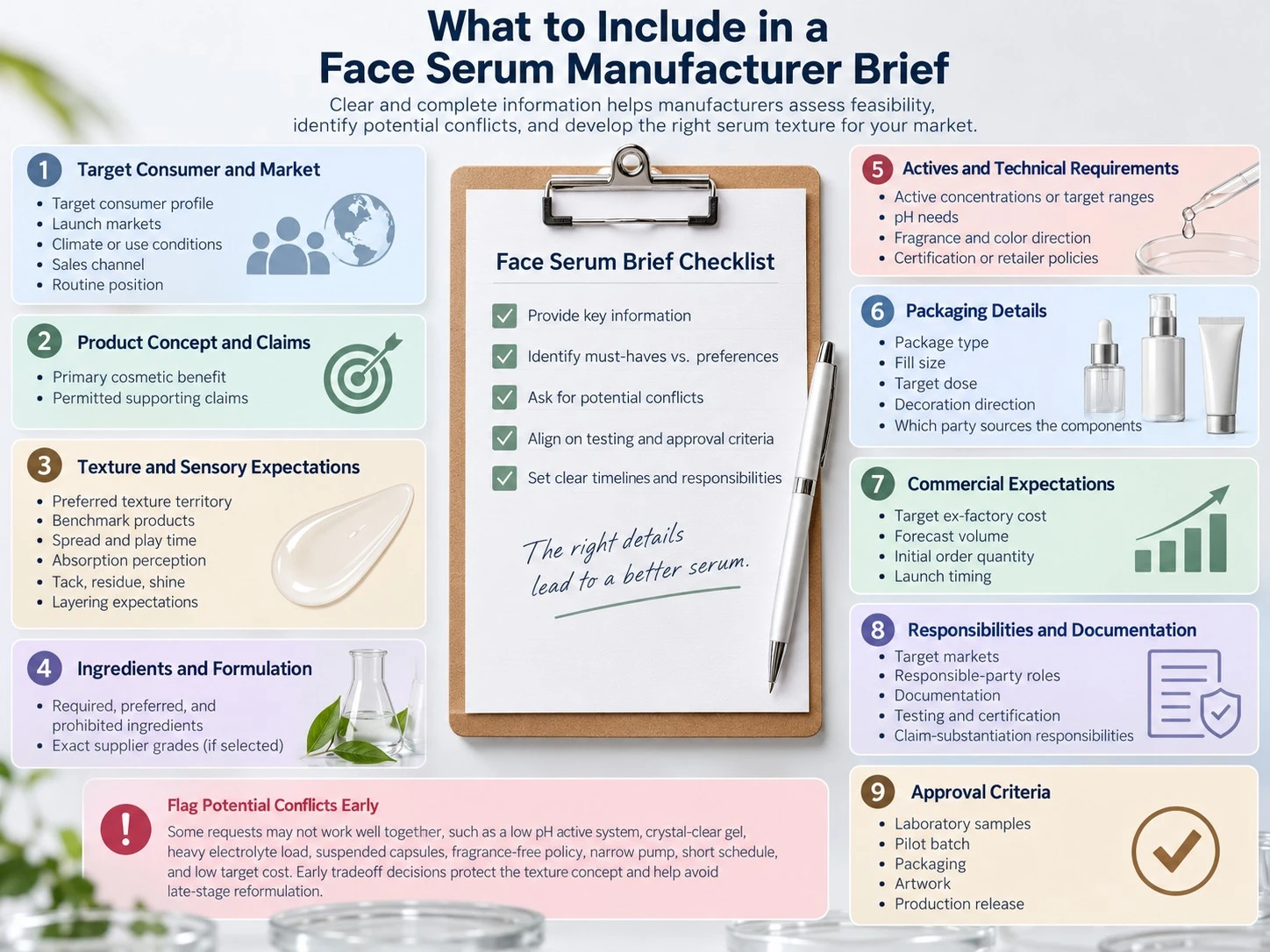
Send enough information for feasibility review while identifying which preferences can change. A practical face serum brief includes:
- target consumer, launch markets, climate or use conditions, sales channel, and routine position;
- one primary cosmetic benefit and the permitted supporting claims;
- preferred texture territory, benchmark products, spread, play time, absorption perception, tack, residue, shine, and layering expectations;
- required, preferred, and prohibited ingredients, including the exact supplier grades when already selected;
- active-system concentrations or target ranges, pH needs, fragrance and color direction, and certification or retailer policies;
- package type, fill size, target dose, decoration direction, and which party sources the components;
- target ex-factory cost, forecast volume, initial order quantity, and launch timing;
- target markets, responsible-party roles, documentation, testing, certification, and claim-substantiation responsibilities; and
- approval criteria for laboratory samples, pilot batch, packaging, artwork, and production release.
Ask the manufacturer to flag conflicts rather than simply quote the requested list. A low-pH active system, crystal-clear gel, heavy electrolyte load, suspended capsules, fragrance-free policy, narrow pump, short schedule, and low target cost may not coexist reliably. Early tradeoff decisions protect the texture concept better than late reformulation.
Develop a Face Serum Texture With ZICAIL
ZICAIL can help translate a face serum concept into a development route covering texture architecture, ingredient direction, sensory targets, packaging, testing, pilot work, and production. Review the face serum formulation guide for the wider technical framework and custom skincare formulation support for project scope.
When you are ready, contact ZICAIL with the target market, benchmark products, preferred format, active and ingredient policy, sensory direction, package, fill size, claims, expected order quantity, budget range, and launch timing. A clearer brief makes feasibility review and prototype feedback more efficient.


