


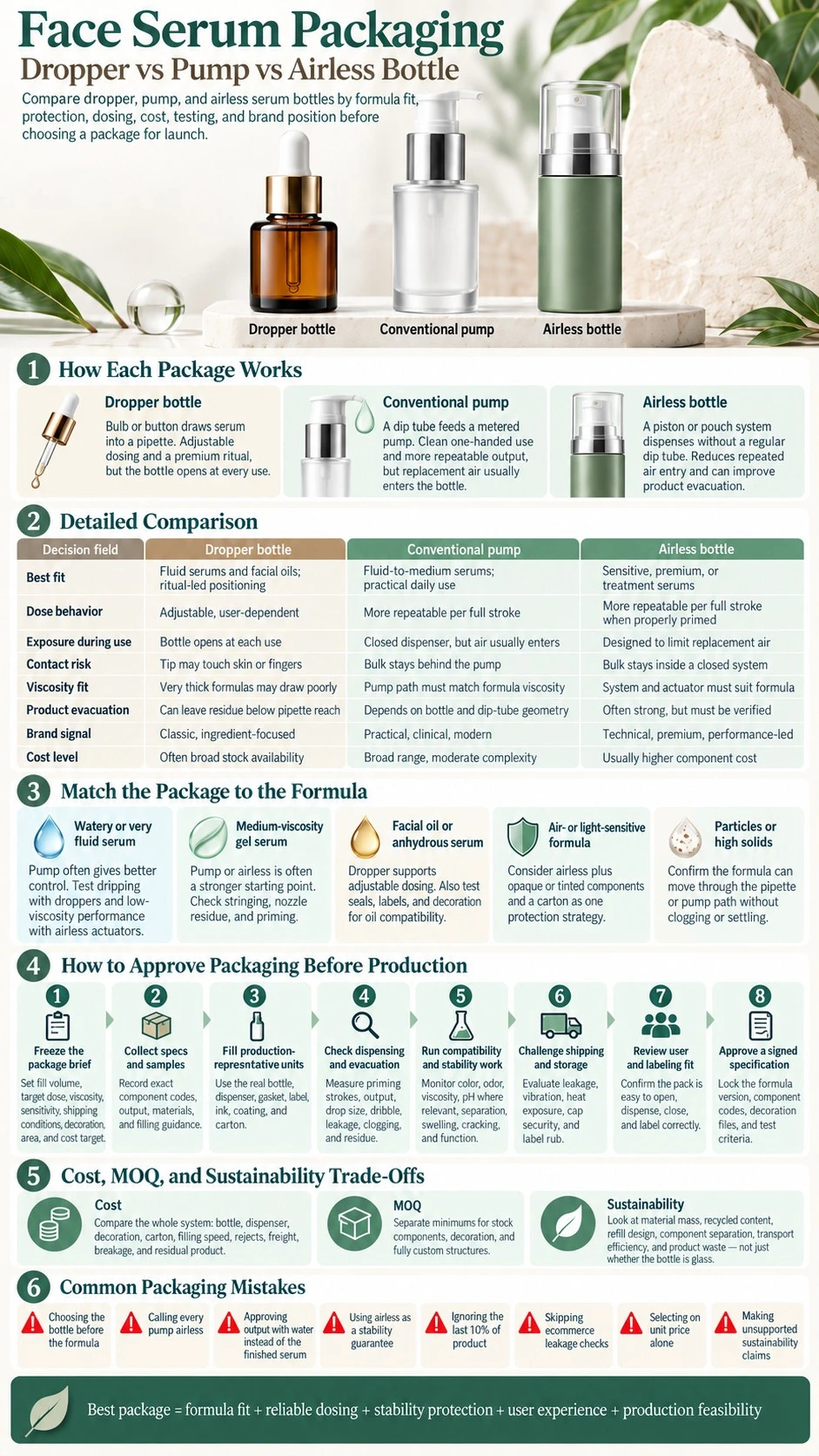
Face serum packaging affects much more than shelf appearance. The bottle and dispenser determine how much product comes out, how often the bulk is exposed during use, whether a customer can empty the pack, and how the product behaves in storage and shipping. A packaging decision that ignores the formula can lead to clogging, dripping, leakage, poor priming, unstable decoration, or wasted product.
This guide compares three common primary packages for facial serums: a pipette dropper, a conventional treatment pump, and an airless bottle. It focuses on the choices a brand team must resolve before sampling and bulk production.
How Dropper, Pump, and Airless Serum Bottles Work
The three formats can look similar on a product page, but they move formula in different ways. That mechanism changes the package’s dose control, exposure pattern, viscosity window, filling requirements, and end-of-use performance. Packaging suppliers therefore offer droppers, cosmetic pumps, and airless systems as distinct dispensing categories rather than interchangeable closures.[1]
Dropper bottle
A dropper uses a bulb or push-button to draw product into a glass or plastic pipette. The user removes the closure and releases individual drops or a partial pipette. This creates a familiar serum ritual and lets the user vary the amount, but the bottle is opened at each use. The pipette tip can also touch fingers or skin if directions and design do not discourage contact.
Dropper performance depends on more than bottle appearance. Pipette bore, wiper design, bulb recovery, formula viscosity, surface tension, and fill level affect how much product is drawn and released. Dropper components also vary in material and construction across supplier catalogs.[2] A sample approved with water is therefore not proof that the same package will work with the finished formula.
Conventional pump bottle
A conventional treatment pump normally pulls product through a dip tube and dispenses a set nominal output per actuation. It supports one-handed use and keeps the remaining bulk from direct finger contact. As product leaves, air generally enters the bottle headspace, so a conventional pump should not be described as airless merely because the actuator covers the opening.
Pump selection must match viscosity and dose. A very thin serum can spit, drip, or deliver more than the intended use amount, while a high-viscosity or particle-containing formula can prime slowly or clog a narrow flow path. The stated output is a component specification; the delivered dose should be measured with the actual formula.
Airless bottle
An airless system dispenses product without a conventional dip tube. Common designs use a rising piston or a collapsible inner pouch so that the package volume contracts as product leaves. This can reduce repeated air entry and support good evacuation, making airless packaging useful for some sensitive serums and premium treatment products. Airless packaging is widely positioned for serums and other sensitive cosmetics.[3]
Airless does not mean oxygen-free, and it does not guarantee formula stability. Initial headspace, material permeability, filling conditions, and the formula itself still matter. The package must also prime, dispense, and move its piston or pouch correctly; a mismatch can cause a no-output pump even when the bottle looks intact.
Dropper vs Pump vs Airless Bottle: Detailed Comparison
Use this table to compare the three systems across the same commercial and technical fields. Individual components vary, so supplier specifications and filled-pack testing take priority over category-level assumptions.
| Decision field | Dropper bottle | Conventional pump bottle | Airless bottle |
|---|---|---|---|
| Best initial fit | Fluid serums and facial oils; ritual-led positioning | Fluid-to-medium serums; daily, one-handed use | Sensitive, premium, or treatment-positioned serums |
| Dispensing method | User draws and releases drops | Dip tube feeds a metered pump chamber | Piston or pouch moves as product is dispensed |
| Dose behavior | Adjustable but user-dependent | More repeatable per full stroke | More repeatable per full stroke when correctly primed |
| Exposure during use | Bottle opens at each use | Closed dispenser, but replacement air usually enters | Designed to limit replacement air entering the product chamber |
| Contact risk | Tip may touch skin or fingers | Bulk stays behind the pump | Bulk stays inside a closed dispensing system |
| Viscosity considerations | Thick formulas may draw or release poorly | Flow path and pump force must suit formula | System, actuator, and piston or pouch must suit formula |
| Product evacuation | Can leave product on walls or below pipette reach | Depends on dip-tube geometry and bottle shape | Often designed for high evacuation, but must be verified |
| Leakage and travel | Closure torque, bulb, wiper, and bottle neck matter | Locking actuator or overcap can improve transport control | Locking actuator, venting, and system assembly need validation |
| Filling and assembly | Familiar filling; closure torque is important | Dip-tube length and pump assembly must be controlled | May require system-specific filling and air-gap control |
| Brand signal | Classic, apothecary, ingredient-focused | Practical, clinical, modern | Technical, premium, performance-led |
| Cost and sourcing | Often broad stock availability; decoration can add cost | Broad range, with cost tied to actuator and bottle | Commonly higher component and qualification complexity |
| Sustainability questions | Glass can be heavy; dropper is usually multi-material | Pump is multi-component; bottle material varies | Multi-component systems are common; mono-material options exist |
The category label does not decide the winner. A conventional pump can outperform an airless pack if it dispenses the serum reliably and better fits the budget. A dropper remains a sound choice when adjustable dosing and the application ritual are deliberate product decisions.
Match the Package to the Serum Formula

Start with formula behavior, then consider branding. Do not assign one package to every serum carrying the same marketing ingredient.
- Watery or very fluid serum: A controlled-output treatment pump can reduce accidental over-dispensing. A dropper may work, but test dripping at the bottle neck and whether the consumer can release single drops. An airless option needs an actuator designed for low-viscosity formulas.
- Medium-viscosity gel serum: A conventional or airless pump is often the stronger starting point because a full stroke can provide a repeatable dose. Check stringing, nozzle residue, suck-back, and priming after storage.
- Facial oil or anhydrous serum: A dropper supports adjustable dosing and visible texture. A compatible pump can offer cleaner use. Test seals, elastomers, labels, and decoration because oils can migrate and stain or soften some materials.
- Air- or light-sensitive formula: Consider an airless system, opaque or tinted components, a carton, and controlled filling conditions as parts of one protection strategy. Dark glass can reduce light exposure, but it does not stop air entering when a dropper is removed.
- Serum with suspended particles or high solids: Confirm that particles remain dispersed and can move through the pipette or pump pathway without settling, bridging, or clogging. A visually attractive dispenser is unsuitable if it changes the delivered product.
Do not rely on a universal viscosity number from a generic packaging article. Each mechanism has its own operating window, while viscosity readings vary with temperature, shear, and test method. Give the packaging and filling teams the formula’s measured data and physical behavior, then test the proposed component.
How to Approve Face Serum Packaging Before Production
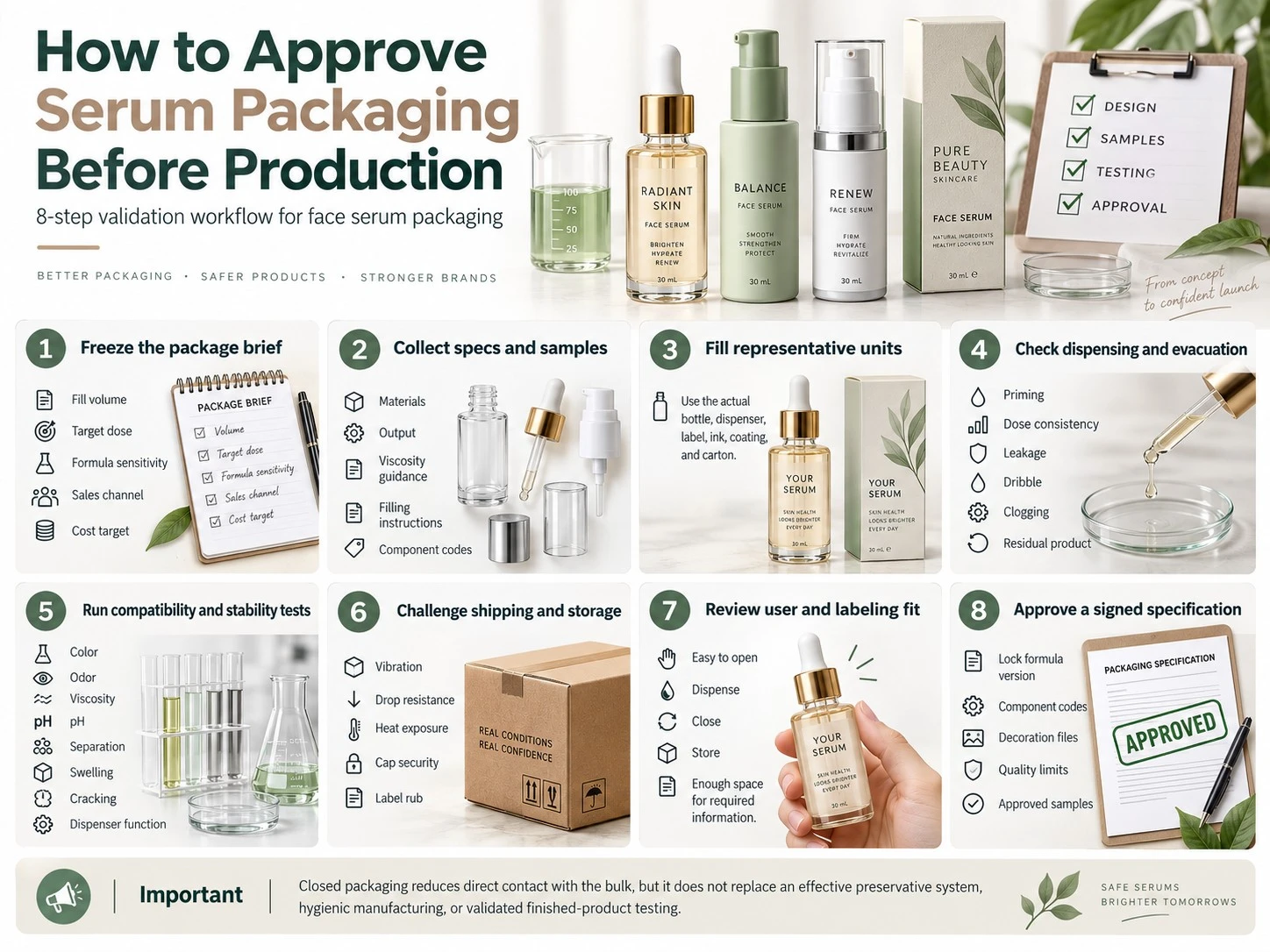
A catalog sample can narrow the search, but approval should use the final or a production-representative formula. This sequence reduces the risk of a late packaging change.
- Freeze the package brief. Define fill volume, target dose, formula sensitivity, viscosity range, sales channel, shipping conditions, label area, decoration, cost target, and desired user experience.
- Collect technical specifications and samples. Request material details, nominal output, viscosity guidance, filling instructions, closure or actuator requirements, available decoration, and any relevant quality documents. Record the exact component codes; visually similar pumps can perform differently.
- Fill production-representative units. Use the intended bottle, dispenser, gasket, dip tube, wiper, label, ink, coating, and carton. Control fill weight, headspace, closure torque, and assembly conditions.
- Check dispensing and evacuation. Measure priming strokes, output over repeated actuations, drop size where relevant, leakage, dribble, clogging, dose consistency, and residual product at end of use. Test upright, angled, and realistic consumer handling where the pack is designed for it.
- Run formula-package compatibility and stability work. Monitor color, odor, viscosity, pH where relevant, separation, weight loss, paneling, swelling, cracking, corrosion, seal changes, and dispenser function under the project’s approved protocols. The dedicated guide to packaging compatibility testing explains the broader evaluation logic.
- Challenge shipping and storage conditions. Evaluate leakage, vibration, drop resistance, temperature exposure, ecommerce orientation, cap security, label rub, and decoration transfer using conditions appropriate to the distribution plan.
- Review user and labeling fit. Confirm that the customer can understand, open, dispense, close, and store the pack. Ensure the primary and secondary package leave enough usable space for required information; ISO 22715 specifies requirements for cosmetic packaging and labeling, while market-specific rules still control the final artwork.[4]
- Approve a signed specification. Lock the formula version, component codes, colors, decoration files, quality limits, test acceptance criteria, and approved filled samples before bulk purchasing.
Packaging is also part of contamination control. Cosmetic companies remain responsible for product safety, and inadequate packaging or consumer use can contribute to microbial contamination.[5] A closed dispenser can reduce direct access to the bulk, but it does not replace an effective preservative system, hygienic manufacturing, or validated finished-product testing.
Cost, MOQ, and Sustainability Trade-Offs
Component price alone does not show total packaging cost. Compare the bottle, dispenser, overcap, decoration, carton, assembly, filling speed, rejects, freight, breakage, quality control, and residual product. A stock glass dropper may limit tooling but add shipping weight. A standard pump can simplify use and production. An airless system may cost more to source and qualify, yet improve evacuation or support a premium position central to the concept.
MOQ depends on whether the project uses stock components, custom color, printing, coating, metallization, a proprietary actuator, or a new mold. Ask for separate minimums and lead times for undecorated components, decoration, and fully custom structures. This makes it easier to distinguish a bottle minimum from a decoration or tooling commitment.
Sustainability also requires a full-system view. Glass is not automatically the lowest-impact choice because weight and breakage affect distribution, and a glass bottle with a bulb, collar, and pipette remains a multi-material pack. Conventional and airless pumps can also contain several materials and small components. Compare material mass, recycled content, refill design, component separation, local recycling acceptance, transport efficiency, product waste, and formula protection. Do not make a broad recyclable or eco-friendly claim until the exact finished pack and target market support it.
Common Face Serum Packaging Mistakes
- Choosing the bottle before the formula. The team’s preferred aesthetic can narrow the formula or force a costly change after stability work begins.
- Calling every pump airless. A dip-tube pump and a piston or pouch-based airless system manage replacement air differently. The specification should name the mechanism.
- Approving output from an empty or water-filled sample. Actual dose, priming, dribble, and clogging depend on the finished serum.
- Using “airless” as a stability guarantee. The package can reduce one exposure route, but formula design, light barrier, material permeability, filling, and storage still affect performance.
- Ignoring the last 10% of product. Poor dip-tube reach, shoulder geometry, piston movement, or serum adhesion can leave meaningful residue and frustrate users.
- Skipping ecommerce leakage checks. Sideways storage, vibration, heat, pressure changes, and repeated handling can reveal failures that an upright desk sample does not.
- Selecting on unit price alone. A cheaper component can become more expensive after decoration rejects, slow filling, leakage, breakage, returns, or excess product waste.
- Making unsupported sustainability claims. Confirm the material structure, recycling route, recycled content evidence, and market wording before placing claims on artwork.
Discuss Your Face Serum Packaging Project
ZICAIL supports face serum projects with formula planning and packaging selection, including dropper bottles, treatment pumps, labels, and outer boxes. Review the private label face serum options and packaging customization support, then share your formula type, target fill volume, preferred dispenser, market, order plan, decoration direction, and launch timing so the team can discuss suitable next steps.


