
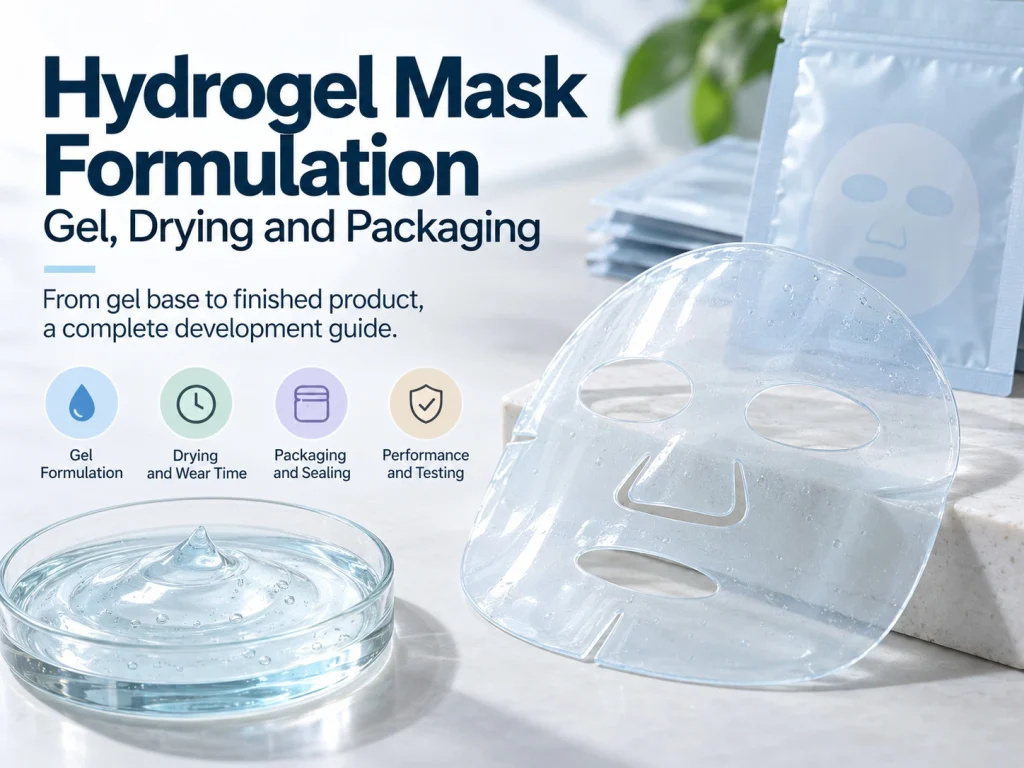

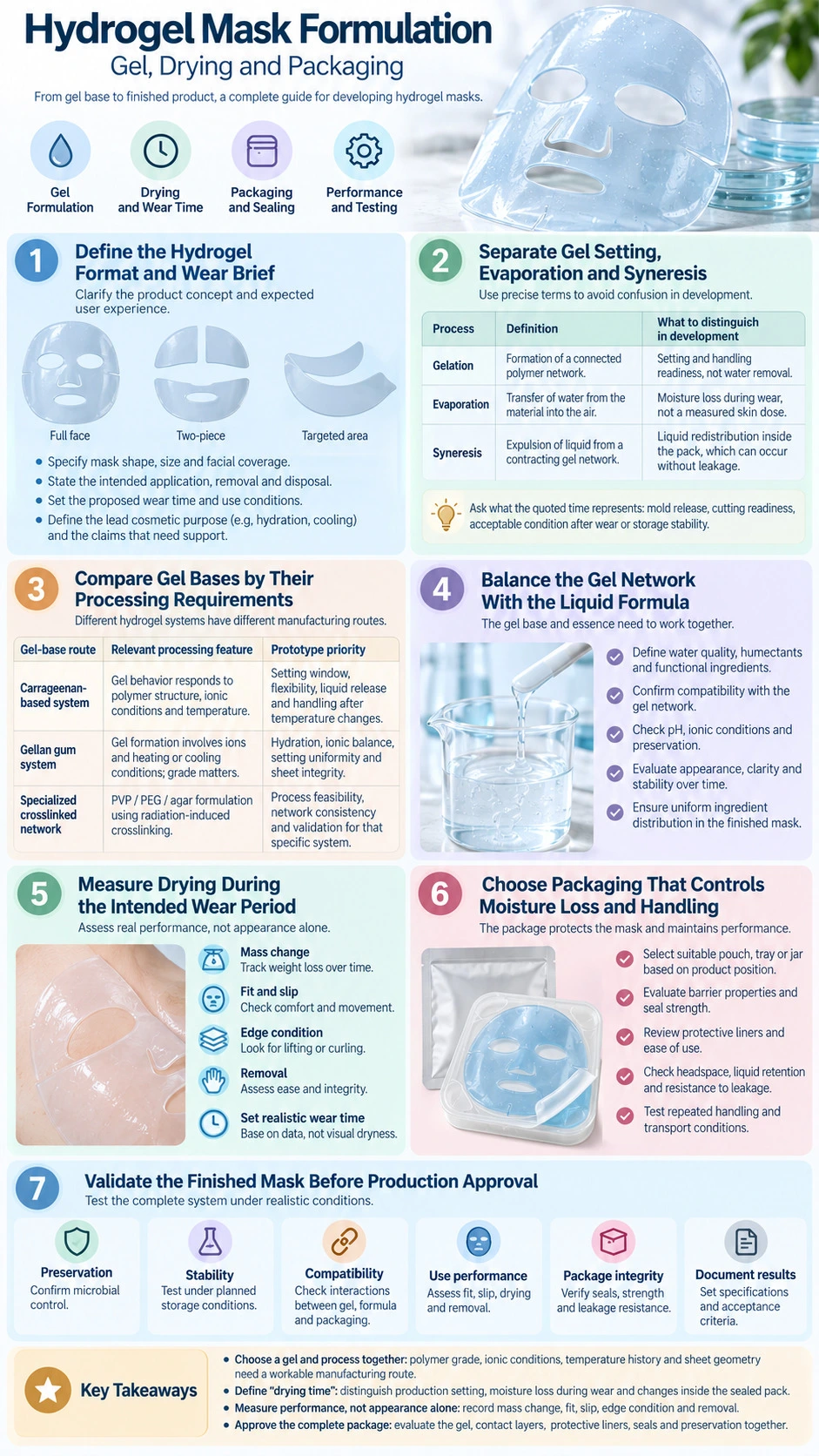
A hydrogel mask is a water-containing polymer network formed into a facial mask, not simply a serum with a thicker texture.[1] For a brand, the useful development question is how that network can remain intact during packing, conform during wear and retain acceptable properties through storage. Those jobs connect the gel base, liquid formula and package from the first prototype.
Define the Hydrogel Format and Wear Brief
Specify a preformed wet mask, its facial coverage and whether it comes in one piece or separate sections. Record the intended application, removal and disposal, including whether consumers should remove protective films. The hydrogel versus sheet mask comparison helps clarify the carrier distinction when defining the concept.
Write the desired experience as observable requirements: comfortable contact, manageable slip, no tearing during removal from the pack, and a finish that fits the next skincare step. State the proposed wear interval and intended use conditions instead of promising that the mask should stay on until it looks dry.
Set the lead cosmetic purpose and the claims that need support. Hydration positioning, a cooling sensation and a change in transparency are different propositions. Select evidence for the actual finished product and target market; do not treat an ingredient list or a familiar hydrogel format as proof of every proposed claim.
Separate Gel Setting, Evaporation and Syneresis
Use precise process names in the development brief. The following terms describe different physical events:
| Process | Definition | What to distinguish in development |
|---|---|---|
| Gelation | Formation of a connected polymer network that gives the material gel behavior | Setting and handling readiness, rather than complete water removal |
| Evaporation | Transfer of water from the material into the surrounding air as vapor | Moisture loss during exposure, rather than a measured skin dose |
| Syneresis | Expulsion of liquid from a contracting gel network | Liquid redistribution inside the pack, which can occur without package leakage |
Carrageenan research shows that gel structure and liquid expulsion can change with ionic composition and temperature.[2] A wet pouch and a mask losing mass in open air therefore need different investigations.
Ask what endpoint a quoted time represents: release from the mold, readiness for cutting, acceptable condition after wear, or stability during storage. If a manufacturing route includes a separate conditioning or drying stage, document that stage independently.
Compare Gel Bases by Their Processing Requirements
Select a candidate network that the production route can form consistently. The options below illustrate why “hydrogel” is not one interchangeable formula.
| Gel-base route | Relevant processing feature | Prototype priority |
|---|---|---|
| Carrageenan-based system | Gel behavior responds to polymer structure, ionic conditions and temperature.[2] | Setting window, flexibility, liquid release and handling after temperature changes |
| Gellan gum system | Gel formation involves ions and heating/cooling conditions; the exact grade matters.[3] | Hydration, ionic balance, setting uniformity and sheet integrity |
| Specialized crosslinked network | A published PVP/PEG/agar facial-mask formulation used radiation-induced crosslinking.[1] | Process feasibility, network consistency and validation for that specific system |
These references establish material and process possibilities, not a ready-to-run cosmetic recipe. Laboratory findings from one network do not establish the safety or wear performance of another finished mask.
Specify the supplier grade, blend composition and relevant quality controls. For gellan, identify the high-acyl or low-acyl form and any blend being used.[3] Do not substitute a gum with the same general ingredient name without rechecking the process. Also distinguish a viscosity-building ingredient from the network responsible for the mask’s mechanical integrity.
Evaluate thickness, wet mass and dimensions together. A sheet that feels strong when held flat can still tear at a cutout, stretch during liner removal or lift at the nose. Record the geometry and method for mechanical measurements so results from different prototypes remain comparable.
Balance the Gel Network With the Liquid Formula
Treat the liquid formula as part of the gel system. Adding a familiar essence after choosing the network can change the product you are trying to manufacture.
- Water and humectants: control water quality and the humectant system. Glycerin is one cosmetic humectant option.[4] Compare the complete formula for wet feel, tack, flexibility and drying behavior rather than assuming more humectant always improves the mask.
- pH and ionic balance: record the final pH, salts and other ingredients that affect the chosen network. Evaluate the proposed acid, buffer or chelator changes with the gel developer before treating them as minor adjustments.
- Actives and dispersion: define the desired ingredient story, solubility and analytical requirements. Screen for crystals, particles, discoloration and uneven distribution in the formed sheet.
- Processing and preservation: define addition order, hold conditions and the preservation strategy. Check whether sensitive ingredients need a different addition stage and whether the finished gel still meets its specification.
Judge the formed gel after storage as well as immediately after manufacture.
For masks packed with additional free essence, specify that liquid separately: composition, quantity and the acceptable condition after contact with the sheet. Extra liquid can complicate the interpretation of wet mass, dripping and pouch residue. It should be an intentional part of the product, not an unexplained correction for a weak gel.
Measure Drying During the Intended Wear Period
Set a wear-performance target before choosing a drying-time number. Define acceptable contact, edge condition, slip and removal throughout the proposed interval. The consumer guide to hydrogel mask wear time explains why finished-product directions matter more than a universal timer.
Complete the appropriate safety review before tests on people. Compare prototypes under a documented protocol:
- Keep the exposure consistent: record temperature, relative humidity, airflow, contact surface, mask thickness and starting condition. Separate open-air bench measurements from an intended-use assessment.
- Use defined measurement points: weigh samples at agreed intervals, photograph the same areas and record shrinkage, curling, tearing, slip and removal behavior. Specify how free surface liquid is handled before weighing.
- Set pass/fail criteria: choose acceptable mass change and functional endpoints for the concept. Do not select a threshold simply because a competitor reports a particular number of minutes.
For a simple comparison, mass loss (%) equals 100 × (starting mass − mass at the measurement time) ÷ starting mass. A sample falling from 20 g to 18 g has lost 10% of its starting mass. This is an illustrative calculation, not a recommended acceptance limit or an ingredient-delivery result.
Mass change alone cannot distinguish evaporation, liquid transferred to a contact surface and other material loss. Likewise, transparency does not identify where the water went or how much active reached the skin. Record appearance alongside functional observations, and use separate evidence for absorption or efficacy claims.
If longer wear is part of the concept, validate that full interval for comfort, integrity and intended use. Slow visible drying is not, by itself, a reason to extend the label’s wear instructions.
Choose Packaging That Controls Moisture Loss and Handling
Specify the exact pouch construction and contact layer, not just “foil packaging.” Water-vapor transmission rate, or WVTR, describes vapor movement through a barrier material under stated test conditions. Film testing such as ASTM F1249 assesses the material; it does not replace evaluation of the finished sealed pack.[5]
Ask for the test conditions and units with any barrier figure. Values measured under different temperature or humidity conditions are not a useful like-for-like comparison. Judge the assembled package with its actual seals, folds, filled weight and storage conditions.
Review three packaging functions:
- Moisture retention: assess filled-pack mass change, sheet condition and liquid distribution through storage. Investigate leakage separately from gel syneresis.
- Protection and release: confirm that any liner, separator or tray supports the wet gel during packing and removal without damaging the surface or cutouts.
- Sealing and transport: define the seal area, contamination controls and handling conditions. Evaluate pack integrity after relevant compression, orientation and distribution challenges.
The packaging compatibility testing guide covers the broader contact-material assessment. Check the actual laminate, sealant, liners and decoration supplied for the order; changing one component can change the approved system.
Liquid inside a closed pouch is not enough to diagnose a barrier failure. Compare total pack mass, free liquid and the gel’s dimensions and handling against the approved specification. Avoid solving a storage problem solely by adding more liquid without identifying the cause.
Validate the Finished Mask Before Production Approval
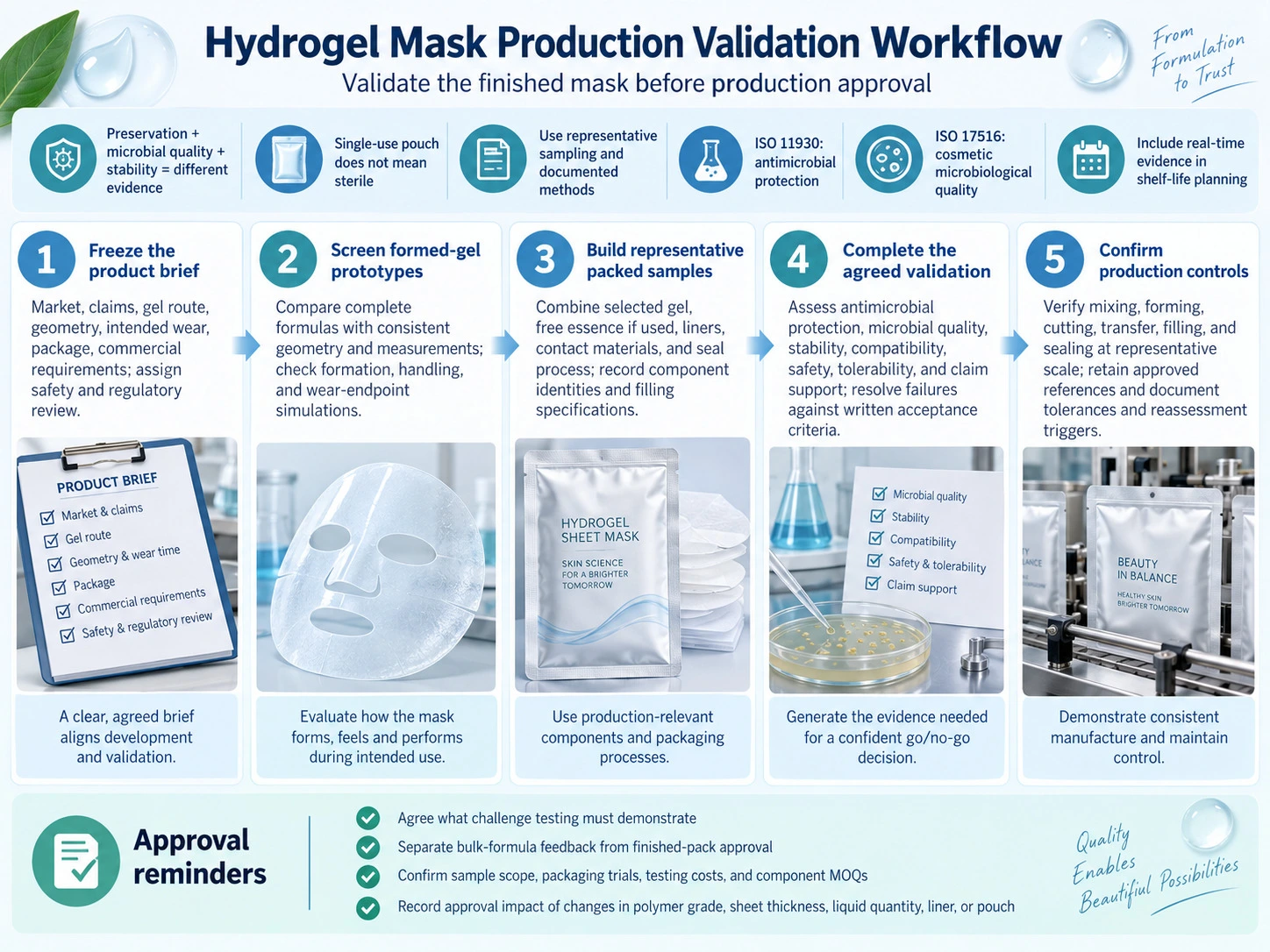
Agree preservation and microbial testing for the gel-containing product. A qualified laboratory should document representative sampling, microbial recovery and any required method adaptation. ISO 11930 provides a framework for assessing antimicrobial protection.[6] ISO 17516 addresses cosmetic microbiological quality.[7] A sealed single-use pouch does not establish sterility.
Agree what the preservative challenge test needs to demonstrate. Preservation efficacy, initial microbial quality and storage stability provide different evidence; none substitutes for the other two.
Follow one approval sequence:
- Freeze the product brief: record market, claims, gel route, geometry, intended wear, package and commercial requirements. Assign safety and regulatory review responsibilities.
- Screen formed-gel prototypes: compare the complete formulas using consistent geometry and measurement methods. Check formation, handling and bench simulations of the intended wear endpoints.
- Build representative packed samples: combine the selected gel, any free essence, liners, contact materials and seal process. Record component identities and filling specifications.
- Complete the agreed validation: assess antimicrobial protection, microbial quality, stability, compatibility and relevant safety, tolerability and claim support. Resolve failures against written acceptance criteria.
- Confirm production controls: verify mixing, forming, cutting, transfer, filling and sealing at a representative scale. Retain approved references and document tolerances and changes that require reassessment.
The stability protocol should cover the gel and its final package. Cosmetic stability guidance leaves methods and conditions to a justified product-specific protocol.[8] Include real-time evidence in the shelf-life plan; a short accelerated screen alone does not establish a universal expiry date.
In the project process, separate bulk-formula feedback from finished-pack approval. Confirm the scope of early samples, later packaging trials, testing costs and component minimum orders before planning the launch. Record the approval impact of changing the polymer grade, sheet thickness, liquid quantity, liner or pouch.
Discuss Your Hydrogel Mask Brief With ZICAIL
ZICAIL’s face mask development includes hydrogel-format discussions, formula or mask-bulk evaluation and packaging coordination. Its published face-mask starting MOQ is 30,000 units, with final specifications and quotation confirmed for each project.[9]
Send the target market, claims direction, reference mask, desired gel feel, shape, wear interval, pack configuration and estimated quantity. Ask how the proposed gel route, representative packaging trials and required testing fit the project.
Formula sampling focuses on the formula or mask bulk; custom-printed sachets move forward after the formal order and relevant approvals.[9] Contact ZICAIL with your brief to confirm feasibility, sample scope and the next development step.


