


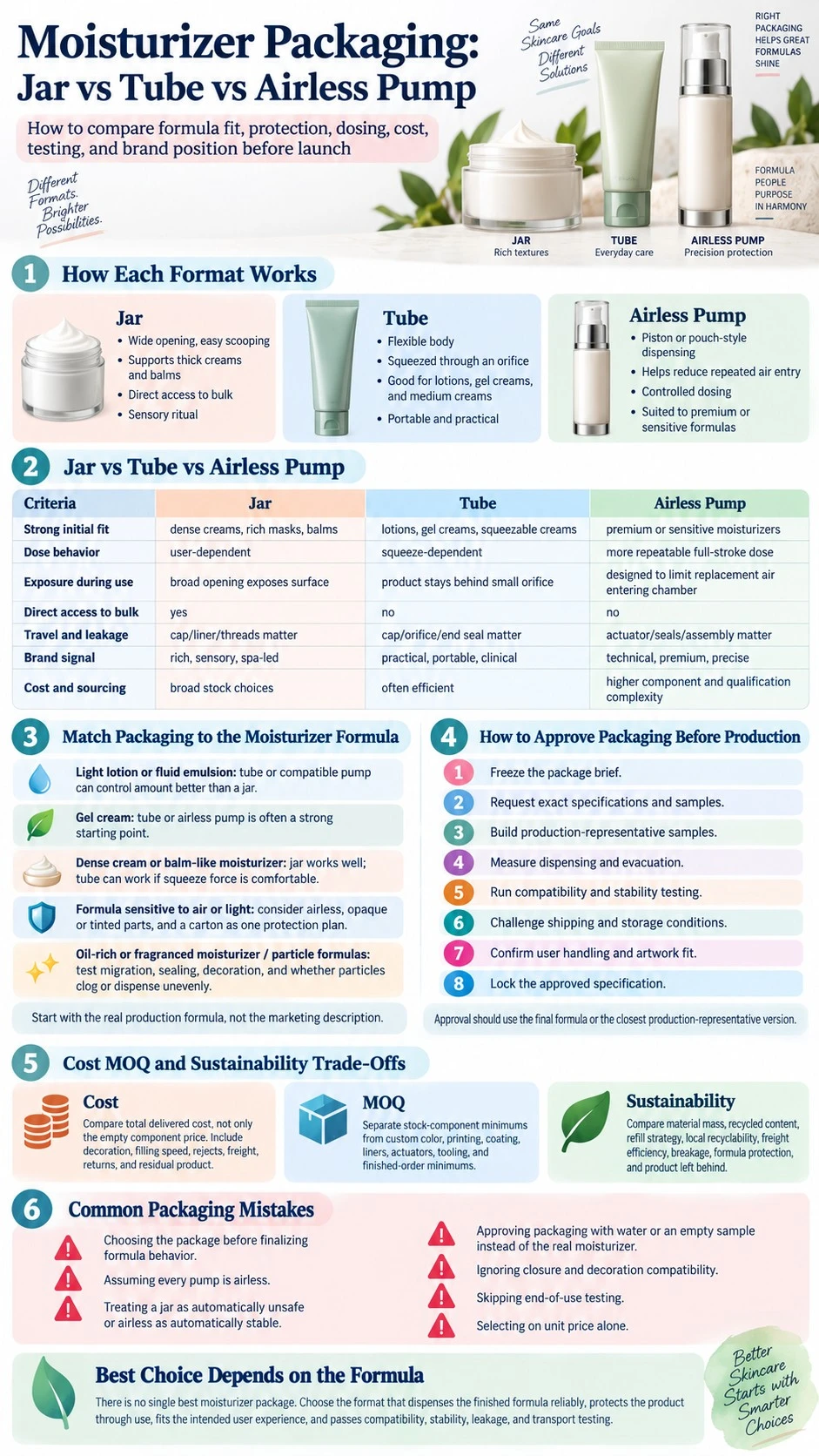
Moisturizer packaging controls more than shelf appearance. It affects how customers access the formula, how much they dispense, how the pack behaves in a bathroom or travel bag, and how much product remains at the end. A package chosen before the formula is understood can cause leakage, messy threads, poor pump priming, paneling, separation, decoration damage, or avoidable product waste.
This guide compares three common primary packages for face moisturizers: a jar, a collapsible tube, and an airless pump. It focuses on the decisions a brand team should resolve before sampling, testing, and bulk purchasing.
How Jars, Tubes, and Airless Pumps Work
The three formats deliver moisturizer in different ways. That mechanism changes user contact, replacement-air behavior, dose control, viscosity limits, filling needs, and evacuation. Packaging suppliers list jars, tubes, and airless systems as separate format families for moisturizers because one is not a cosmetic substitute for another.[1]
Jar
A jar has a wide neck and a removable cap. The customer reaches the product with a finger, spatula, or applicator, so it accommodates creams too thick to move well through a narrow pump pathway. The opening also makes the formula visible and supports a scoopable, sensory application ritual.
Opening the jar exposes a large product surface and gives the customer direct access to the bulk. That does not make every jar formula unsafe, but the preservative system, manufacturing controls, directions, package design, and intended use must work together. FDA identifies inadequate packaging and finger dipping among possible routes by which cosmetics can become contaminated.[2]
Jar performance still requires engineering. Check cap torque, liner or gasket fit, thread cleanliness, induction seals if used, product migration into the closure, and leakage after side storage. An inner disc can reduce mess and transfer, but it does not convert an open jar into a closed dispensing system.
Tube
A tube stores product inside a flexible body and dispenses it when the user squeezes. Common constructions include plastic, laminate, and aluminum, with different barrier, decoration, recovery, and recycling characteristics. The orifice and closure determine how readily the moisturizer leaves the pack and whether residue collects around the opening.
Tubes suit many lotions, gel creams, and medium-to-thick creams because the user can vary the squeeze. An inverted tube can make dispensing convenient as the fill level falls. However, a very fluid formula can surge or leak, while a dense or stringy cream may require excessive force or leave a long tail at the nozzle.
The tube body, shoulder, cap, seal, and decoration must be evaluated as one system. Oils, fragrance components, temperature, repeated flexing, and closure stress can reveal swelling, delamination, cracking, ink transfer, or seal failure that is not obvious in an empty sample.
Airless pump
An airless pump usually uses a rising piston or collapsible pouch instead of a conventional dip tube. As product is dispensed, the usable chamber contracts. This can limit repeated replacement air entering the product chamber, support repeatable full-stroke dosing, and help move product toward the actuator. Airless packaging and cosmetic pumps are distinct skincare dispensing categories, and suppliers emphasize matching the system, inserts, and materials to the formula.[3]
Airless does not mean oxygen-free, sterile, or automatically stable. Oxygen can be present during manufacture and filling, and packaging materials have different barrier properties. The pump also has to suit the cream’s viscosity and flow behavior. Incorrect filling, excessive air gaps, a weak actuator match, or a piston problem can cause slow priming, intermittent output, or apparent pump failure.
Jar vs Tube vs Airless Pump: Detailed Comparison
Use the table to compare the three formats across the same technical and commercial fields. Individual designs vary, so a supplier specification and filled-pack test should override a category-level assumption.
| Decision field | Jar | Tube | Airless pump |
|---|---|---|---|
| Strong initial fit | Dense creams, rich masks, and balms; scoopable ritual | Lotions, gel creams, and squeezable creams; portable use | Premium or sensitive moisturizers; controlled dispensing |
| Dispensing method | Finger, spatula, or applicator enters an open neck | User squeezes product through an orifice | Piston or pouch moves as a pump dispenses product |
| Dose behavior | Flexible but user-dependent | Flexible and squeeze-dependent | More repeatable per full stroke when correctly primed |
| Exposure during use | Broad opening exposes the surface at each use | Product remains behind a small orifice | Designed to limit replacement air entering the product chamber |
| Direct access to bulk | Yes unless a dispensing insert changes the system | No during normal use | No during normal use |
| Viscosity considerations | Broadest access for very thick textures | Must squeeze cleanly without surging or excessive force | Flow path, actuator force, and system must suit the cream |
| Product evacuation | User can reach walls and base, but product may remain under shoulders | Depends on tube recovery, orientation, and formula adhesion | Often designed for high evacuation, but must be measured |
| Leakage and travel | Cap torque, liner, threads, and seal matter | Cap security, orifice, crimp or end seal, and body recovery matter | Locking actuator, venting, seals, and assembly need validation |
| Filling and assembly | Wide opening simplifies many thick fills; cap torque must be controlled | Filling method and end sealing depend on tube construction | System-specific filling and air-gap control may be required |
| Brand signal | Rich, sensory, classic, or spa-led | Practical, portable, accessible, or clinical | Technical, premium, precise, or treatment-led |
| Cost and sourcing | Broad stock choice; glass, double-wall, and decoration add variables | Often efficient, but material, cap, print, and sealing change cost | Commonly greater component and qualification complexity |
| Sustainability questions | Weight, material mix, refillability, and product residue | Material layers, cap compatibility, tube recovery, and local collection | Component count, material mix, refill design, and evacuation |
The package category does not decide the winner. A well-matched tube can outperform an airless system if it dispenses the moisturizer more reliably, survives distribution, and fits the launch economics. A jar is a valid choice when access to a dense texture and the application ritual are deliberate product decisions rather than defaults.
Match Packaging to the Moisturizer Formula

Start with the production formula, not a marketing description. Two products both called “face cream” can have very different flow, oil phase, fragrance load, sensitivity, and dispensing behavior.
- Light lotion or fluid emulsion: A small-orifice tube or compatible pump can control the amount better than a wide jar. Test leakage during inverted storage and after warm conditioning.
- Gel cream: A tube or airless pump is often a useful starting point. Check stringing, nozzle residue, dose consistency, priming, and whether the pack changes how the gel structure recovers after dispensing.
- Dense cream or balm-like moisturizer: A jar gives direct access without forcing the formula through a narrow pathway. A tube can work if squeeze force and orifice size remain comfortable. Use an airless system only after the exact cream primes and dispenses reliably.
- Formula sensitive to air or light: Consider an airless system, opaque or tinted components, a carton, and controlled filling as parts of one protection plan. No package name replaces finished-product stability work.
- Oil-rich or fragranced moisturizer: Evaluate the body, liner, gasket, seals, inks, coatings, labels, and adhesives. Migration, swelling, softening, staining, or decoration changes can occur even when dispensing initially looks normal.
- Moisturizer with particles or capsules: Confirm that the particles remain distributed and pass through the opening or pump without bridging, breaking, or clogging. A visible effect in the bulk is not useful if the package delivers an inconsistent formula.
Do not use a universal viscosity threshold from a generic packaging chart. Viscosity changes with temperature and test method, while each tube or pump has its own flow path and operating range. Share measured formula data with the packaging and filling teams, then test the proposed components with production-representative bulk.
How to Approve Moisturizer Packaging Before Production
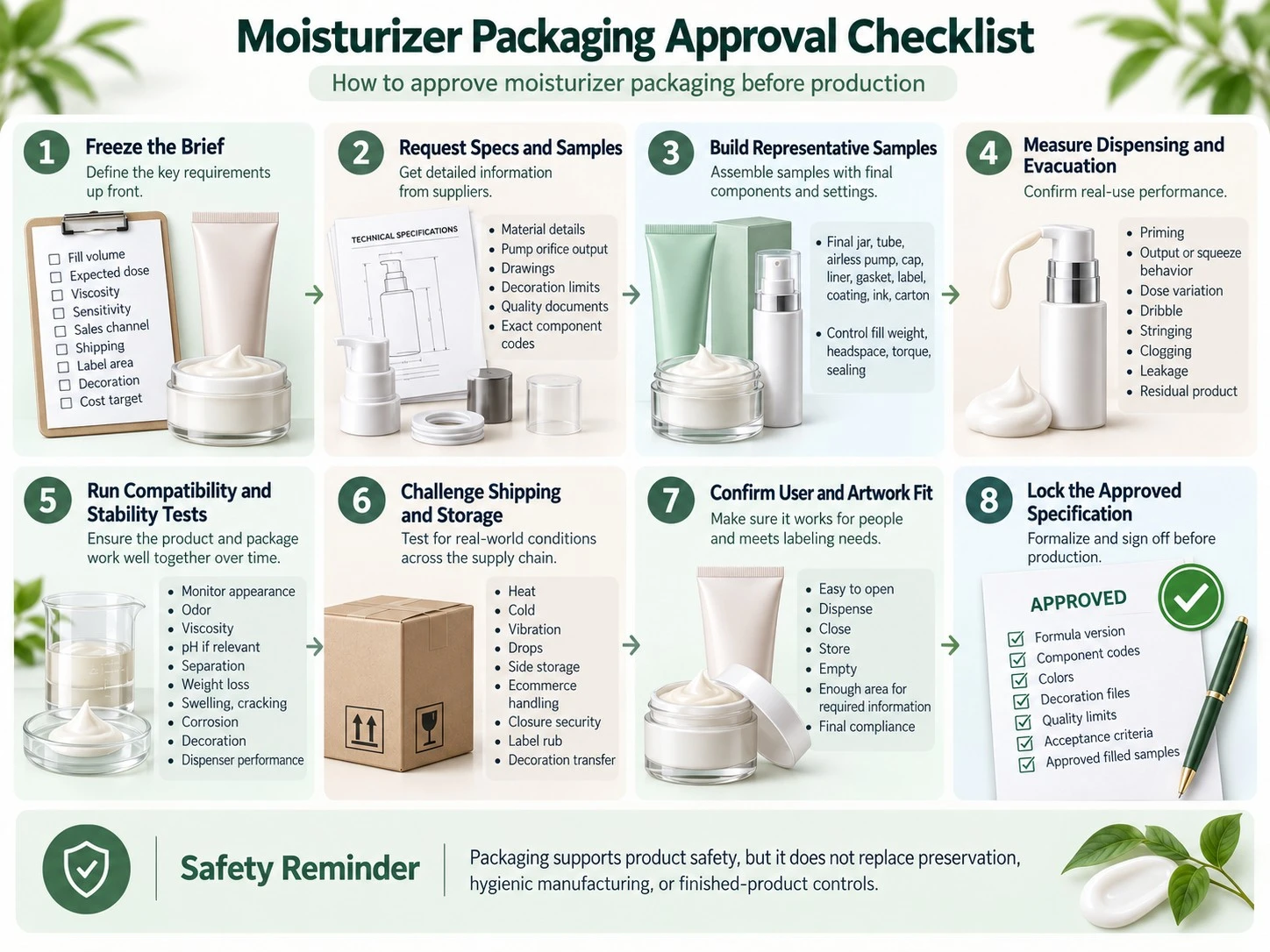
Approval should use the final formula or the closest production-representative version. Follow a controlled sequence so a visual sample does not become an accidental technical approval.
- Freeze the package brief. Define fill volume, expected dose, formula viscosity and sensitivity, sales channel, shipping conditions, label area, decoration, cost target, positioning, and intended user gesture.
- Request exact specifications and samples. Collect material details, nominal pump output or orifice options, viscosity guidance, filling and sealing instructions, component drawings, decoration limits, and relevant quality documents. Record exact component codes.
- Build production-representative samples. Use the intended jar, tube, actuator, cap, liner, gasket, label, coating, ink, and carton. Control fill weight, headspace, cap torque, sealing, and assembly conditions.
- Measure dispensing and evacuation. Record priming strokes, full-stroke output or squeeze behavior, dose variation, dribble, stringing, clogging, leakage, closing cleanliness, and residual product. Test normal, angled, inverted, and travel-relevant orientations where appropriate.
- Run compatibility and stability work. Monitor appearance, odor, viscosity, pH where relevant, emulsion separation, weight loss, paneling, swelling, cracking, corrosion, seal changes, decoration, and dispenser performance under the project’s approved conditions. The detailed guide to packaging compatibility testing explains the broader evaluation logic.
- Challenge shipping and storage. Test heat and cold exposure, vibration, drop resistance, side storage, ecommerce handling, closure security, label rub, and decoration transfer using conditions that reflect the distribution plan.
- Confirm user and artwork fit. Check that users can open, dispense, close, store, and empty the pack without unreasonable force or confusion. Leave enough usable area for required information; ISO 22715 specifies requirements for cosmetic packaging and labeling, while destination-market rules control final compliance.[4]
- Lock the approved specification. Sign off the formula version, component codes, colors, decoration files, quality limits, acceptance criteria, and filled reference samples before issuing bulk orders.
Packaging is one part of product safety, not a substitute for preservation or hygienic manufacture. Cosmetic companies are responsible for product safety, including protection from harmful microorganisms.[2] A tube or airless pump reduces direct finger access to the bulk, but the complete formula-package system still needs validated manufacturing and finished-product controls.
Cost, MOQ, and Sustainability Trade-Offs
Compare total delivered cost, not only the empty component quote. Include the container, cap or actuator, liner, seal, decoration, label, carton, assembly, filling speed, quality checks, rejects, freight, breakage, customer returns, and residual product. A stock jar can reduce tooling but add weight. A decorated tube may consolidate graphics yet require its own printing and sealing minimum. An airless pump can support dosing and evacuation but bring more components and qualification work.
MOQ depends on how much is standard. Ask suppliers to separate minimums and lead times for stock components, custom color, direct printing, coating, metallization, liners, actuators, and new tooling. Also confirm whether the quoted minimum applies to components, decoration, filling, or a finished private-label order.
Sustainability requires a full-system comparison. A heavy glass jar is not automatically lower impact, and a plastic tube is not automatically unrecyclable in every market. Review material mass, recycled content, refill strategy, component separation, local collection and recycling acceptance, freight efficiency, breakage, formula protection, and product left behind. Claims such as recyclable, refillable, or made with recycled content must describe the exact finished pack and be supportable in the target market.
For a broader view of structures, decoration, and selection factors, use the skincare packaging guide as a companion reference rather than adding unrelated formats to this three-way comparison.
Common Moisturizer Packaging Mistakes
- Choosing the package before finalizing formula behavior. A preferred look can force formula compromises or a costly pack change later.
- Assuming every pump is airless. A conventional dip-tube pump and a piston- or pouch-based airless system manage replacement air differently.
- Calling a jar automatically unsafe. Safety depends on the preservative system, manufacturing, package, directions, and use; finger access is one factor to evaluate.
- Treating airless as a shelf-life guarantee. It can reduce one exposure route, but formula design, filling, barrier, storage, and closure performance still matter.
- Approving a package with water or an empty hand sample. Priming, squeeze force, dose, dribble, leakage, and evacuation change with the real moisturizer.
- Ignoring closure and decoration compatibility. The cream may dispense correctly while a liner swells, a cap cracks, ink transfers, or a label lifts.
- Skipping end-of-use testing. Product trapped in shoulders, folds, corners, or below a pump’s effective travel affects value perception and actual fill use.
- Selecting on unit price alone. Slow filling, sealing rejects, leakage, breakage, excessive freight, and returns can reverse the apparent saving.
Discuss Your Moisturizer Packaging Project
ZICAIL supports private label face moisturizer projects with formula development and packaging customization, including jars, tubes, pumps, labels, and outer boxes. Share your moisturizer texture, target fill volume, preferred format, market, order plan, decoration direction, and launch timing so the team can discuss suitable samples and next steps.


