


Cleansing Balm vs Cleansing Oil: Key Differences
| Feature | Cleansing Balm | Cleansing Oil |
|---|---|---|
| Starting texture | Solid, buttery, waxy, or semi-solid | Liquid and fluid |
| Texture during use | Melts into an oil as it warms on the skin | Spreads as an oil immediately |
| Typical feel | Rich, cushioned, and controlled | Light, slippery, and fast-spreading |
| Application | Scoop or twist up, melt, massage, emulsify, and rinse | Pump or pour, massage, emulsify, and rinse |
| Makeup and sunscreen removal | Can work well for long-wear and waterproof products | Can work well for daily sunscreen and long-wear products |
| Rinsing | May take longer if the formula is thick or leaves a richer film | Often emulsifies and spreads quickly, but performance depends on the formula |
| Packaging | Usually a jar, tube, or solid stick | Usually a pump or pour bottle |
| Travel | Lower spill risk, although jars require clean handling | Convenient at home but more likely to leak in luggage |
| Best reason to choose it | You prefer a rich texture and precise application | You prefer speed, fluid spread, and pump dispensing |
The comparison is mainly about texture and routine preference. Ingredient quality, emulsification, fragrance, eye comfort, and how completely the cleanser rinses away usually matter more than whether the label says balm or oil.
What Is a Cleansing Balm?
A cleansing balm is a solid or semi-solid oil-based cleanser. It commonly combines oils or emollients with waxes, thickeners, surfactants, and emulsifiers. The balm melts as it warms between the fingers and on the face, allowing it to spread like an oil.[2]
Cleansing balms are usually applied to dry skin. After the product dissolves makeup and sunscreen, adding water should turn it into a milky emulsion that can be rinsed away. A good balm should reduce the need for rubbing or tugging, especially around long-wear foundation and eye makeup.
The richer texture does not guarantee that a balm is more moisturizing or better for sensitive skin. Some contain fragrance, essential oils, exfoliating ingredients, or a high level of waxes that may feel heavy or leave residue.
What Is a Cleansing Oil?
A cleansing oil is a liquid oil-based cleanser designed to spread quickly over dry skin. It combines oils or oil-like emollients with surfactants and emulsifiers that help the product mix with water and rinse away.
The fluid texture makes cleansing oil easy to dispense from a pump and distribute across the face. It can loosen foundation, mascara, lipstick, sunscreen, and sebum without requiring a thick layer of product.
A light texture does not automatically mean that a cleansing oil is better for oily skin. Some oils rinse very cleanly, while others leave a film. The finished formula matters more than the plant oil or emollient listed first.
How Cleansing Balms and Oils Remove Makeup and Sunscreen
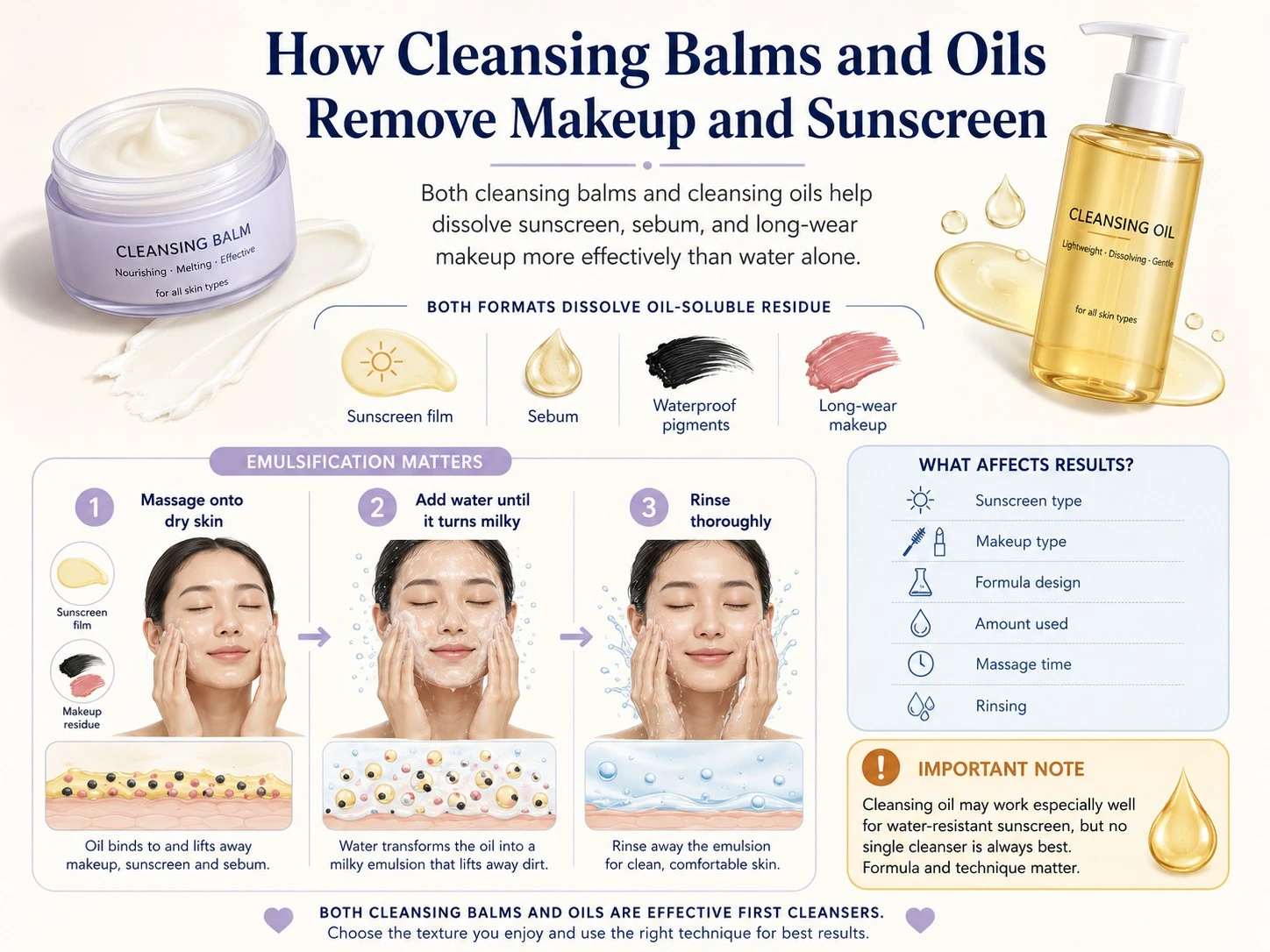
Both formats are designed to dissolve oil-soluble material. Sunscreen films, sebum, waterproof pigments, and long-wear makeup are often easier to loosen with an oil-based cleanser than with water alone.
Emulsification is the step that allows the loosened residue and cleansing oils to mix with water. After massaging the product onto dry skin, wet your fingertips and continue massaging until the cleanser becomes milky. Then rinse thoroughly.
Cleansing oil can be especially useful for water-resistant sunscreen. It left less waterproof sunscreen residue than water or a standard cleanser under the tested conditions, while both cleanser types worked for the non-water-resistant sunscreen.[3]
This does not mean every cleansing oil will outperform every balm or water-based cleanser. Sunscreen film, makeup type, formula design, amount used, massage time, and rinsing all affect the result.
Which Should You Choose?
Choose according to the residue you remove, the texture you enjoy, and how your skin feels after rinsing.
| Your Priority | Better Starting Option | Why | What to Check |
|---|---|---|---|
| Quick daily sunscreen removal | Cleansing oil | Spreads immediately and is easy to dispense | Complete emulsification and a clean rinse |
| Heavy or waterproof makeup | Either | Both formats can dissolve long-wear products | Eye comfort and removal without repeated rubbing |
| Rich, cushioned cleansing experience | Cleansing balm | Thicker texture provides more control during massage | Avoid excessive fragrance and residue |
| Fast, lightweight routine | Cleansing oil | Pump dispensing and fluid spread reduce application time | Choose a bottle that does not leak or over-dispense |
| Dry or sensitive-feeling skin | Either gentle formula | Mildness depends on the full ingredient system, not texture alone | Fragrance-free formula, easy rinsing, no post-cleanse tightness |
| Oily or acne-prone skin | Either clean-rinsing formula | Oil-based cleansers can remove sebum and sunscreen, but residue may be uncomfortable | Non-comedogenic positioning and no persistent film |
| Travel | Cleansing balm | Solid texture is less likely to leak | Use a clean spatula or hands with jar packaging |
| Minimal contact with jar contents | Cleansing oil | A pump limits repeated scooping | Keep the pump opening clean and dry |
Use our skin type guide if you are unsure whether your skin is dry, oily, combination, or sensitive. For a wider comparison of gel, cream, foaming, oil-based, and active cleansers, see how to choose a cleanser.
Are Cleansing Balms or Oils Better for Acne-Prone Skin?
Acne-prone skin can use either format, but no cleansing balm or oil is guaranteed to be non-comedogenic for every person. Breakouts may relate to residue, fragrance, individual ingredients, incomplete makeup removal, excessive rubbing, or another product in the routine.
Look for:
- A formula labeled non-comedogenic or “won’t clog pores” when available.
- Complete emulsification rather than an oily coating that remains after rinsing.
- Fragrance-free options if the skin is reactive.
- A mild second cleanser only when the first cleanse leaves residue.
- No scrubbing cloth or repeated washing to force the product off.
Remove makeup before bed and choose makeup and skincare products labeled non-comedogenic when possible.[4] Keep proven treatment at the center of an acne-prone skincare routine rather than expecting an oil cleanser to treat acne.
Stop using a balm or oil if you repeatedly develop small clogged bumps, inflamed breakouts, itching, or a rash after introducing it. Change one product at a time so the cause is easier to identify.
Do You Need to Double Cleanse After a Cleansing Balm or Oil?
Not always. A cleansing balm or oil can be your only evening cleanser if it removes your sunscreen, makeup, and daily buildup completely and rinses away without leaving an uncomfortable film.
A second gentle water-based cleanser may help when:
- You wear waterproof makeup, water-resistant sunscreen, or heavy foundation.
- Residue remains around the hairline, nose, or jaw after rinsing.
- The balm or oil leaves a noticeable coating on the skin.
- The product instructions recommend following with another cleanser.
Skip the second cleanse when the first cleanser leaves your skin clean and comfortable. Washing twice automatically can increase dryness, tightness, and irritation, especially on dry or sensitive skin.
How to Use Cleansing Balm or Cleansing Oil Correctly
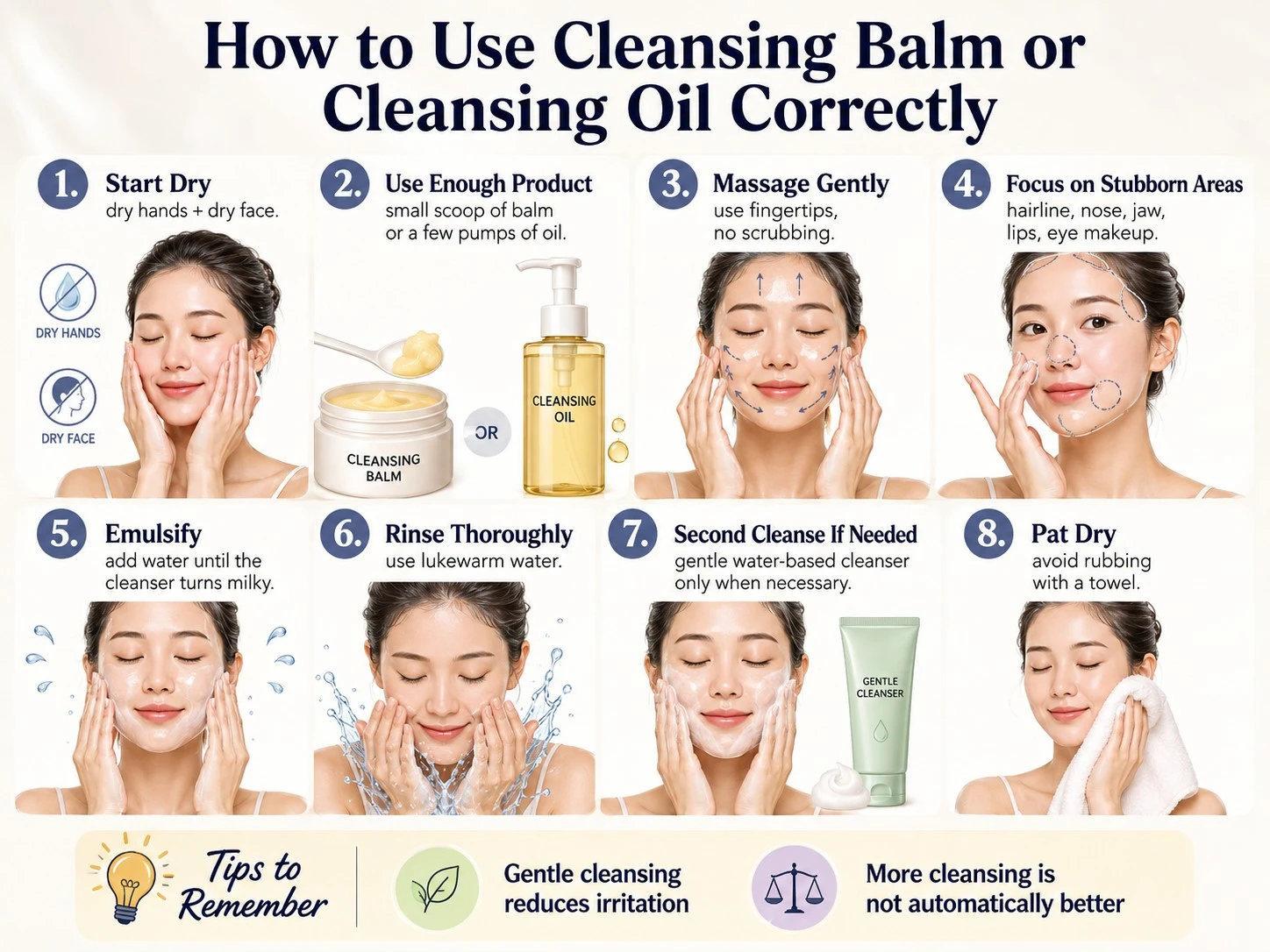
- Start with dry hands and a dry face: water can make some formulas emulsify before they have dissolved makeup and sunscreen.
- Use enough product for slip: use a small scoop of balm or the number of oil pumps listed in the product directions.
- Massage gently: spread the cleanser over the face with fingertips rather than scrubbing or pulling the skin.
- Give stubborn areas more attention: gently work over the hairline, sides of the nose, jaw, lips, and eye makeup.
- Emulsify with water: wet your fingertips and massage until the cleanser turns milky.
- Rinse thoroughly: use lukewarm water and check areas where residue commonly remains.
- Add a second cleanser only if needed: choose a gentle water-based cleanser rather than another aggressive wash.
- Pat dry: avoid rubbing with a towel.
Gentle cleansing with fingertips, lukewarm water, and a non-abrasive cleanser reduces unnecessary irritation.[5] Strong surfactants and excessive cleansing can remove skin components and interfere with barrier comfort, so more cleansing is not automatically better.[6]
Cleansing is normally the first step in the evening routine. See our skincare routine order guide for the placement of treatment, serum, moisturizer, and facial oil.
How to Tell If the Product Is Not Right for You
A cleansing balm or oil should remove buildup without creating a new problem.
- Persistent oily film: the formula may not emulsify well for you, or you may need less product or more complete rinsing.
- Tightness or flaking: the routine may involve excessive massage, hot water, a harsh second cleanser, or cleansing too often.
- Burning or itching: stop using the product and check for fragrance, essential oils, or another irritant.
- Cloudy vision or eye discomfort: avoid using the product close to the eyes unless it is intended for eye makeup removal.
- New clogged bumps: discontinue the product and monitor whether the bumps improve.
- Makeup remains: increase massage and emulsification before assuming that stronger rubbing is required.
Persistent burning, swelling, blistering, hives, or a spreading rash requires medical attention. A dermatologist can also help when acne or repeated reactions continue despite a simple routine.
Common Cleansing Balm and Oil Mistakes
- Applying the product to wet skin when the directions specify dry skin.
- Using too little product and creating friction.
- Skipping emulsification and rinsing only the surface oil.
- Assuming every balm is suitable for dry skin and every oil is suitable for oily skin.
- Using a rough washcloth to remove residue.
- Double cleansing automatically even when one cleanser is enough.
- Choosing by one plant oil instead of evaluating the complete formula.
- Ignoring fragrance or essential oils in reactive skin.
- Using the product as an acne treatment rather than a makeup and sunscreen remover.
- Leaving makeup or sunscreen around the hairline and jaw.
Final Thoughts
Cleansing balm and cleansing oil perform the same basic job: they dissolve oil-based sunscreen, makeup, sebum, and residue before rinsing. Their main difference is the experience of using them.
Choose balm for a solid, rich, controlled texture and lower spill risk. Choose oil for quick spreading, pump convenience, and a lighter feel. The better product is the one that removes what you wear, emulsifies fully, rinses comfortably, and does not cause repeated irritation or clogged pores.
FAQs About Cleansing Balm vs Cleansing Oil
Is cleansing balm better than cleansing oil?
Not generally. Cleansing balm offers a thicker, more controlled texture, while cleansing oil spreads faster and feels lighter. Formula performance and personal preference matter more than the format.
Which removes waterproof makeup better?
Both can remove waterproof makeup when formulated well. Choose the product that dissolves mascara, foundation, and lip color without repeated rubbing and that emulsifies completely when water is added.
Can oily skin use a cleansing balm?
Yes. Oily skin can use a cleansing balm if it rinses clean and does not cause persistent heaviness or clogged bumps. A cleansing oil may feel lighter, but it is not automatically less comedogenic.
Can cleansing oil clog pores?
Any skincare product can cause problems for an individual user. Choose a well-emulsifying, non-comedogenic formula when possible, rinse thoroughly, and discontinue it if new clogged bumps repeatedly appear.
Do I need to double cleanse after a cleansing balm or oil?
No. Add a second gentle cleanser only when makeup, sunscreen, or oily residue remains. If the first cleanser removes everything comfortably, another wash may be unnecessary.
Can cleansing balm or oil replace face wash?
It can be your only evening cleanser when it removes all residue and rinses clean. People who prefer a cleaner finish or wear heavy products may follow it with a gentle water-based cleanser.
Sources
[1] Cleveland Clinic. Double Cleansing Method Explained
[2] Naissan O. Wesley, MD. Cleansing Balms
[3] Chen W, et al. The Optimal Cleansing Method for the Removal of Sunscreen: Water, Cleanser or Cleansing Oil?
[4] American Academy of Dermatology. I Have Acne! Is It Okay to Wear Makeup?
[5] American Academy of Dermatology. Face Washing 101
[6] Walters RM, et al. Cleansing Formulations That Respect Skin Barrier Integrity


