

Face masks are concentrated, time-limited skincare formats. Some hold a water-based essence against the skin, some absorb oil as they dry, and others deliver exfoliating or moisturizing ingredients in a cream or gel base. The useful question is therefore not whether every mask works, but whether a specific formula can deliver the result you want.
A mask can be effective and still be optional. If a gentle cleanser, suitable moisturizer, daily sunscreen, and any needed treatment already meet your skin’s needs, adding a mask may improve the experience or give a temporary boost without fundamentally changing the routine.
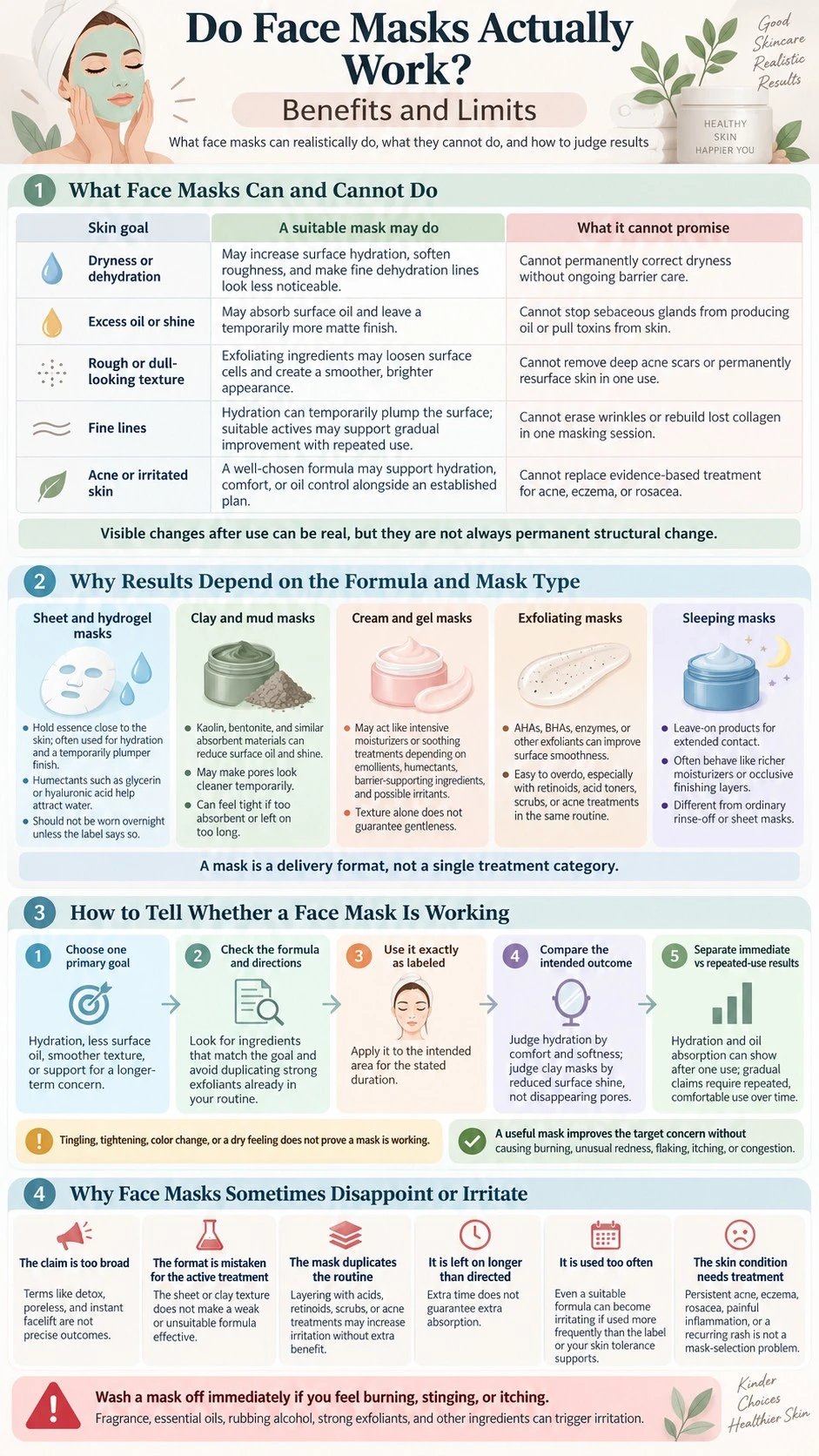
What Face Masks Can and Cannot Do
The most reliable way to judge a mask is to match one defined concern with one plausible outcome. Visible changes immediately after removal are often real, but they do not necessarily represent permanent structural change.
| Skin goal | What a suitable mask may do | What it cannot promise |
|---|---|---|
| Dryness or dehydration | Increase surface hydration, soften roughness, and make fine dehydration lines look less noticeable | Permanently correct dryness without ongoing barrier care |
| Excess oil or shine | Absorb oil from the skin’s surface and leave a temporarily more matte finish | Stop sebaceous glands from producing oil or “pull toxins” from skin |
| Rough or dull-looking texture | Exfoliating ingredients may loosen surface cells and create a smoother, brighter appearance | Remove deep acne scars or permanently resurface skin in one use |
| Fine lines | Hydration can temporarily plump the surface; suitable actives may support gradual improvement with repeated use | Erase wrinkles or rebuild lost collagen during one masking session |
| Acne or irritated skin | A well-chosen formula may support hydration, comfort, or oil control alongside an established plan | Replace evidence-based acne, eczema, or rosacea treatment.[1] |
Hydration is one of the clearest short-term examples. In a 2024 study comparing different sheet-mask materials and wear times, use for less than 25 minutes improved hydration and other measured skin characteristics, while longer use increased adverse reactions such as redness and dryness.[2] That finding does not prove that every sheet mask performs equally; it shows that a temporary hydration effect is plausible and that more contact time is not automatically better.
The same distinction applies to “glow.” Hydrated, smoother skin can look fresher, but that appearance does not prove that pigmentation or collagen loss has been corrected.
Why Results Depend on the Formula and Mask Type
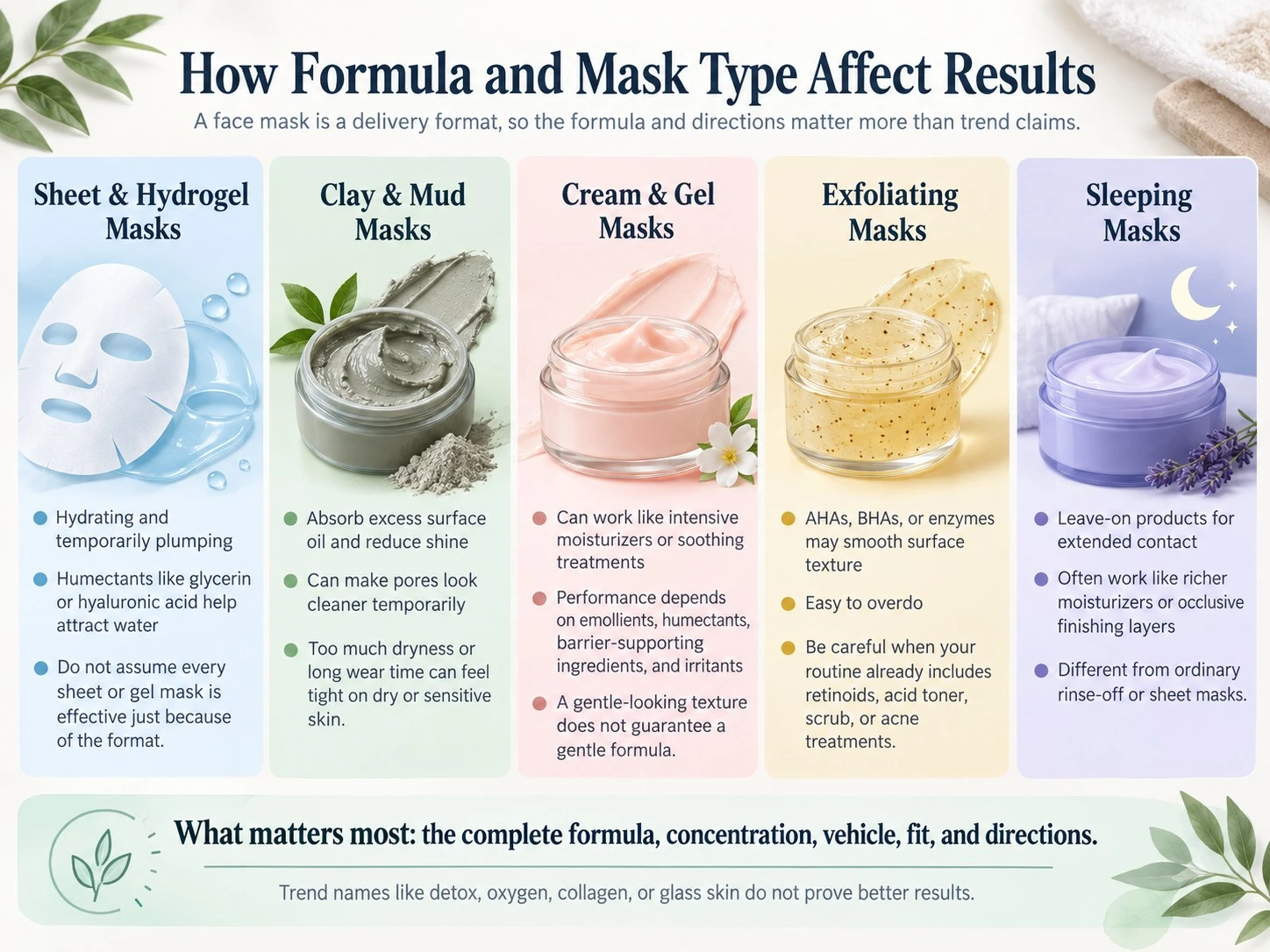
A mask is a delivery format, not a single treatment category. It stays in contact with skin for a defined period, which can give moisturizing or active ingredients time to interact with the outer skin layer. What happens during that contact depends on the complete formula, concentration, vehicle, fit, and directions.[1] A recent review likewise describes cosmetic facial masks as a diverse group of materials and formulations rather than one uniform technology.[3]
- Sheet and hydrogel masks: These hold an essence close to the skin and are commonly designed for hydration and a temporarily plumper finish. Humectants such as glycerin or hyaluronic acid can help attract water to the outer skin layer. The sheet or gel does not make every included ingredient effective, and a standard mask should not be worn overnight unless its label specifically says to do so. For a closer look at this format, see the guide to sheet mask benefits.
- Clay and mud masks: Kaolin, bentonite, and similar absorbent materials can reduce surface oil and shine. This can make pores look cleaner or less obvious temporarily, but it does not change their permanent anatomical size. Dry or sensitive skin may feel tight if the formula is too absorbent or is left on too long. The article on clay mask benefits explains that oil-control role in more detail.
- Cream and gel masks: These may function like intensive moisturizers or soothing treatments, depending on their emollients, humectants, barrier-supporting ingredients, and potential irritants. The texture alone does not guarantee that a product is gentle.
- Exfoliating masks: Formulas containing AHAs, BHAs, enzymes, or other exfoliants can improve surface smoothness. They are also easier to overdo, especially when the routine already contains a retinoid, acid toner, scrub, or acne treatment. The American Academy of Dermatology advises avoiding redundant active ingredients that may increase dryness and irritation.[1]
- Sleeping masks: These are leave-on products designed for extended contact and often behave like richer moisturizers or occlusive finishing layers. They are different from ordinary rinse-off or sheet masks. If the distinction is unclear, compare a sleeping mask and moisturizer by formula and function.
Relevant ingredients and directions matter more than trend names such as “detox,” “oxygen,” “collagen,” or “glass skin.” A collagen-containing mask may moisturize or form a smoothing film, for example, but the presence of collagen on the label does not show that it will replace collagen in the dermis. Evaluate the finished product by the benefit its usable ingredients can plausibly provide.
How to Tell Whether a Face Mask Is Working
Give the mask a specific job and assess that job. If you expect one product to hydrate, clear acne, fade dark spots, tighten pores, and erase lines, almost any result will be confusing or disappointing.
- Choose one primary goal. Decide whether you want immediate hydration, less surface oil, smoother texture, or support for a longer-term concern.
- Check the formula and directions. Look for ingredients relevant to that goal and confirm the product is intended for your skin type and planned contact time. Avoid duplicating strong exfoliants already in your routine.
- Use it exactly as labeled. Apply it to the area and for the duration directed. The complete guide to using a face mask covers preparation, removal, and aftercare for different formats.
- Compare the intended outcome. After a hydrating mask, look for comfort and softness rather than a lifting effect. After a clay mask, assess surface shine rather than expecting pores to disappear.
- Separate immediate from repeated-use results. Hydration and oil absorption can be visible after one use. A formula marketed for gradual improvement should be judged only over its stated use period—and only if it remains comfortable.
A product is not “working” merely because it tingles, tightens, changes color, or becomes dry. Those sensations can reflect evaporation, film formation, or irritation. Likewise, a dramatic before-and-after image taken under different lighting does not establish a durable skin change.
Record how the skin feels immediately, later that day, and the next morning. A useful mask should improve the target concern without creating a larger problem. If the same product repeatedly leaves skin burning, unusually red, flaky, itchy, or congested, the formula or frequency is a poor fit even if it produces a brief glow.
Why Face Masks Sometimes Disappoint or Irritate
When a mask fails, the problem is often a mismatch between the promise, formula, and way it is used—not proof that every mask is useless.
- The claim is too broad. Words such as “detox,” “poreless,” and “instant facelift” are not precise outcomes. Skin does not need a mask to remove undefined toxins, and a cosmetic cannot permanently close pores.
- The format is mistaken for the active treatment. A sheet can hold serum in place, but it cannot turn an unsuitable or weak formula into an effective one. A clay texture can absorb oil, but it does not automatically treat every cause of acne.
- The mask duplicates the routine. Combining an exfoliating mask with acids, retinoids, scrubs, or acne treatments may increase irritation without adding a useful benefit.[1]
- It is left on longer than directed. Extra time does not guarantee extra absorption. Prolonged sheet-mask use has been associated with more short-term redness and dryness, and an over-dried clay mask can leave skin uncomfortable.[2]
- It is used too often. Even a suitable formula can become irritating when repeated more frequently than the label or skin tolerance supports. Use the guide to how often to use a face mask when setting a schedule.
- The skin condition needs treatment. Persistent acne, eczema, rosacea, painful inflammation, or a recurring rash is not a mask-selection problem. A dermatologist can diagnose the cause and recommend treatment.
Wash a mask off immediately if you feel burning, stinging, or itching. New products can also trigger irritant or allergic reactions, particularly when they contain fragrance, essential oils, rubbing alcohol, strong exfoliants, or another ingredient your skin does not tolerate.[1]
FAQs About Face Mask Effectiveness
Are face masks necessary for good skin?
No. A face mask can provide a targeted or enjoyable extra step, but healthy skin does not require one. A consistent basic routine—gentle cleansing, a suitable moisturizer, sun protection, and treatment when needed—matters more. Add a mask only when it serves a clear purpose that the routine does not already meet.
Can face masks permanently shrink pores?
No cosmetic face mask can permanently change pore size. Clay may absorb surface oil, exfoliating ingredients may clear some buildup, and hydration may smooth the surrounding surface, so pores can look temporarily less noticeable. Genetics, oil production, loss of skin firmness, and congestion still influence their appearance.
Do face masks help acne?
A mask may support an acne routine if its ingredients address oil, clogged pores, or irritation and the formula does not worsen dryness. However, masks do not replace acne treatment. Avoid harsh scrubbing and stacking an acid mask with other strong actives; if acne is painful, scarring, or persistent, seek dermatologic care.[1]
How long do face mask results last?
It depends on the result. Extra hydration, softness, plumping, or a matte finish may last for hours or until cleansing and environmental exposure change the skin surface. Benefits from active ingredients require repeated, well-tolerated use and may be modest. A single mask should not be expected to create permanent changes in pores, pigmentation, wrinkles, or acne.
Can you use a face mask every day?
Only when the product directions permit daily use and your skin tolerates it. Frequency depends on the complete formula: a mild hydrating mask may suit more frequent use than a clay or exfoliating mask. Daily use is unnecessary for most people, and increased tightness, redness, stinging, or flaking is a reason to reduce frequency or stop.
Sources
[1] American Academy of Dermatology Association. Do facial masks work, and should I add one to my skin care routine?
[2] Wang Y, Cao Y, Huang X, et al. Short-term skin reactions and changes in stratum corneum following different ways of facial sheet mask usage
[3] Saeed HAM, Yang H. The versatile world of cosmetic facial masks in skincare: Fabrication, properties, and future directions: A review


