


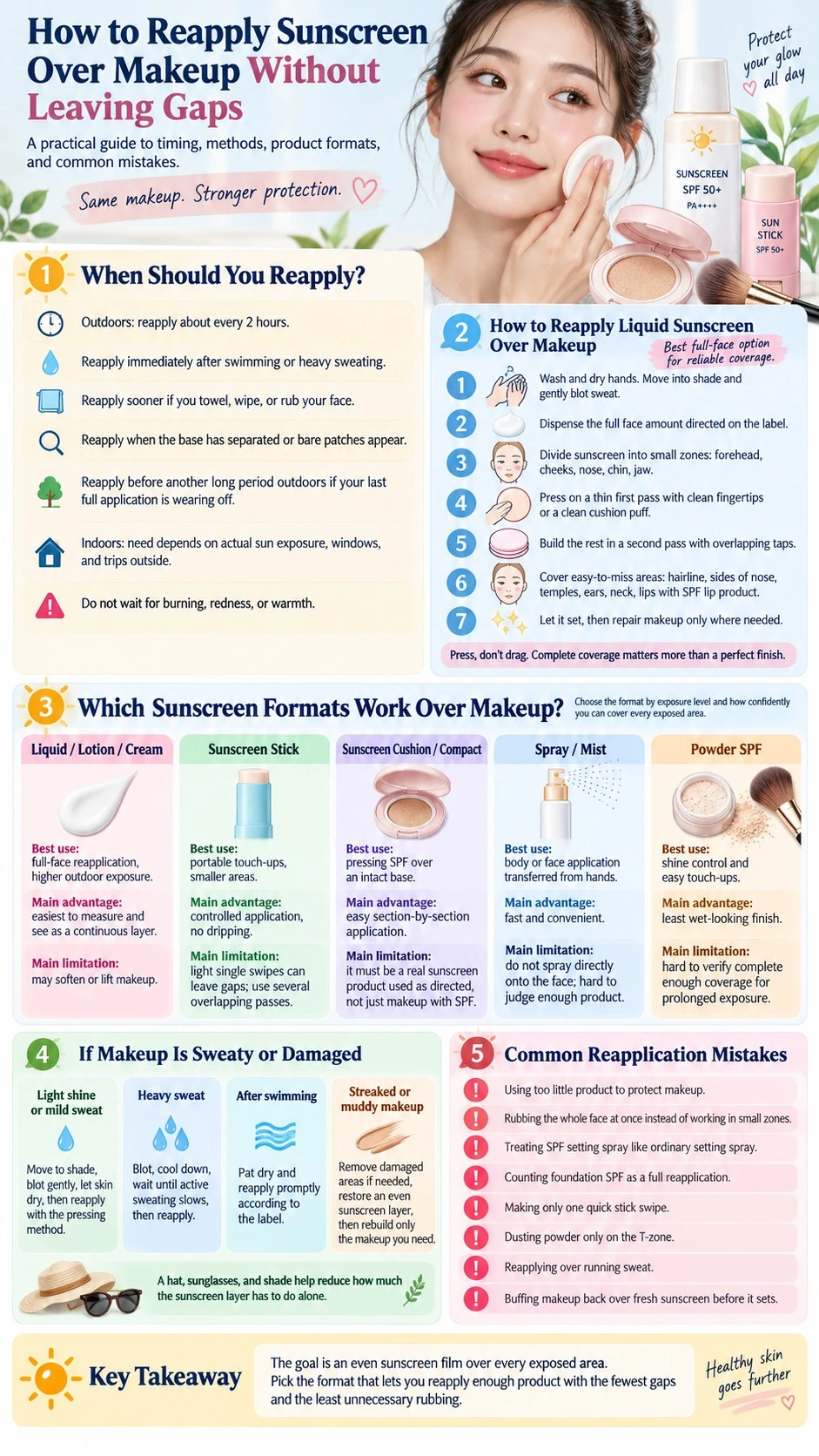
Makeup does not remove the need to reapply sunscreen, but it does change the easiest technique. The aim is not to keep every pigment molecule in its original position. It is to restore an even sunscreen film while disturbing the makeup as little as practical.
Your initial sunscreen still belongs underneath makeup; this article begins after those layers are already in place.
When Should You Reapply Sunscreen Over Makeup?
When you are outdoors, reapply sunscreen about every two hours and immediately after swimming or sweating.[1] Makeup does not restart that clock or make the original sunscreen last longer.
Reapply sooner when:
- You towel, wipe, or rub the face. Friction can remove both makeup and the sunscreen beneath it.
- You swim or sweat heavily. Water resistance means a sunscreen has been tested for 40 or 80 minutes in water, not that it is waterproof.[2]
- The base has separated. Bare patches around the nose, hairline, cheeks, or jaw suggest the protective layer is no longer continuous.
- You are beginning another period outdoors. Reapply before extended exposure if the last adequate application is approaching the label interval.
The common two-hour instruction is specifically framed around being outdoors. If most of your day is spent indoors, the need for another full application depends on actual exposure, including time near sunny windows and repeated trips outside. The guides to how often to reapply sunscreen and whether you need sunscreen indoors handle those broader timing decisions.
Do not wait for burning, redness, or warmth. Those are not useful reapplication timers, and sunburn can develop after meaningful exposure has already occurred.
How to Reapply Liquid Sunscreen Over Makeup

Liquid, lotion, or cream sunscreen is the strongest default for a full-face reapplication because you can portion it and see where a continuous layer has formed. It may soften a matte finish, but no makeup-preserving hack is more important than complete coverage during sustained outdoor exposure.
- Wash and dry your hands. Move into shade or indoors. If the face is damp with sweat, blot it gently with a clean tissue and let the surface dry rather than rubbing.
- Dispense the intended amount. Portion the amount you would use on bare skin, following the label. The guide to how much sunscreen to use on your face explains practical measurements; makeup is not a reason to cut the dose.
- Divide the sunscreen into small zones. Place small dots on the forehead, each cheek, nose, chin, and jaw. Working in sections helps prevent one area from receiving most of the product.
- Press on the first thin pass. Use clean fingertips or a clean, dense cushion puff. Tap vertically and lift rather than swiping. Start where coverage matters most and work outward to the hairline and jaw.
- Build the remaining amount in a second pass. Let the first layer settle briefly, then press on the rest with overlapping taps. Product left on a sponge or puff did not reach your skin, so do not treat an empty-looking tool as proof that the full portion was applied.
- Check easy-to-miss areas. Cover the sides of the nose, temples, hairline, ears, and exposed neck, and use an SPF lip product for the lips.[1] Keep facial sunscreen out of the eyes unless its label permits that area.
- Repair color only after the film sets. Pat on a small amount of concealer, blush, or setting powder where needed. Avoid vigorous buffing that could reopen gaps.
Some makeup movement is normal. If a formula repeatedly pills or lifts the base even with light pressing, use fewer incompatible layers in the morning or choose a sunscreen that sets more cleanly. The guide to sunscreen pilling under makeup covers that separate compatibility problem.
Which Sunscreen Formats Work Over Makeup?
Choose a format by the level of exposure and how clearly you can confirm coverage—not only by which product changes the makeup least.
| Format | Best use over makeup | Main advantage | Main limitation |
|---|---|---|---|
| Liquid, lotion, or cream sunscreen | Full-face reapplication and higher outdoor exposure | The amount and continuous layer are easiest to see and control | Can soften, lift, or change the makeup finish |
| Sunscreen stick | Portable reapplication and smaller facial zones | Controlled application with little dripping | Light single passes can leave stripes or gaps; apply four passes back and forth per area and rub or press into an even layer.[3] |
| Sunscreen cushion or compact | Pressing product over an intact base | A puff supports section-by-section application | It must be a labeled sunscreen used as directed, not ordinary cushion foundation with incidental SPF |
| Spray or mist sunscreen | Body reapplication or face application transferred from the hands | Fast distribution on suitable areas | Spray sunscreen should not be sprayed directly onto the face; avoiding inhalation and judging enough product are additional problems.[3] |
| Powder SPF | Reducing shine and adding a convenient touch-up | Least likely to make the base look wet | A light cosmetic dusting makes complete, sufficient coverage difficult to verify |
Research on real-world use shows that lower application density reduces measured sunscreen protection, and powder-type foundation was applied much more thinly than sunscreen in the same study.[4] That study does not prove that every powder SPF fails, but it supports a practical limit: do not equate a nearly invisible dusting with a full liquid-sunscreen layer during prolonged or intense exposure.
The choice between a sunscreen stick and spray involves coverage and safety differences beyond makeup compatibility. Whichever format you choose, its SPF claim depends on using the product according to its own directions.
What to Do When Makeup Is Sweaty or Damaged
Once the face is wet, visibly streaked, or repeatedly wiped, preserving the makeup is no longer the main goal. Water, sweat, and friction can disturb both the visible base and the sunscreen film underneath.
- For light shine or mild sweat: Move to shade, press with a clean tissue, allow the face to dry, and reapply sunscreen with the controlled pressing method.
- For heavy sweat: Blot, cool down, and wait until active sweating slows. Applying more product onto running sweat can create uneven dilution and movement.
- After swimming: Pat the face dry and reapply promptly, following the water-resistance and reapplication directions on the label.[2]
- After towel drying or obvious streaking: Remove loose or muddy makeup where necessary, restore an even sunscreen layer, and then rebuild only the makeup you need.
A hat, sunglasses, shade, and other protective measures reduce how much of the job must be carried by a cosmetically perfect sunscreen layer. No sunscreen blocks all UV radiation, so these measures still matter even after careful reapplication.[3]
Common Sunscreen Reapplication Mistakes
- Using a tiny amount to save the makeup: SPF performance depends on adequate, even application. A few careful dots that never join into a continuous film do not solve the coverage problem.
- Rubbing the whole face at once: Sweeping motions can move foundation and sunscreen together. Use small zones and vertical pressing.
- Treating setting spray with SPF as ordinary setting spray: The sunscreen directions and amount still control. A few finishing spritzes should not be assumed to provide the labeled protection.
- Counting foundation SPF as a full reapplication: Makeup may contribute protection, but normal cosmetic application is often too thin or uneven to assume the full labeled SPF.
- Making one quick stick swipe: Use several overlapping passes and even out the layer as directed; a transparent trail can be hard to inspect.
- Dusting only the oily center of the face: Powder applied to the T-zone leaves the cheeks, temples, ears, hairline, and jaw without a meaningful touch-up.
- Reapplying over running sweat: Blot, cool down, and let the surface dry first so the next layer is not immediately displaced.
- Buffing makeup back over fresh sunscreen: Give the sunscreen time to settle, then use light pressing for any color correction.
Sunscreen format affects technique, but it does not change the target: an even layer on every exposed area. Convenience matters only when it helps you reapply enough product instead of replacing a full application with a token touch-up.
FAQs About Reapplying Sunscreen Over Makeup
Can you reapply sunscreen over foundation?
Yes. Portion the sunscreen, divide the face into sections, and press thin overlapping layers over foundation with clean fingertips or a clean cushion puff. Expect some change in finish. If the foundation is already wet, streaked, or breaking apart, remove the damaged areas and rebuild sunscreen first.
Does makeup with SPF count as sunscreen reapplication?
Only when the makeup is labeled as a sunscreen and you follow its sunscreen directions, including the amount. For U.S. products, a Drug Facts label and sunscreen-specific directions identify it as sunscreen.[5] Foundation, skin tint, or powder with incidental SPF can contribute protection, but a normal cosmetic layer should not be counted automatically as a complete reapplication.
Can you spray sunscreen directly over makeup?
No. Spray sunscreen should not be sprayed directly onto the face. Spray it into your hands and then apply it to the face, follow the label, and avoid inhaling the product.[5] A light facial mist may preserve makeup better, but convenience does not confirm sufficient or even coverage.
Is powder sunscreen enough over makeup?
Powder SPF is useful for a portable touch-up and shine control, but it is difficult to see whether enough reached every area. Do not rely on a light dusting as your only reapplication method during prolonged or intense sun. Use a liquid, cream, or thoroughly applied labeled format and add shade, a hat, and sunglasses.
Do you need to remove makeup before reapplying sunscreen?
Not for every ordinary midday reapplication. You can press sunscreen over an intact, dry base. Remove or partially remove makeup when swimming, heavy sweat, toweling, or visible separation has made the layers patchy, because rebuilding an even sunscreen film is then more important than preserving the original finish.
Sources
[1] American Academy of Dermatology Association. How to Apply Sunscreen
[2] American Academy of Dermatology Association. How to Decode a Sunscreen Label
[3] American Academy of Dermatology Association. How to Use Stick and Spray Sunscreens
[4] Fujiwara R, Muta K, Izutsu Y, Hatao M. The Effect of On-Site Application Density on the UV Protection Efficacy of Sunscreens
[5] U.S. Food and Drug Administration. Sunscreen: How to Help Protect Your Skin from the Sun


