


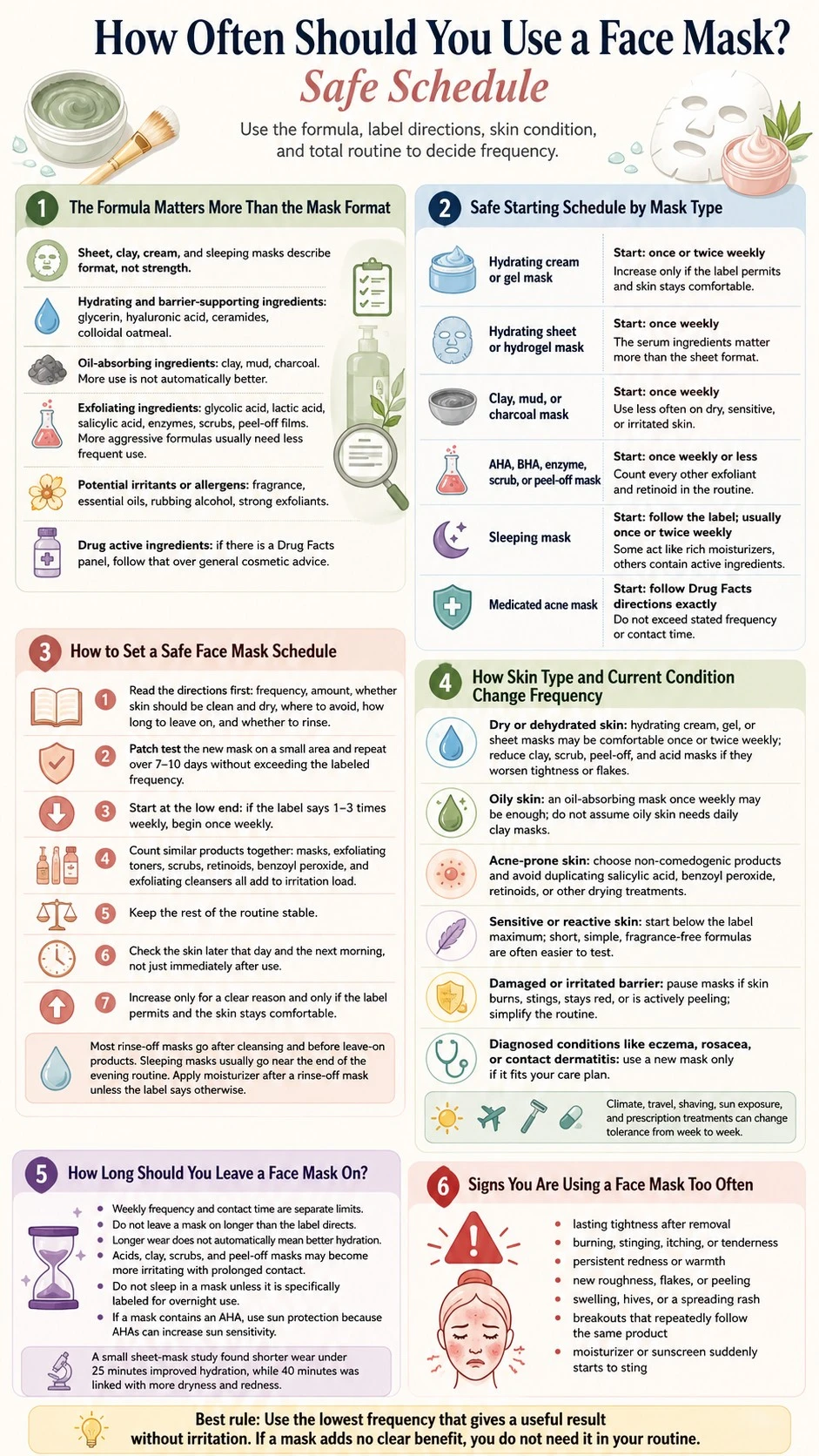
Face masks are optional treatments, not steps that everyone needs on a fixed schedule. They can temporarily hydrate, absorb surface oil, or deliver exfoliating ingredients, but they do not replace a gentle cleanser, moisturizer, sunscreen, or treatment for a skin condition.[1]
This guide covers topical cosmetic masks that you spread on the skin or place over it. It does not cover LED devices, professional peels, or protective face coverings. The safest schedule for a topical mask comes from its complete formula, label directions, contact time, your other products, and how your skin responds after use.
The Formula Matters More Than the Mask Format
“Sheet mask,” “clay mask,” and “sleeping mask” describe a material or delivery format, but they do not fully describe strength. A sheet mask may contain only humectants such as glycerin and hyaluronic acid, or it may carry fragrance, an AHA, a BHA, or another active ingredient. A creamy mask may function like a rich moisturizer, an exfoliant, or both.
Check the ingredient list and any active-ingredient or Drug Facts panel before choosing a frequency. The following features usually matter most:
- Hydrating and barrier-supporting ingredients: Glycerin, hyaluronic acid, ceramides, and colloidal oatmeal are commonly used for hydration or comfort. A simple formula may be tolerated more often than a treatment mask, but “hydrating” on the front label does not cancel irritating ingredients elsewhere in the formula.[1]
- Oil-absorbing ingredients: Clay, mud, and charcoal can reduce surface oil temporarily. More use is not automatically better for oily skin; an overly drying schedule can leave the face tight, flaky, or irritated.
- Exfoliating ingredients: Glycolic acid, lactic acid, salicylic acid, enzymes, scrubbing particles, and peel-off films add exfoliation or physical stress. The more aggressive the method, the less often it generally needs to be used.[2]
- Potential irritants or allergens: Fragrance, essential oils, rubbing alcohol, and strong exfoliants may be difficult for sensitive skin. “Natural,” “clean,” and “unscented” do not prove that a mask is non-irritating. The guide to fragrance-free vs unscented skincare explains one common labeling distinction.
- Drug active ingredients: A mask marketed to treat acne may have a Drug Facts panel in the United States. That panel explains what the medicine does, who should or should not use it, and how to use it; its dose, frequency, warnings, and treatment area take priority over general cosmetic advice.[3]
Skin type is a useful modifier, not a dosing system. Two people with oily skin may tolerate the same clay mask differently because one also uses adapalene and salicylic acid while the other follows a simple, non-exfoliating routine. Judge the mask as part of the whole routine rather than as an isolated product.
How to Set a Safe Face Mask Schedule
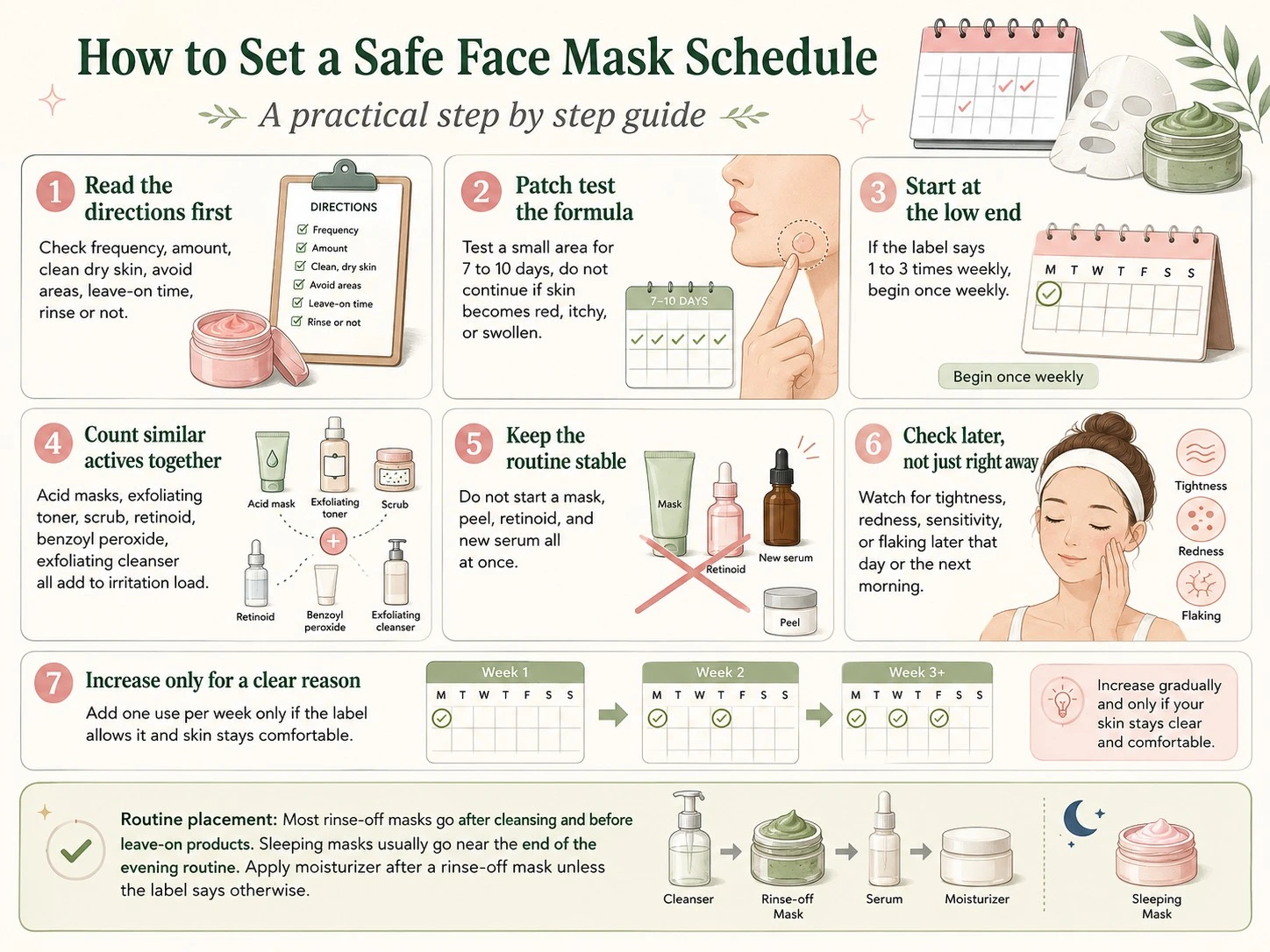
Use this process when a label gives a range, when you are adding a new mask, or when your current schedule no longer feels comfortable.
- Read the directions before the ingredient list. Confirm how often to use the mask, how much to apply, whether skin should be clean and dry, which areas to avoid, how long to leave it on, and whether to rinse. Treat the stated frequency as a ceiling, not a target you must reach. Using a facial mask too often or leaving it on too long can cause irritation.[1]
- Test the new formula on a small area. Follow any test directions on the product. Otherwise, use the normal amount and contact time on a small test spot and repeat the test over seven to 10 days without exceeding the mask’s labeled frequency. Do not proceed if the area becomes red, itchy, or swollen.[4]
- Choose the lower end of the schedule. If a label says “one to three times weekly,” begin once weekly. That makes it easier to see whether the mask adds a useful benefit without confusing the result with repeated exposure. A person with reactive skin or a strong active routine may need an even slower start.
- Count similar products together. An acid mask, exfoliating toner, scrub, retinoid, benzoyl peroxide treatment, and exfoliating cleanser all contribute to the routine’s irritation load. Do not schedule each product at its own maximum. Exfoliation used alongside retinol, prescription retinoids, or benzoyl peroxide can worsen dryness and irritation.[2] The guide to how often to exfoliate provides a broader framework.
- Keep the rest of the routine stable. Do not introduce a mask, peel, retinoid, and new serum during the same few days. Changing one variable at a time makes both benefits and reactions easier to trace.
- Judge more than the immediate after-feel. Check the skin later that day and the next morning. A mask may leave the surface soft at first yet still be too frequent if tightness, persistent redness, increased sensitivity, or flaking appears later.
- Increase only for a clear reason. If the label permits more frequent use, the skin remains comfortable for several applications, and the extra use provides a result you value, add one use per week. Do not increase simply because the jar remains full or a social-media routine uses a mask daily.
Place the mask where its directions fit within your skincare routine order. Most rinse-off masks follow cleansing and come before leave-on products; sleeping masks usually go near the end of the evening routine. Apply a suitable moisturizer after a rinse-off mask unless the label directs otherwise.[1]
How Skin Type and Current Condition Change Frequency
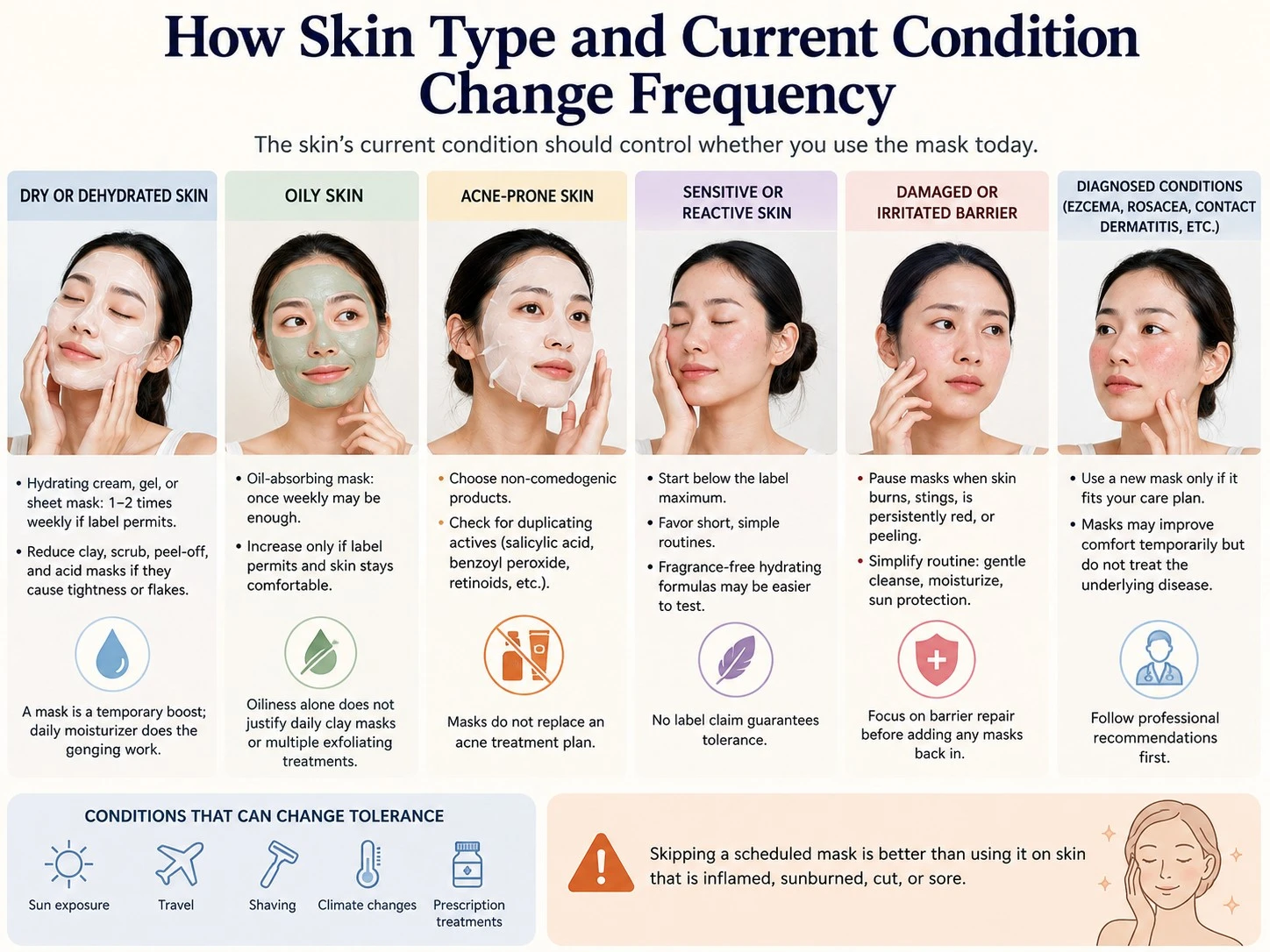
The front-label skin type can help narrow your choice, but the skin’s current condition should control whether you use the mask today.
- Dry or dehydrated skin: A simple hydrating cream, gel, or sheet mask may be comfortable once or twice weekly, with more frequent use only when the label permits. Reduce clay, scrub, peel-off, and acid masks if they worsen tightness or flakes. A mask offers a temporary boost; a daily moisturizer does the ongoing work of reducing dryness and water loss.
- Oily skin: An oil-absorbing mask once weekly may be enough. Increase only if the label allows it and the skin does not become tight, rough, or unusually reactive. Oiliness alone does not justify daily clay masks or multiple exfoliating treatments.
- Acne-prone skin: Choose products labeled non-comedogenic and check whether the mask duplicates salicylic acid, benzoyl peroxide, retinoids, or other treatments. A cosmetic mask cannot replace an acne treatment plan, and scrubbing or overdrying can make an irritated routine harder to tolerate.[1]
- Sensitive or reactive skin: Start below the label maximum and favor a short, simple routine. Fragrance-free hydrating formulas may be easier to test than strong acids, essential oils, scrubs, or peel-off masks, but no label claim guarantees tolerance.
- A damaged or irritated barrier: Pause masks when the face burns, stings with bland products, looks persistently red, or is actively peeling. Simplify the routine and focus on gentle cleansing, moisturizing, and sun protection. The guides to the skin barrier and over-exfoliated skin explain the next steps.
- Eczema, rosacea, contact dermatitis, or another diagnosed condition: Use a new mask only if it fits the care plan recommended for you. A mask may improve comfort temporarily, but it does not treat the underlying disease.[1]
Climate, travel, shaving, sun exposure, and prescription treatments can change tolerance from one week to the next. Skipping a scheduled mask is better than using it on skin that is already inflamed, sunburned, cut, or sore.
How Long Should You Leave a Face Mask On?
Weekly frequency and contact time are separate limits. Using a mask only once a week does not make it safe to leave on twice as long. Follow the label timer and remove the product when directed, even if it has not dried completely or still contains serum.
This matters for both treatment and hydrating masks. Acids, clay, scrubs, and peel-off products may become more irritating with prolonged contact. A randomized study of three sheet-mask formulas found that shorter applications under 25 minutes improved hydration, while 40-minute use was associated with more dryness and redness in the small study group.[5] That result does not establish one universal timer for every sheet mask, but it supports following product-specific directions instead of assuming longer wear gives more hydration.
Do not sleep in a mask unless it is specifically designed and labeled for overnight use. If a mask contains an AHA, follow its warnings and use sun protection; U.S. labeling guidance warns that AHAs may increase sun sensitivity during use and for a week afterward.[6]
Signs You Are Using a Face Mask Too Often
Reduce the frequency or stop the mask when you notice a pattern of:
- tightness that lasts after the mask is removed;
- burning, stinging, itching, or tenderness;
- persistent redness or warmth;
- new roughness, flakes, or peeling;
- swelling, hives, or a spreading rash;
- breakouts that repeatedly follow the same product; or
- ordinary moisturizer or sunscreen suddenly stinging.
Wash off a mask immediately if it causes itching, burning, or stinging during use.[1] For mild dryness or irritation, stop the mask and other optional active products, cleanse gently, moisturize, and protect the skin from the sun. Do not try to “repair” the reaction by applying a different mask the next day.
Seek medical care for severe swelling, hives with breathing symptoms, blistering, eye involvement, signs of infection, or a reaction that continues or worsens after you stop the product. Persistent acne, eczema-like rash, or facial redness also deserves proper evaluation rather than repeated mask experiments.
The right frequency is the lowest one that gives a useful result without creating irritation or crowding out the basics. If you cannot identify a benefit after consistent, label-directed use, you do not need to keep a face mask in the routine.
Sources
[1] American Academy of Dermatology Association. Do Facial Masks Work, and Should I Add One to My Skin Care Routine?
[2] American Academy of Dermatology Association. How to Safely Exfoliate at Home
[3] U.S. Food and Drug Administration. The Over-the-Counter Drug Facts Label
[4] American Academy of Dermatology Association. How to Test Skin Care Products
[5] Wang Y, Cao Y, Huang X, et al. Short-Term Skin Reactions and Changes in Stratum Corneum Following Different Ways of Facial Sheet Mask Usage
[6] U.S. Food and Drug Administration. Alpha Hydroxy Acids


