
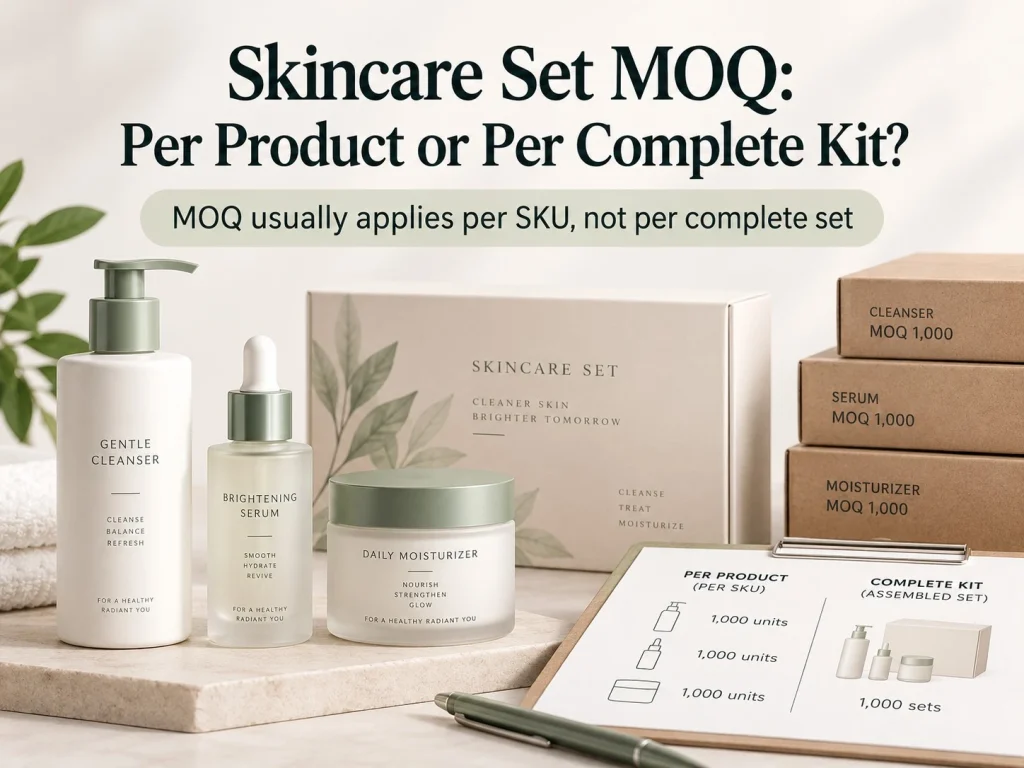


A skincare set looks like one item to a shopper, but it is usually several production items to a manufacturer. Each cleanser, serum, cream, mask, or eye product may require its own bulk batch, filling setup, packaging components, artwork, quality checks, and inventory record. The gift box adds another packaging and assembly operation.
This distinction changes the budget quickly. If a three-piece set has an MOQ of 1,000 units per product, the production commitment is normally 3,000 finished products, which can make 1,000 complete sets. It is not 1,000 products divided among the three formulas. The final answer still depends on the quotation, so brands should verify the unit, SKU scope, acceptable production variance, and treatment of unused components before paying a deposit.
Why One Skincare Set Can Have Several MOQs
MOQ is not a universal property of the marketing concept called a “set.” It is a commercial minimum attached to a particular production or purchasing activity. Formula batching, filling, container purchasing, decoration, carton printing, and final assembly may be handled by different suppliers or production lines. Each can set its own economic minimum.
A SKU is one item defined by attributes such as size, packaging, or count.[1] For skincare production, a 30 ml serum and a 50 ml serum are normally different SKUs. The same 30 ml serum in two language versions, two fragrances, or two decorated bottles may also create separate packaging or artwork runs even if the base formula is shared.
This is why a broad statement such as “our MOQ is 1,000” is incomplete. A manufacturer may mean 1,000 finished units per SKU. A packaging supplier may mean 1,000 identical bottles per color and decoration. A gift-box printer may mean 1,000 identical set boxes. A co-packer may mean it will assemble no fewer than 500 completed kits. None of those figures automatically replaces the others.
For general ranges and cost drivers, use ZICAIL’s private label skincare MOQ guide. For a set project, the more important task is to identify which minimum controls each line item.
The Four Quantity Layers Behind a Skincare Kit
Treat the quote as a stack of related quantities rather than one headline number. The controlling MOQ is the requirement that creates the largest unavoidable commitment for a specific item.
| Quantity layer | What it applies to | Usually counted by | Question to ask |
|---|---|---|---|
| Formula or bulk batch | Each distinct cleanser, serum, cream, or other formula | Kilograms, liters, or fill-equivalent units | What is the smallest validated batch, and how many saleable units should it yield after normal loss? |
| Finished-product production | Filling, closing, coding, labeling, and packing each product | Units per SKU | Is the minimum per formula, per size, per packaging version, or per artwork? |
| Packaging and decoration | Bottles, jars, tubes, pumps, labels, unit cartons, set boxes, and inserts | Identical components or print runs | Can quantities be shared across SKUs, and what change creates a separate run? |
| Set assembly | Placing finished SKUs into one retail box, pouch, or bundle | Complete kits | Is assembly included, and what is the minimum and fee for each set configuration? |
Custom packaging is commonly assessed by specific configuration. Differences in size, color, artwork, closure, decoration, or format can require separate production or print runs rather than one pooled quantity.[2] Stock containers with pressure-sensitive labels may therefore support a lower practical commitment than custom-colored bottles with direct printing, but the actual minimum remains supplier-specific.
The retail set box also needs its own specification. A reusable pouch, folding carton, rigid box, molded insert, paper tray, and shrink-wrapped bundle do not share the same tooling, print, freight, or assembly requirements. Packaging decisions should be evaluated early with the skincare packaging guide, not after formula approval.
How to Calculate MOQ for a Three-Product Set
Start by converting every requirement into finished-unit equivalents. Then calculate how many saleable complete kits the available quantities can support.
Assume a launch contains one cleanser, one serum, and one moisturizer per kit:
| Line item | Required or expected quantity | Complete kits supported |
|---|---|---|
| Cleanser | 1,000 finished units | 1,000 |
| Serum | 1,200 finished units | 1,200 |
| Moisturizer | 1,000 finished units | 1,000 |
| Printed set box | 1,500 boxes | 1,500 |
| Final assembly | 1,000 kits | 1,000 |
The project can initially produce 1,000 complete kits because the cleanser and moisturizer are the limiting components. After assembly, 200 serums and 500 empty set boxes remain. Those balances are not automatically free inventory: the purchase order should say who owns them, where they are stored, whether storage fees apply, whether they can be used in a reorder, and whether shelf-life or artwork changes could make them unusable.
For a set requiring one unit of each product, the basic calculation is:
Maximum complete kits = the lowest available finished-unit quantity among the required SKUs and set packages.
If a kit contains two units of one SKU, divide that SKU’s acceptable finished quantity by two before finding the lowest result. Use released finished quantities rather than theoretical bulk yield because filling loss, quality rejects, component damage, and agreed production tolerances can change the delivered total.
The arithmetic also affects cash planning. A quote for 1,000 three-piece kits may include 3,000 finished products plus boxes and assembly, while another quote may price the three products and the assembly service separately. Compare the same cost boundary when using a three-product skincare line budget.
When a Per-Kit MOQ Really Does Apply
A genuine per-complete-kit MOQ is possible, but it should be stated clearly. It is more likely when the supplier controls or already stocks every included product and sells a predefined assortment. Examples include ready-made white-label kits, prepacked promotional bundles, sample sets, and co-packing services that receive finished products from the brand.
Even then, “1,000 kits” does not prove that upstream product and packaging minimums disappear. The supplier may have already absorbed those minimums into stock, may require the brand to purchase residual units, or may restrict the brand to fixed formulas and packaging. A low set MOQ can therefore reflect less customization rather than a smaller custom manufacturing run.
Confirm whether the kit is sold as one assortment or whether its contents will also be sold individually. For U.S. cosmetic labeling, a retail assortment containing several cosmetic products is treated as a multiunit package; ingredient declarations generally belong on the outside container, with additional requirements depending on whether the inner units are customarily sold separately.[3] This regulatory packaging concept does not determine the commercial MOQ, but it can change artwork scope and the number of labels or cartons required.
What Happens When Component MOQs Do Not Match?
Mismatched minimums are normal. The important question is how the commercial and operational consequences are allocated.
- Surplus finished products: Extra units may be held for individual sale, used as testers, reserved for replacements, or stored for the next assembly run if labeling and shelf life remain suitable.
- Surplus primary packaging: Unused bottles, pumps, tubes, or jars may be brand-owned stock, manufacturer-owned stock, or nonrefundable material charged to the brand.
- Surplus printed materials: Labels and cartons are vulnerable to artwork, address, claim, regulatory, or brand-design changes. A large leftover quantity can become obsolete before the next order.
- Uneven reorders: The fastest-selling standalone SKU or the component with the shortest supply lead time can force a reorder before the rest of the set needs replenishment.
- Production variance: Actual acceptable output can be above or below the target within an agreed tolerance. The purchase order should define the invoicing and delivery treatment rather than leaving it to assumption.
Do not solve a mismatch by ordering more complete kits automatically. First test whether simplifying artwork, using shared stock components, reducing the number of sizes, or phasing the launch can lower the constrained line without weakening the retail concept. Shared components help only when the supplier permits quantity pooling and the components are truly identical before decoration.
How to Get an Unambiguous Skincare Set Quote
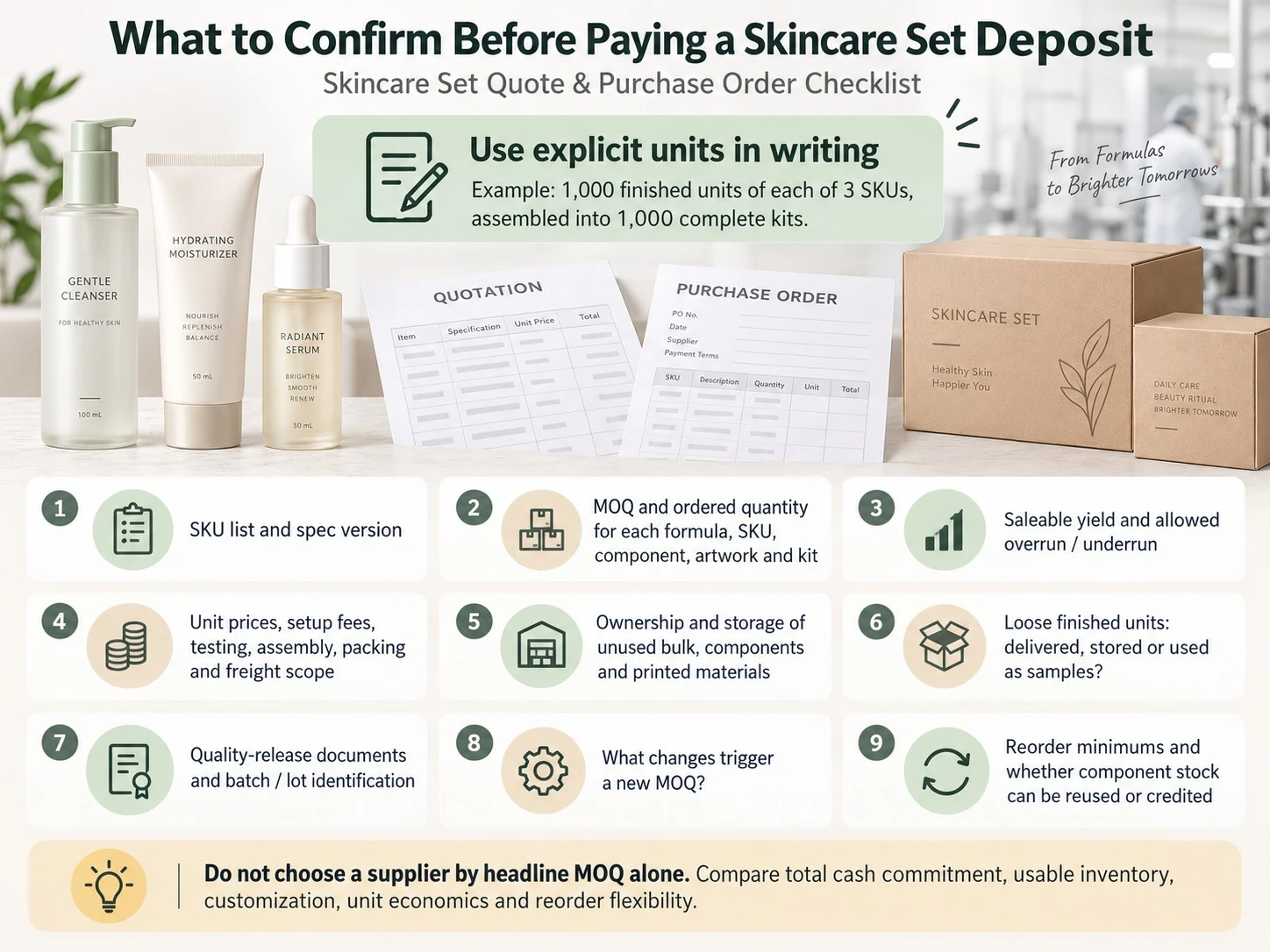
The goal is a quote that can be reconciled line by line. Prepare the request before comparing prices; otherwise, two suppliers may appear to quote the same set while including different quantities and services.
1. Define Every Sellable SKU
List each formula, fill size, fragrance, packaging format, artwork version, target market, and whether the item will be sold alone as well as inside the set. Treat any variation that changes production, labeling, or inventory as a possible separate SKU.
2. Separate Product and Packaging Quantities
Request the formula batch minimum, expected fill yield, finished-product MOQ, component MOQ, decoration MOQ, label or carton print minimum, and set-box MOQ as separate fields. Ask which quantities are estimates and which become binding after samples and specifications are approved.
3. State the Required Number of Complete Kits
Specify the exact bill of materials for one kit: for example, one 100 ml cleanser, one 30 ml serum, one 50 g cream, one insert, and one printed box. State the desired number of retail-ready kits and any desired loose units for sampling, replacement, or individual sale.
4. Ask How Surplus Components Will Be Handled
For every line with a quantity above the kit requirement, identify ownership, unit cost, storage location, storage period, fees, reorder use, and disposal approval. Do not assume a manufacturer will store leftovers indefinitely or that branded materials can be returned to a supplier.
5. Confirm Acceptance Quantities and Reorder Terms
Record the acceptable production variance, payment basis, quality-release process, batch or lot documentation, shelf-life expectations at dispatch, and MOQ for repeat orders. Ask whether a reorder of one SKU can proceed independently or whether all set components must be ordered again.
A structured private label skincare RFQ makes these answers easier to compare across manufacturers.
What Should Be Confirmed Before You Pay a Deposit?
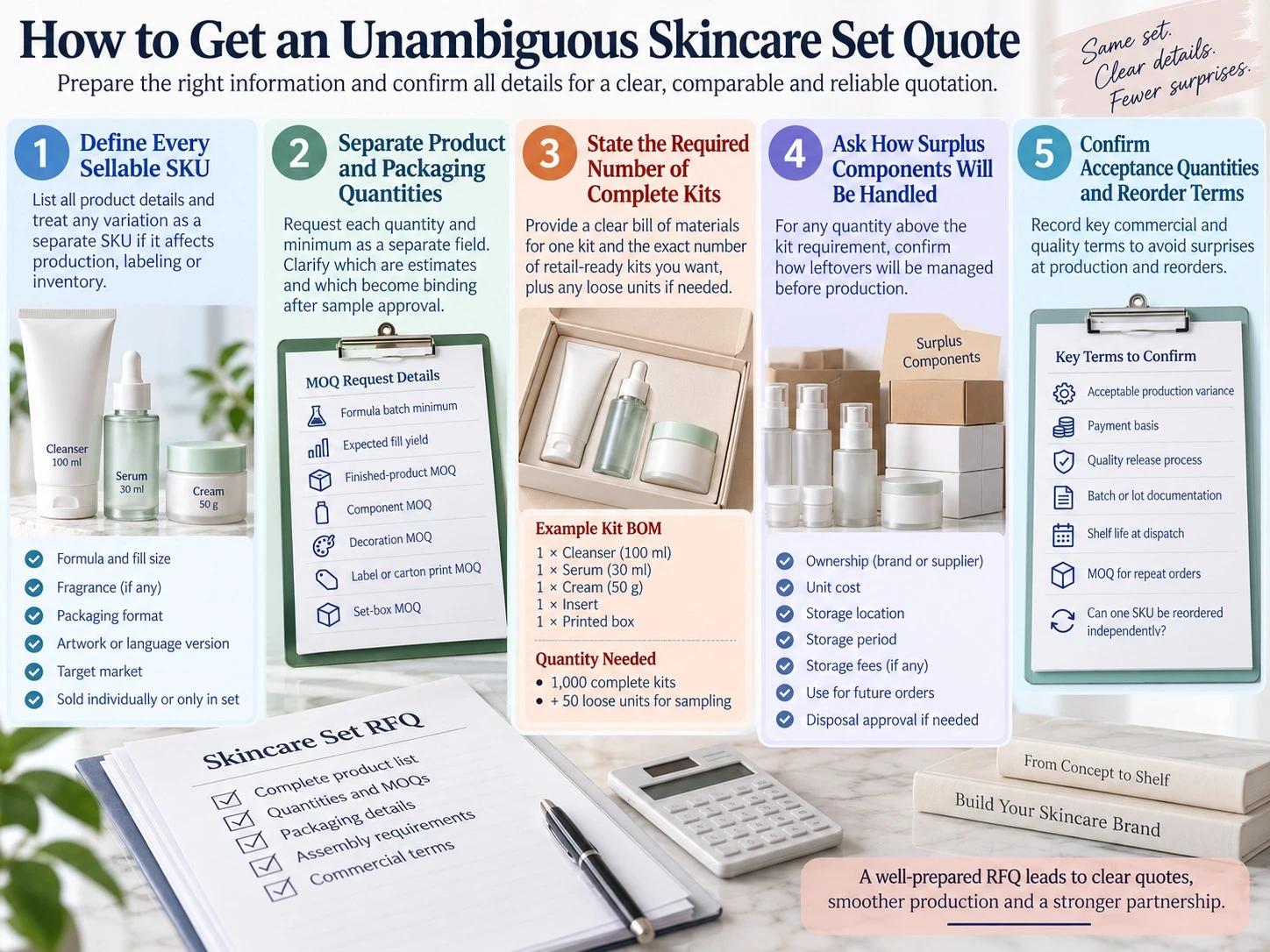
The final quotation and purchase order should use explicit nouns and units. Replace “set MOQ: 1,000” with language such as “1,000 finished units of each of three SKUs, assembled into 1,000 complete kits,” if that is the actual agreement.
Confirm these points in writing:
- the SKU list and specification version covered by the quote;
- minimum and ordered quantity for every formula, finished product, component, artwork, and kit;
- expected saleable yield and permitted overrun or underrun;
- unit prices, setup charges, testing, assembly, packing, and freight boundaries;
- ownership and storage terms for unused bulk, components, and printed materials;
- whether loose finished products are delivered, stored, or consumed as samples;
- quality-release documents and batch or lot identification for each finished SKU;
- conditions that trigger a new MOQ, such as a size, color, artwork, fragrance, market, or packaging change;
- reorder minimums and whether component stock can be credited or reused.
Do not use the lowest headline MOQ as the only supplier-selection criterion. One manufacturer’s published minimums can vary by product category and are confirmed at project kickoff, illustrating why the project-specific written quote governs.[4] Compare the total cash commitment, usable inventory, customization level, unit economics, and reorder flexibility.
Discuss Your Skincare Set Quantity Plan With ZICAIL
ZICAIL works with brands on private label skincare projects and can discuss product scope, formula direction, packaging, and set configuration. Prepare your SKU list, target markets, fill sizes, packaging preferences, desired kit quantity, loose-unit needs, and launch schedule, then contact ZICAIL to review the project requirements and request a quantity-specific quotation.


