


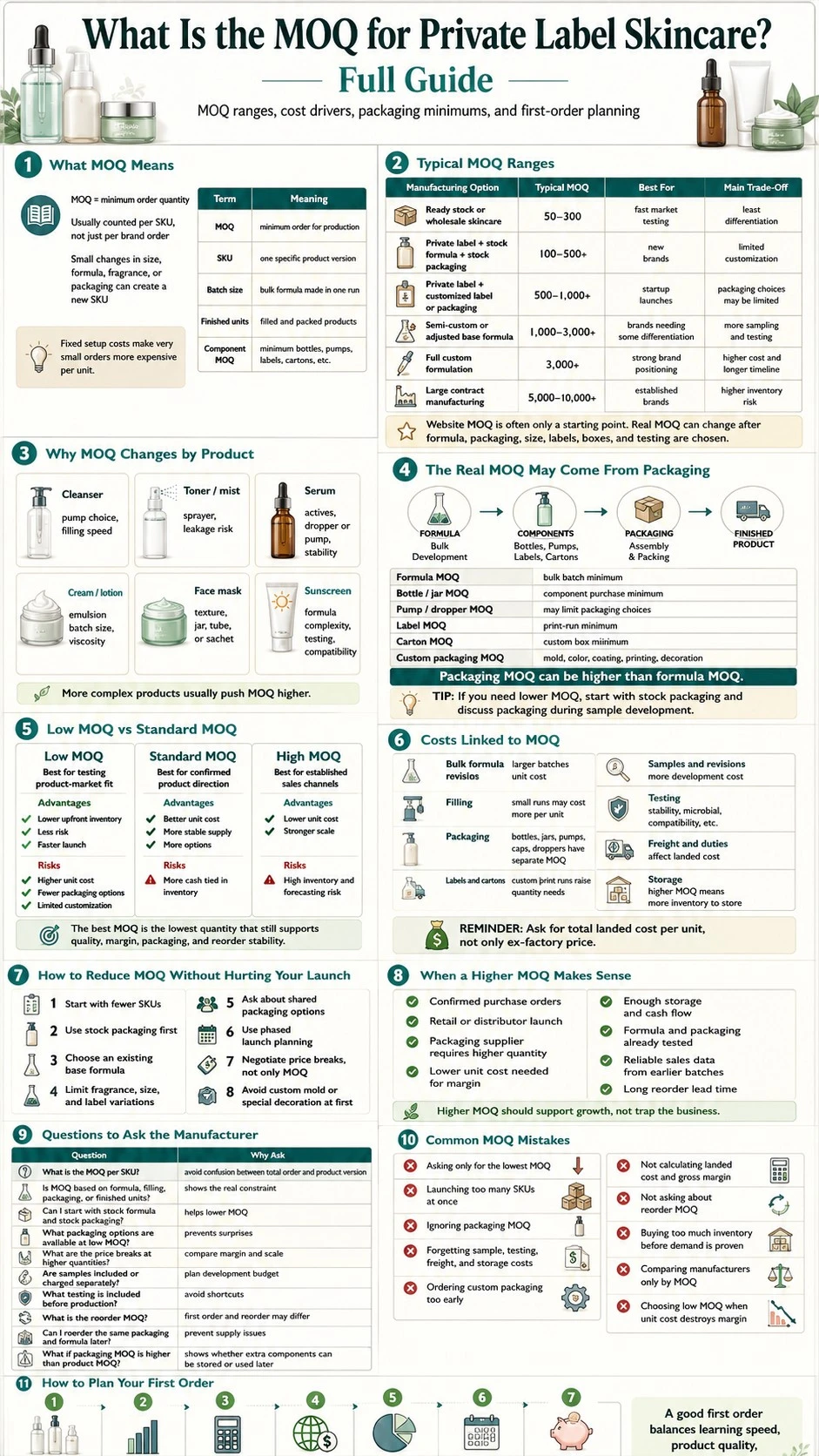
What MOQ Means in Private Label Skincare
In private label skincare, MOQ is usually counted per SKU, not only per brand order. A SKU is one specific product version. For example, a 30ml vitamin C serum in an amber dropper bottle with your label is one SKU. A 50ml version, a different fragrance, a new size, or another packaging option may count as a separate SKU.
| Term | Meaning for a Skincare Brand |
|---|---|
| MOQ | The minimum order quantity required for production |
| SKU | One specific product version, size, formula, packaging, or label |
| Batch size | The amount of bulk formula made in one production run |
| Finished units | Final filled and packed products ready to sell |
| Component MOQ | Minimum order for bottles, jars, pumps, labels, cartons, or other parts |
MOQ exists because production has fixed costs. A manufacturer needs to prepare materials, clean equipment, set up filling lines, check packaging, manage labor, run quality checks, and handle normal production loss.
Small orders can be possible, but they often cost more per unit because those fixed costs are spread across fewer products.
Typical MOQ Ranges for Private Label Skincare
There is no single MOQ for all private label skincare. A simple stock product can have a much lower MOQ than a custom serum in special packaging.
Use the ranges below as a planning guide, not as a fixed promise.
| Manufacturing Option | Typical MOQ Range | Best For | Main Trade-Off |
|---|---|---|---|
| Ready stock / wholesale skincare | 50–300 units | Testing the market fast | Least brand differentiation |
| Private label with stock formula and stock packaging | 100–500+ units | New brands and small launches | Limited customization |
| Private label with label or packaging customization | 500–1,000+ units | Startup brand launch | Packaging choices may be limited |
| Semi-custom formula or adjusted base formula | 1,000–3,000+ units | Brands needing some differentiation | More sampling and testing |
| Full custom formulation | 3,000+ units | Strong brand positioning | Higher cost and longer timeline |
| Large contract manufacturing | 5,000–10,000+ units | Established brands | Higher inventory risk |
A low MOQ skincare manufacturer may offer small runs for basic formulas, stock packaging, or ready-made products. A larger cosmetic manufacturer may require higher MOQ because its production lines, material buying process, and packaging supply chain are built for bigger runs.
The number on a manufacturer’s website is often only a starting point. Your real MOQ can change after you choose product type, formula, packaging, label, box, fragrance, size, testing, and shipping method. For example, a 500-unit cleanser may still need 3,000 pumps if that is the packaging supplier’s minimum.
Why MOQ Is Different for Each Skincare Product
Different skincare products need different materials, equipment, filling methods, packaging, and quality checks. A cleanser, serum, cream, toner, sunscreen, mask, balm, and lip product can all create different MOQ pressure.
| Product Type | Why MOQ Can Change |
|---|---|
| Cleanser | Surfactant system, bottle or pump choice, filling speed |
| Toner / mist | Bottle, sprayer, leakage risk, large liquid volume |
| Serum | Active ingredients, dropper or pump packaging, stability needs |
| Cream / lotion | Emulsion batch size, viscosity, jar, tube, or pump choice |
| Face mask | Texture, filling method, jar, tube, or sachet packaging |
| Sunscreen | Formula complexity, testing needs, packaging compatibility |
| Balm / lip product | Hot filling, mold or tube requirements, texture control |
The more complex the product, the more likely the MOQ will rise. For a first private label skincare launch, one to three focused SKUs are often easier to manage than a full routine.
The Real MOQ May Come from Packaging, Not Formula
Many new skincare brands ask about formula MOQ first, but packaging MOQ can be the bigger constraint. A manufacturer may be willing to produce 500 finished units, while the bottle, pump, label, or carton supplier requires a higher quantity.
| MOQ Type | What It Means | Why It Matters |
|---|---|---|
| Formula MOQ | Minimum bulk formula batch | Affects how many finished units can be filled |
| Bottle / jar MOQ | Minimum packaging component purchase | May be higher than production MOQ |
| Pump / dropper MOQ | Minimum dispenser component order | Can limit packaging choices |
| Label MOQ | Minimum label print run | Affects cost for small batches |
| Carton MOQ | Minimum box order | Custom boxes often require higher quantity |
| Custom packaging MOQ | Minimum for mold, color, coating, printing, or decoration | Can push the project MOQ much higher |
Stock packaging usually keeps MOQ lower. Custom color, molds, coating, printing, electroplating, special pumps, and custom boxes can push MOQ higher quickly.
Tip: If you need low MOQ, choose stock packaging first and discuss packaging while samples are still being developed. A formula that looks good in a lab sample still needs the right container and shipping setup.
Low MOQ vs Standard MOQ: Which Is Better?
Low MOQ helps new skincare brands test demand with less upfront inventory risk. The trade-off is higher unit cost, fewer packaging options, less customization, and weaker margin.
| Option | Best For | Advantages | Risks |
|---|---|---|---|
| Low MOQ | Testing product-market fit | Lower upfront cost, less inventory risk, faster launch | Higher unit cost, fewer packaging options, limited customization |
| Standard MOQ | Confirmed product direction | Better unit cost, more stable supply, more options | More cash tied in inventory |
| High MOQ | Established sales channel | Lower unit cost, stronger scale | High inventory and forecasting risk |
For a startup, the best MOQ is the lowest MOQ that still gives you acceptable product quality, margin, packaging, and reorder stability. A 300-unit order may feel safe, but a 1,000-unit order can be stronger if it gives better packaging, healthier margin, and a workable reorder plan.
What Costs Are Usually Linked to MOQ?
MOQ affects your first-order budget, not just the number of products you receive.
A private label skincare quote may include finished products only, or it may separate formula, filling, packaging, label, carton, testing, freight, and other services. Always ask what is included and what is not.
| Cost Item | How It Connects to MOQ |
|---|---|
| Bulk formula | Larger batches usually reduce cost per unit |
| Filling | Small runs may have higher filling cost per unit |
| Packaging | Bottles, jars, pumps, caps, and droppers can have separate MOQ |
| Labels and cartons | Custom print runs may require higher quantity |
| Samples and revisions | More revisions increase development cost |
| Testing | Stability, microbial, compatibility, or other tests may be needed |
| Freight and duties | Larger orders cost more upfront and affect landed cost |
| Storage | Higher MOQ means more inventory to store |
The production unit price is only one part of the real cost. Ask for the total landed cost per unit, not only the ex-factory unit price. This gives you a clearer view of margin after packaging, shipping, duties, testing, and storage.
For example, a 500-unit order with expensive packaging can cost more per unit than a 1,000-unit order with stock packaging. The better choice is the order that works with your budget, sales price, and margin.
How to Reduce MOQ Without Hurting Your Launch
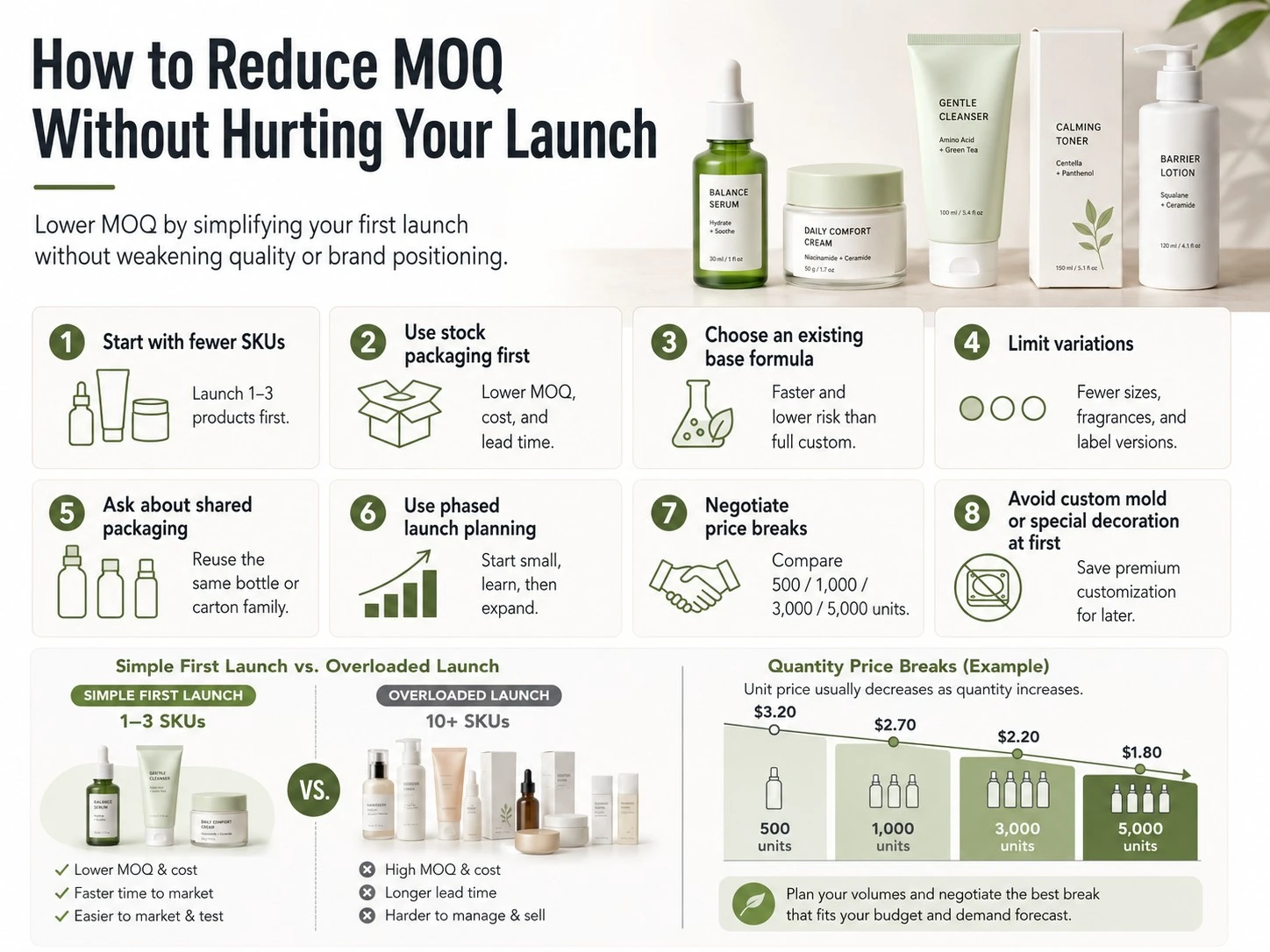
You can often reduce MOQ by simplifying the launch while keeping product quality and brand positioning strong.
1. Start with Fewer SKUs
Do not launch cleanser, toner, serum, cream, mask, and sunscreen all at once unless you already have strong demand. For most new brands, one to three SKUs are easier to manage, market, and reorder.
2. Use Stock Packaging First
Stock packaging can reduce MOQ, cost, and lead time. You can still build brand identity through label design, outer box design, color direction, texture, product story, and formula choice.
3. Choose an Existing Base Formula
An existing base formula usually has lower MOQ than a full custom formulation. It can shorten sample time and reduce development risk when speed, budget, and first launch testing matter more than complete formula uniqueness.
4. Limit Fragrance, Size, and Label Variations
Each variation can create a new SKU. A 30ml serum and 50ml serum may have different MOQ. The same cream with two fragrances may also count as two versions.
For a first order, keep variations limited. You can expand after you see what sells.
5. Ask About Shared Packaging Options
Some product lines can use the same bottle family, jar style, or carton structure. Ask your manufacturer which packaging options can support multiple products.
6. Use Phased Launch Planning
Start with a smaller product range, collect sales data, then reorder or add new SKUs. A phased launch is often safer than a large first launch with many untested products.
7. Negotiate Price Breaks, Not Only MOQ
Ask for pricing at 500, 1,000, 3,000, and 5,000 units. Sometimes a slightly higher MOQ gives a much better unit cost. Other times, the difference is small and the lower MOQ is safer.
8. Avoid Custom Mold or Special Decoration at First
Custom mold, special coating, unique cap shape, metallic decoration, and complex printing can raise MOQ quickly.
Save high-custom packaging for your second or third production stage, after product demand is clearer.
When a Higher MOQ Makes Sense
Higher MOQ can make sense when the business is ready:
- You already have confirmed purchase orders.
- You are preparing for a retail or distributor launch.
- Your packaging supplier requires higher quantity.
- Your unit cost must be lower to protect margin.
- You have enough storage and cash flow.
- Your formula and packaging are already tested.
- You have reliable sales data from earlier batches.
- Your reorder lead time is long and stockouts would hurt your launch.
Higher MOQ can improve unit cost, packaging options, supply stability, and gross margin. But it should support growth, not trap the business. Move higher only when demand, cash flow, storage, and reorder planning support it.
MOQ Questions to Ask a Private Label Skincare Manufacturer
Before you approve a private label skincare quote, ask specific MOQ questions. Do not accept a single number without understanding what it includes.
| Question | Why You Should Ask |
|---|---|
| What is the MOQ per SKU? | Avoids confusion between total order and product version. |
| Is the MOQ based on formula, filling, packaging, or finished units? | Shows the real constraint. |
| Can I start with stock formula and stock packaging? | Helps lower MOQ. |
| What packaging options are available at low MOQ? | Prevents later packaging surprises. |
| What are the price breaks at higher quantities? | Helps compare margin and scale. |
| Are samples included or charged separately? | Helps plan development budget. |
| What testing is included before production? | Avoids quality shortcuts. |
| What is the reorder MOQ? | First order and reorder rules may differ. |
| Can I reorder the same packaging and formula later? | Prevents supply issues. |
| What happens if packaging MOQ is higher than product MOQ? | Shows whether excess components can be stored or used later. |
These questions also help you compare manufacturers more fairly. One supplier may look cheaper because testing, packaging, labels, or freight are not included. Another may look more expensive but offer a clearer full project cost.
See our skincare manufacturer questions guide for a deeper supplier checklist before you sign or place your first order.
Common MOQ Mistakes New Skincare Brands Make
Most MOQ mistakes come from looking only at order quantity, not the full launch plan.
Avoid these common mistakes:
- Asking only for the lowest MOQ.
- Launching too many SKUs at once.
- Ignoring packaging MOQ.
- Forgetting sample, testing, freight, and storage costs.
- Ordering custom packaging too early.
- Not calculating landed cost and gross margin.
- Not asking about reorder MOQ.
- Buying too much inventory before demand is proven.
- Comparing manufacturers only by MOQ.
- Choosing low MOQ even when the unit cost destroys margin.
A good first order should protect learning speed, product quality, cash flow, and margin at the same time. A small order can reduce inventory risk, but it should not create quality problems, weak packaging, or a business model with no profit.
How to Plan Your First Private Label Skincare Order

Your first order should be planned around what you can sell, support, store, and reorder.
1. Choose Your Launch SKU Count
For a new skincare brand, one to three SKUs are easier to manage than a full routine. A hero serum, moisturizer, cleanser, or mask can be easier to position than six products launched at the same time.
2. Estimate Realistic Sales for 3–6 Months
Do not base your first order on ideal sales. Estimate demand from your audience size, sales channel, launch campaign, pricing, repeat purchase rate, and cash flow.
3. Ask for MOQ and Price Breaks
Ask your manufacturer for several quantity options. Compare unit cost, total order cost, packaging options, lead time, and margin at each level.
4. Calculate Total Landed Cost
Landed cost is the real cost of getting the product ready to sell.
Include:
- Formula and bulk production.
- Filling.
- Packaging.
- Labels and cartons.
- Samples and revisions.
- Testing.
- Freight.
- Duties.
- Storage.
- Any required documentation or support.
This gives you a better view of profit than production price alone.
5. Check Your Margin
Your margin should work after wholesale pricing, retail discounts, platform fees, influencer samples, paid ads, returns, and shipping support. If your MOQ is low but your margin is too thin, the launch may still be difficult.
6. Plan Reorder Timing
Ask how long reorders take and what could delay them. If it takes 8–12 weeks to reorder and ship, you need to reorder before you run out.
7. Keep Cash for Marketing and Operations
Do not spend your entire launch budget on inventory. You still need money for brand assets, marketing, content, sampling, shipping, ads, platform fees, and customer support. A balanced first order leaves room to sell the product, not just produce it.
Final Thoughts
MOQ for private label skincare is not one universal number. It depends on product type, formula, packaging, customization, supplier setup, and launch plan.
A new brand should not chase the lowest MOQ without checking unit cost, packaging limits, testing, margin, and reorder stability. The best MOQ supports product quality, cash flow, customer demand, gross margin, and future reorders.
FAQs About Private Label Skincare MOQ
What is the MOQ for private label skincare?
The MOQ for private label skincare can range from a few hundred units to several thousand units per SKU. Some low-MOQ options may start around 100–500 units, while standard private label or custom projects often start at 1,000–3,000+ units.
Can I start a skincare brand with 100 units?
You may be able to start with 100 units if you use ready stock, wholesale skincare, or a very low-MOQ private label option. Products with custom packaging, labels, formula changes, or testing often require a higher MOQ. Always ask whether the MOQ is based on finished units, packaging, or formula batch size.
Why do skincare manufacturers have MOQ?
Skincare manufacturers have MOQ because each production run has fixed costs, including raw materials, packaging, equipment setup, filling, cleaning, labor, quality checks, and product loss. Larger quantities spread these costs across more units, which helps lower the unit price.
Is low MOQ always better for startups?
No. Low MOQ reduces inventory risk and upfront cost, but it can also create higher unit cost, fewer packaging options, limited customization, and weaker profit margin. For startups, the best MOQ still needs to support product quality, margin, packaging, and reorder stability.
Does packaging affect skincare MOQ?
Yes. Packaging often affects MOQ as much as the formula does. Bottles, jars, pumps, droppers, labels, cartons, and custom decorations can have their own supplier minimums. Custom packaging usually raises MOQ, while stock packaging usually helps keep MOQ lower.
What does MOQ per SKU mean?
MOQ per SKU means the minimum order applies to each specific product version. A 30ml serum and a 50ml serum may count as two SKUs. The same formula with different fragrances, labels, sizes, or packaging may also count as separate SKUs. This is why a full product line can raise total order quantity quickly.
How can I reduce MOQ for private label skincare?
You can reduce MOQ by launching fewer SKUs, using stock packaging, choosing an existing base formula, limiting fragrance and size variations, avoiding custom molds, and asking about low-MOQ packaging options. A phased launch can also help you test demand before committing to larger orders.


