


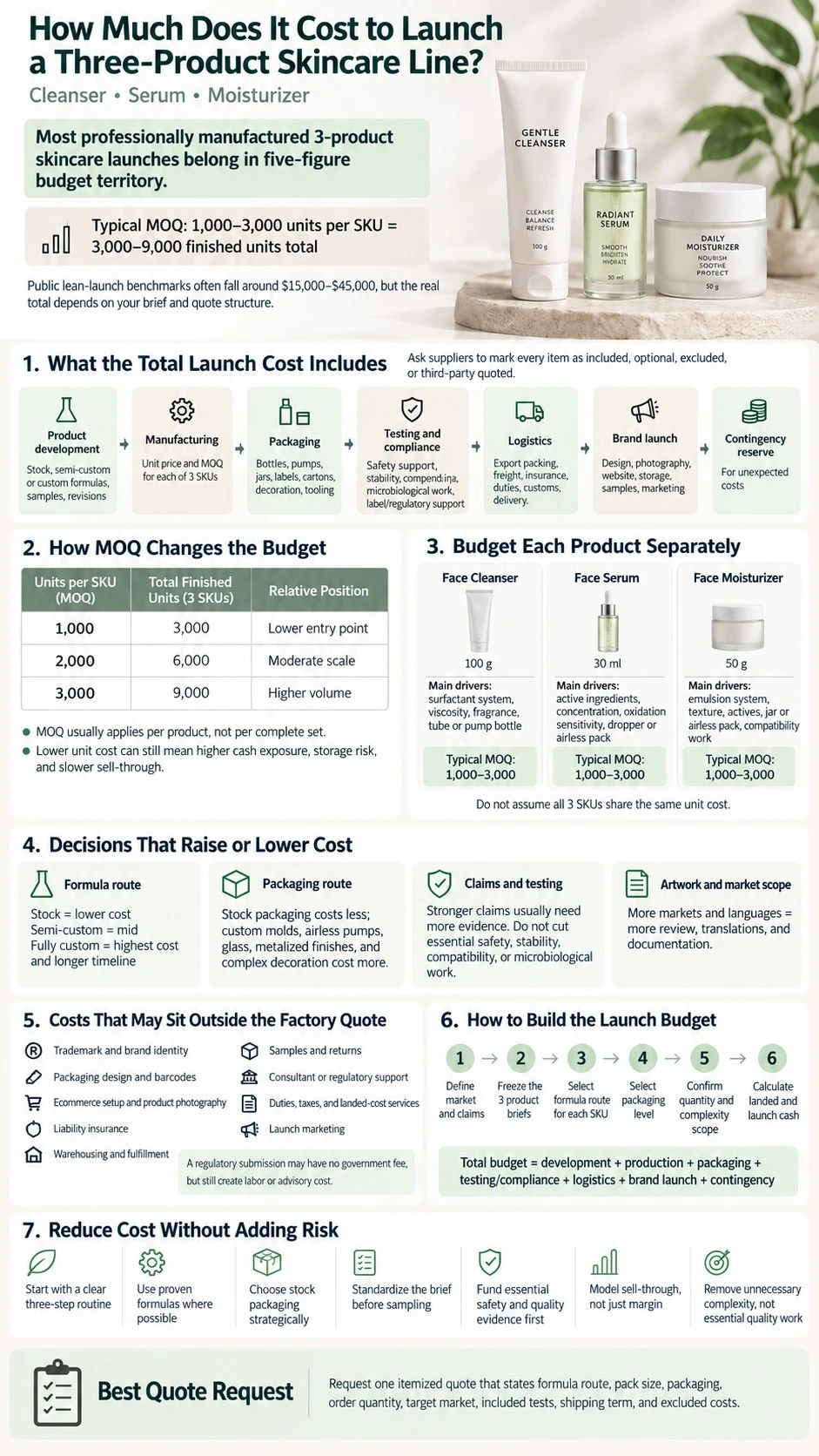
The cost to launch a three-product skincare line is not simply one bottle price multiplied by three. A founder must fund three formulas or formula selections, three production quantities, three packaging systems, three sets of artwork, and the compliance work needed for the intended market. The project may also require freight, import costs, warehousing, insurance, content, and customer acquisition before the first sale.
As a planning rule, a commercially manufactured cleanser, serum, and moisturizer line belongs in five-figure budget territory once the full launch is considered. Public industry estimates vary widely—even a lean private-label hero-product launch has been estimated at $15,000–$45,000—because formula ownership, packaging, quantity, testing, creative work, and marketing are often counted differently.[1] That benchmark is context, not a ZICAIL quotation. The only defensible project total comes from a defined brief and itemized supplier quotes.
What Does the Total Launch Cost Include?
First separate the manufacturing quote from the complete launch budget. A factory quote may cover bulk formula, filling, standard components, and basic packing, but it does not automatically include every expense required to place compliant products in customers’ hands. Ask the supplier to mark every line as included, optional, excluded, or quoted by a third party.
| Cost group | What it may include | Question to ask |
|---|---|---|
| Formula and samples | Formula selection, customization, laboratory samples, and revision rounds | How many samples or revisions are included? |
| Production | Raw materials, batching, filling, assembly, quality checks, and finished units | Is the quoted MOQ and unit price stated separately for each SKU? |
| Packaging | Primary container, closure, pump, label, decoration, carton, and inserts | Are packaging setup charges, plates, molds, and overruns included? |
| Testing and documents | Stability, compatibility, microbiological work, specifications, certificates, and regulatory support | Which tests and documents are included for the destination market? |
| Logistics | Export packing, freight, insurance, duties, customs fees, and delivery | What Incoterm applies, and where does supplier responsibility end? |
| Brand launch | Design, photography, website, insurance, storage, samples, and marketing | Which costs remain payable outside the manufacturing contract? |
A useful working equation is: total launch budget = development and samples + production for all three SKUs + packaging and artwork + testing and compliance + landed logistics + commercial launch costs + contingency. This equation prevents a low ex-factory number from being mistaken for the cash needed to launch.
How Does MOQ Change the Cost of a Three-Product Line?
MOQ is normally applied per product, not across the complete assortment. If the cleanser, serum, and moisturizer each require 1,000 units, the purchase order contains 3,000 finished units. At 3,000 units per SKU, the same line contains 9,000 units. This distinction changes both the upfront invoice and the amount of inventory the brand must sell.
ZICAIL’s typical MOQ is 1,000–3,000 units per SKU, subject to formula, component, and decoration choices. Special packaging can carry its own higher component MOQ, so the finished-product MOQ and packaging-purchase quantity may not always match. Founders should review the detailed private label skincare MOQ guide before comparing quotes.
Do not choose the lowest unit price without checking cash exposure and sell-through. A larger run may reduce the unit price while increasing storage, working-capital, and obsolescence risk. Compare scenarios using the same specification: 1,000, 2,000, and 3,000 units for each SKU, plus any excess packaging that must be purchased and stored.
What Should You Budget for Each Product?
The three SKUs should not be assigned the same assumed unit cost. Their formulas, fill weights, packaging systems, processing requirements, and testing plans differ. Use each product as its own cost center, then add shared project costs separately.
| Product | Reference size | Main cost drivers | Typical ZICAIL MOQ |
|---|---|---|---|
| Face cleanser | 100 g | Surfactant system, viscosity, fragrance, tube or pump bottle, and rinse-off testing plan | 1,000–3,000 units |
| Face serum | 30 ml | Active ingredients, concentration, oxidation sensitivity, dropper or airless pack, and claims support | 1,000–3,000 units |
| Face moisturizer | 50 g | Emulsion system, texture, active ingredients, jar or airless pack, and compatibility work | 1,000–3,000 units |
A serum is not automatically the most expensive item, although high-cost actives or protective packaging can make it so. A cleanser in an elaborate pump bottle may cost more than expected, while a moisturizer using a stock formula and stock jar may be comparatively efficient. The brief, not the product name, determines the quote.
Which Decisions Increase or Reduce the Cost?

Formula Route
A stock or private-label formula is generally the lowest-cost, fastest route because core development work already exists. Semi-custom development may adjust fragrance, color, selected ingredients, or texture within practical limits. Fully custom formulation adds laboratory work, iterations, validation, and often a longer timeline. The stock formula versus custom formula comparison can help founders match differentiation goals to available capital.
Packaging Route
Stock bottles, tubes, jars, and labels usually require less cash than custom molds, colors, finishes, or complex decoration. Airless pumps, glass components, metalized finishes, and multi-part cartons can increase both unit cost and setup charges. Packaging must also remain compatible with the formula; an attractive component that leaks, clogs, discolors, or allows evaporation is not a saving.
Claims and Testing
Claims influence both formulation and evidence costs. Simple cosmetic positioning such as cleansing, moisturizing, or improving the appearance of skin may be easier to support than aggressive performance language. The U.S. FDA states that cosmetic companies and individuals marketing cosmetics are responsible for ensuring product safety, and testing should be scientifically sound.[2] Stability, packaging compatibility, microbiological quality, and preservative efficacy should be scoped according to the formula, pack, market, and risk—not removed merely to reach a target price.
Artwork and Market Scope
Launching in one market and one language is usually simpler than preparing artwork and documentation for several jurisdictions at once. In the United States, labels must address requirements such as product identity, net quantity, business information, ingredient declaration, and applicable warnings.[3] Each additional market may add label review, translations, responsible-person or notification work, and market-specific claims restrictions.
Which Costs May Sit Outside the Factory Quote?
The factory invoice is only one layer of the project. A brand may need to budget separately for trademark work, brand identity, packaging design, barcode licensing, ecommerce setup, product photography, liability insurance, third-party regulatory advice, warehouse receiving, fulfillment, samples, returns, and launch marketing. These expenses vary by business model and should not be hidden inside a vague “miscellaneous” line.
For U.S. launches, the responsible person may need to handle cosmetic product listing and annual updates unless an exemption applies; FDA currently states that there is no fee to submit a facility registration or product listing, but a consultant or service provider may charge for its work.[4] In other words, a regulatory task can create labor or advisory cost even when the government submission itself has no fee.
Imported goods may also attract duties, taxes, and user fees. The applicable amount depends on factors including tariff classification, country of origin, customs value, and current trade measures, so ask a qualified customs broker for a landed-cost estimate rather than copying a generic duty percentage.[5] Freight quotes should state the Incoterm, destination, shipment method, and whether customs clearance and final delivery are included.
How to Build a Three-Product Skincare Launch Budget

- Define the market and claims. Name the destination country, sales channel, intended consumer, positioning, and claims before formula and label work begins.
- Freeze the three product briefs. Specify a cleanser, serum, and moisturizer with target textures, hero ingredients, exclusions, fragrance preference, and reference sizes.
- Select the formula route. Decide whether each SKU will use a stock, semi-custom, or fully custom formula; the three products do not have to use the same route.
- Select the packaging level. Identify stock or custom components, decoration, labels, cartons, and any sustainability or material requirements.
- Confirm quantity and compliance scope. Request per-SKU prices at realistic MOQs and list the tests, documents, label reviews, and registrations required for the market.
- Calculate landed and launch cash. Add samples, production, packaging, freight, duties, warehousing, insurance, creative work, marketing, and a contingency reserve; also record deposits and payment dates to expose the cash-flow peak.
Use a spreadsheet with one column for each SKU and a fourth column for shared costs. Record unit price, order quantity, setup charges, test fees, freight allocation, and expected sellable units. Then calculate both total cash required and landed cost per sellable unit. A complete private label skincare RFQ makes supplier responses more comparable and reduces expensive assumptions.
How Can a Startup Reduce Cost Without Creating More Risk?
- Use a coherent three-step routine. A cleanser, serum, and moisturizer can cover a clear consumer routine without the inventory burden of a broad assortment.
- Start with proven formulas. Stock formulas reduce development work while the brand validates positioning, price, and demand.
- Choose stock packaging strategically. Different labels, colors, or cartons can create a unified brand system without custom molds.
- Standardize the brief before sampling. Changing actives, fragrance, claims, and components during development creates extra rounds and delays.
- Separate essential evidence from optional claims. Fund safety, stability, compatibility, and microbiological needs first; add expensive marketing claims only when they support the commercial plan.
- Model sell-through, not only margin. A lower unit price is not economical if excess inventory expires, is reworked, or consumes cash needed for marketing.
Cost control should remove unnecessary complexity, not essential quality work. The goal is a launch that the brand can finance, document, sell, and reorder—not merely the lowest initial invoice.
Request an Itemized Three-Product Skincare Quote
ZICAIL can evaluate a three-step cleanser, serum, and moisturizer project against your target market, positioning, packaging, and quantity. Send your product brief, reference formulas or products, target claims, desired pack sizes, packaging direction, destination market, and estimated volume. The response can then separate product development, per-SKU production, packaging, testing, documentation, and logistics assumptions so you can see what drives the budget before approving samples.


