

A travel skincare set should be compact without running out halfway through the use occasion it promises. That balance cannot be achieved by shrinking every full-size product by the same percentage. A cleanser used twice daily, a concentrated serum dispensed in small doses and a moisturizer applied in a thin layer consume product at different rates.
Brands should therefore choose capacity product by product. The strongest brief connects each fill to a target trip, application frequency, measured dose, package output and retail position. It also distinguishes travel size from trial or sample size: a travel product should function as a durable, resealable retail SKU, not merely provide a few first impressions.
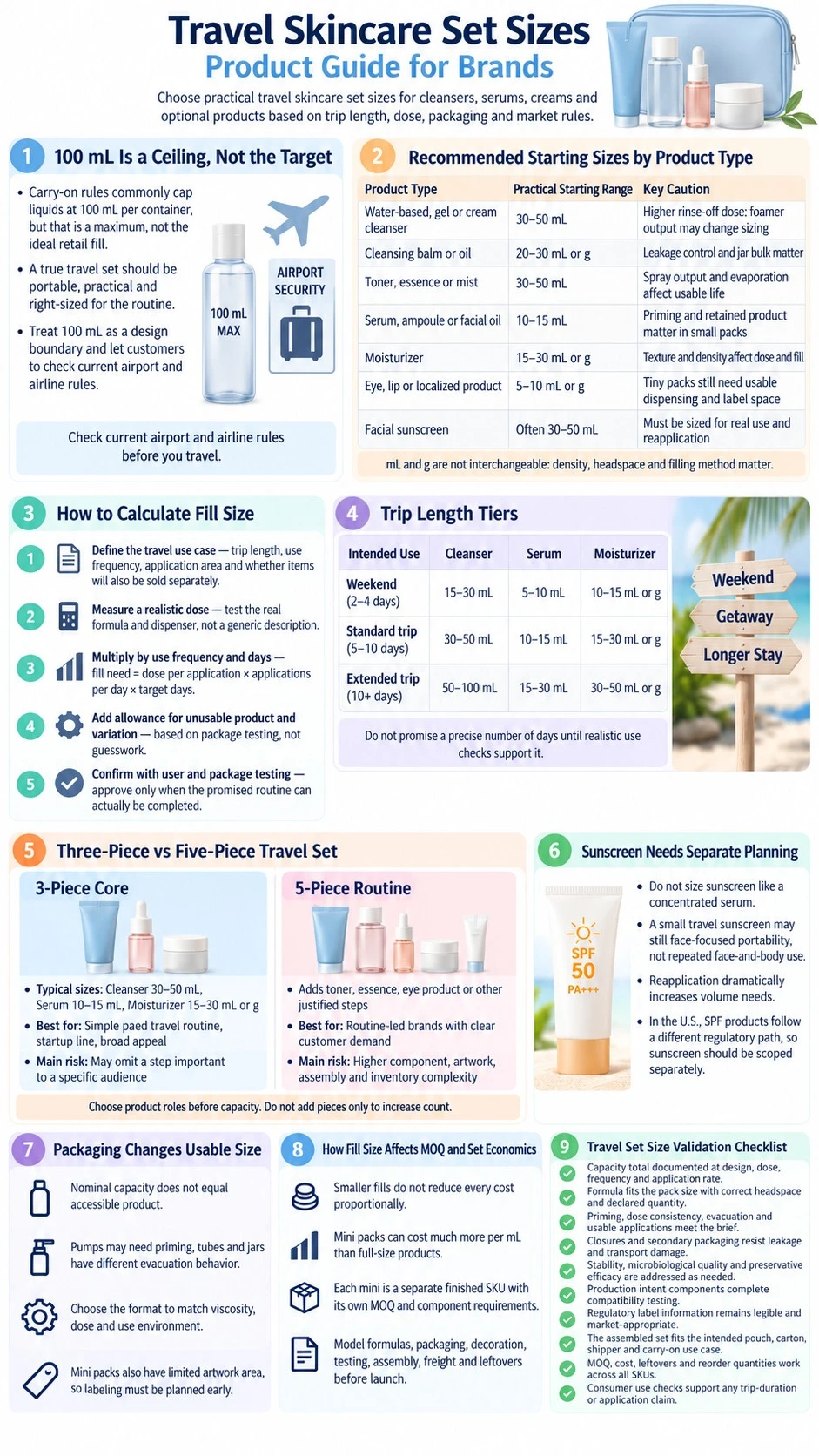
Why 100 mL Is a Ceiling, Not the Target Size
For U.S. carry-on baggage, TSA permits liquids, aerosols, gels, creams and pastes in containers of 3.4 ounces or 100 mL or less, subject to the quart-sized-bag rule.[1] European Union aviation-security guidance also uses individual containers no greater than 100 mL within a transparent one-liter resealable bag.[2]
Those rules describe the maximum container capacity accepted through security in the relevant circumstances. They do not define the ideal retail fill for cleanser, serum or cream. Five products in 100 mL containers would consume far more luggage space than most facial routines require, even though each individual container sits at the limit.
“Airline-friendly” also needs careful wording. Screening rules, exceptions and airport procedures can change, and a package below 100 mL can still leak or fail in transit. Treat 100 mL as a design boundary, verify the intended markets, and tell customers to check current airport and airline requirements before travel.
The commercial distinction between portable retail products and smaller evaluation formats is covered in ZICAIL’s travel, trial and sample size guide. This article focuses on choosing the fill inside a true travel set.
Recommended Starting Sizes by Product Type
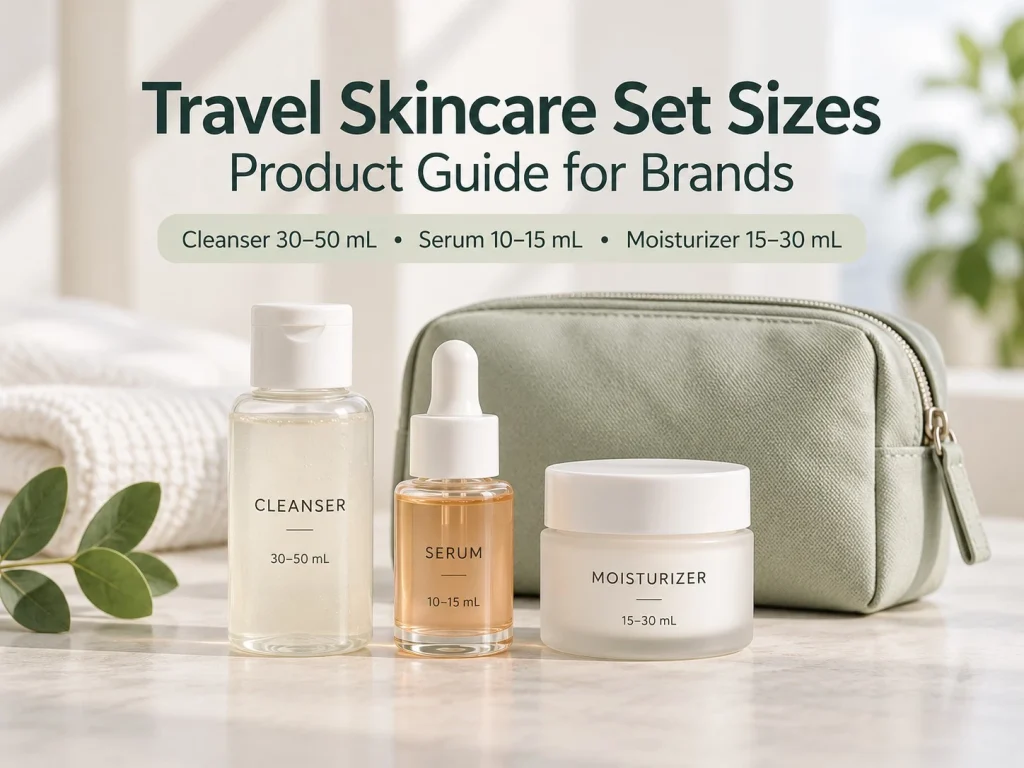
Current travel sets illustrate a recurring pattern rather than one mandatory formula. One official product assortment combines a 30 mL cleanser, 10 mL treatment and 20 mL cream.[3] Another combines a 30 mL cleansing balm with 10–15 mL leave-on products.[4] These examples support the market familiarity of the ranges below, but the brand still needs its own usage and package data.
| Product type | Practical starting range | Why the range differs | Common mini-pack direction | Main sizing caution |
|---|---|---|---|---|
| Water-based, gel or cream cleanser | 30–50 mL | Rinse-off dose is usually higher than leave-on dose | Tube, bottle or controlled-output pump | A foamer may need a different formula and output calculation |
| Cleansing balm or oil | 20–30 mL or g | Dose depends on makeup and sunscreen removal expectations | Jar, tube or leak-resistant bottle | Wide jars add bulk; oils require strong leakage control |
| Toner, essence or mist | 30–50 mL | Repeated face coverage can consume volume quickly | Bottle, reducer, pump or fine-mist spray | Spray output and evaporation can shorten usable life |
| Serum, ampoule or facial oil | 10–15 mL | Lower dose per application can support many uses | Dropper, treatment pump or mini airless pack | Priming and retained product matter in very small pumps |
| Moisturizer | 15–30 mL or g | Face-only use is lower-volume than cleanser but often twice daily | Tube, jar, lotion pump or airless pack | A rich cream and light gel may have different dose and density |
| Eye, lip or localized product | 5–10 mL or g | Applied to a smaller area | Precision tube, mini jar or narrow-tip pack | Tiny packs still need usable dispensing and label space |
| Facial sunscreen | Often 30–50 mL for face-focused portability | Correct use and reapplication can consume product faster | Tube, pump, stick or category-appropriate pack | Never imply a small mini will cover face and body for a long sun trip without use testing |
Liquid capacities are commonly stated in mL, while some creams, balms and sticks are declared by net weight. Do not assume that 15 g occupies exactly 15 mL. Formula density, package headspace and filling method determine the component capacity required for the declared quantity.
How to Calculate Fill Size for the Intended Trip
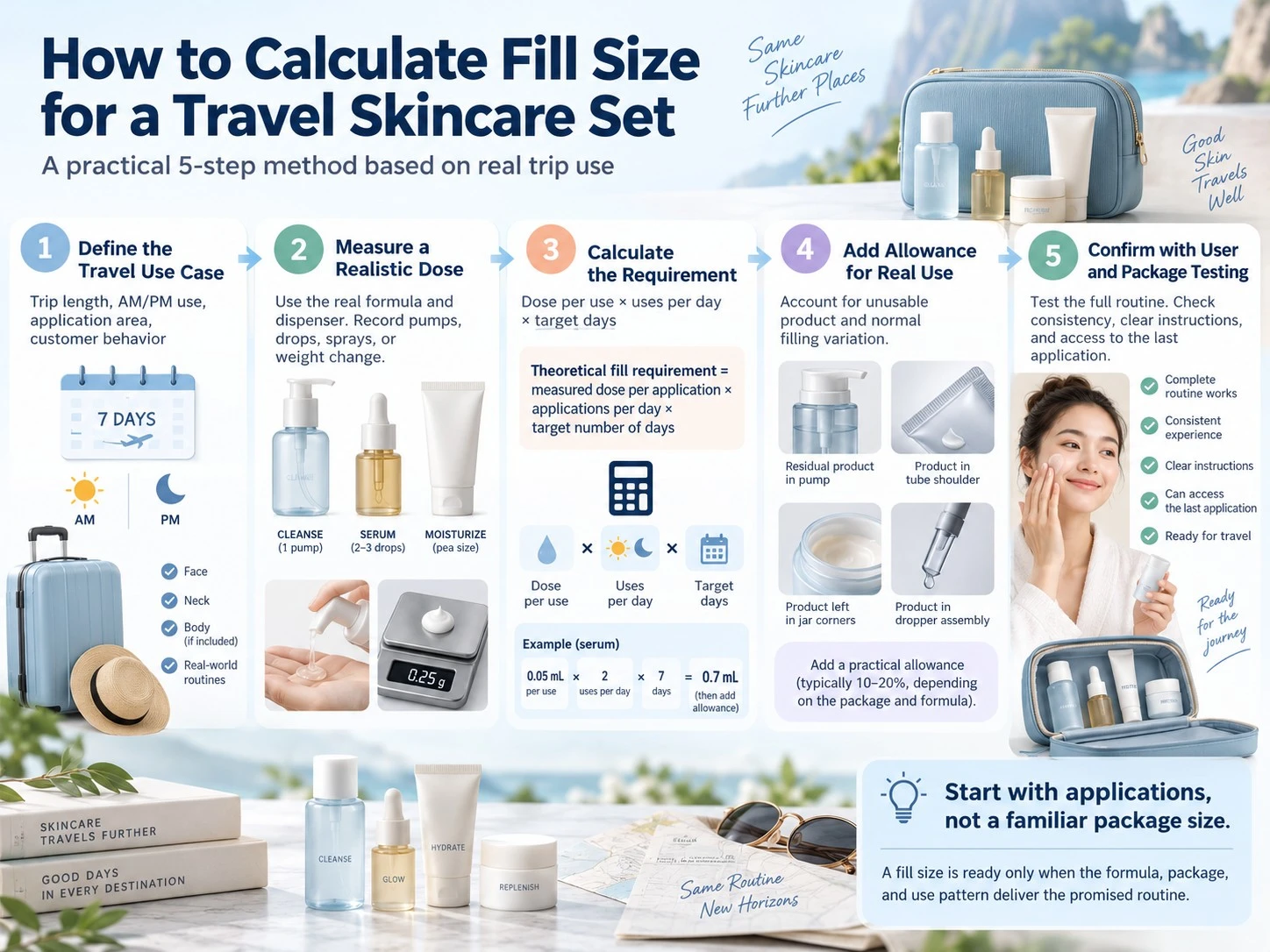
The calculation should start with applications, not a familiar package size. Use one repeatable procedure for every SKU.
1. Define the Travel Use Case
Specify the intended trip length, morning or evening use, application area and customer behavior. “A seven-day facial routine used morning and evening” is actionable. “Perfect for travel” is not. Decide whether the set is designed for a weekend, one week, ten days or a longer trip and whether products may also be sold separately.
2. Measure a Realistic Dose
Use the production-intent formula and dispenser to observe the amount used per application. Record pump actuations, drops, spray duration or the weight change of the package before and after use. Do not rely on a generic pea-size description when viscosity, spread and package output are still changing.
3. Multiply by Use Frequency and Trip Length
Calculate the theoretical requirement for each SKU:
Theoretical fill requirement = measured dose per application × applications per day × target number of days.
A once-daily serum and twice-daily moisturizer should not receive equal fills merely to make the set look symmetrical. If the cleanser is expected to remove makeup or water-resistant sunscreen, test that use case rather than relying on the lowest observed dose.
4. Account for Unusable Product and Production Variation
Add a justified allowance for product that remains in a pump, tube shoulder, jar corner or dropper assembly and for normal filling and use variation. The declared net quantity must still be accurate; extra headspace is not extra usable product. Determine the allowance from package testing rather than applying one arbitrary percentage to every format.
5. Confirm the Result with User and Package Testing
Run the proposed set through the intended number of applications. Check whether users dispense consistently, whether instructions are clear, and whether the final application is still accessible. A capacity is ready only when the formula, package and use pattern deliver the promised routine with an acceptable margin—not when the nominal calculation fits a catalog component.
How Should Sizes Change by Trip Length?
Trip length is a planning variable, not a legal product class. Use the following tiers to brief prototypes, then replace the illustrative ranges with measured results.
| Intended use occasion | Cleanser direction | Serum direction | Moisturizer direction | Development implication |
|---|---|---|---|---|
| Weekend or 2–4 days | About 15–30 mL | About 5–10 mL | About 10–15 mL or g | Compact, but dispensing losses become a larger share of the fill |
| Standard trip of roughly 5–10 days | About 30–50 mL | About 10–15 mL | About 15–30 mL or g | Strong starting tier for a paid three-piece facial set |
| Extended trip beyond about 10 days | About 50–100 mL | About 15–30 mL | About 30–50 mL or g | Luggage space, price and full-size overlap need review |
Do not market a precise number of days until realistic-use checks support it. Customer dose varies with face size, texture preference, climate, makeup removal, frequency and the amount left in the pack. A safer claim may describe the intended routine and product capacities without guaranteeing an exact duration.
Three-Piece vs Five-Piece Travel Set Sizes
A three-piece set can allocate more space and budget to the highest-use products. A five-piece set needs smaller, role-specific fills so the total pack remains portable and commercially workable.
| Set architecture | Practical starting configuration | Best commercial fit | Main risk |
|---|---|---|---|
| Three-piece core | Cleanser 30–50 mL, serum 10–15 mL, moisturizer 15–30 mL or g | Simple paid travel routine, startup line or broad facial-care positioning | May omit a step important to a specific audience |
| Four-piece routine | Add toner or essence at 30–50 mL, or a localized product at 5–10 mL or g | Brand whose identity depends on the added step | Added liquid volume can make the set bulky |
| Five-piece routine | Core three plus two justified additions, usually at the lower end of their category ranges | Established routine-led brand with clear customer demand | Higher component, artwork, assembly and inventory complexity |
Product roles should be chosen before capacities. ZICAIL’s three-step private label skincare line guide explains how cleanser, serum and moisturizer can form a coordinated base. A travel set should not add toner, mist, eye cream or mask simply to reach a higher piece count.
Why Sunscreen Needs Separate Size Planning
Sunscreen should not be sized like a concentrated serum. For broad body coverage, an average-size adult may need at least one ounce per application, and outdoor use generally requires reapplication at least every two hours or as directed after swimming or sweating.[5] A 30 mL mini can therefore be a portable face-focused product, but it should not be presented as enough for repeated face-and-body use throughout a beach holiday without evidence from the intended directions and usage.
In the United States, products marketed with sun-protection claims are OTC drugs, including moisturizers labeled with SPF, and must follow the applicable sunscreen requirements.[6] Adding SPF to an otherwise cosmetic travel set changes more than the fill size: formulation, testing, labeling, facility, listing and manufacturing considerations need a separate regulatory assessment.
If the brand is not prepared for that path, keep the initial travel set cosmetic-only and plan sunscreen as a separate project. If sunscreen is essential to the concept, define whether it is face-only or face-and-body, the expected exposure, reapplication directions and the target market before choosing the pack.
How Packaging Changes the Usable Size
Nominal capacity does not tell the user how much product can be accessed. A 10 mL airless pump that needs repeated priming, a thick cream trapped below a pump dip tube, or a cleanser tube that cannot be squeezed near the shoulder may deliver fewer usable applications than expected.
Match the format to viscosity, dose and use environment. Tubes can suit cleansers and creams; small treatment pumps can control serum dosing; reducers can manage oils and essences; jars can provide direct access to viscous products but need an appropriate hygiene and protection strategy. Review the broader skincare packaging guide before selecting a visual family.
Mini packs also have limited artwork area. U.S. retail cosmetics generally require product identity, an accurate net-quantity statement, business information, ingredient declaration and other applicable information, with placement and presentation requirements.[7] Finalize the primary container, outer package and any permitted labeling solution together rather than shrinking approved full-size artwork until it becomes unreadable.
How Fill Size Affects MOQ and Set Economics
Reducing formula volume does not reduce every cost proportionally. The component, closure, decoration, label, carton, filling setup, inspection, assembly and freight still contribute to the unit cost. A 10 mL serum can therefore cost much more per milliliter than its full-size counterpart.
Each mini is also a separate finished SKU. Confirm the bulk-formula minimum, component MOQ, decoration or label minimum, efficient filling quantity and set-assembly minimum for every product. These quantities may not match, so model leftover components and uneven reorders. The private label skincare MOQ guide provides the broader framework.
Evaluate the set at its intended retail price. Include all formulas, packs, decoration, testing, labels, set packaging, inserts, assembly, freight, duties, storage, fulfillment and expected promotion. An extra miniature may add little perceived value while introducing another MOQ and artwork file; a well-sized three-piece set can be commercially stronger than a crowded five-piece kit.
Travel Set Size Validation Checklist
Before approving bulk production, confirm:
- every capacity is tied to a documented trip length, dose, frequency and application area;
- the formula fits the package with appropriate headspace and declared net quantity;
- priming, dose consistency, evacuation and usable applications meet the brief;
- closures, seals and secondary packaging resist leakage and damage under realistic transport conditions;
- stability, microbiological quality and preservative efficacy are addressed as appropriate for each formula;
- production-intent components complete packaging compatibility testing;
- required label information remains legible and market-appropriate on the complete sales presentation;
- the assembled set fits the intended pouch, carton, shipper and carry-on use case;
- MOQ, unit cost, leftover materials and reorder quantities work across all included SKUs;
- consumer-use checks support any stated number of applications or trip-duration claim.
Develop a Travel Skincare Set With ZICAIL
ZICAIL can discuss private label skincare projects involving coordinated small-format formulas, packaging and set configurations. Prepare the target market, customer, trip length, proposed products, measured or estimated use frequency, preferred capacities, packaging references, required quantity, price position and launch schedule. Then contact ZICAIL to review feasibility, sampling, testing, MOQ and quotation requirements.


