

A cleansing balm is an oil-rich cleanser that softens during application and is removed afterward. It differs from a balm designed to stay on the skin.
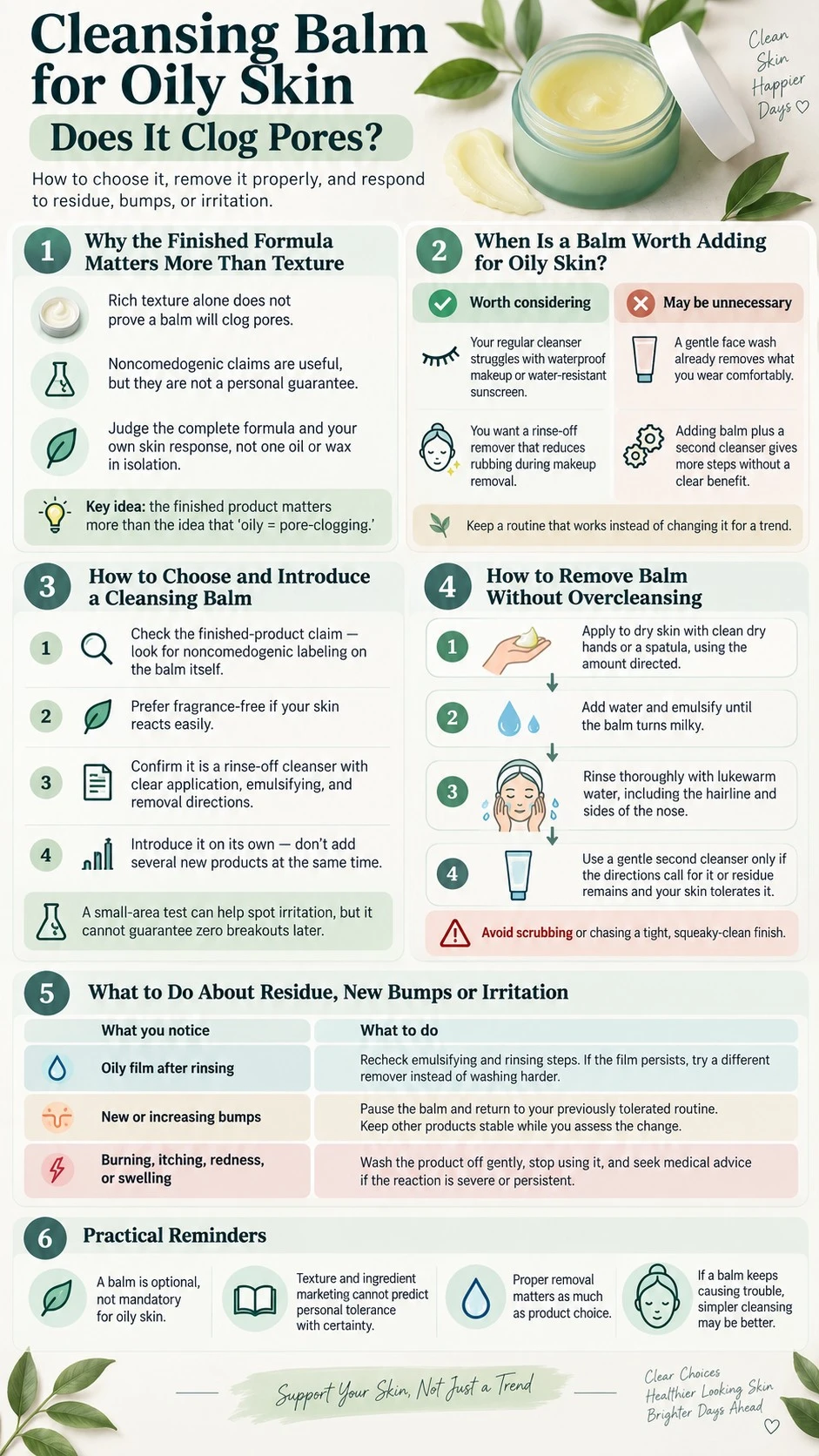
Why the Finished Formula Matters More Than Balm Texture
Comedogenic means having the potential to clog pores. Some skin care products contribute to breakouts. Noncomedogenic products are a useful starting point, but the label is not a personal guarantee.[1] Your own past reactions still matter.
An ingredient list cannot reliably turn that probability into a yes-or-no prediction. A small human study found that finished cosmetics containing ingredients considered comedogenic were not necessarily comedogenic themselves. It tested a limited set of cosmetics under patches on the back, not cleansing-balm use on oily faces. That supports judging the complete formula, not declaring every balm safe.[2]
For example, one US makeup-removing balm containing jojoba oil is labeled noncomedogenic and marketed for oily skin.[3] That product-specific label does not establish that every oil or wax suits acne-prone skin.
When Is a Balm Worth Adding for Oily Skin?
You do not need a balm simply because your skin produces a lot of oil. A mild, oil-free, noncomedogenic face wash is a sensible baseline for oily skin; routine oily-skin guidance also cautions against oil-based cleansers.[4]
A balm has a clearer role when your usual cleanser struggles with waterproof makeup or water-resistant sunscreen. Oil-based removal can help with those products, but it can also cause breakouts in acne-prone skin. Double cleansing is not necessary for most people, and excess washing can cause dryness or irritation.[5]
Consider whether adding a remover would reduce the rubbing needed to remove makeup. If one gentle wash already works, adding balm and another wash gives you more steps to tolerate without an obvious removal benefit. Keep a routine that works rather than changing it to match a cleansing trend.
How to Choose and Introduce a Cleansing Balm
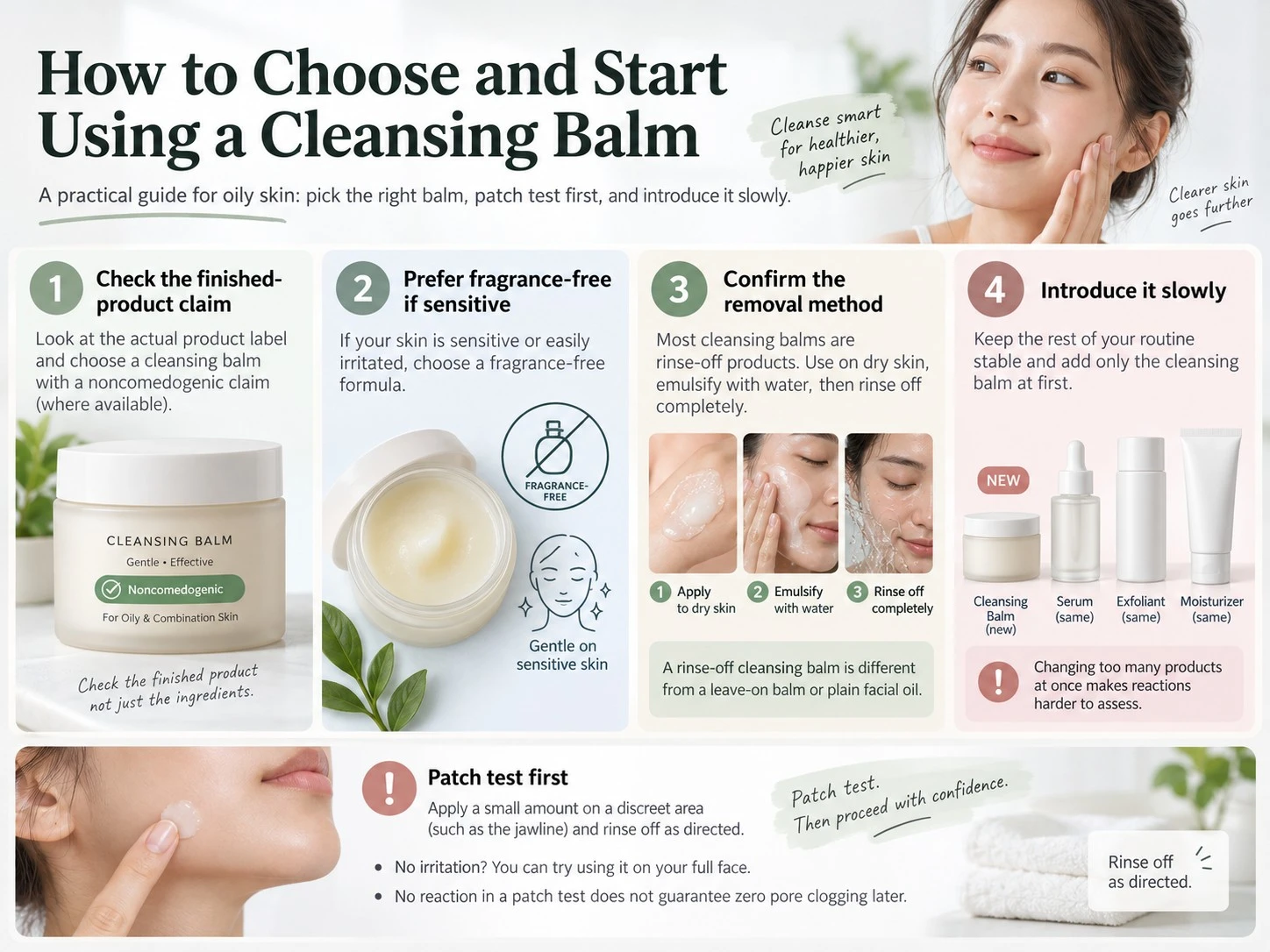
Choose by the actual product’s directions and your skin history:
- Check the finished-product claim: Look for noncomedogenic labeling on the balm itself, rather than assuming that one advertised oil makes the whole formula suitable.
- Prefer a fragrance-free option if you are sensitive: Known reactions matter more than “natural,” “clean” or botanical marketing. Those descriptions do not rule out irritation.
- Confirm the removal method: Choose a rinse-off cleanser with clear directions for application, emulsifying when needed and removal. A plain facial oil or leave-on balm is not an equivalent substitute.
Before full-face use, a small-area product test can help identify a skin reaction. Use a cleanser as directed, including rinsing it off; do not leave it on overnight to make the test stronger.[6] A test without redness or itching does not prove that you will never develop clogged pores on your face.
Introduce the balm without also adding a new serum, exfoliant and moisturizer. Keeping other products stable makes a later change in your skin easier to assess. There is no universal number of uses that proves a balm will never cause breakouts.
How to Remove Balm Without Overcleansing
When using cleansing balm, follow your product’s directions. This sequence applies to rinse-off balms that call for dry application and emulsification.
- Apply as directed: Use clean, dry hands or the supplied spatula and the label’s suggested amount. Gently spread the balm over dry skin; follow any eye-area restrictions.[7]
- Add water: Gently work water into the balm to emulsify it, often creating a milky mixture. Keep water out of the jar.[7]
- Rinse thoroughly: Remove the balm with lukewarm water, paying attention to the hairline and sides of the nose.[7] Use light fingertips rather than scrubbing.
- Finish the wash: Use a gentle second cleanser if the directions require it or residue remains and your skin tolerates the extra wash. Otherwise, finish after removing the balm. Pat dry after the final rinse.[5]
Follow the label’s massage instructions; avoid trying to extract material from pores. Repeated scrubbing or a tight, squeaky finish is a reason to reassess your cleanser or the extra wash.
What to Do About Residue, New Bumps or Irritation
These observations help you choose a next step, but they cannot identify the cause by themselves.
| What you notice | What it tells you | What to do |
|---|---|---|
| Oily film immediately after rinsing | The finish or removal needs reassessing; feel alone does not prove clogged pores | Check the label’s emulsifying and rinsing directions. If the film persists, try a different remover rather than repeatedly washing harder. |
| New or increasing bumps after introducing balm | The product is worth reassessing, but timing alone does not prove it caused the bumps | Pause the balm and return to your previously tolerated routine. Keep other products stable and seek advice if breakouts persist. |
| Burning, itching, redness or swelling | This could be a skin reaction rather than ordinary pore congestion | Gently wash the product off and stop using it. Seek medical advice for a severe or persistent reaction.[6] |
You do not need to keep using a suspect balm just because the package says noncomedogenic. If breakouts continue, a dermatologist can help assess possible triggers and treatment; harsher cleansing is not the solution.[1]
FAQs About Cleansing Balm for Oily Skin
Can you use cleansing balm every day on oily skin?
Daily use is reasonable only if the product allows it, you need that removal step and your skin tolerates it. Oily skin alone does not make a daily balm necessary.
Can a cleansing balm cause purging?
Do not assume new breakouts are purging. An ordinary makeup-removing balm does not need to make your skin worse before it works; pause a suspect product and reassess.
Is cleansing oil less likely to clog pores than balm?
Liquid texture does not guarantee a lower risk. Compare the finished formulas, removal directions and your own tolerance rather than assuming an oil is safer because it contains less wax.
Will cleansing balm remove blackheads?
An ordinary cleansing balm is not a blackhead treatment. Persistent blackheads may need acne care; trying to scrub them away can irritate skin.[1]
Sources
[1] American Academy of Dermatology. 10 skin care habits that can worsen acne
[2] Zoe Diana Draelos and Joseph C. DiNardo. A re-evaluation of the comedogenicity concept
[3] CeraVe. Makeup Removing Cleanser Balm
[4] American Academy of Dermatology. How to control oily skin
[5] Cleveland Clinic. Double Cleansing Method Explained: Should You Try It?
[6] American Academy of Dermatology. How to test skin care products
[7] Farmacy Beauty. Green Clean Makeup Removing Cleansing Balm


