

Toner pads can look like cleansing wipes, exfoliating treatments, and tiny sheet masks all at once. That creates a practical problem: a method that suits one jar may be wrong for another.
The useful question is not simply whether toner pads are good. It is what the liquid does, how the pad should touch your skin, and whether that adds something your current routine needs.
Toner Pads vs Liquid Toner: What Changes?
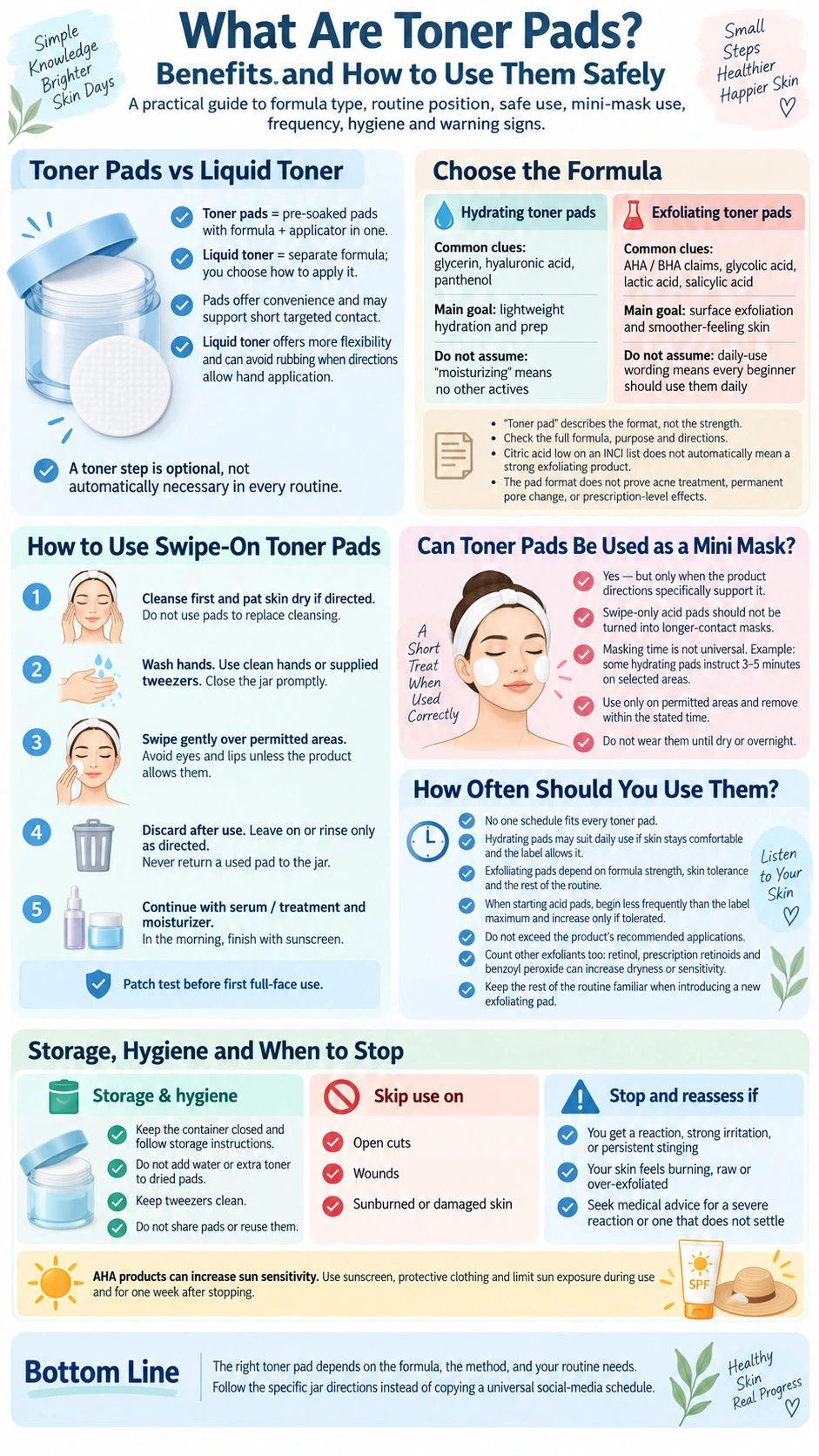
A toner pad packages the liquid and its applicator together. You lift out a ready-soaked pad instead of pouring toner into your hands or onto a separate cotton round. Some are intended for short, targeted contact rather than an all-over wipe; one hydrating product, for example, directs users to place pads on selected areas before gently wiping.[1]
Other pads combine an exfoliating formula with textured and smooth sides for different stages of application.[2] The pad itself does not tell you whether the formula mainly hydrates or exfoliates. Nor does being pre-soaked prove better results than an appropriately chosen bottled toner.
The practical trade-off is convenience versus flexibility. Pads include a disposable applicator and may require a timed session. Liquid toner lets you choose your application method, including clean hands when the directions permit. For skin that dislikes rubbing, a suitable liquid toner applied without a pad avoids that friction.
Toner is an optional addition, not a missing step that every routine must fill. If your current products already address your needs, consider whether you need toner before buying another format.
Choose the Formula: Hydrating or Exfoliating?
Read the product’s purpose and directions alongside its ingredient list. “Toner pad” describes the delivery format, not a standard strength or benefit.
| Formula group | Clues to look for | Main reader goal | What not to assume |
|---|---|---|---|
| Hydrating toner pads | Glycerin, hyaluronic acid, panthenol; directions focused on moisture or makeup preparation | Add lightweight hydration | A moisturizing label means the formula contains no acids or other active ingredients |
| Exfoliating toner pads | AHA or BHA claims; acids such as glycolic, lactic, or salicylic acid; directions focused on exfoliation | Address surface buildup and rough-feeling texture | A daily-use label means every beginner should use them daily |
These groups overlap. A moisture-focused pad can contain several kinds of ingredients, including acids, while an exfoliating pad can also include hydrators. Check the full formula rather than one headline ingredient.[1]
For AHA products, exfoliating action depends on the acid type, concentration, pH, and other ingredients. Some acids are also used to adjust pH, so seeing citric acid near the end of a list does not, by itself, identify a strong exfoliating treatment.[3]
Claims such as brightening, soothing, and pore care need the same scrutiny: which ingredients and directions support the claim, and is the product suitable for your routine? A pad’s shape is not evidence that it treats acne, permanently changes pores, or replaces a treatment prescribed for you.
If you are deciding between the two main jobs, compare hydrating and exfoliating toners before choosing the pad format.
How to Use Swipe-On Toner Pads Step by Step
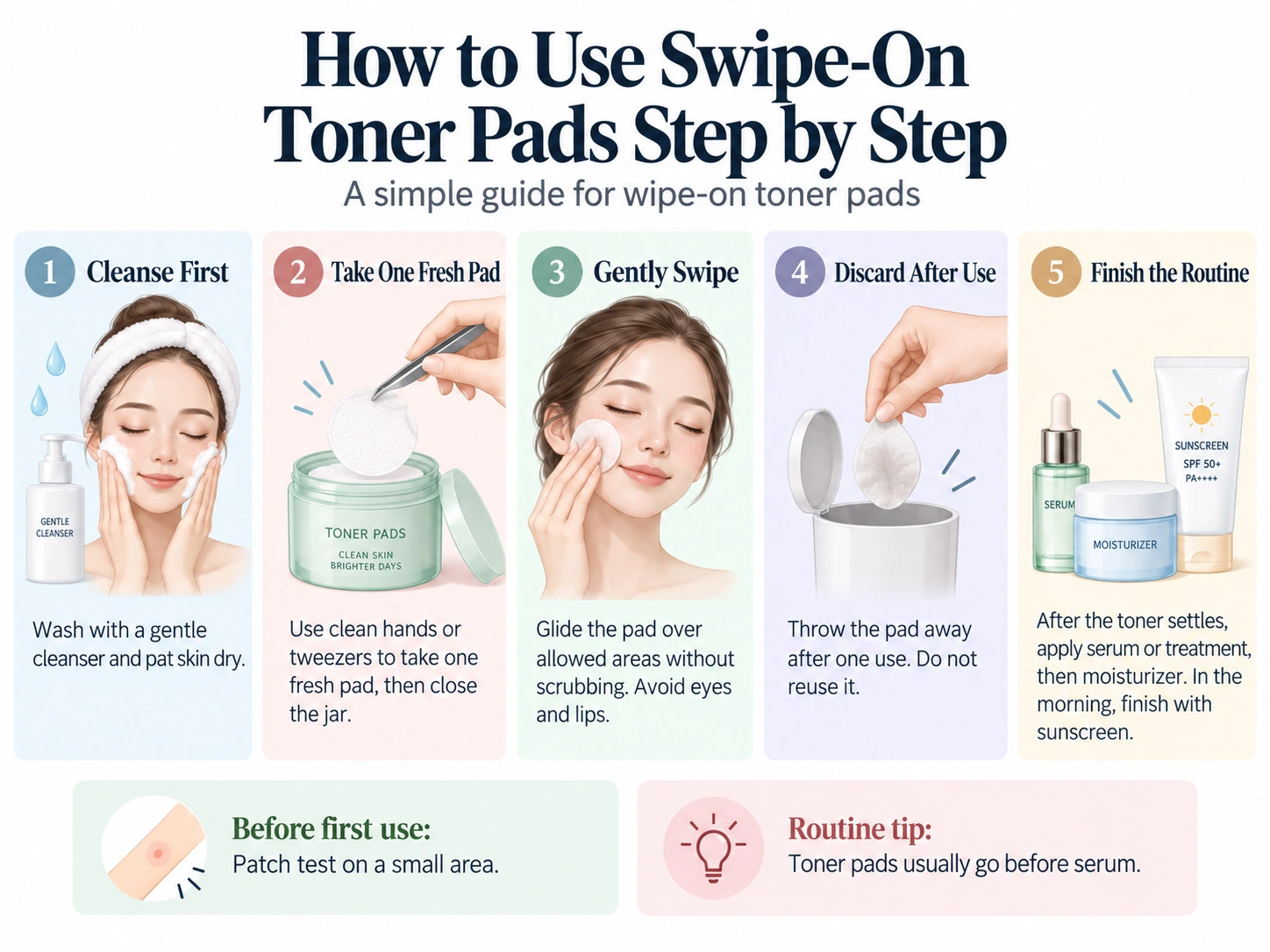
This sequence is for a pad whose directions specify wiping. It is not a replacement for the instructions on a peel, a two-step treatment, or a pad intended only for masking.
Before the first full-face use, test the skincare product on a small area, respecting its application limits and contact time. A home test can help identify a reaction, but it cannot guarantee that your face will tolerate every later use.[4]
- Cleanse and prepare the skin: wash your face with a gentle cleanser and pat dry.[5] Follow any specific instruction about dry or damp skin. Do not use the pad to skip removing makeup or washing your face.
- Retrieve a fresh pad: wash your hands before handling the product.[6] Use the supplied clean tweezers if provided, or clean hands, and close the container. Keep the unused pads separate from anything that has touched your face.
- Swipe as directed: gently glide the pad over the permitted areas without scrubbing. Avoid your eyes and lips unless the product specifically allows those areas. If the directions specify textured and smooth sides, follow that sequence; not every pad needs two passes.[2]
- Discard the pad and follow the finish instructions: throw away the disposable pad after use. For a leave-on toner formula, leave the liquid on; rinse only if the product tells you to. Do not return a used pad to the jar.
- Complete the routine: once the formula has settled, apply compatible serum or treatment as directed, then moisturizer. Finish the morning routine with sunscreen.[5] Follow any prescribed medication instructions rather than rearranging them to fit a cosmetic pad.
For ordinary leave-on toner pads, the routine position is generally before serum. You do not need to add a fixed waiting period between products unless their directions require one.
Can You Use Toner Pads as a Mini Mask?
Yes, but only when the product directions support leaving the pad in place. A swipe-only acid pad should not become a longer-contact mask simply because it sticks to your cheek.
There is no universal toner-pad masking time. For example, the DIVE IN Multi Pad directions specify 3–5 minutes on selected areas, followed by gentle wiping away from the eye area and light patting.[1] That is an instruction for that product, not permission to leave every toner pad on for five minutes.
Use the number of pads needed for the permitted areas, remove them within the stated time, and follow the finishing directions. Do not extend the session until the pads dry out or wear them overnight. More contact time is not a dependable shortcut to better results.
How Often Should You Use Toner Pads?
There is no schedule that fits every toner pad. A moisturizing product labeled for daily use may fit a daily routine if your skin stays comfortable. An exfoliating pad needs a schedule based on its formula, your skin, and the other products you use; more aggressive exfoliation generally calls for less frequent use.[7]
When introducing an acid pad, avoid making daily use the automatic starting point. Begin less frequently than the label maximum, keep the rest of your routine familiar, and increase only if there is a useful reason and no irritation. Do not exceed the product’s recommended applications.[8] This is a cautious introduction strategy, not a rule that every formula needs the same number of weekly uses.
Count other exfoliants too. Retinol, prescription retinoids, and benzoyl peroxide can make skin more sensitive or prone to peeling, and adding exfoliation can worsen dryness.[7] A practical beginner approach is to keep exfoliating pads out of those treatment sessions while checking the product or prescriber’s instructions. This is about tolerance, not a claim that all such ingredients are chemically incompatible.
If you need help setting an exfoliation schedule, use the factors in how often to exfoliate your face rather than counting pads as a separate, harmless category.
Storage, Hygiene and Signs to Stop
Keep the container clean, close it after use, and follow the storage instructions. Do not add water or another toner to revive dried-out pads: adding liquid can introduce microorganisms and dilute the product’s preservatives.[6] Keep any supplied retrieval tool clean, and never share used pads or save them for another session.
- Skip damaged skin: do not exfoliate open cuts, wounds, or sunburned areas. Aggressive exfoliation can also worsen dark spots, particularly in people prone to pigmentation after irritation.[7]
- Stop for a reaction: remove the pad and gently wash off the product if you develop a skin reaction. Seek medical advice for a severe reaction or symptoms that are not settling.[4] Persistent stinging from a BHA product is also a reason to stop and consult a clinician.[8]
- Protect against sun exposure: AHA products can increase sun sensitivity. Use sunscreen, protective clothing, and limit sun exposure during use and for a week after stopping.[3]
If you develop an over-exfoliation reaction, pause exfoliating pads rather than trying a rougher side or longer session. A burning or raw feeling is not a result you need to push through.
FAQs About Toner Pads
Can you use toner pads every day?
Some hydrating toner pads allow daily use, but follow the label and your skin’s tolerance. Exfoliating pads are not automatically a daily step. Consider other exfoliants and treatments in your routine, and reduce use or stop if irritation develops.
Do you wash off toner pads?
Usually, you remove and discard the pad but leave the toner liquid on your skin. Rinse if the product instructions require it. A peel or multi-step treatment may have different directions, so do not apply a leave-on rule to every pre-soaked pad.
Do you need a separate toner with toner pads?
No. Toner pads can fill the toner step on their own. Add a separate toner only if it serves a distinct purpose and your skin tolerates the combination; layering a second exfoliating toner is not automatically helpful.
Can toner pads replace face cleanser?
No. Toner pads intended for post-cleansing skincare are not a substitute for washing your face or removing makeup. Use them after cleansing, even if the used pad appears to pick up residue.
Sources
[1] Torriden. DIVE IN Multi Pad
[2] Medicube. Zero Pore Pads
[3] U.S. Food and Drug Administration. Alpha Hydroxy Acids
[4] American Academy of Dermatology. How to test skin care products
[5] American Academy of Dermatology. Should I apply my skin care products in a certain order?
[6] U.S. Food and Drug Administration. Microbiological Safety and Cosmetics
[7] American Academy of Dermatology. How to safely exfoliate at home
[8] U.S. Food and Drug Administration. Beta Hydroxy Acids


