

Lip serum and lip balm can both leave lips softer and more comfortable. The useful question is whether the particular serum offers something your balm does not—or whether a different balm would meet the same need with one product.
Lip Serum vs Lip Balm: Side-by-Side Comparison
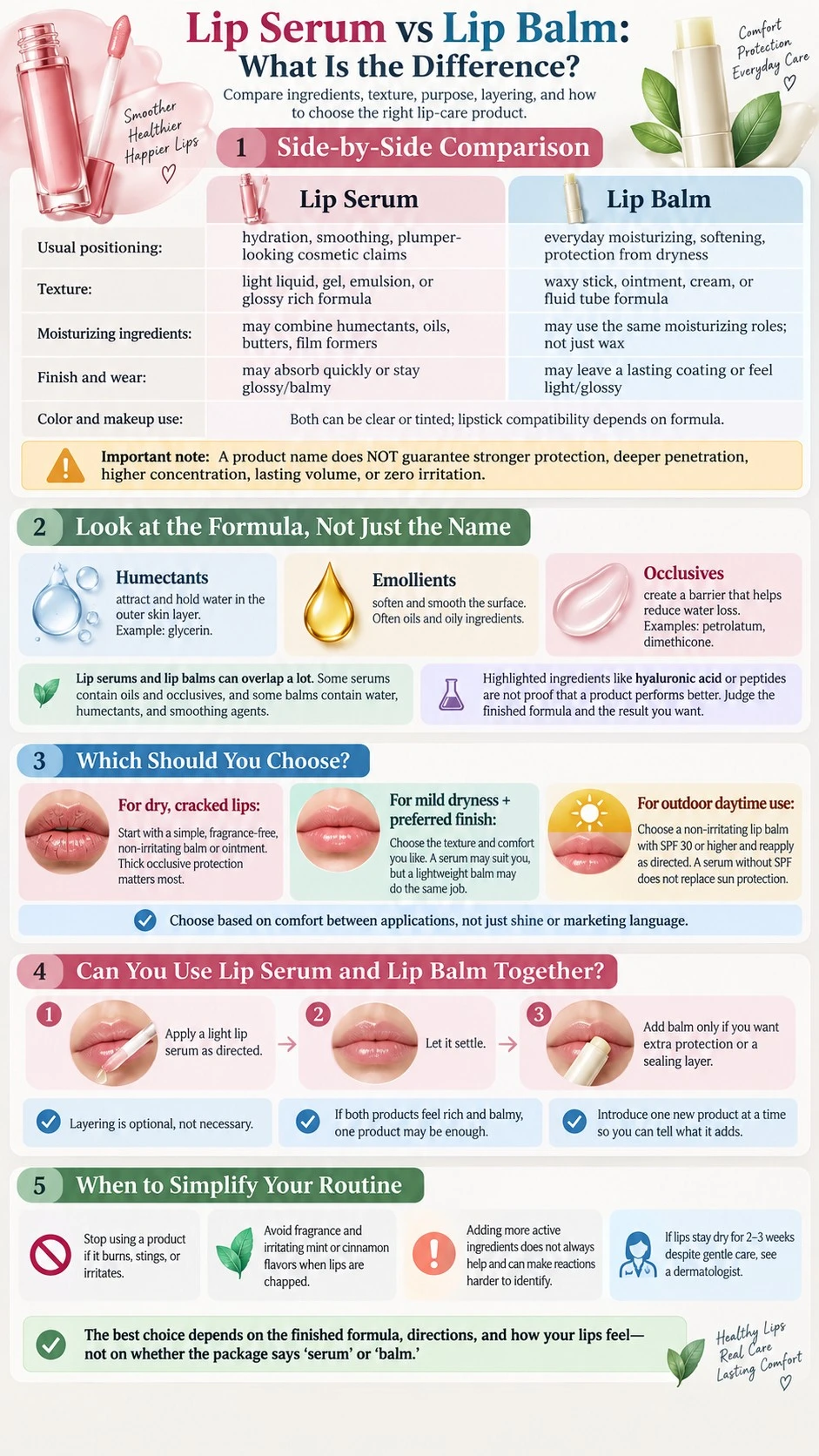
A lip serum is a lip-care product positioned around targeted cosmetic benefits, often hydration or smoother-looking lips. A lip balm is a moisturizing lip product, commonly sold as a stick, tube or pot. These are useful shopping descriptions, but they do not create a strict divide between water-based treatment and oil-based protection.
| Comparison point | Lip serum | Lip balm |
|---|---|---|
| Usual positioning | Hydration, smoothing, lip-line or plumper-looking cosmetic claims | Everyday moisturizing, softening and protection from dryness |
| Texture | Can be a light liquid, gel, emulsion or rich glossy formula | Can be a waxy stick, soft ointment, cream or fluid tube formula |
| Moisturizing ingredients | May combine humectants, oils, butters and film-forming ingredients | May combine the same moisturizing roles; not necessarily just wax |
| Finish and wear | Some absorb quickly; others remain glossy or balmy | Some leave a lasting coating; others feel light or glossy |
| Color and makeup use | Clear or tinted; lipstick compatibility is formula-specific | Clear or tinted; heaviness and slip vary by formula |
| What the name cannot guarantee | Deeper penetration, higher ingredient concentrations or lasting volume | Stronger protection, freedom from irritation or sun protection |
Treat the table as a map of common positioning, not a test result. A thin serum is not automatically weak at retaining moisture, and a thick balm is not automatically the best match for every lip. Packaging also gives few answers: a tube can hold either a watery serum or a rich balm.
Look at the Moisturizing Formula, Not Just the Name
Three ingredient roles help explain what you are buying. A formula can combine all three, and some ingredients serve more than one role.[2]
- Humectants: attract and hold water in the outer skin layer. Glycerin is one example.
- Emollients: soften and smooth the surface. Oils and other oily ingredients often contribute this feel.
- Occlusives: form a surface barrier that reduces water loss. Petrolatum and dimethicone are examples.
Real ingredient lists show the overlap. One marketed lip serum combines water and glycerin with shea butter, squalane and oils.[3] Another lists petrolatum and beeswax.[4] A product sold as a lip balm includes water, betaine and sodium PCA alongside squalane and waxes.[5] You therefore cannot assume that every serum is a water-based hydrator or every balm is a water-free seal.
Hyaluronic acid, peptides or other highlighted ingredients can be reasons to examine a formula, but they are not proof that it beats your current balm. An ingredient list does not tell you the finished product’s measured performance. Look for evidence about the result you want, the product actually tested and the conditions of use.
For a lip-line claim, ask whether the change concerns the appearance of dryness-related lines or a lasting change to lip structure. For a long-wear claim, ask whether it describes hydration, visible shine or color wear. Those are different outcomes, even when the same front label mentions them together.
Which Should You Choose for Your Lips?
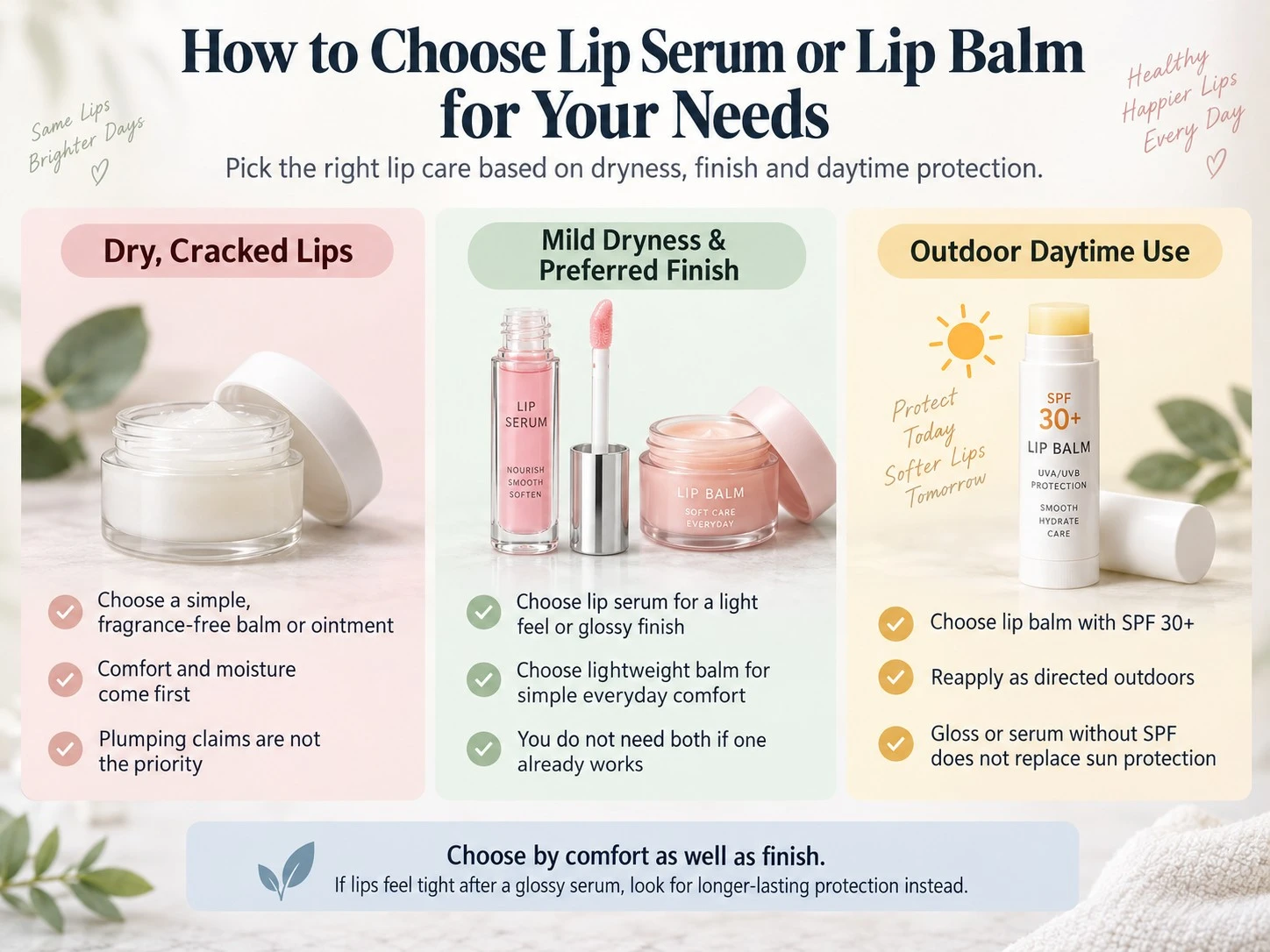
Choose around your current need rather than buying the most elaborate category.
- For dry, cracked lips: start with a simple, fragrance-free, non-irritating product. A thick ointment such as white petroleum jelly can help retain moisture when lips are very dry.[1] A cosmetic plumping or smoothing claim is not the priority while your lips are uncomfortable.
- For mild dryness and a preferred finish: a lip serum is reasonable if you like its feel and it keeps your lips comfortable. A lightweight balm can serve the same purpose. If your existing product already gives you the softness and finish you want, you do not need to add a serum just to make the routine more complete.
- For outdoor daytime use: choose a non-irritating lip balm with SPF 30 or higher and reapply while outdoors as directed.[1] A serum, balm, tint or gloss without a labeled SPF does not replace a sun-protective lip product.
Judge the formula by comfort between applications as well as its finish. If a glossy serum looks appealing but leaves your lips feeling tight, look for more lasting protection instead of choosing by shine alone.
Can You Use Lip Serum and Lip Balm Together?
Yes, but layering is optional. It makes the most sense when the serum is a light hydrating formula and the balm adds a protective coating. Some lip-serum directions specifically place the serum before richer lip care.[3]
If you choose that combination, apply the lip serum as directed and allow it to settle before adding the balm. There is no universal waiting time: use the formula’s instructions and avoid piling on more while the first layer is still sliding around. If both products are oily or balmy, using one alone may give you the finish you want.
Introduce one new product at a time so you can tell what it adds. If you want to layer at bedtime, use a serum whose directions allow that combination. Keep a serum that stings out of the routine rather than trying to cover it with balm.
When to Simplify Your Lip-Care Routine
If a product burns, stings or irritates your lips, stop using it. While lips are chapped, avoid fragrance and irritating mint or cinnamon flavors rather than treating tingling as a sign of better results.[1] This applies to both serums and balms.
Switching from balm to serum will not automatically solve lips that stay dry after lip balm. Recheck the products you are applying and whether the optional layers are helping. Repeatedly adding more active ingredients can make it harder to identify what your lips tolerate.
If chapping does not improve after two to three weeks of gentle care, see a dermatologist. Persistent dryness can have causes beyond ordinary weather-related chapping.[1] Buying a stronger-sounding cosmetic is not a substitute for finding the cause.
FAQs About Lip Serum and Lip Balm
Can lip serum replace lip balm?
Yes, if the serum alone provides the moisture, comfort and finish you need, and its directions allow standalone use. A rich serum may already perform much like a balm. If a light serum leaves your lips feeling dry again, choose a more protective formula or consider a compatible balm layer. You do not have to use both.
Can you use a face serum on your lips?
Do not assume that a face serum is suitable for the lips. Follow its intended-use directions; a formula intended for facial skin is not automatically tested or directed for lip use. A product specifically labeled for lip use is the simpler choice when the face-serum instructions do not address lip application.
Does lip serum make your lips permanently bigger?
Do not expect permanent enlargement from the word “serum.” Moisturizing can improve the appearance of dryness-related lines, but smoother-looking lips are not proof of a lasting increase in volume.[2] Any specific plumping claim needs evidence for that finished formula and the effect it promises.
Can you wear lip serum under lipstick?
Yes, if the formula is designed for that use. Some lip-serum directions advise letting it absorb before lipstick.[3] Apply a thin layer as instructed; a very oily or glossy product may change the lipstick’s finish or grip. Check the combination rather than assuming every serum works as a primer.
Sources
[1] American Academy of Dermatology Association. 7 dermatologists’ tips for healing dry, chapped lips
[2] DermNet. Emollients and moisturisers
[3] CHANEL. HYDRA BEAUTY MICRO SÉRUM LÈVRES Intense Replenishing Hydration
[4] SKINTIFIC. Peptide Brightening Lip Serum
[5] The Ordinary. Squalane + Amino Acids Lip Balm


