

A sleeping mask is usually a spreadable gel, cream or balm made for overnight facial use. This guide covers that type of product. The word “mask” alone does not mean a sheet mask, peel or rinse-off treatment can safely stay on while you sleep.
Where Does a Sleeping Mask Go in Your Nighttime Routine?
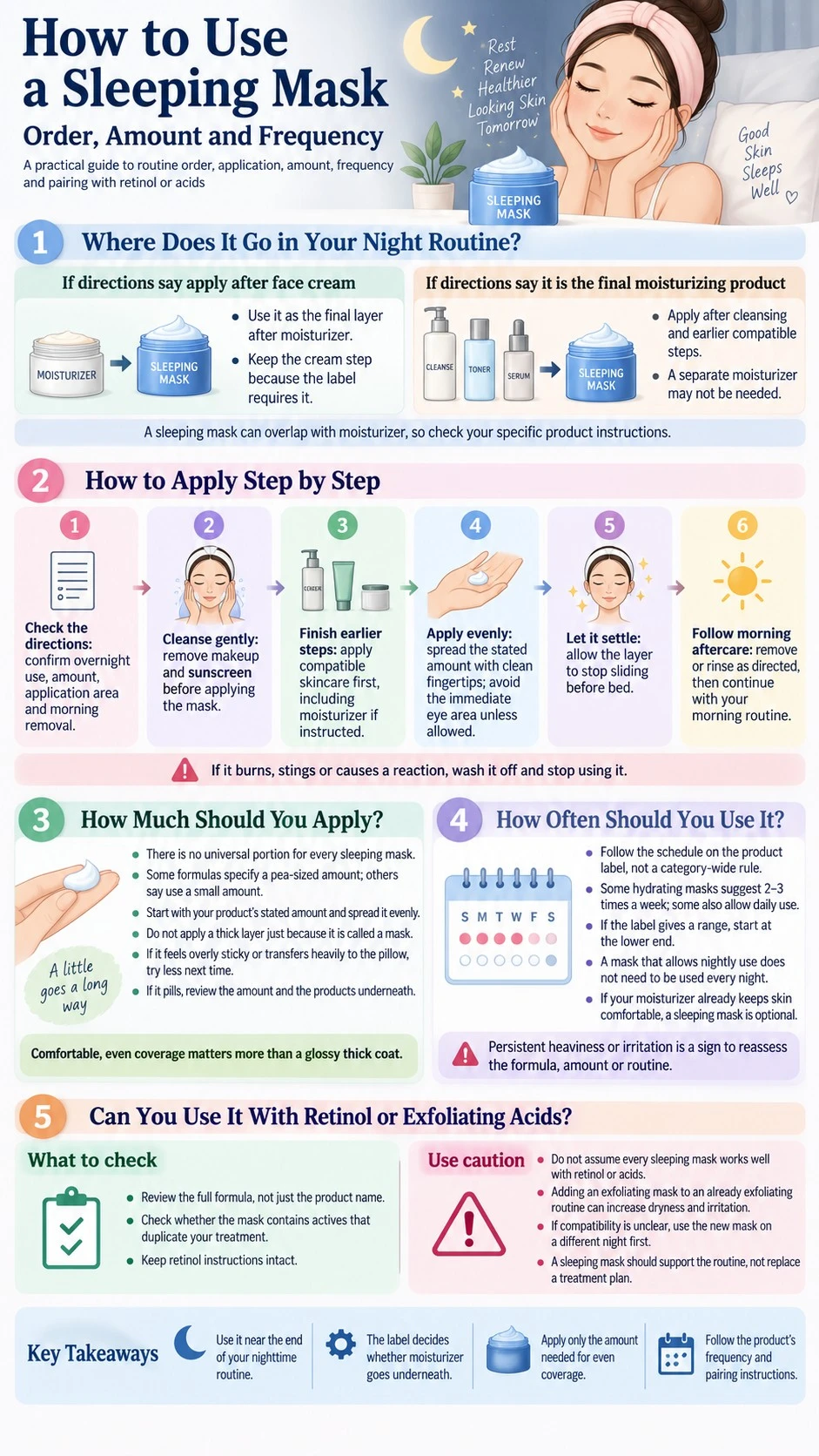
A hydrating sleeping mask commonly goes last, after earlier skincare steps. A sleeping mask can overlap with moisturizer, so check whether your formula is an extra layer over cream or the product that takes its place.
| What the directions say | Where the mask goes | What that means for moisturizer |
|---|---|---|
| Apply after face cream or moisturizer | After your moisturizer, as the final layer | Keep the cream step specified by the directions |
| Use as the final moisturizing product, with no cream required | After cleansing and any suitable earlier products | A separate cream is not automatically needed |
For example, one overnight hydrating mask explicitly goes after face cream.[1] Another overnight mask’s directions say that a moisturizer underneath is not required.[2] “Last step” therefore does not always mean using two moisturizing products.
Your earlier nighttime skincare steps do not have to include toner, essence and several serums. Use the products your skin needs and follow any treatment instructions.
How to Apply a Sleeping Mask Step by Step
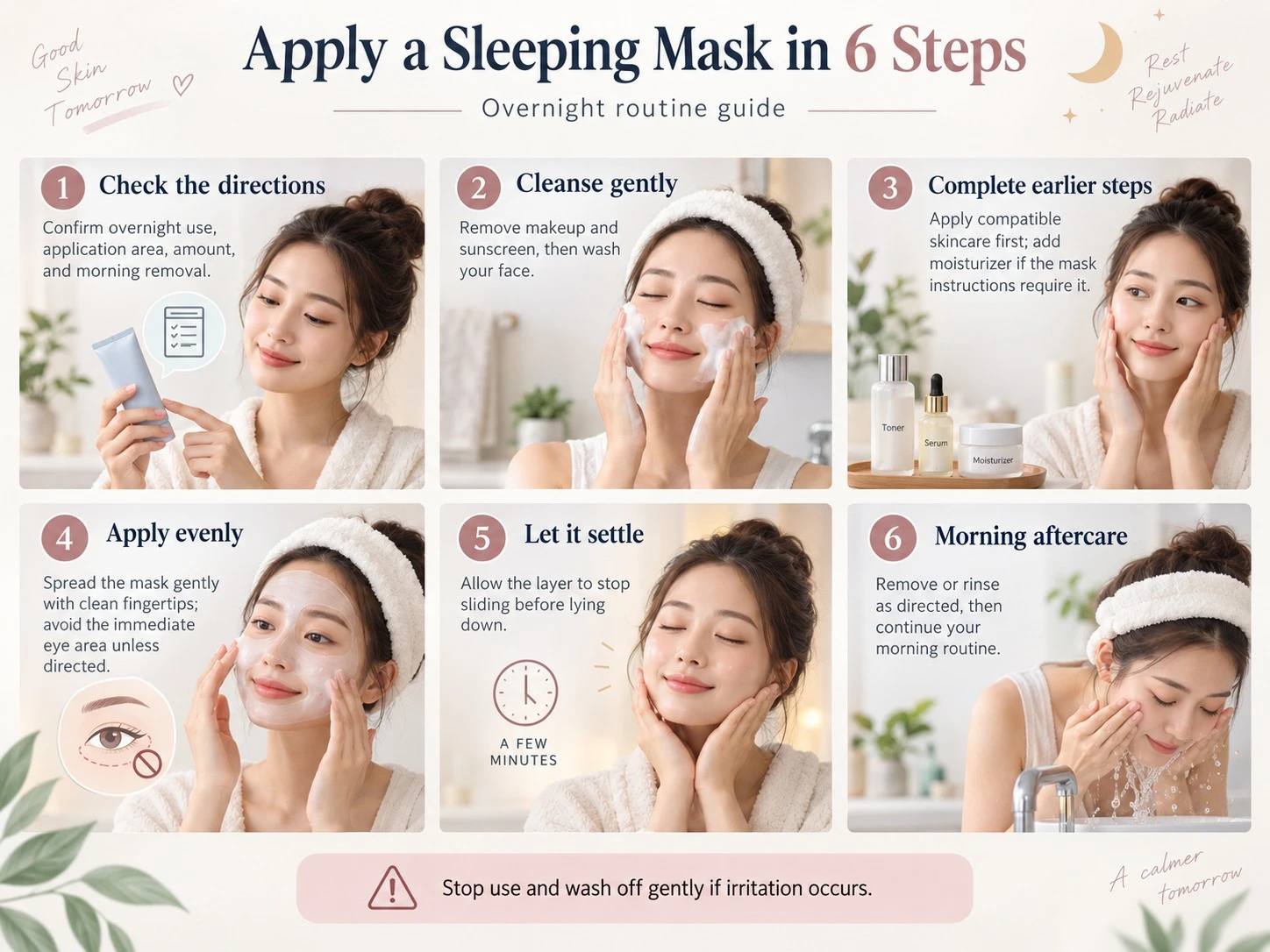
Use this sequence for a spreadable mask whose instructions permit overnight wear. Test a new product on a small area before applying it across your face.[3]
- Check the directions: confirm overnight use, application area, portion and morning removal. If the same product has a short rinse-off option, choose its overnight instructions rather than mixing the two methods.[4]
- Cleanse gently: remove the day’s makeup and sunscreen, wash your face and finish cleansing before applying the mask. Do not use the mask to cover an uncleansed face.[4]
- Complete the earlier steps: apply compatible products in their directed order. Include moisturizer underneath according to the mask’s instructions.[2]
- Apply evenly: spread the stated amount gently with clean fingertips or the recommended tool. Avoid the immediate eye area unless specified, and follow any lip-area restrictions.[1]
- Let it settle: give the layer a chance to stop sliding before lying down. You do not need a fixed waiting period or a completely dry film unless the label specifies one.
- Follow morning aftercare: remove the mask as directed, then continue your morning routine. Rinse gently if the label calls for it.[1]
An overnight label permits overnight wear; it does not mean you should ignore discomfort. If the product causes a skin reaction, wash it off gently and stop using it. Seek professional advice for a severe or persistent reaction.[3]
How Much Sleeping Mask Should You Apply?
There is no single portion for every sleeping mask. One cream-type mask’s instructions specify a pea-sized amount for the face.[5] Another manufacturer’s guide describes a small amount.[4] Those are directions for particular formulas, not proof that every jar should be used the same way.
Start with your own product’s stated amount. Spread it over the intended areas before deciding you need more. If the label gives no measurement, aim for even coverage in the layer it describes, rather than building a thick visible coating simply because it is a mask. Do not extend facial directions to the neck or eye area without checking intended use.
If the layer stays excessively sticky or transfers heavily to your pillow, try less at the next use while still following the label. If it rolls into bits, review the amount and products underneath. Skincare pilling can involve the amount, application or formulas you combine; rubbing harder or adding more mask is unlikely to solve it.
A thicker application is not automatically a more effective one. Judge the amount by the product’s instructions and comfortable coverage, not by whether your face looks glossy at bedtime.
How Often Should You Use a Sleeping Mask?
Follow the formula’s schedule rather than a category-wide rule. Some hydrating-mask instructions recommend two to three uses weekly while also allowing daily use.[1] Other products specify a few uses a week.[4] Neither instruction should be applied to every sleeping mask.
If your label gives a range, start at its lower end and assess your skin before increasing use. If it permits nightly use, you can still use it only on nights when the additional step helps. If your normal moisturizer already leaves your skin comfortable, a sleeping mask is optional.
Notice how your skin feels the next morning and between applications. Persistent heaviness, new irritation or an unwanted reaction is a reason to reassess the formula, amount and routine—not to add more nights. Masks used too often, especially those with exfoliating ingredients, can irritate the skin.[6]
Increasing both the portion and frequency at once makes it harder to tell what changed. Keep one steady while adjusting the other within the directions, and do not use “sleeping mask” as permission to use an active treatment more often than its label allows.
Can You Use a Sleeping Mask With Retinol or Exfoliating Acids?
Sometimes, but the complete formulas and treatment directions matter more than the mask’s name. A moisturizing overnight product and a mask containing exfoliating acids are not interchangeable routine choices.
Check the sleeping mask for actives that duplicate your existing treatment. Adding an exfoliating mask to a routine that already exfoliates can increase dryness and irritation.[6] A hydrating description on the front of the package does not rule out exfoliating ingredients elsewhere in the formula.
For retinol, do not assume that adding more layers prevents irritation or that every sleeping mask is compatible. Keep the retinol’s application instructions intact, and check the mask’s combination guidance. If compatibility is unclear, use the new mask on a different night while you assess it rather than experimenting with both together. For prescription treatment, ask your prescriber how the mask fits.
A sleeping mask should support the routine, not replace an acne or eczema treatment plan.[6] If your skin is already irritated by the products underneath, adding a mask is not a reason to continue through burning or stinging.
FAQs About Using a Sleeping Mask
Do you need to wash a sleeping mask off in the morning?
Follow its aftercare instructions. Some sleeping-mask instructions specifically call for a water rinse in the morning.[1] You do not need harsh cleansing to remove the overnight layer. Do not assume that “leave on overnight” means “leave on indefinitely.”
Can you use a sleeping mask during the day?
Only if the product gives a suitable daytime or short-wear option. One dual-use formula specifies a 10–15-minute rinse-off option as well as overnight wear.[4] Follow the directions for the mode you choose; do not transfer that timing to a different mask. It also does not replace daytime sunscreen.
Can oily or acne-prone skin use a sleeping mask?
Yes, if the formula suits your skin and routine. A lightweight moisturizing texture may be preferable to a heavy layer, but “gel” does not guarantee that a product will suit you. Test it first and reassess if it repeatedly causes unwanted breakouts. A sleeping mask does not replace acne treatment.
Can you sleep in a sheet mask or hydrogel mask instead?
Only if that specific product explicitly permits overnight wear. Otherwise, remove it within its labeled wear time. A leave-on gel or cream sleeping mask and a removable sheet or hydrogel mask have different use instructions; the word “mask” does not make their wear times interchangeable.
Sources
[1] LANEIGE. Water Sleeping Mask
[2] Kiehl’s. Ultra Facial Overnight Rehydrating Mask with 10.5% Squalane
[3] American Academy of Dermatology Association. How to test skin care products
[4] e.l.f. Cosmetics. Sleeping Masks: Benefits & How to Use
[5] COSRX. Ultimate Nourishing Rice Overnight Spa Mask
[6] American Academy of Dermatology Association. Do facial masks work, and should I add one to my skin care routine?


