


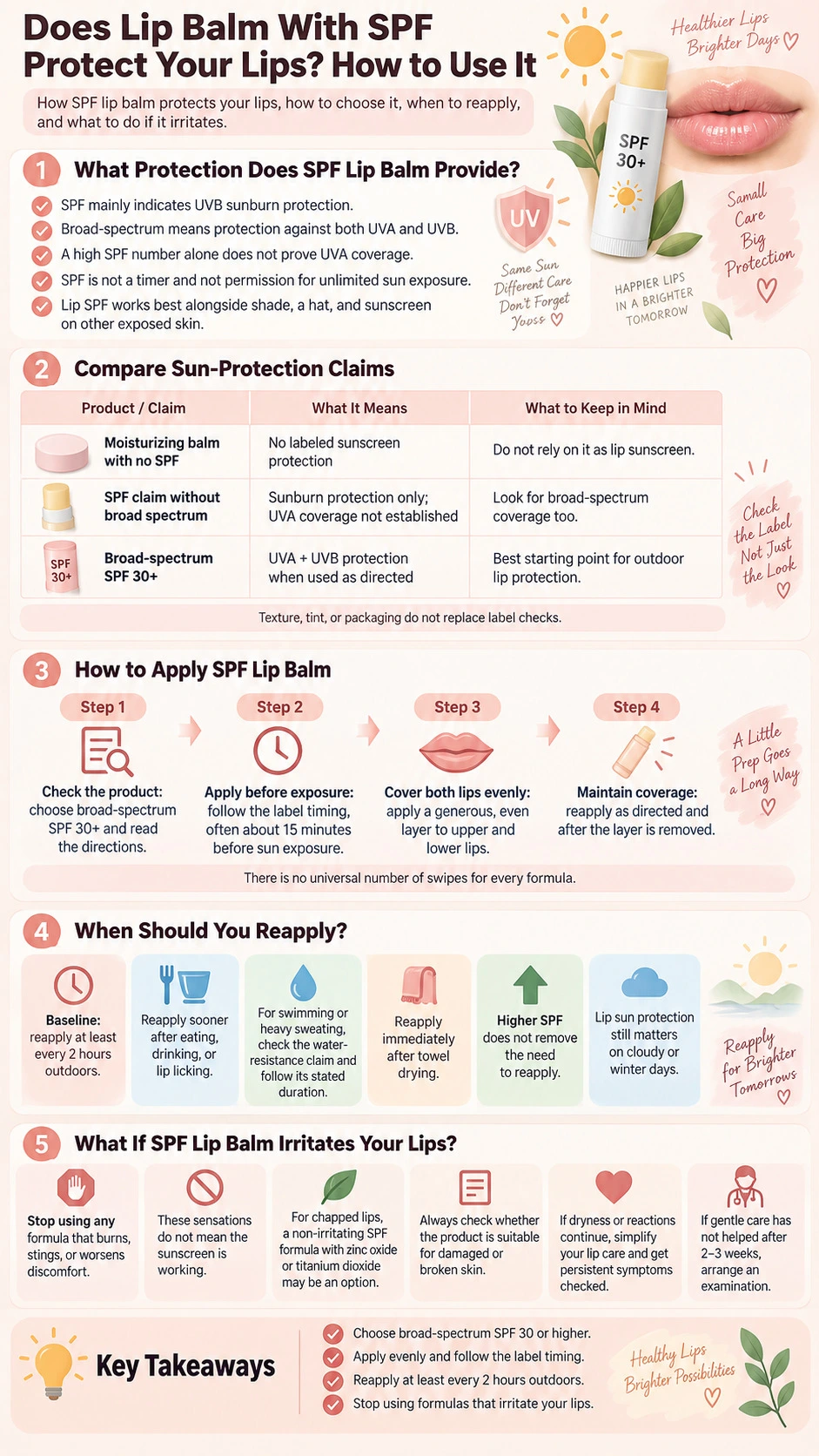
A lip balm can feel moisturizing without providing labeled sunscreen protection. Equally, a product carrying SPF can be useful only when it remains on your lips in an adequate layer.
The key questions are what protection the label claims, whether you cover your lips properly and what happens to that coverage during the day.
What Protection Does SPF Lip Balm Provide?
SPF describes sunburn protection: The number primarily reflects protection against UVB radiation. “Broad spectrum” adds the important distinction that the product protects against both UVA and UVB rays.[2] Check for both claims rather than treating a high SPF number as proof of UVA coverage.
SPF is not a timer: SPF 30 does not mean 30 hours of protection or permission to spend 30 times longer in the sun. The rating relates to tested UV exposure, while actual exposure varies with conditions.[2]
No sunscreen filters out every UVB ray.[3] Lip protection should sit alongside shade, a suitable hat and sunscreen on other exposed skin, rather than being your only sun-protection measure.
How to Compare Lip Balm Sun-Protection Claims
Read the actual sunscreen claims, not just words such as “protective,” “nourishing” or “repairing.” These categories have different implications:
| Lip product label | What the claim tells you | Practical choice |
|---|---|---|
| Moisturizing balm with no SPF | No labeled sunscreen protection | Do not rely on it as your lip sunscreen. |
| SPF claim without broad spectrum | Sunburn protection; the SPF number alone does not establish UVA coverage.[3] | Look for broad-spectrum coverage as well. |
| Broad-spectrum SPF 30 or higher | UVA and UVB protection when used as directed.[1] | A suitable starting point for outdoor lip protection. |
Texture, tint and packaging do not replace those label checks. A balm that feels rich is not automatically a stronger sunscreen, and a clear formula is not automatically less protective.
Our explanation of broad-spectrum sunscreen covers the UVA and UVB distinction in more detail.
How to Apply SPF Lip Balm
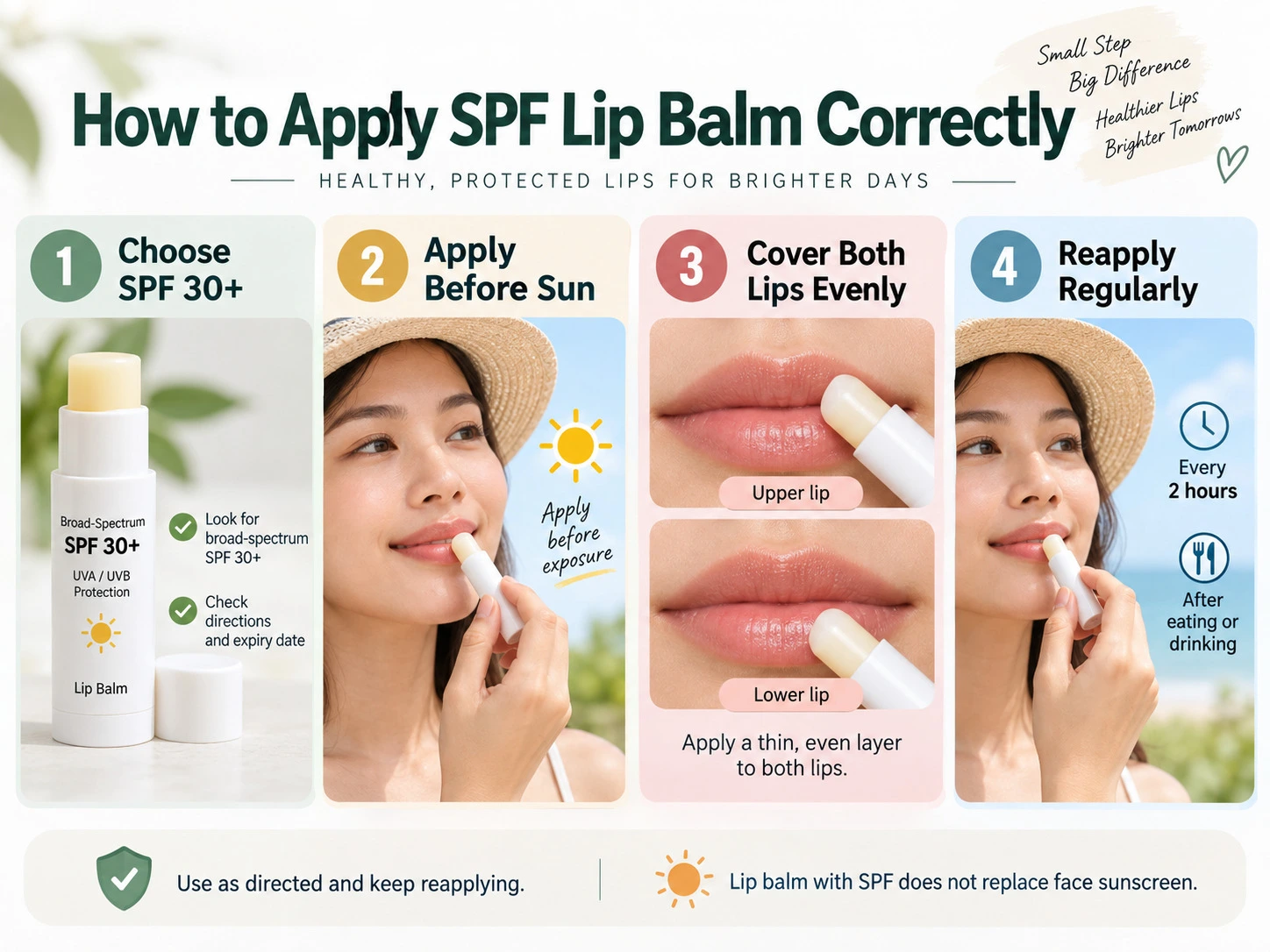
Use this sequence before an outdoor session, then maintain the coverage:
- Check the product: Choose a lip product with broad-spectrum SPF 30 or higher.[1] Read its directions and application restrictions. Check the expiry date and follow its storage instructions.[4]
- Apply before exposure: Follow the label’s timing. For example, one SPF lip-balm label directs generous application 15 minutes before sun exposure.[5]
- Cover both lips: Cover exposed upper and lower lip surfaces generously and evenly, following the label’s amount instructions.[5]
- Maintain the coverage: Reapply at least every two hours outdoors and after eating or drinking removes the layer.[6] Follow additional swimming, sweating and towel-drying directions.
There is no single number of swipes that guarantees the labeled SPF for every stick, tube or formula. The important instruction is to use the product as directed with even coverage, then keep renewing it.
Do not replace sunscreen for your face and other exposed areas with a small lip product. They need their own adequate coverage.
When Should You Reapply SPF Lip Balm?
Two hours is the outdoor baseline: Eating, drinking and lip licking can make more frequent reapplication necessary.[6] If you wipe the layer away, renew it rather than waiting for the clock.
For swimming or heavy sweating, check for a water-resistance claim and follow its stated duration. A 40- or 80-minute water-resistance label describes tested protection during swimming or sweating; it does not mean waterproof protection or resistance to every meal.[3]
Towel drying is a separate reapplication trigger. One SPF lip-balm label specifies immediate reapplication after towel drying, alongside its 80-minute swimming or sweating instruction and two-hour baseline.[5] Your current product’s instructions determine its schedule.
Higher SPF does not remove the need to reapply. Outdoor protection also matters in winter and on cloudy days.[4] Do not judge whether your lips need protection only by how hot or bright the weather feels.
What If SPF Lip Balm Irritates Your Lips?
Stop using a formula that burns, stings or worsens discomfort. Those sensations are not evidence that the sunscreen is working. For chapped lips, a non-irritating SPF formula containing zinc oxide or titanium dioxide may be an option.[7] The complete formula still needs to suit your lips.
Read skin-condition warnings too. Some SPF lip products instruct users not to apply them to damaged or broken skin.[5] Do not assume every sunscreen balm is intended for open cracks.
Persistent dryness or repeated reactions need a different check from ordinary reapplication. See our guide to lips that stay dry after lip balm. If gentle care has not helped after two to three weeks, arrange an examination.[7]
FAQs About Lip Balm With SPF
Is SPF 15 lip balm useless?
No. SPF 15 provides some sunburn protection.[3] Choose broad-spectrum SPF 30 or higher for outdoor lip care.[1] Both require proper application and reapplication.
Can SPF lipstick or gloss replace SPF lip balm?
A lip color with the required sunscreen claims can provide protection; a lipstick with SPF 30 or higher is an option. Check broad-spectrum coverage and apply it as directed. Cosmetic wear does not remove the need to reapply outdoors.[4]
Can you use regular face sunscreen on your lips?
A lip-specific SPF product is the practical choice. General sunscreen directions may tell you to avoid the mouth, while recommending SPF lip balm for lips. Do not assume every face sunscreen is intended for lip application; check its label.[2]
Do you need SPF lip balm before bed?
For ordinary sleep without sunlight exposure, SPF is not needed for sun protection. A plain, non-irritating balm or ointment can provide nighttime moisturizing care. Use your SPF lip product as directed when outdoor exposure begins again.[7]
Sources
[1] American Academy of Dermatology. How do I know if I’m using the right sunscreen?
[2] U.S. Food and Drug Administration. Sunscreen: How to Help Protect Your Skin from the Sun
[3] American Academy of Dermatology. How to decode a sunscreen label
[4] American Academy of Dermatology. Sunscreen FAQs
[5] DailyMed. COTZ LIP BALM—titanium dioxide, zinc oxide stick
[6] Cleveland Clinic. 5 Spots You’re Probably Forgetting To Put Sunscreen
[7] American Academy of Dermatology. 7 dermatologists’ tips for healing dry, chapped lips


