

Lip balm sounds simple, yet the label can hide very different products: a light wax stick, a glossy oil blend, a thick petrolatum ointment, or an over-the-counter sunscreen. Knowing what each formula can and cannot do makes it easier to choose a balm that feels comfortable without falling into a cycle of irritation and constant reapplication.
Why Do Lips Get Dry So Easily?
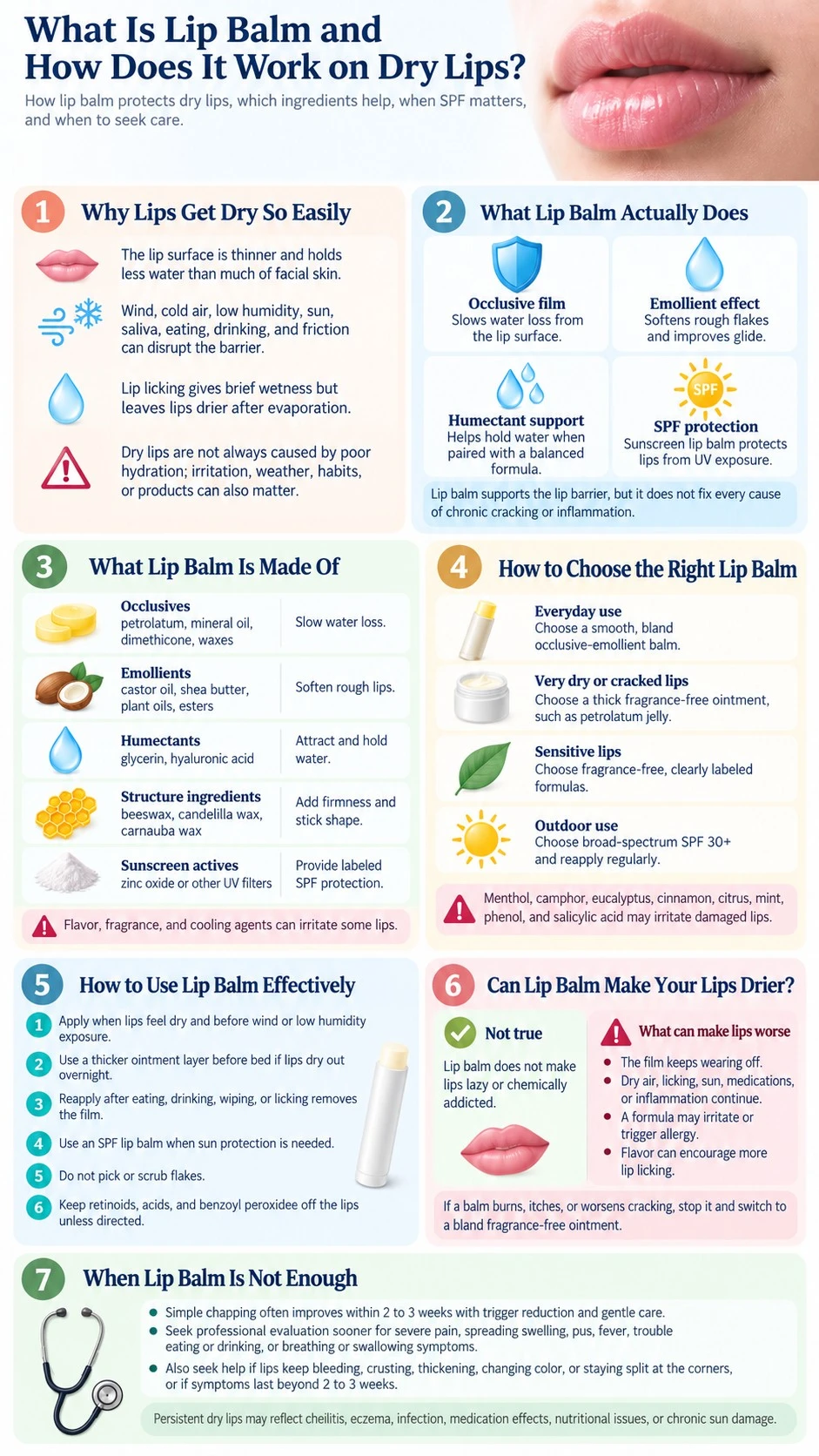
The visible red or brown part of the lips, called the vermilion, is a transition between facial skin and the moist tissue inside the mouth. Its outer barrier is thinner and holds less water than skin on many other parts of the face. Lip condition is also linked to the organization of barrier lipids such as ceramides.[1]
That vulnerable surface faces constant movement and exposure. Talking, eating, drinking, wiping, wind, low humidity, cold weather, sun, and saliva can all remove or disrupt its protective film. Lip licking gives brief wetness, but evaporation leaves the surface drier; repeated licking also exposes the lips and surrounding skin to saliva and friction.[2]
Ordinary chapping is therefore not always a sign that the whole body is dehydrated. Drinking enough fluid matters for health, but a person can have dry lips because of local weather, habits, irritating products, medications, allergies, or inflammation even when fluid intake is adequate.
What Does Lip Balm Actually Do?
Lip balm mainly changes the conditions at the lip surface. Many sticks and ointments contain little or no water, so they do not “pour hydration” into the lips. Instead, they help the outer lip layer retain water and stay flexible. Lip balm does not permanently retrain the lips or correct every cause of dryness.
First, an occlusive film slows evaporation. This keeps more of the water already present in the outer lip layer from escaping. In a controlled study, a highly occlusive lip formula improved lip roughness and maintained the effect after the treatment period, supporting water-loss control as a meaningful mechanism for dry lips.[3]
Second, emollient oils, butters, silicones, and waxes spread between rough surface cells. They reduce friction and make flakes feel smoother and more flexible. This comfort is real, but it should not be confused with curing an underlying dermatitis or infection.
Third, some formulas contain humectants, which attract and hold water within the product and outer surface. Glycerin and hyaluronic acid are examples. A humectant is most useful when the formula also contains emollient or occlusive ingredients that help keep that water from evaporating. The broader guide to humectants, emollients, and occlusives explains how these roles overlap in moisturizers.
Finally, a lip balm sold and labeled as sunscreen can reduce ultraviolet exposure when used as directed. This is a separate function that comes from tested sunscreen active ingredients, not from ordinary wax or shine. The FDA specifically identifies lips as a frequently missed area and advises using an SPF lip balm.[4]
What Is Lip Balm Made Of?
A finished balm usually combines several ingredient roles. One ingredient may perform more than one role, and the full formula determines spread, wear, taste, stability, and irritation risk.
| Ingredient role | Common examples | Main job in lip balm | Important limit |
|---|---|---|---|
| Occlusive | Petrolatum, mineral oil, dimethicone, waxes | Forms a film that slows water loss | Does not add much water by itself |
| Emollient | Castor oil, shea butter, plant oils, esters | Softens rough cells and improves glide | Natural origin does not guarantee tolerance |
| Humectant | Glycerin, hyaluronic acid | Helps attract and hold water near the surface | Works best inside a balanced formula that limits evaporation |
| Structure and feel | Beeswax, candelilla wax, carnauba wax | Gives a stick shape, firmness, and staying power | A very waxy stick may drag on severely cracked lips |
| Sunscreen active | Zinc oxide or other permitted UV filters | Provides labeled UV protection after required testing | SPF requires correct amount and reapplication |
| Sensory additive | Flavor, fragrance, cooling agents, color | Changes taste, scent, sensation, or appearance | Can irritate or trigger allergy in some users |
“Moisturizing” on the front label is an umbrella claim. To understand how a balm is likely to work, look at the whole ingredient list and whether the product is a wax stick, fluid balm, ointment, or regulated sunscreen. This is the same basic barrier principle covered in the guide to the skin barrier, although lip tissue has its own structure and exposures.
How to Choose the Right Lip Balm
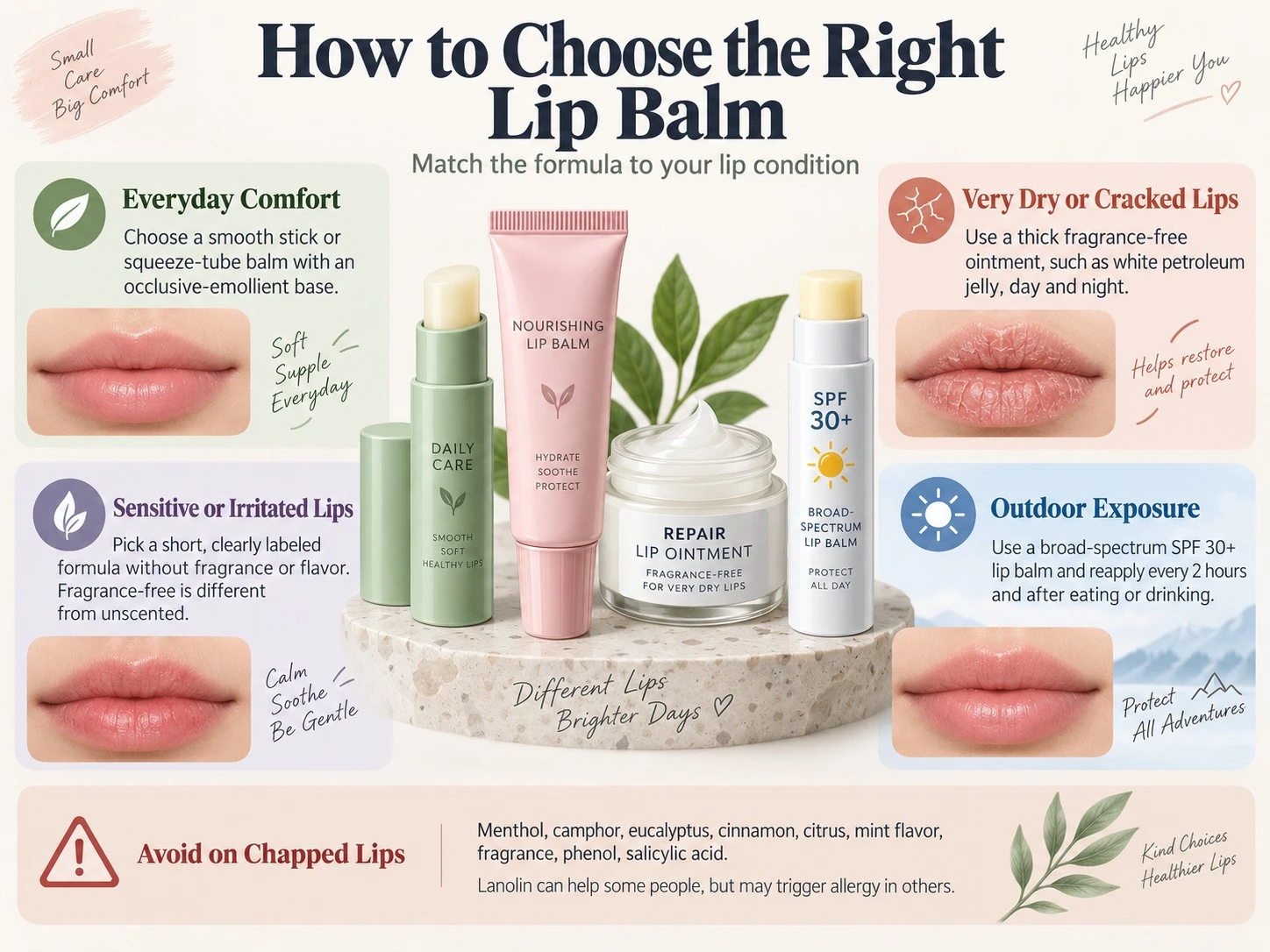
Match the formula to the current condition of your lips rather than choosing by flavor or the strongest sensation.
- For everyday comfort: A smooth, bland stick or squeeze-tube balm with an occlusive-emollient base is easy to reapply. The best texture is one that does not tug and that you will use consistently.
- For very dry or cracked lips: A thick fragrance-free ointment, such as white petroleum jelly, usually seals water longer than a light wax or oil. Apply it before bed as well as during the day.[5]
- For sensitive or already irritated lips: Choose a short, clearly labeled formula without fragrance or flavor. “Unscented” can still contain fragrance ingredients used to mask odor, so it is not the same claim as fragrance-free. See fragrance-free vs unscented for the label distinction.
- For outdoor exposure: Choose a broad-spectrum SPF 30 or higher lip balm and reapply at least every two hours, as well as after eating, drinking, swimming, or wiping the lips.[5] The complete sunscreen guide explains broad spectrum, SPF, amount, and reapplication.
When lips are actively chapped, cooling or tingling is a warning rather than proof that a product is working. Menthol, camphor, eucalyptus, cinnamon, citrus, mint flavor, fragrance, phenol, and salicylic acid can be irritating on damaged lips. Lanolin helps some people but is a contact allergen for others, so a prior reaction matters more than whether an ingredient is marketed as natural.[5]
How to Use Lip Balm Effectively
Lip balm does not require a complicated routine. Use enough to leave an even film without rubbing hard, and reapply when that film has worn away.
- Apply a non-irritating balm when the lips feel dry and before exposure to wind or low humidity.
- Use a thicker layer of ointment before bed if overnight dryness or mouth breathing is a problem.
- Reapply after eating, drinking, wiping, or licking removes the product.
- Use only a product labeled for sun protection when you need SPF, and follow its Drug Facts directions.
- Stop picking or scrubbing flakes. Pulling off attached skin can deepen cracks and delay recovery.
- Keep facial retinoids, exfoliating acids, benzoyl peroxide, and other potentially irritating products off the lips unless their directions specifically allow lip use.
Applying a plain occlusive after washing, while the lip surface is comfortable rather than dripping wet, can help trap existing water. More product is not always better: a thin intact film reapplied when needed is usually more comfortable than repeated heavy rubbing.
Can Lip Balm Make Your Lips Drier?
Lip balm does not make healthy lips “lazy,” and it does not create a chemical addiction. Frequent use usually means the protective film keeps wearing off or the original trigger—dry air, licking, sun, a medication, or inflammation—has not changed.
A particular formula can still make chapping worse. Burning or stinging may be direct irritation. Itching, persistent redness, scaling, or cracking can point to allergic contact cheilitis. Lip cosmetics, toothpaste, flavorings, fragrances, preservatives, and metals are recognized allergen sources, and diagnosis may require testing a person’s own products.[6]
Flavor can also encourage licking. Each lick removes balm, wets the surface with saliva, and restarts the wet-dry cycle. The result can feel like “dependence” even though the behavior and irritation—not the balm category itself—are driving the reapplication.
If a balm seems to make your lips worse, stop it and simplify to a bland fragrance-free ointment. Also review toothpaste, mouthwash, lipstick, dental products, and facial skincare that may touch the area. Do not keep testing a product that causes swelling, hives, or breathing difficulty.
When Lip Balm Is Not Enough
Simple chapping should improve when triggers are reduced and a non-irritating balm is used consistently. Noticeable improvement often occurs within two to three weeks.[5] Seek medical or dental evaluation sooner if you have severe pain, spreading swelling, pus, fever, trouble eating or drinking, or breathing or swallowing symptoms.
An appointment is also appropriate when:
- cracking or scaling persists beyond two to three weeks despite simple care;
- one area repeatedly bleeds, crusts, thickens, changes color, or does not heal;
- the corners of the mouth stay split or soggy;
- there are blisters, recurrent sores, or changes inside the mouth;
- symptoms began after a medication or include an itchy rash around the lips.
Persistent “dry lips” can reflect allergic or irritant cheilitis, eczema, infection, angular cheilitis, medication effects, nutritional problems, or chronic sun damage. Lip balm can protect the surface while those causes remain untreated, so continued reapplication should not replace a diagnosis.
FAQs About Lip Balm
Is petroleum jelly the same as lip balm?
Petroleum jelly is not the entire lip-balm category, but it works as a simple lip ointment. It forms a strong occlusive film that reduces water loss and is often useful for very dry or cracked lips. It does not provide sun protection unless the product is specifically labeled with SPF.
Can you become addicted to lip balm?
Lip balm does not cause chemical addiction. A person may become used to the smooth feeling or reapply often because wind, dry air, licking, medication, or an irritating formula keeps the lips uncomfortable. If use keeps increasing, look for the continuing trigger rather than forcing yourself to tolerate dryness.
How often should you apply lip balm?
Apply a plain balm as needed, including before bed and after eating or drinking removes it. For an SPF lip balm, follow the label and reapply at least every two hours outdoors and more often after swimming, sweating, wiping, eating, or drinking.
Why are my lips still peeling when I use lip balm?
The balm may be too light, may wear off quickly, or may contain an irritant or allergen. Lip licking, picking, dry air, facial skincare, toothpaste, and an underlying form of cheilitis can also continue the problem. Switch to a bland fragrance-free ointment and seek evaluation if peeling persists, worsens, or affects one nonhealing area.
Sources
[2] Fonseca et al. Art of Prevention: Practical Interventions in Lip-Licking Dermatitis
[3] Tamura et al. The Efficacy of a Highly Occlusive Formulation for Dry Lips
[4] U.S. Food and Drug Administration. Sunscreen: How to Help Protect Your Skin from the Sun
[5] American Academy of Dermatology. 7 Dermatologists’ Tips for Healing Dry, Chapped Lips
[6] DermNet. Allergic Contact Cheilitis


