

The practical comparison is about the job a product performs. A light lotion, a rich moisturizing cream and a protective balm can all support moisture retention, while differing in comfort, application and intended use.
Barrier Cream and Moisturizer Are Overlapping Terms
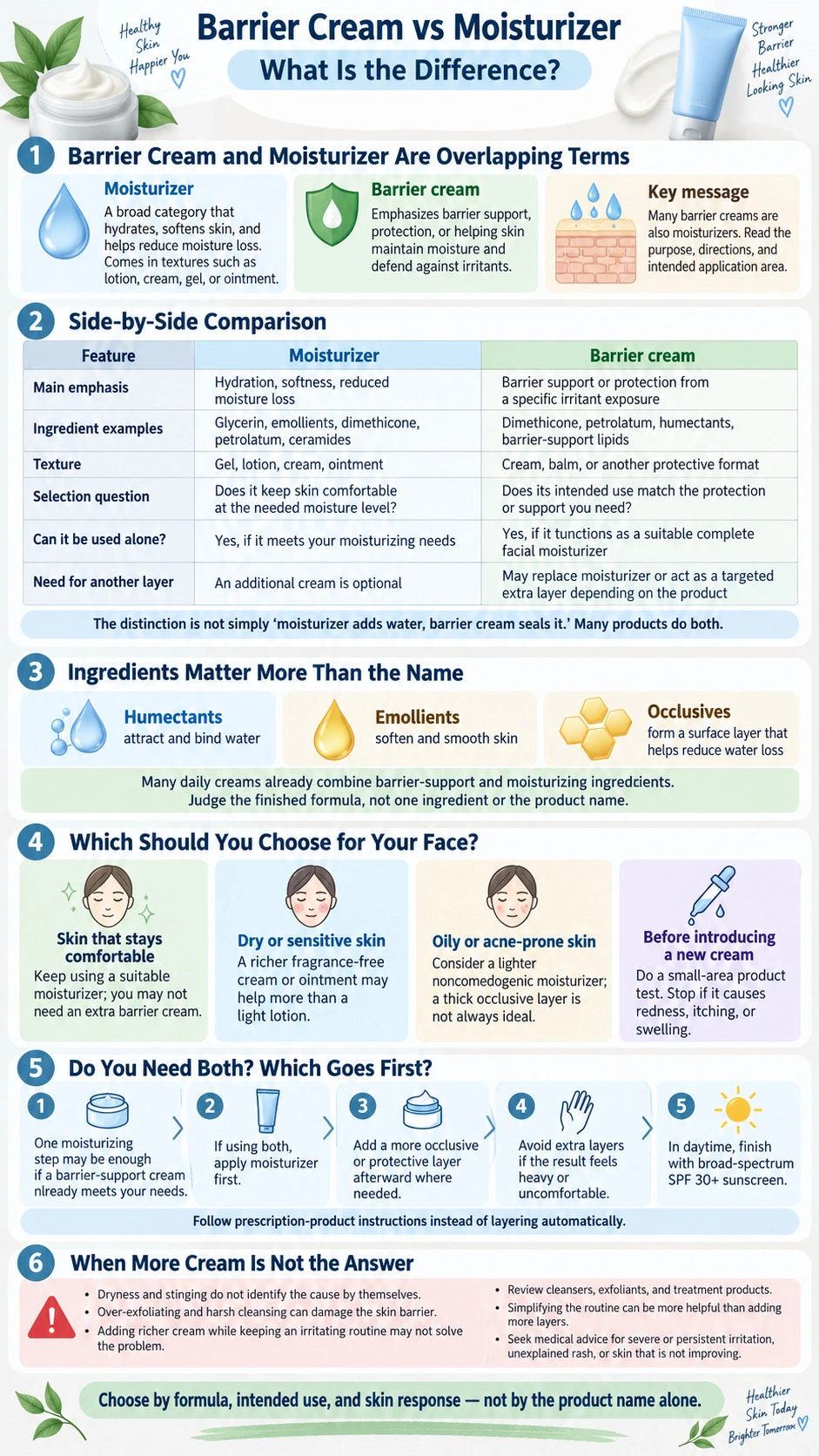
Moisturizer: A broad name for products that reduce dryness through water-attracting, skin-softening and water-loss-limiting ingredients. Moisturizers come in several textures, including lotions, creams and ointments.[1]
Barrier cream: A product intended to help maintain the skin’s physical barrier, limit drying or provide protection from irritants. Conventional protective products and newer barrier-support formulas can contain overlapping moisturizing ingredients.[2]
In facial skincare, “barrier repair” often describes a moisturizer’s focus. In other settings, a barrier product may be designed for a particular exposure or application area. Read the label’s purpose and face-use directions rather than treating those uses as interchangeable.
Barrier Cream vs Moisturizer: Side-by-Side Comparison
Use this table to compare the emphasis of each name. Individual formulas can fit both columns.
| What to compare | Moisturizer | Barrier cream |
|---|---|---|
| Main emphasis | Hydration, softness and reduced moisture loss | Barrier support or protection from a specified irritant exposure |
| Ingredient examples | Glycerin, emollients, dimethicone, petrolatum or ceramides | Dimethicone, petrolatum, humectants or barrier-support lipids |
| Texture | Gel, lotion, cream or ointment | Cream, balm or another protective format; not necessarily the richest option |
| Selection question | Does it keep your skin comfortable at the needed level of moisture? | Does its intended use match the protection or moisturizing support you need? |
| Can it be used alone? | Yes, if it meets your moisturizing needs | Yes, if it functions as a suitable complete facial moisturizer |
| Need for another layer | An additional cream is optional | May replace your moisturizer or serve as a targeted extra layer, depending on the product |
The distinction is not “moisturizer adds water, barrier cream seals it.” Many moisturizers already help prevent water from escaping, while some barrier creams also include humectants. Look at the whole formula and its directions to decide whether a second product would add a useful function.
Which Ingredients Matter More Than the Product Name?
Three ingredient roles commonly work together. Humectants, such as glycerin, attract and bind water. Emollients soften skin. Occlusives, such as petrolatum, help skin hold onto moisture by forming a surface coating.[3] These roles explain why hydration and protection can come from the same product.
For example, one everyday moisturizing cream lists glycerin, petrolatum, dimethicone, ceramides and cholesterol.[4] Moisturizing and barrier-support ingredients can already be present in your daily cream.
A long ingredient list does not establish superior repair, and one ingredient cannot predict how well the finished formula will work on your face. Choose a product that provides the needed moisture without stinging or feeling uncomfortably heavy.
Which Should You Choose for Your Face?
Start with the state of your skin and the routine you already tolerate:
- Skin that stays comfortable: Keep using a suitable moisturizer. You do not need an additional barrier cream simply because it sounds more protective.
- Dry or sensitive skin: A richer, fragrance-free cream or ointment may be more useful than a light lotion.[5] Check that it is intended for facial use and comfortable on your skin; either product name can describe a suitable choice.
- Oily or acne-prone skin: Consider a lighter, noncomedogenic moisturizer rather than automatically covering the whole face with a thick protective layer.[6] Some occlusive barrier creams can aggravate acne on the face.[2]
When choosing a moisturizer, assess dry patches separately rather than assuming every part of your face needs the same extra layer.
Before introducing a new cream, a small-area product test can help identify a reaction. If it causes redness, itching or swelling, gently wash it off and stop using it.[7] A “barrier” label does not rule out sensitivity to fragrance, preservatives or other ingredients. Do not apply a product to broken skin unless its directions explicitly permit that use.[2]
Do You Need Both, and Which Goes First?
One moisturizing step: A barrier-support cream that meets your moisturizing needs can occupy your usual moisturizer step. There is no automatic requirement to place another moisturizer underneath it.
If you use a separate moisturizer and a more occlusive facial product for a dry area, the practical approach is moisturizer first, then the protective layer where needed.[8] Follow the label’s amount and application instructions, and avoid adding a second product when the result feels heavy or uncomfortable.
Apply moisturizer after gentle cleansing, while skin is still slightly damp, unless your product or treatment instructions require otherwise.[3] Follow your clinician’s order and application instructions for prescription products rather than placing a heavy layer over them automatically.[3]
For daytime use, continue with appropriate sun protection. A barrier-support claim does not provide an SPF rating; choose a sunscreen labeled broad-spectrum SPF 30 or higher.[6]
When More Cream Is Not the Answer
Dryness and stinging do not identify the cause by themselves. Over-exfoliating and harsh cleansing can disrupt the skin barrier; underlying conditions can also require specific care.[9] Adding a richer cream while continuing an irritating routine may leave the original problem unresolved.
Review recent changes to your cleanser, exfoliant or treatment products. Simplifying the routine and choosing gentle products can be more useful than repeatedly adding protective layers.
Seek medical advice for severe or persistent irritation, an unexplained rash or skin that is not improving. Moisturizing care can support comfort, but it does not replace treatment for a condition that needs it.
FAQs About Barrier Cream and Moisturizer
Can barrier cream replace moisturizer?
Yes, if it is suitable for your face and provides the moisturizing care you need. A protective product intended for another application area should not automatically replace your facial moisturizer.
Can you use barrier cream every day?
Use it as often as its directions allow and your skin needs. A plain facial barrier-support moisturizer may fit daily care, but products with medicinal ingredients or special protective uses have their own instructions.
Can barrier cream clog pores?
Some occlusive barrier creams can worsen acne on the face.[2] Choose by the formula and your response; heavier texture does not guarantee either a breakout or a better result.
How long does barrier cream take to repair the skin barrier?
There is no universal timeline that follows from the product name. Improvement depends on the cause of the problem and the care it needs. Feeling softer after application does not prove complete repair; persistent symptoms deserve assessment.
Sources
[1] DermNet. Emollients and Moisturizers (Moisturisers)
[2] DermNet. Barrier cream
[3] Cleveland Clinic. Emollients
[4] CeraVe. Moisturizing Cream
[5] American Academy of Dermatology. How to pick the right moisturizer for your skin
[6] American Academy of Dermatology. How to control oily skin
[7] American Academy of Dermatology. How to test skin care products
[8] Cleveland Clinic. Slugging: Does This Skin Care Trend Work?
[9] Cleveland Clinic. Signs Your Skin Barrier Is Damaged


