

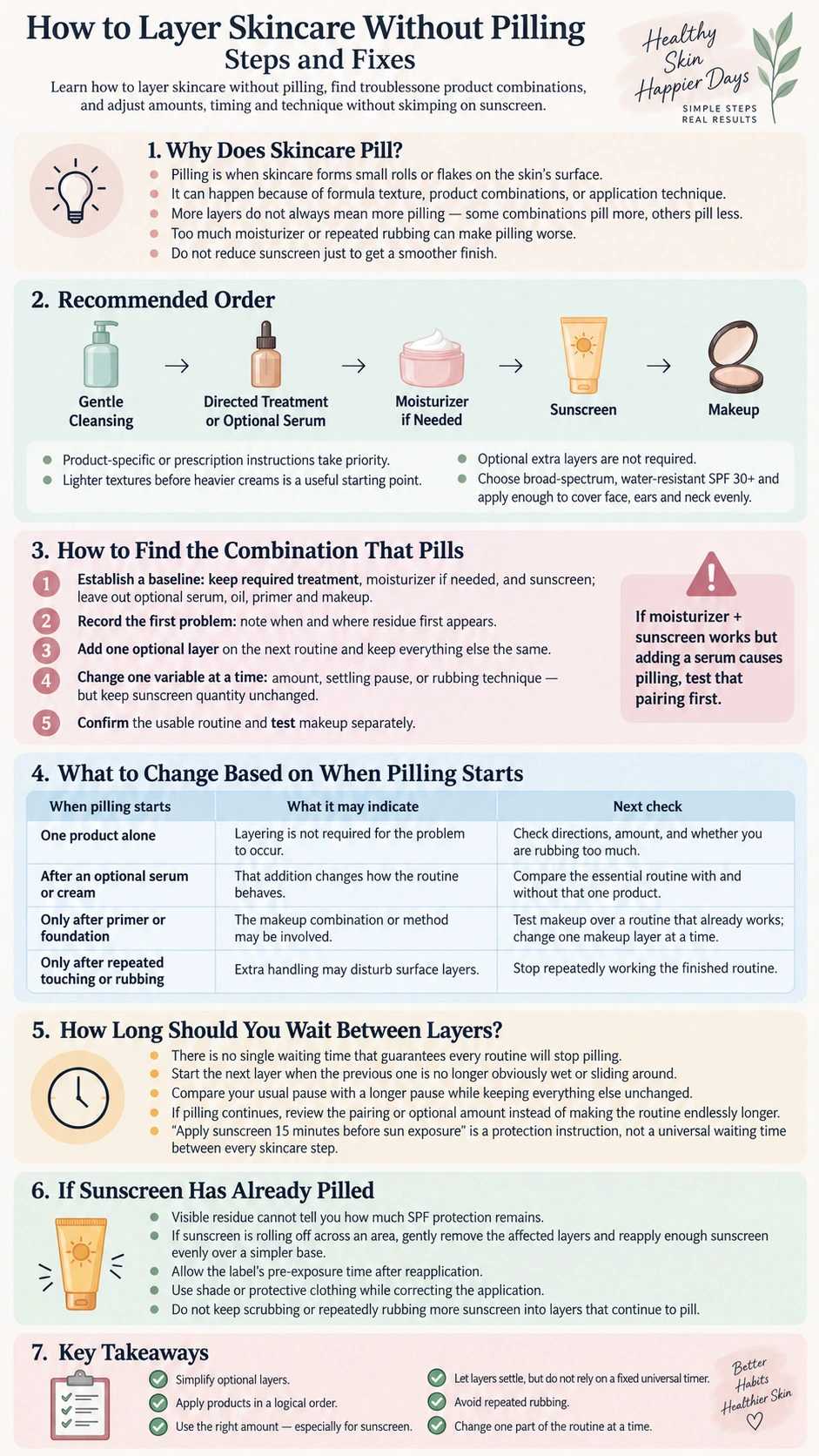
Skincare pilling is the formation of small rolls or flakes of product on the skin’s surface.[1] It often becomes noticeable when you add moisturizer, sunscreen or makeup. The product you apply last may reveal the problem without being its only cause.
Why Does Skincare Pill?
Pilling varies with formulas, combinations and application. In testing, adding a layer beneath sunscreen increased pilling for some participants and reduced it for others. More layers do not invariably mean more pilling.[1]
Some polymers used to thicken skincare can clump during application.[2] But seeing balls of residue does not identify the responsible ingredient. Treat “these two products pill together” as a useful observation; treat “all products containing this ingredient will pill” as an unproven conclusion.
Too much moisturizer can also contribute to pilling, and compatibility with other routine steps matters.[4] Before discarding a product, check whether you are applying more than its directions suggest. The guide to how much moisturizer to use helps you assess that layer without reducing sunscreen.
What Order Should You Use?
A basic morning sequence is gentle cleansing → directed treatment or optional serum → moisturizer if needed → sunscreen → makeup. Treatment instructions can change the sequence, so a prescription or product-specific direction takes priority over a general layering rule.[3]
For optional skincare, lighter textures before heavier creams can be a useful starting point. However, thickness alone should not determine where sunscreen or medication belongs. You do not need a toner, multiple serums or a face oil to make the routine complete.
Apply each product separately. If an oil or extra serum creates a troublesome daytime combination, consider leaving that optional step out or using it at another permitted time. Keep any ingredient-combination restrictions in place; separating products by a few minutes does not override them.
Choose a broad-spectrum, water-resistant sunscreen with SPF 30 or higher. Apply enough to cover exposed skin evenly, including your face, ears and neck.[5] A smoother finish obtained by using less sunscreen does not solve the protection problem.
How to Find the Product Combination That Pills
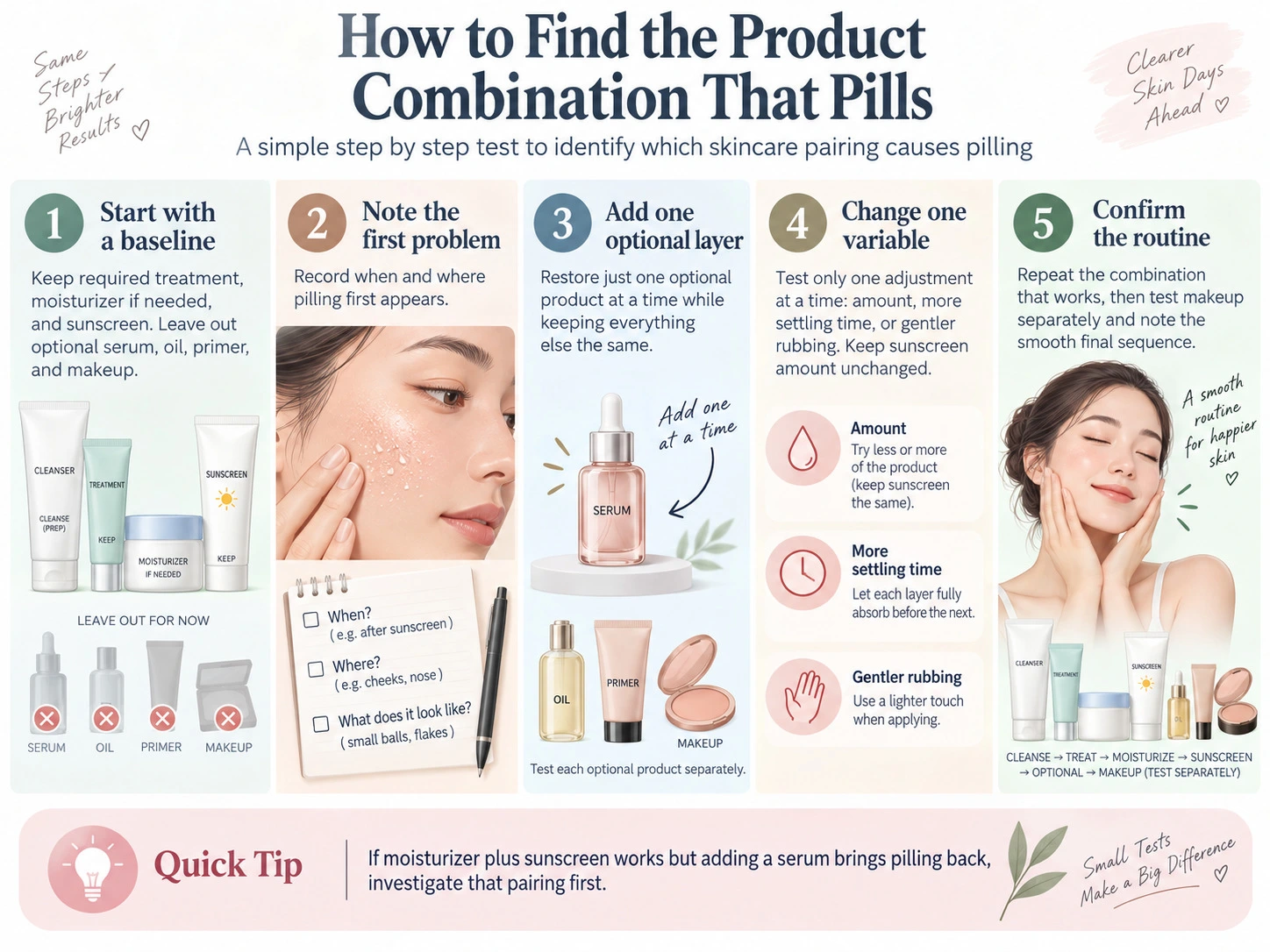
Use this practical comparison over separate routine applications. It helps identify a troublesome pairing; it does not measure absorption, treatment effectiveness or SPF. Avoid repeatedly cleansing and rebuilding the routine in one session.
- Establish a baseline: Keep your required treatment as directed, moisturizer if needed and sunscreen. Temporarily leave out optional serums, oils, primer and makeup.
- Record the first problem: Note when and where residue first appears. If the baseline already pills, use the troubleshooting table below before adding optional products.
- Add one optional layer: On the next comparison, restore just one product in its intended position. Keep the other products, quantities and application method consistent.
- Change one variable: If pilling returns, test that pairing with the optional product’s directed amount, a longer settling pause or less repeated rubbing—one change per comparison. Keep sunscreen quantity unchanged.
- Confirm the usable routine: Repeat the combination that works, then test makeup separately. Keep a brief note of the sequence that remains comfortable and smooth.
For example, if moisturizer plus sunscreen works but adding a serum brings pilling back, investigate that pairing first. This does not prove the serum is badly formulated. If a required medication is involved, ask your prescriber or pharmacist about application order or compatible supporting products before changing treatment.
What Should You Change Based on When Pilling Starts?
Use the point where residue first appears to choose your next comparison. These are clues, not diagnoses of a particular ingredient or skin condition.
| When pilling starts | What it may indicate | Next check |
|---|---|---|
| One product applied by itself | Layering is not required for the problem to occur. | Check its directions and amount; compare gentle application without repeatedly rubbing the same spot. |
| After adding an optional serum or cream | That addition changes how the combination behaves. | Compare the same essential routine with and without that one optional product. |
| Only when primer or foundation is added | The makeup combination or application may be involved. | Test makeup over the routine that already works; change one makeup layer or application method at a time. |
| Only after repeatedly touching or rubbing a finished routine | Further handling may disturb the surface layers. | Stop repeatedly working the finished layers; distinguish normal application from rubbing done only to test for residue. |
For recurring sunscreen pilling, assess the supporting layers before changing the sunscreen. If adjusting optional layers does not help, consider a different sunscreen while retaining the required amount.
How Long Should You Wait Between Layers?
There is no single waiting time that guarantees every combination will stop pilling. Allowing a little more time between products may help, but directions and the behavior of the particular formula matter.[2] Start the next step when the previous layer is no longer obviously wet or sliding around; do not keep rubbing it to check.
A useful comparison is your usual pause versus a longer pause with everything else unchanged. If neither works, investigate the pairing or optional amount rather than extending your routine indefinitely. The guide to waiting between skincare steps explains timing exceptions in more detail.
The instruction to apply sunscreen 15 minutes before sun exposure is a protection instruction. It is not a universal waiting time between every skincare layer or proof that a serum has fully absorbed.[6]
What If Sunscreen Has Already Pilled?
The pilling research measured visible residue, not remaining SPF. A few small rolls cannot tell you how much protection remains.[1]
If sunscreen is visibly rolling off across an area, do not assume that brushing away the balls leaves reliable coverage. A cautious practical response is to gently remove the affected product layers and reapply enough sunscreen evenly, using a simpler combination underneath. This is a coverage precaution, not a claim that every tiny pill removes all protection.
Allow the label’s pre-exposure time after reapplication, and use shade or protective clothing while correcting the application.[6] Avoid scrubbing the skin or repeatedly rubbing more sunscreen into layers that continue to roll off. Persistent trouble is a reason to change the supporting combination or sunscreen formula.
Rubbing was associated with more pilling events, but participants chose their techniques. These findings do not establish a patting method that preserves SPF.[1] Spread sunscreen thoroughly and evenly as directed, then avoid unnecessary repeated manipulation.[5]
FAQs About Skincare Pilling
Is skincare pilling the same as dead skin?
No. Pilling describes product rolling into residue. Flaking that is present before you apply anything may be a separate skin issue. Persistent flaking with soreness or irritation deserves attention rather than more rubbing or exfoliation.[7]
Should you avoid all silicones to prevent pilling?
An ingredient blacklist is not a reliable shortcut. Different complete formulas behave differently; test the actual product combination before blaming every silicone-containing product.[1]
Does pilling mean your skincare is not working?
Visible residue does not measure how much of an active ingredient reached your skin or whether treatment will work. It does show an application problem worth correcting, especially when sunscreen coverage becomes uncertain.
Should you exfoliate to stop pilling?
Do not add exfoliation automatically. It can worsen dryness or irritation, especially alongside retinol, prescription retinoids or benzoyl peroxide. Address product amounts and combinations first; seek advice if skin remains sore or flaky.[7]
Do all your products need to be from the same brand?
No. Matching brand names does not establish compatibility. Use each product’s directions and the behavior of the finished combination to decide what layers successfully.[2]
Sources
[1] Lua BL et al. Understanding the causes of skincare product pilling
[2] The Ordinary. How to Prevent and Solve for Product Pilling
[3] American Academy of Dermatology Association. Should I apply my skin care products in a certain order?
[4] La Roche-Posay, Consumer Care Center response. Toleriane Double Repair Matte Face Moisturizer for Oily Skin
[5] American Academy of Dermatology Association. How to apply sunscreen
[6] U.S. Food and Drug Administration. Sunscreen: How to Help Protect Your Skin from the Sun
[7] American Academy of Dermatology Association. How to safely exfoliate at home


