

Coin sizes and pump counts make useful starting points, but they are poor universal measurements. Different pumps can dispense very different amounts, a gel occupies a different volume from a dense cream, and not every face has the same surface area.
The more reliable method is to start with a reasonable estimate, spread it over a defined area, and judge the result. This article stays focused on quantity rather than repeating a complete application or skincare-order guide.
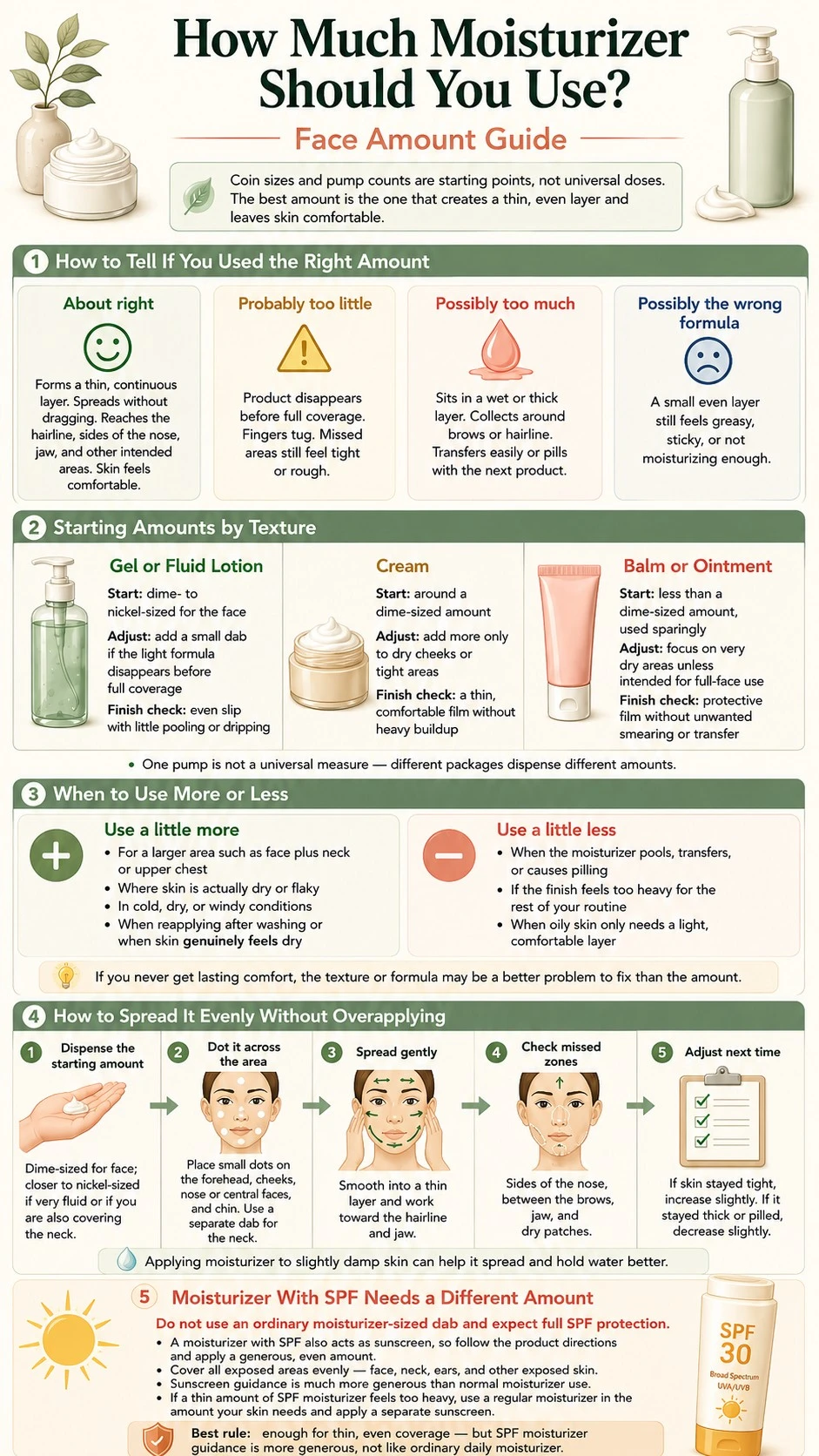
How to Tell If You Used the Right Amount
The correct amount is enough to create a thin, continuous layer over the skin you meant to moisturize. It does not need to remain visibly white or glossy to work. Use these signals after the product has had a moment to settle:
- About right: The moisturizer spreads without dragging, reaches the hairline, sides of the nose, jaw, and other intended areas, and leaves the skin comfortable. A richer product may leave some sheen, but it should still feel wearable for its intended use.
- Probably too little: The product disappears before you reach all areas, your fingers tug against the skin, or missed areas still feel tight or rough. Add a small dab only where needed instead of restarting with a large second layer.
- Possibly too much: The product sits in a wet or thick layer, collects around the brows or hairline, transfers easily, or repeatedly rolls into flakes when the next product is applied. Reduce the amount at the next use before deciding the formula is incompatible.
- Possibly the wrong formula: If a small, evenly applied amount still feels greasy, sticky, or insufficient, quantity may not be the main problem. The texture may not suit your skin, climate, or routine.
Immediate feel is only one clue. If skin becomes tight again soon after application, you may need a little more, a richer texture, or a different formula—not automatically several extra layers. Understanding what moisturizer does helps separate insufficient coverage from a product that simply does not meet your skin’s needs.
Starting Amounts for Different Moisturizer Textures
Use the table as a starting framework rather than a dosing chart. Gels, lotions, creams, and ointments differ in water and oil balance, spread, and surface feel; creams and ointments are generally richer than lotions and gels.[2]
| Moisturizer texture | Practical starting amount for the face | How to adjust | Useful finish check |
|---|---|---|---|
| Gel or fluid lotion | Dime- to nickel-sized amount | Add a small dab if the light formula disappears before full coverage | Even slip with little pooling or dripping |
| Cream | Around a dime-sized amount | Add to dry cheeks or other tight areas instead of thickening the whole face | A thin, comfortable film without heavy buildup |
| Balm or ointment | Less than a dime-sized amount, applied sparingly | Concentrate on very dry areas unless the product is intended for full-face use | Protective film without unwanted smearing or transfer |
Packaging changes the apparent amount. One pump, dropper squeeze, or fingertip scoop is meaningful only for that specific container. Once you know how many pumps of your product create the right finish, that repeatable personal measure is more useful than comparing it with someone else’s pump.
If the main problem is choosing between textures rather than measuring them, compare gel and cream moisturizer separately.
When to Use More or Less Moisturizer
Adjust in small increments. Doubling the amount at once makes it harder to tell whether the quantity or the formula caused a heavy finish.
- Use a little more for a larger area. Including the neck or upper chest requires more product than covering the face alone. Area is a better reason to increase quantity than copying a fixed coin size.
- Use more where skin is actually dry. Combination skin does not require the same layer everywhere. Apply a normal thin layer, then add a small amount to tight or flaky areas.
- Reassess in cold, dry, or windy conditions. Skin may need more support when humidity drops, but switching to a richer cream can work better than repeatedly layering a light lotion.
- Use less when the finish interferes with the routine. If moisturizer consistently pools, transfers, or causes the next layer to pill, reduce it slightly and allow it to settle. Persistent problems can also signal a formula mismatch.
- Do not skip solely because skin looks oily. Oily skin can still become dehydrated or irritated. A smaller amount of a light, well-tolerated formula may be more comfortable than either a thick layer or no moisturizer at all. The guide to whether oily skin needs moisturizer explains that choice.
- Apply again when skin genuinely feels dry. Dry skin may benefit from moisturizer several times a day, especially after washing; applying to slightly damp skin helps trap existing water.[3] Reapplication is often more useful than putting on an excessively thick layer once.
If you keep changing the amount but never get lasting comfort, choose a formula for your actual dryness level and skin type instead of treating quantity as the only variable. The moisturizer selection guide can help with that separate decision.
How to Spread Moisturizer Evenly Without Overapplying
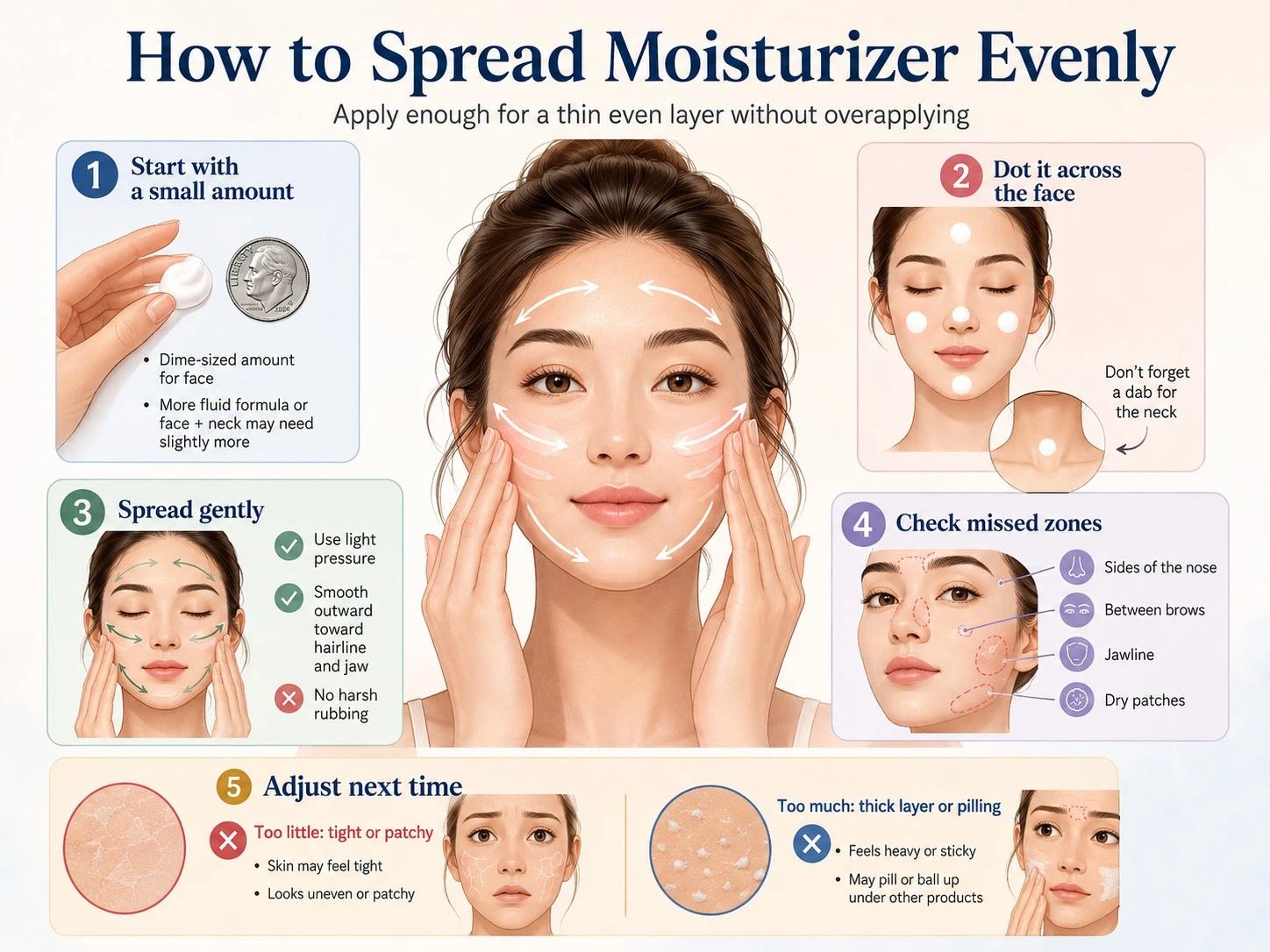
Even distribution matters more than creating the largest possible dollop. A small amount can cover well when it is divided before you begin rubbing.
- Dispense the starting amount. Use a dime-sized amount for the face, moving closer to nickel-sized when the formula is very fluid or you are also covering the neck.
- Divide it across the area. Place small dots on the forehead, cheeks, nose or central face, and chin. Reserve a separate dab for the neck rather than hoping the remainder will reach it.
- Spread gently. Smooth the moisturizer into a thin layer without aggressive rubbing. Work toward the hairline and jaw so the center of the face does not receive all the product.
- Check for missed zones. Look at the sides of the nose, between the brows, the jaw, and any dry patches. Add only what those areas need.
- Let the finish guide the next use. If the layer was uneven or skin stayed tight, increase slightly next time. If it remained thick or caused pilling, decrease slightly.
Applying moisturizer while skin is still a little damp after cleansing can improve water retention, unless another product’s directions require fully dry skin.[3] This can help a modest amount spread comfortably, but it does not eliminate the need for complete coverage.
Moisturizer With SPF Follows a Different Amount Rule
A daytime moisturizer labeled with SPF is also serving as a sunscreen. Its protective claim depends on applying enough product, so a dime-sized moisturizer amount should not be assumed to provide the labeled protection.
Follow the Drug Facts or product directions and cover every exposed area evenly. Current sunscreen guidance calls for a much more generous application than most people use for ordinary moisturizer: at least 1 teaspoon for the face, plus full coverage of the neck, ears, and other exposed skin.[4] If that amount of an SPF moisturizer feels too heavy, use a regular moisturizer in the amount your skin needs and apply a separate sunscreen that you can wear at the required amount.
The guide to how much sunscreen to use on your face covers measurement and application in detail. The key quantity rule here is simple: do not reduce an SPF product to a cosmetic moisturizer-sized dab and still assume full labeled protection.
FAQs About Moisturizer Amount
Is a pea-sized amount of moisturizer enough?
A pea-sized amount may cover the face when the formula spreads easily or the skin needs only a light layer, but it is often too little for the face and neck together. Start with it if you prefer, then add another small dab if you feel dragging, miss areas, or cannot create a thin continuous layer. “Pea-sized” is a test amount, not a universal rule.
Can using too much moisturizer cause breakouts?
Using more moisturizer than your skin needs can leave residue and feel heavy, but excess quantity does not guarantee acne. Breakouts also depend on the finished formula, your skin, other products, and how completely you cleanse. First reduce the amount. If congestion continues despite a thin, even layer, try a lighter or non-comedogenic formula rather than assuming all moisturizer is the problem.
Should you use more moisturizer at night?
Not automatically. You can use more or choose a richer formula at night if your skin feels dry and the finish is comfortable. In the morning, a thinner layer may sit better under sunscreen and makeup. The correct day and night amounts can differ, but each should be based on coverage and skin response rather than the clock alone.
How much moisturizer should you use on your neck?
Use enough to form the same thin, even layer you apply to your face. A small extra dab is usually a better starting point than stretching leftover face product down the neck. Increase the amount for the upper chest or other exposed areas, and stop or switch formulas if the neck stings or becomes irritated.
Sources
[1] Byrdie. The Correct Amount of Skincare Product to Use, According to Dermatologists
[2] American Academy of Dermatology Association. How to Pick the Right Moisturizer for Your Skin
[3] American Academy of Dermatology Association. Dermatologists’ Top Tips for Relieving Dry Skin
[4] American Academy of Dermatology Association. How to Apply Sunscreen


