
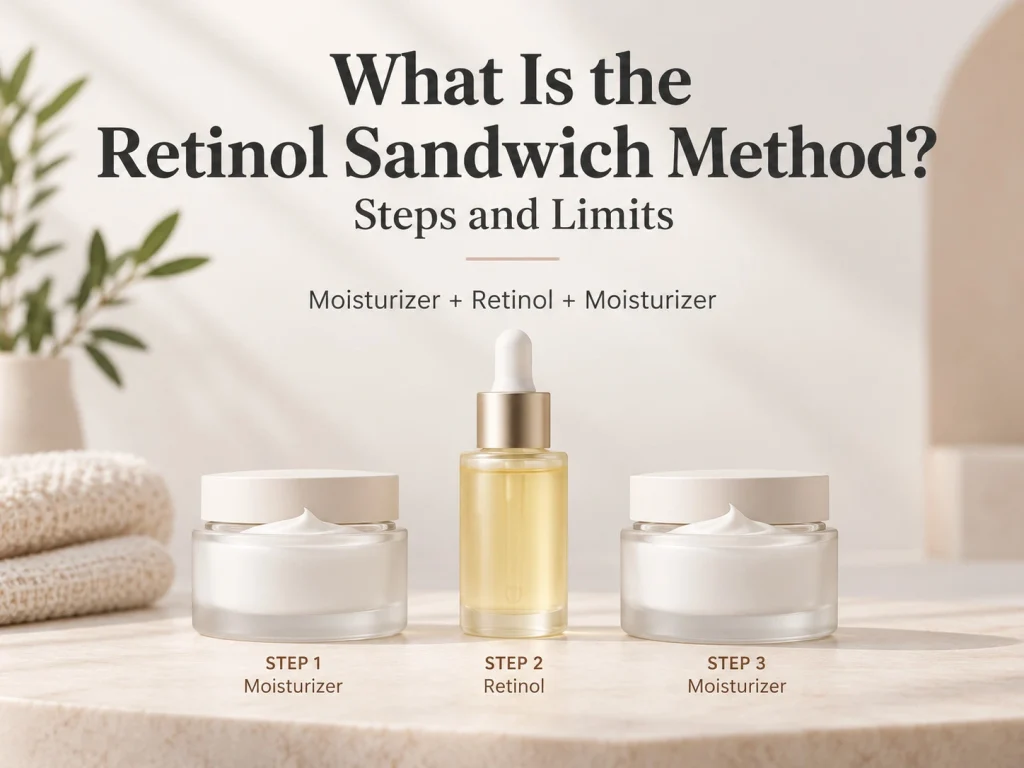

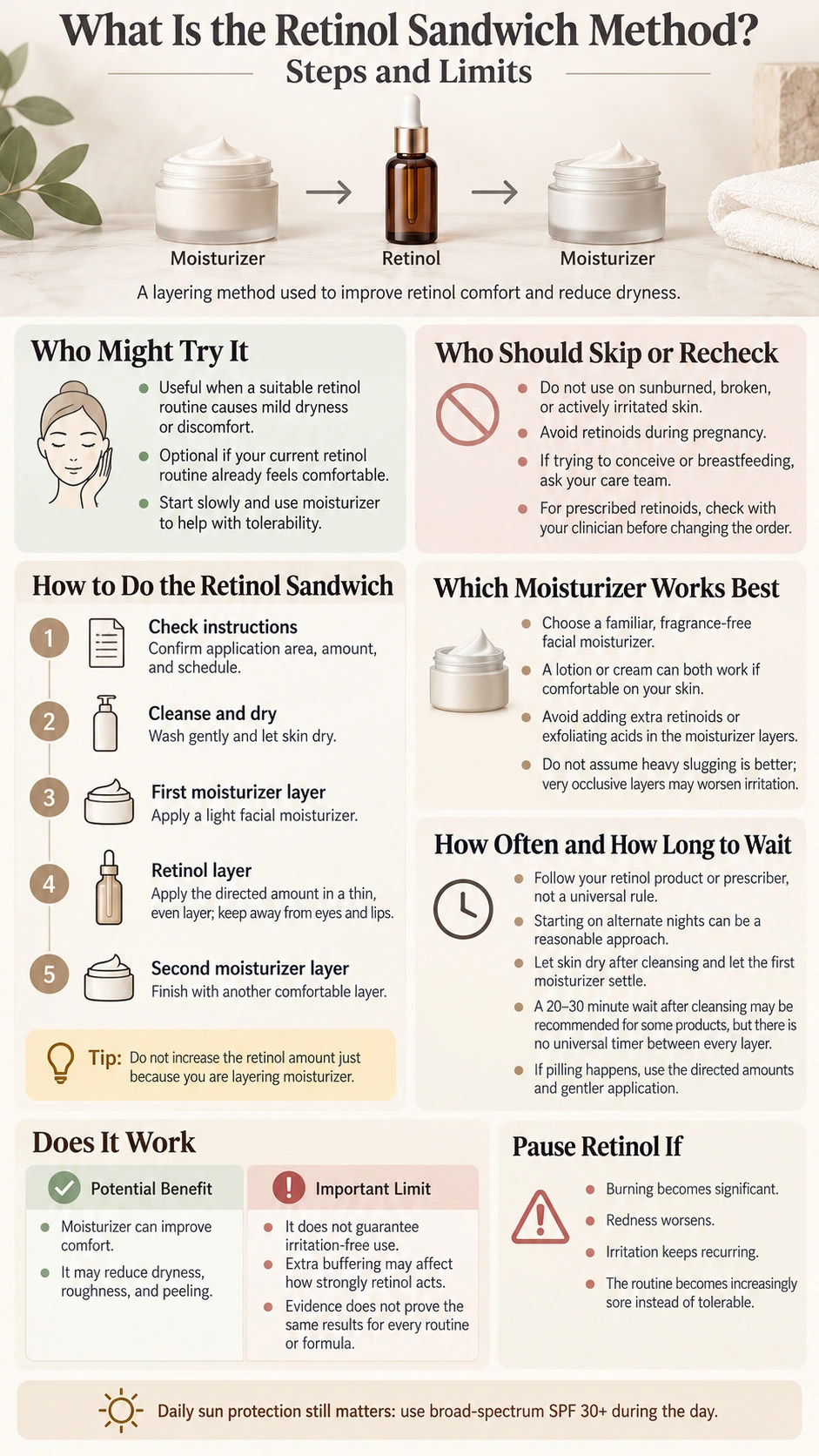
Sandwiching changes where moisturizer sits in a routine. It does not change the retinol percentage printed on the bottle or turn a product into a different retinoid.
The important decision is whether adjusting the order helps you use an appropriate product comfortably, without increasing its dose or ignoring a reaction.
Who Might Try the Method, and Who Should Skip It?
It may be an option when you are starting a suitable retinol product and mild dryness is making the routine difficult. Starting slowly and using moisturizer are established ways to help manage retinoid-related irritation.[2] A full sandwich is optional if your existing routine already feels comfortable.
Inflamed or damaged skin: Do not treat sandwiching as permission to apply retinol to sunburned, broken or actively irritated skin.[3] Persistent redness, inflammation or a condition such as a rosacea flare calls for individual advice.[2]
Pregnancy: Avoid retinoids, including retinol, during pregnancy. If you are trying to conceive or breastfeeding, discuss your skincare and medications with your care team.[4] Moisturizer layering does not change these safety considerations.
Retinol is one member of the retinoid family; adapalene and tretinoin have their own uses and directions.[2] Our retinol guide covers the ingredient background. For prescribed treatment, ask your clinician before changing its application order.
How to Do the Retinol Sandwich Method
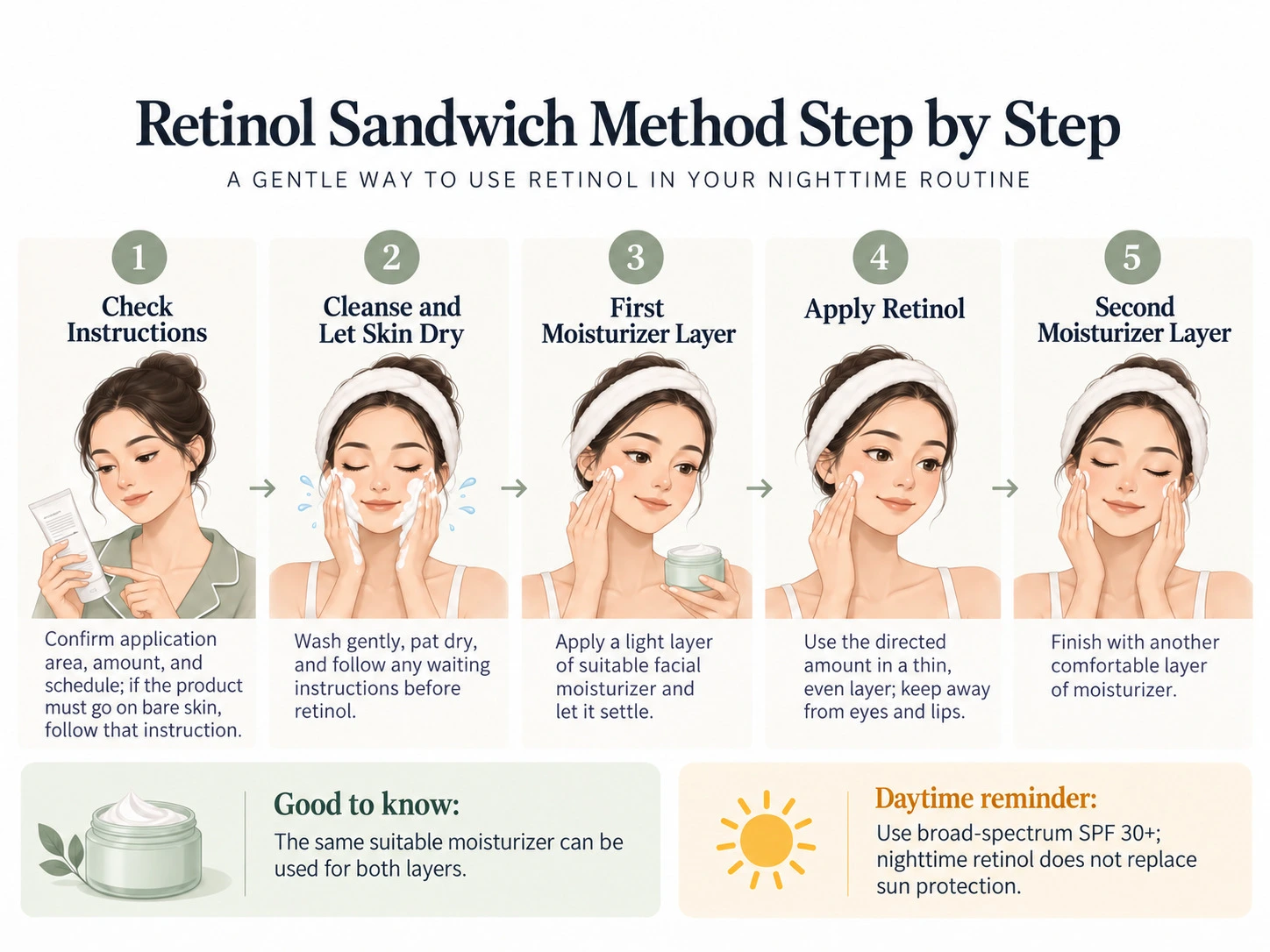
Use this nighttime sequence only when your product directions or clinician support the approach:
- Check your instructions: Confirm the retinol’s application area, amount and schedule. If it must go on bare skin, follow that instruction rather than adding an unapproved first layer.
- Cleanse and let skin dry: Wash gently and pat dry. Follow any waiting instructions before applying your retinol; do not scrub to prepare the skin.[3]
- Apply the first moisturizer layer: Spread a light layer of a suitable facial moisturizer. Let it settle before the retinol step.[5]
- Apply the directed retinol amount: Use the amount specified for that formula in a thin, even layer over its intended area. Keep it away from eyes, lips and other areas excluded by the label.[3]
- Apply the second moisturizer layer: Finish with another comfortable layer of moisturizer, smoothing it on gently.[1]
The same suitable moisturizer can serve both layers. There is no need to use twice as much retinol because moisturizer sits underneath it.
During daylight exposure, maintain sun protection with broad-spectrum SPF 30 or higher, shade and suitable clothing.[5] Sandwiching at night does not replace daytime protection.
Which Moisturizer Should You Use?
Choose a familiar, fragrance-free facial moisturizer that feels comfortable on your skin. Keep the optional moisturizing layers free of extra retinoids or exfoliating acids rather than adding another treatment at both ends of the sandwich.[1] Follow any prescribed combination plan instead of changing it on your own.
A lotion or cream can be suitable; a particular texture or ingredient does not guarantee compatibility. When choosing a moisturizer for your skin type, consider how the whole formula feels with your existing retinol.
Avoid adding slugging automatically: A heavy petroleum-jelly seal over retinoids can worsen irritation.[6] An ordinary final moisturizer layer and a thick occlusive coating are different applications. Do not assume adding more layers will provide more buffering.
How Often Should You Sandwich Retinol, and How Long Should You Wait?
Frequency follows the retinol: Starting on alternate nights is one approach discussed in retinoid guidance, with gradual increases as tolerated.[2] Your product or prescriber’s schedule takes priority. Two moisturizing layers do not make nightly use appropriate for everyone.
If dryness increases, reassess the schedule and formula rather than compensating with more retinol or thicker cream. Avoid changing strength and frequency together while you are trying to understand your tolerance.
Waiting serves a specific purpose: Let cleansed skin dry and let the first moisturizer settle so the next product spreads comfortably. Follow any explicit retinoid waiting directions. Some guidance recommends a 20- to 30-minute interval after cleansing before applying a retinoid.[5] That does not establish a universal timer between every sandwich layer.
If layering causes pilling, use the products’ directed amounts and gentler application. Visible rubbing-off is a reason to review how the layers fit together, not to add another dose of retinol.
Does the Retinol Sandwich Method Work?
Moisturizing can improve comfort: A small clinical study in people using oral isotretinoin or topical tretinoin found less dryness, roughness and peeling on the moisturized side of the face.[7] It supports moisturizer as an adjunct, but did not test this three-layer retinol routine.
Unchanged effectiveness is not guaranteed: An industry-sponsored conference study tested specific retinol, tretinoin and moisturizer formulas on skin tissue from one donor. Full sandwiching lowered a laboratory marker of retinoid activity; moisturizer used only before or only after the retinoid maintained comparable activity in that experiment.[8]
Those were laboratory activity measurements, not a trial of acne clearance or wrinkle improvement in people following a nightly routine. They cannot tell you that sandwiching cuts your product’s results by a particular percentage.
Treat the method as a tolerability option. If your skin already tolerates retinol, more buffering may not be necessary; if treatment remains difficult, ask about the formula, schedule or application order.
When Should You Pause Retinol?
Pause a cosmetic retinol that causes significant burning, worsening redness or persistent irritation. Do not keep applying it simply because moisturizer is included; an irritating product should be stopped and reassessed.[5]
Seek medical advice for a severe reaction or symptoms that keep recurring.[3] If you use prescribed treatment, contact the prescriber for a plan rather than repeatedly modifying the dose yourself.
Peeling is not a reliable measure of how well a product is working. A routine that feels increasingly sore needs attention, not a stronger sandwich.
FAQs About the Retinol Sandwich Method
Can you mix retinol into moisturizer instead?
Mixing products is different from applying separate layers. Use the retinol as directed rather than improvising a blend and assuming it has a known lower strength. Only mix when the product instructions or your clinician specifically support it.
Can you sandwich tretinoin or adapalene?
Moisturizer can be used alongside topical retinoids.[7] Their directions and treatment goals differ, so follow the medication label and ask your clinician about buffering before changing the order. Keep your prescribed application plan in charge.
Do you need two different moisturizers?
No. You can use the same suitable moisturizer for both layers. The method is defined by the order, not by using two brands.
Does sandwiching prevent purging?
It is not a guaranteed way to prevent breakouts. Early acne changes sometimes called purging can occur with retinol.[3] Do not assume burning, a rash or worsening irritation is purging; have persistent or severe changes assessed.
Sources
[1] Westlake Dermatology. The Retinol Sandwich Method: A Gentler Way to Use Retinoids
[2] American Academy of Dermatology. Retinoid or retinol?
[3] Cleveland Clinic. Retinol
[4] American Academy of Dermatology. Dermatologist-approved pregnancy skin care
[5] American Academy of Dermatology. Dermatologist-recommended skin care for your 20s
[6] Cleveland Clinic. Slugging: Does This Skin Care Trend Work?
[7] National Library of Medicine, PubMed. Beneficial effect of a moisturizing cream as adjunctive treatment to oral isotretinoin or topical tretinoin in the management of acne


