

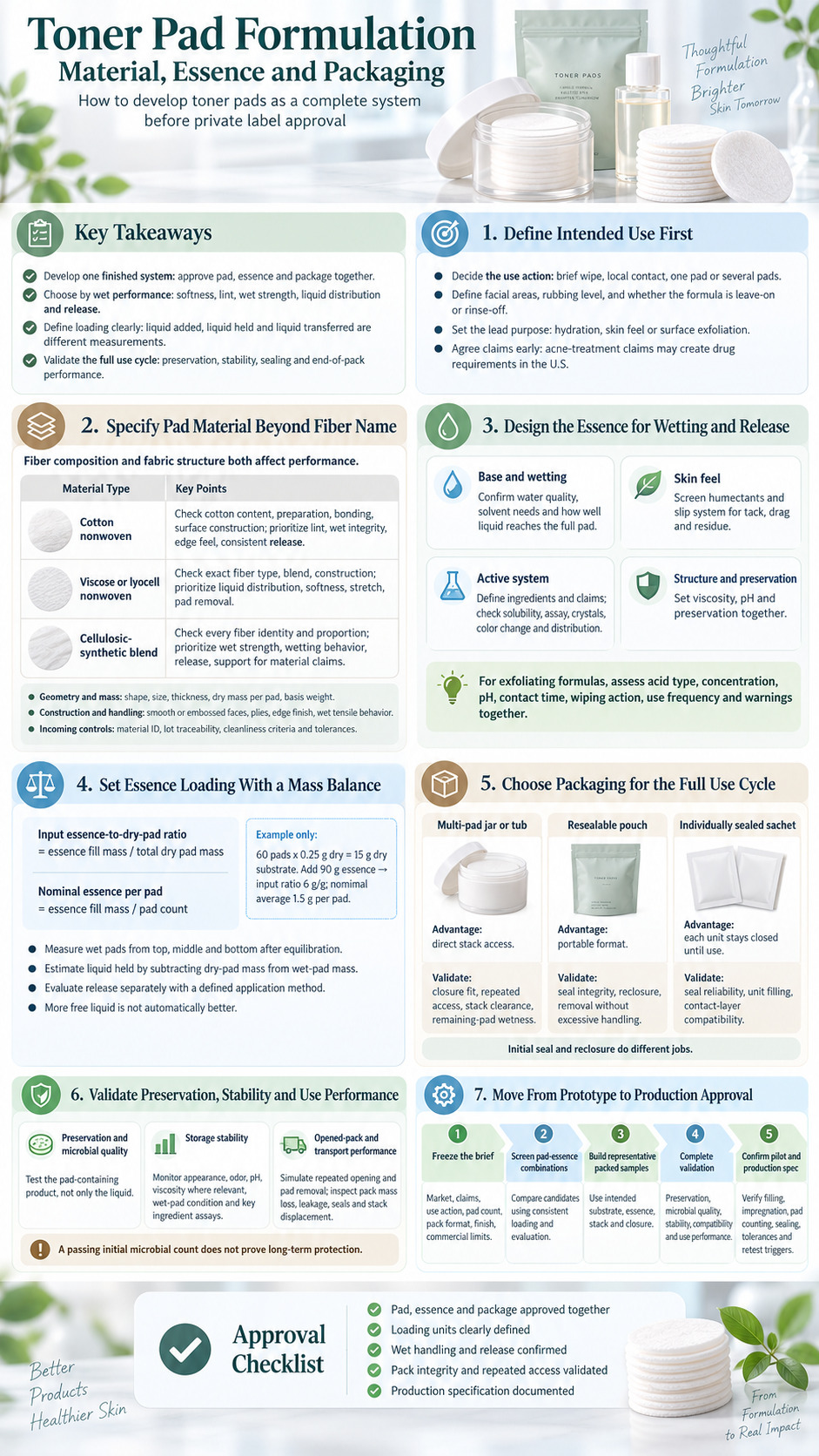
A toner pad combines a liquid skincare formula with a carrier that stores and delivers it. For brands, that carrier adds development variables that a bottle does not have: stack distribution, wet handling, pad removal and changing liquid levels during use. This guide covers pre-soaked nonwoven toner pads.
Define the Toner Pad’s Intended Use First
Define how the customer will use the toner pads. A pad intended for a brief wipe needs different handling evaluation from one positioned for short local contact. State whether the user will use one or several pads, which facial areas are included, whether rubbing is intended, and whether the formula is leave-on or rinse-off.
Then name the lead cosmetic purpose: hydration, a comfortable skin feel, or surface exfoliation. A textured side does not automatically prove better exfoliation, and a smooth pad does not establish suitability for sensitive skin. Assess the finished product and the proposed directions together.
The target market belongs in this brief. For U.S. products, intended use and claims determine whether a product is a cosmetic, a drug or both; acne-treatment claims can trigger drug requirements.[1] Agree the claim boundary before selecting actives or printing packaging. A pad format does not remove that responsibility.
Specify Pad Material Beyond the Fiber Name
Cotton, viscose and lyocell name fibers; “spunlace” describes a nonwoven production method. Fiber composition and fabric structure are separate specification fields, and both influence the carrier’s performance.[2] Request the exact blend rather than accepting a description such as “premium cotton feel.”
Cellulosic fibers can support liquid absorption and release, but supplier fiber properties do not guarantee the behavior of your finished pad.[3] Use candidate samples to compare the same essence under the same loading and evaluation conditions.
| Material candidate | What to establish with the supplier | Priority in the wet prototype |
|---|---|---|
| Cotton nonwoven | Cotton content, preparation, bonding and surface construction | Lint, wet integrity, edge feel and consistent release |
| Viscose or lyocell nonwoven | Exact fiber type, blend and construction | Liquid distribution, softness, stretch and pad removal |
| Cellulosic–synthetic blend | Identity and proportion of every fiber, including polyester if present | Wet strength, wetting behavior, release and support for material claims |
Add three practical groups to the purchase specification:
- Geometry and mass: shape, dimensions, thickness, dry mass per pad and basis weight. GSM means grams per square meter of fabric; it does not specify the weight of a whole pad without its area.
- Construction and handling: smooth or embossed faces, plies, edge finish, wet tensile behavior, lint and whether one pad can be removed without pulling out several.
- Incoming controls: material identification, lot traceability, agreed cleanliness criteria and tolerances for dimensions and mass.
Approve the feel of a wet pad rather than its dry display sample. If a textured side is included, evaluate that side with the proposed wiping pressure and frequency. A heavier or thicker pad is not automatically the better choice.
Design the Essence for Wetting and Release
The essence must distribute through the stack, remain uniform during storage and transfer during the intended action. A pleasant drop on the back of a hand does not establish those properties.
Set the formula brief around four functions:
- Base and wetting: define water quality, solvent needs and how readily the liquid reaches the center and edges of the pad. Screen with the actual substrate.
- Skin feel: glycerin is one humectant option.[4] Screen the humectant and slip system for tack, drag and residue after pad use. More cushion in the bulk does not necessarily mean better release.
- Active system: define the ingredients and intended claims, for example a concept centered on niacinamide, panthenol or hyaluronic acid.[5] Set solubility and assay requirements, then check for crystals, color changes or uneven distribution after pad contact.
- Structure and preservation: set viscosity, pH and preservation requirements together. Assess any thickener, solubilizer or emulsion system in the assembled product.
For a milky essence, ask whether it remains evenly distributed without shaking. A bottle that requires shaking is a weak starting point for a stacked-pad product whose users cannot readily remix each pad. The face toner formulation guide explains the differences between aqueous, exfoliating and milky architectures.
An exfoliating formula needs more than a headline acid percentage. For acids such as glycolic or lactic acid, AHA performance depends on acid type, concentration, pH and the rest of the formula; U.S. AHA labeling guidance also addresses increased sun sensitivity.[6] Review concentration, final pH, contact time, wiping action, frequency and warnings together. Do not copy a bottled acid toner’s directions onto a pad without assessing the changed application.
Set a justified pH range and measurement method. There is no single pH or viscosity target suitable for every toner pad concept.
Set Essence Loading With a Mass Balance
Write the loading specification in defined units. “Highly saturated” is a feel description, not a reproducible filling instruction.
Input essence-to-dry-pad ratio: essence fill mass divided by the total dry mass of the pads in that pack.
Nominal essence per pad: essence fill mass divided by pad count. This is an arithmetic average, not a measured skin dose.
For example, a hypothetical pack of 60 pads weighing 0.25 g dry each contains 15 g of dry substrate. Adding 90 g of essence gives an input ratio of 6 g/g and a nominal average of 1.5 g of essence per pad. These numbers illustrate the calculation; they are not recommended development targets.
Some liquid may remain free in the container, and pads may not hold equal amounts. Measure representative wet pads from the top, middle and bottom after a defined equilibration period. Estimate liquid held by subtracting the matched dry-pad mass from the wet-pad mass. Keep the draining procedure consistent so a dripping pad is not compared with a blotted one.
Evaluate release separately with an agreed application method. A high wet mass can coexist with poor transfer, excessive dripping or substantial liquid left in the pad. If fill volume is used on the line, relate it to the essence’s measured density rather than assuming every milliliter weighs one gram.
Choose the final load from useful transfer, handling, stack uniformity and end-of-pack performance. More free liquid is not automatically a better product.
Choose Packaging for the Full Use Cycle
Packaging must accommodate the stack and retain the essence while allowing the intended pad-removal method. Select the closure and contact materials before treating the formula as final.
| Format | Development advantage | Main issue to validate |
|---|---|---|
| Multi-pad jar or tub | Direct access to a stack and space for a pad-removal tool | Closure fit, repeated access, stack clearance and remaining-pad wetness |
| Resealable pouch | Flexible format for a smaller or portable pack | Seal integrity, reclosure performance and removal without excessive handling |
| Individually sealed sachet | Each unit remains closed until its use | Seal reliability, unit filling and compatibility of the contact layer |
A first-opening seal and a reclosure do different jobs. A good initial seal does not show that the opened pack will retain liquid throughout use. Tweezers may help pad removal, but they do not make the product sterile or replace preservation testing.
Evaluate the exact jar resin, liner, seal, pouch laminate and closure supplied for the project. Check fit with the wet stack, liquid contact, leakage, swelling, stress cracking where relevant, and interaction with printing or decoration. The packaging compatibility testing guide covers the wider formula–package assessment.
Validate Preservation, Stability and Use Performance
A liquid-only preservation result should not automatically be transferred to the pad product. Wet-wipe experiments found that fabric composition and preservative interactions changed antimicrobial performance. Those results justify testing the combined system; they do not prove that every cellulosic pad is unsafe or every synthetic blend is adequately preserved.[2]
Agree a preservative challenge test with a qualified laboratory that addresses the pad-containing product and documents sampling, recovery and any necessary method adaptation. ISO 11930 provides a framework for evaluating antimicrobial protection.[7] The laboratory must determine a suitable approach rather than applying a liquid protocol without considering the substrate.
Finished-product microbial quality is a separate check from preservation efficacy. ISO 17516 addresses cosmetic microbiological limits.[8] Specify the applicable standard edition and market criteria in the test plan, together with controls for water, pad materials, equipment and filling. A passing initial count does not establish resistance to later contamination.
Also define three performance evaluations:
- Storage stability: monitor appearance, odor, pH, viscosity where relevant, wet-pad condition and selected ingredient assays. Compare bulk, pad-contact liquid and the packed product where useful.
- Opened-pack use: simulate the intended opening, removal and reclosure pattern. Track pack mass loss, remaining pad condition, tool handling and first-to-last-pad performance.
- Transport and pack integrity: challenge the filled package in relevant orientations and distribution conditions; inspect leakage, seals, closure movement and stack displacement.
The stability test plan should justify its conditions and acceptance criteria. Stability guidance does not prescribe one universal protocol for every cosmetic.[9] Do not turn a short accelerated study into an unsupported shelf-life guarantee. Safety and tolerability assessment must also match the final formula and intended use.
Move From Prototype to Production Approval

Use a sequence that prevents attractive early samples from becoming an incomplete production specification:
- Freeze the brief: record the target market, claims, use action, pad count, pack format, desired finish and commercial constraints. Identify the regulatory and safety review responsibilities.
- Screen pad–essence combinations: compare a small documented set using consistent loading and evaluation methods. Select candidates for wet handling, distribution and release rather than dry appearance alone.
- Build representative packed samples: include finished-pack approval in the project process and use the intended substrate, essence, loading, stack and closure. Record component identifiers so the approved sample can be reproduced.
- Complete the agreed validation: assess preservation, microbial quality, stability, compatibility and use performance against written criteria. Resolve failures before final approval.
- Confirm the pilot and production specification: verify filling, impregnation, pad counting and sealing at a representative scale. Retain reference samples and document tolerances, batch controls and the conditions that require retesting.
Ask for the quote to separate essence, substrate conversion, filling, primary packaging, decoration and testing. Confirm component minimum orders, waste allowances, sample scope and the lead-time starting point. Record how a change in pad supplier, fiber blend, essence load or closure affects approval; similarity in appearance is not sufficient change control.
Discuss Your Toner Pad Brief With ZICAIL
For brand teams preparing a toner pad concept, ZICAIL supports face toner development through formulation and packaging discussions.[5] Use the initial review to confirm the available substrate, impregnation, filling and testing arrangements for your proposed pad format.
Send your target market, cosmetic purpose, reference pad, desired wet feel, pad dimensions and count, package preference, estimated order quantity and claim constraints. Request a clearly defined sampling scope and quotation that identifies which components and tests are included.
Contact ZICAIL with the brief to discuss feasibility and the next sampling step.
FAQs About Toner Pad Formulation
Can you use an existing bottled toner in toner pads?
It can be a starting candidate, but the pad version needs reassessment. Confirm wetting, release, stack uniformity, preservation and packaging performance; bottled-toner approval does not cover the new carrier and use conditions.
What is the best GSM for toner pads?
There is no universal best GSM. Basis weight must be considered with pad area, thickness, construction, wet strength and essence release. Set the specification from comparative prototypes rather than a supplier’s premium-weight claim.
Can toner pads be preservative-free?
A water-rich pad needs demonstrated antimicrobial protection.[7] A preservative-free claim is not evidence of safety. Ask the assessor to justify the protection strategy and testing for the complete product rather than removing preservation to meet a marketing preference.
Can consumers refill the jar with their own toner?
Do not build that instruction into a standard pre-soaked-pad product. A different toner changes the formula, liquid load and preservation conditions. A refill concept needs its own defined components, directions and validation.
What determines the MOQ and lead time for a toner pad project?
Pad conversion, packaging, decoration, filling arrangements, testing and formula customization can have different minimums and schedules. Request project-specific figures and specify when the production clock starts; a general toner or mask MOQ is not a pad-product commitment.
Sources
[1] U.S. Food and Drug Administration. Is It a Cosmetic, a Drug, or Both? (Or Is It Soap?)
[2] Salama P et al. Why Are Wet Wipes So Difficult to Preserve? Understanding the Intrinsic Causes
[3] Lenzing. VEOCEL™ Lyocell
[4] Cosmetic Ingredient Review. Safety Assessment of Glycerin as Used in Cosmetics
[5] ZICAIL. Private Label Face Toner
[6] U.S. Food and Drug Administration. Alpha Hydroxy Acids
[7] International Organization for Standardization. ISO 11930:2019 — Cosmetics — Microbiology — Evaluation of the antimicrobial protection of a cosmetic product
[8] International Organization for Standardization. ISO 17516:2014 — Cosmetics — Microbiology — Microbiological limits
[9] International Organization for Standardization. ISO/TR 18811:2018 — Cosmetics — Guidelines on the stability testing of cosmetic products


