

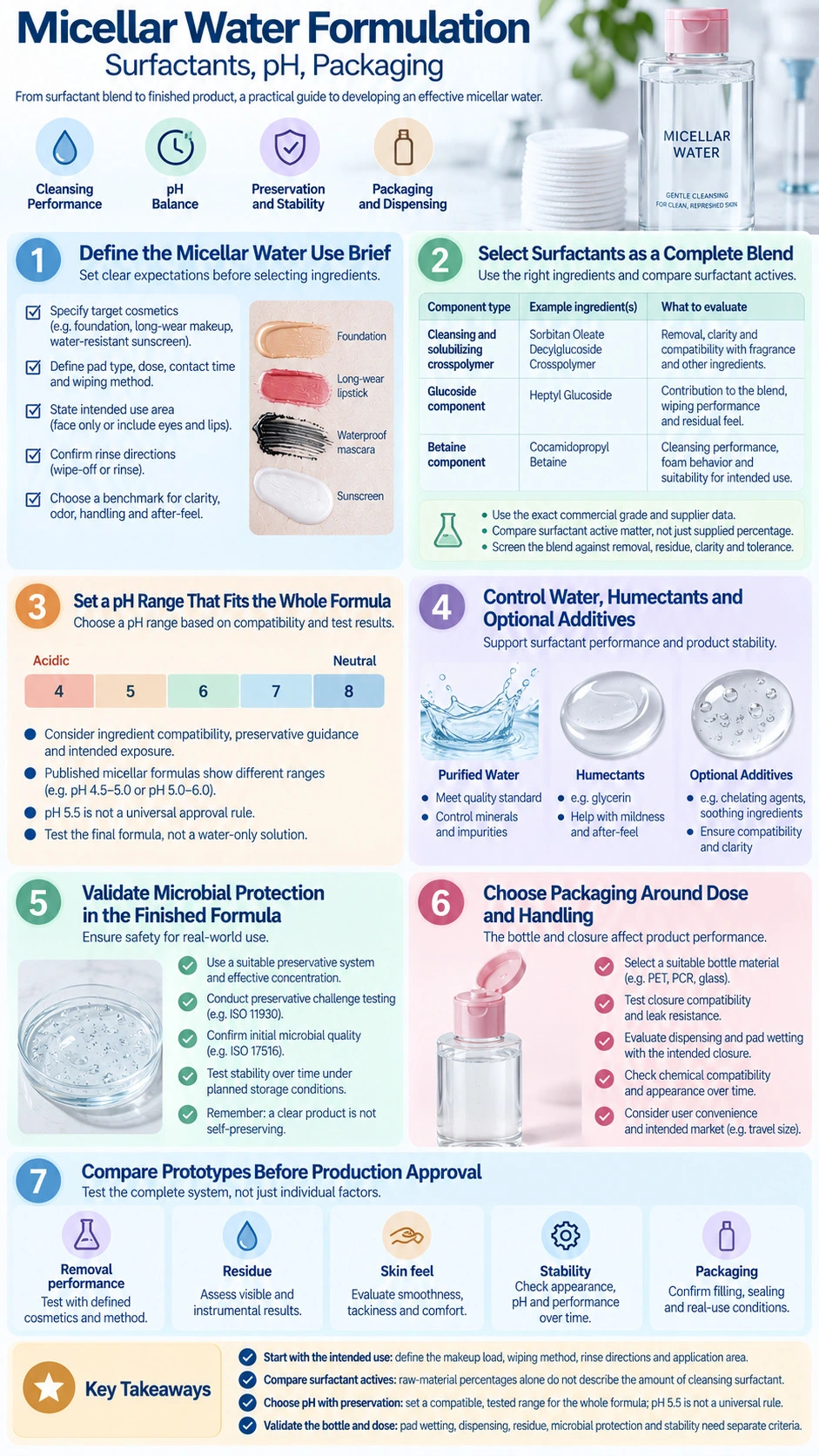
A micellar water formulation is a water-based cleansing system whose surfactants, supporting ingredients and pH must work together. The commercial target is a product that removes the specified cosmetics with the intended wiping method, feels acceptable after use and remains protected in its final bottle.
Develop it around measurable performance rather than water-like appearance alone. A clear prototype can still leave unwanted residue, dispense inconsistently or fail preservation testing.
Define the Micellar Water Use Brief
Micelles are small surfactant aggregates that exist in equilibrium with individual molecules or ions in solution.[1] In a cleansing water, surfactants help mobilize oily material, while the wetted pad and wiping action help remove it. The product name alone does not establish its aggregate structure or cleaning performance.
Specify everyday foundation, long-wear makeup or water-resistant sunscreen as separate removal targets. Record the pad type, dose, contact time, wiping method and intended use frequency. Also state whether the product is for the face only or includes the eye and lip areas; these uses change the safety assessment.
Decide the intended micellar water rinse directions during development. A wipe-off product marketed for use without rinsing must be assessed under that exposure scenario, including the material left on skin. Testing a rinsed sample does not answer the same question.
Choose a benchmark and define desired clarity, odor, foam during handling and after-feel. “Removes the selected foundation within the agreed wiping procedure” is more useful than “powerful yet gentle.”
Select Surfactants as a Complete Blend
Choose cleansing and solubilizing ingredients by grade, supplier guidance and finished-formula behavior. A published micellar solution uses Sorbitan Oleate Decylglucoside Crosspolymer for cleansing and fragrance solubilization.[2] Another micellar water combines Heptyl Glucoside with Cocamidopropyl Betaine.[3] These examples show why the category should not be reduced to one required surfactant or a nonionic-only rule.
| Component shown in a supplier prototype | Documented ingredient example | What to compare in your formula |
|---|---|---|
| Cleansing and solubilizing crosspolymer | Sorbitan Oleate Decylglucoside Crosspolymer | Removal, clarity and compatibility with any fragrance or other poorly water-soluble ingredients. |
| Glucoside component | Heptyl Glucoside | Its contribution within the blend, including clarity, wiping performance and residual feel. |
| Betaine component | Cocamidopropyl Betaine | The blend’s cleansing performance, foam behavior and suitability for the intended exposure. |
These are formulation components, not interchangeable recipes or a mildness ranking. Source the exact commercial grades and evaluate the complete blend; an INCI name does not specify every characteristic of the supplied material. The broader cleanser surfactant selection decision should include the intended wiping and rinse conditions.
Compare both supplied-material level and surfactant active matter. For a hypothetical single ingredient supplied at 50% surfactant active matter, adding 0.8% of that material contributes 0.4% surfactant actives to the finished formula: 0.8% × 0.50 = 0.4%. This arithmetic is an example, not a recommended micellar water level. For blends, use the supplier’s composition data and add the contributions of the relevant surfactants; total solids are not necessarily surfactant actives.
Critical micelle concentration, or CMC, describes the concentration transition associated with micelle formation in a particular solution.[4] It is not a universal finished-product dosage. Screen a supplier-supported range against removal, residue, clarity and tolerance in the complete formula and intended use method.
Set a pH Range That Fits the Whole Formula
Set the cleanser pH specification at the intersection of ingredient compatibility, preservative guidance, intended exposure and finished-product test results. Do not choose one number solely because it is associated with skin care.
Published prototypes illustrate different specifications: one micellar solution lists pH 4.5–5.0.[2] Another lists pH 5.0–6.0 measured at 25°C.[3] These ranges belong to those formulas. They are neither a universal target nor evidence that every formula within them is safe or adequately preserved.
Review each preservative system’s supplier-specified pH window when choosing preservatives. A change made to improve skin feel must remain compatible with preservation and the other ingredients. Establish a release range and investigate drift during storage instead of accepting a single fresh-sample reading.
Use a documented measurement method. Potentiometric pH measurement uses a glass electrode and reference electrode in an aqueous sample solution.[5] Have the laboratory select suitable equipment, calibration buffers, sample preparation, temperature and reading endpoint. Record whether the result refers to the product as supplied or a defined dilution; those measurements should not be treated as interchangeable.
Make adjustments gradually with a defined, suitable acid or base solution under the laboratory’s procedure. Mix completely, allow the agreed equilibration period and remeasure. Include the adjustment in batch records.
Control Water, Humectants and Optional Additives
Specify the water grade, chemical and microbiological limits, and storage and handling controls. A description such as “deionized” or “distilled” does not establish the water’s microbiological quality. Contaminated water or raw materials can introduce microorganisms into cosmetics.[6]
Humectants support the desired after-feel, but the wipe-off residue must remain acceptable. A published micellar prototype includes glycerin as a humectant.[2] Screen the chosen amount for pad glide, drying feel and tackiness rather than assuming a higher level improves the product.
Add fragrance, oils, botanical extracts and other optional materials only when they serve the brief. Each addition can introduce a new solubility or compatibility question. Compare it against the base for haze, sediment, odor, color, pH and performance, and assess the resulting formula’s safety and preservation requirements.
Keep solubilization and cleansing as separate approval questions. A blend that keeps a small fragrance load clear has not necessarily demonstrated removal of a dried, long-wear cosmetic film. Likewise, added soothing or hydrating ingredients do not automatically justify claims about the completed cleanser.
Use the processing conditions appropriate to the actual grades. Record addition order, mixing, any heating, cool-down and pH adjustment. Control aeration so entrained bubbles do not confuse appearance checks or filling observations.
Validate Microbial Protection in the Finished Formula
A water-rich micellar cleanser needs a documented microbial-control strategy covering raw materials, manufacture, storage and use. A preservative on the ingredient list is one part of that strategy, not proof that the finished formula is protected. Packaging and consumer handling can also contribute to contamination risk.[6]
Plan preservative challenge testing on the relevant final formulation. ISO 11930 provides a framework for evaluating antimicrobial protection and is primarily designed for water-soluble or water-miscible cosmetics.[7] Agree on the applicable method and criteria with the laboratory, including neutralization and recovery suitability. Supplier results from a different prototype do not transfer to your own formula.
Assess initial microbiological quality separately. ISO 17516 addresses cosmetic microbiological quality; that assessment answers a different question from how effectively a formulation resists an introduced microbial challenge.[8] Define the applicable product category and testing scope, especially for an eye-area use claim.
If the surfactant blend, pH, botanical load or preservative system changes, review whether the preservation evidence remains representative. A smaller bottle or a different closure does not automatically remove the need for protection.
Choose Packaging Around Dose and Handling
Select a dispenser that wets the intended pad predictably while limiting spills and unnecessary contact. A water-thin product needs a different dispensing review from a cream cleanser; bottle appearance alone is insufficient.
| Packaging format | Main use advantage | Checks before approval |
|---|---|---|
| Flip-top or disc-top bottle | Direct pouring onto a pad in a familiar format. | Orifice size, stream control, drips, closure sealing and leakage in the intended transport orientation. |
| Conventional dispensing pump | Repeated doses without tipping the bottle. | Output per stroke, priming, splashing, lock function and performance near the end of the bottle. |
| Pad-press dispenser | A pad is pressed against a dispensing surface. | Pad wetting, contact-surface cleanliness, pooling, possible backflow and leakage around the mechanism. |
Treat these as candidate formats to evaluate, not promises that one design is inherently hygienic or suitable for every formula. Test the actual bottle, closure, liner, seals, dip tube and other product-contact parts with the approved formula. Do not approve compatibility solely from a label such as PET, PP or glass.
For dose control, weigh repeated deliveries from representative packs. If the specification is in milliliters, use the measured product density to convert mass to volume; assuming every formula has exactly the density of water can distort the result. Check the beginning, middle and end of pack use where dispensing behavior may differ.
Include leakage, handling, transport, decoration and component interaction in packaging compatibility testing. For refill concepts, assess the refill container and reused dispenser together, including intended cleaning and refilling instructions. Do not assume a reused contact surface behaves like a new pack.
Compare Prototypes Before Production Approval
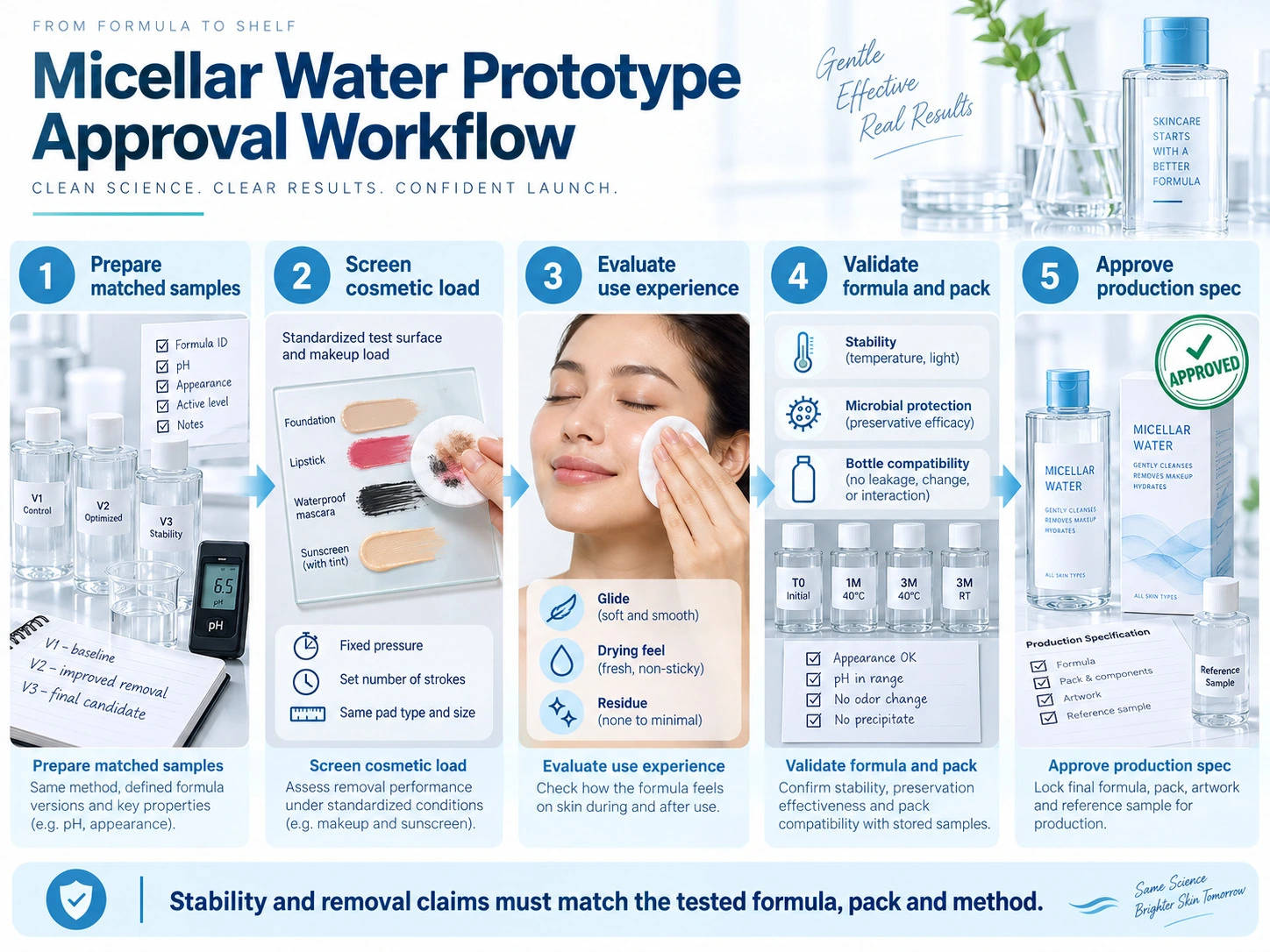
Use a repeatable development sequence that separates performance screening from safety, preservation and shelf-life approval. Cosmetic stability guidance leaves the manufacturer responsible for specifying and justifying the test protocol rather than prescribing one universal schedule.[9]
- Prepare matched samples: Record formula version, raw-material grades and processing history. Condition prototypes and the benchmark consistently, then measure appearance, pH and relevant physical properties using agreed methods.
- Screen the specified cosmetic load: Apply the same makeup or sunscreen to a suitable bench substrate, using a defined application area and drying period. Standardize pad type, weighed product dose, contact time, wiping force and number of passes; record remaining cosmetic material.
- Evaluate the intended use experience: After appropriate safety review, assess pad glide, removal, drying feel and residue under the proposed directions. Evaluate face-only, eye-area and no-rinse uses according to their actual exposure; bench cleaning results do not establish human tolerance.
- Complete formula and pack validation: Conduct the agreed microbial-protection, microbiological-quality, stability and compatibility assessments on representative samples. Include stored samples in relevant performance checks, and investigate haze, pH drift, sediment, odor or dispenser changes.
- Approve a reproducible production specification: Confirm the formula, processing limits, fill quantity, dispenser output, pack components, artwork and acceptance criteria. Compare pilot or production samples with the approved reference before release, and review later substitutions for their testing impact.
A stability testing result supports the conditions and configuration actually studied. A clear bottle after a short heat exposure does not, by itself, establish a commercial shelf life. Keep claims such as waterproof-makeup removal tied to the specific cosmetics, method and results used to substantiate them.
Discuss Your Micellar Water Brief With ZICAIL
ZICAIL’s face cleanser development services cover private label, OEM/ODM, custom formulation and packaging options.[10] For a micellar water project, confirm the specific formula route, dispenser availability, testing scope, MOQ and sampling plan with the team.
Send your micellar water brief with the destination market, benchmark, target makeup or sunscreen, application areas, rinse direction, fragrance preference, desired after-feel, bottle concept, fill volume, order quantity and launch timing. These inputs help define which sample and packaging evaluations the project needs.


