

Pimple patch manufacturing combines material selection, skin-contact design, conversion and protective packaging. A commercial specification must connect the material system, patch geometry, application method and protective packaging with the intended claims.
For brands, the first task is to choose the format and identify which production steps the supplier actually controls. A factory converting purchased hydrocolloid rolls offers a different development route from one formulating the adhesive or producing dissolving microneedle arrays.
Define Intended Use and Claims Before Material Selection
Specify the destination market, intended user, application area, skin condition at application and wear directions. Also define whether the patch is a physical covering, contains an ingredient intended to act on skin, or uses projections designed to enter the skin.
For the United States, intended use helps determine whether a product is a cosmetic or drug; labeling and promotional claims contribute to that determination.[1] A physically acting product can also require medical-device classification review. The device definition considers intended purpose and whether that purpose is achieved primarily through chemical action or metabolism.[2]
Have a qualified regulatory specialist review the actual construction and claims before artwork and tooling approval. “Treats acne,” “kills acne bacteria,” a wound-care indication and a decorative-covering claim do not describe the same intended use. Adding salicylic acid does not, by itself, establish that the finished patch qualifies for a particular OTC route.
Keep the product claims and evidence brief aligned with the selected route. Do not assume every product called a pimple patch can use the same cosmetic documentation or manufacturing controls.
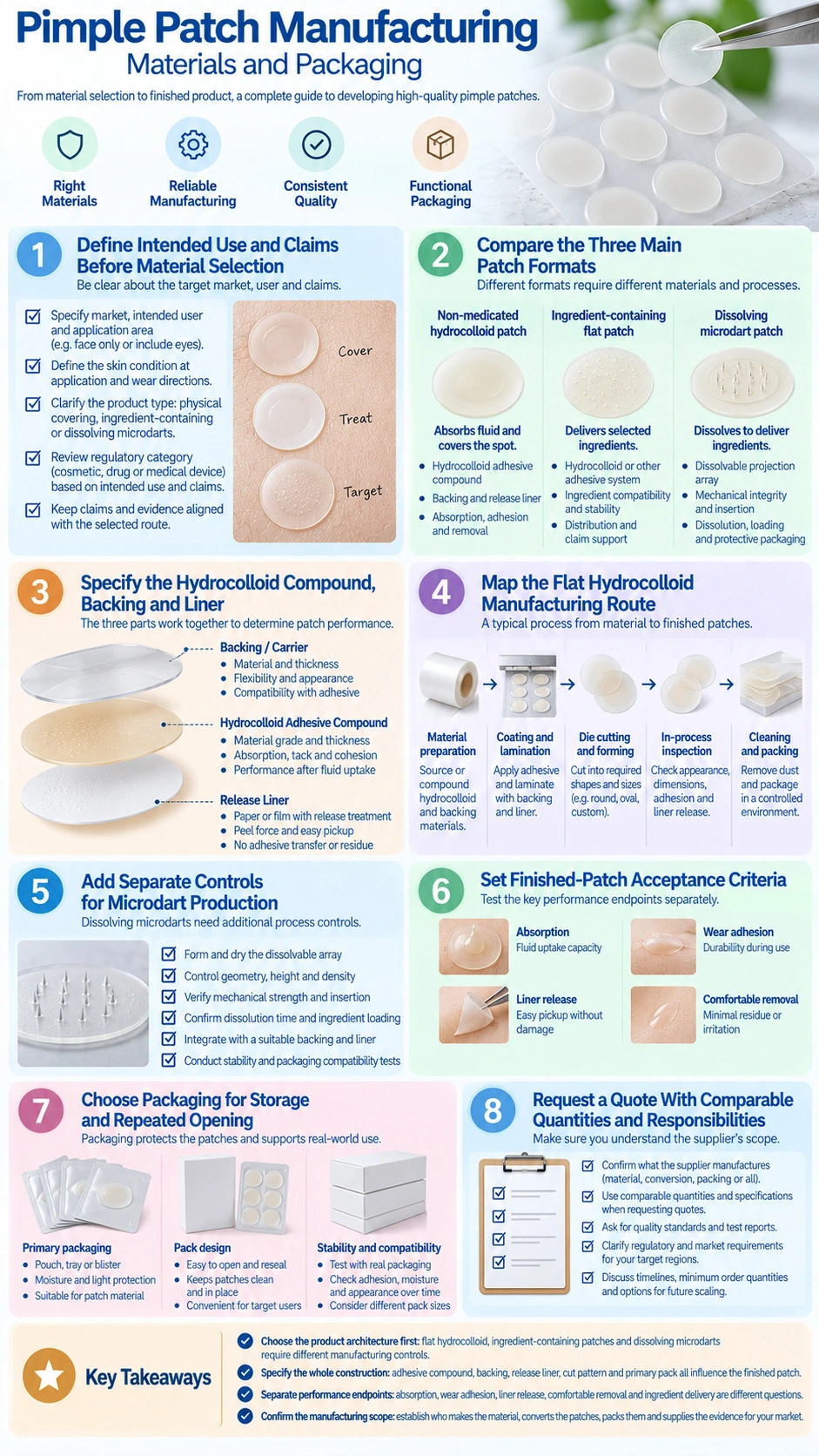
Compare the Three Main Patch Formats
Choose the format by its intended mechanism and technical requirements. Ingredient-containing flat patches may use hydrocolloid or another adhesive construction; a marketing name does not establish the layer design.
| Patch format | Main construction task | Additional development questions |
|---|---|---|
| Non-medicated hydrocolloid patch | Combine an absorbent adhesive compound, supporting backing and removable liner. | Absorption, wear adhesion, edge visibility, release and removal after use. |
| Ingredient-containing flat patch | Incorporate the selected ingredients into a suitable flat patch system. | Ingredient compatibility, distribution, stability, availability at the contact surface and claim substantiation. |
| Dissolving microdart patch | Form a dissolvable projection array and integrate its support and attachment system. | Array geometry, mechanical integrity, insertion, dissolution, ingredient loading and protective packaging. |
The hydrocolloid versus microdart distinction is a production decision as well as a consumer choice. Flat-patch cutting equipment does not establish the ability to mold and validate microdarts. Resolve that capability before comparing quotations.
Specify the Hydrocolloid Compound, Backing and Liner
A hydrocolloid adhesive combines an adhesive base with gel-forming absorbent particles. Carboxymethylcellulose and pectin are examples used in commercial hydrocolloid materials.[3] The compound is not interchangeable with the water-rich gel used in a hydrogel face mask.
Specify three parts of the flat construction together:
- Hydrocolloid adhesive compound: Record the material grade, thickness or coating specification, absorption behavior, tack and cohesive integrity. Evaluate it after fluid uptake as well as when dry; the absorbent and adhesive functions belong to the same working system.
- Backing or carrier: Specify the retained support layer, including its material, thickness, flexibility, appearance and compatibility with the compound. A thin edge and low visibility must be evaluated on the finished patch rather than inferred from a film name.
- Release liner: Specify the removable paper or film, release treatment, peel behavior and presentation. Check that the user can lift a patch without stretching it, transferring adhesive or unnecessarily touching the contact surface.
Published master-roll options include polyurethane or polyethylene carriers and polyester or paper release liners.[4] These are examples of component choices, not proof that any available grade suits your product.
Ask for a construction drawing that separates the skin-contact side, retained backing and discarded liner. For colored or printed designs, identify where decoration sits and assess its contact, migration and compatibility implications rather than treating ink as an artwork-only change.
Map the Flat Hydrocolloid Manufacturing Route
Flat patches can begin with qualified purchased roll stock or a custom material-making program. Commercial hydrocolloids are supplied as rolled materials and converted components, so material production and final conversion need not occur at the same facility.[3]
Use the following sequence to define the production route and responsibilities. The exact equipment and process limits depend on the chosen construction.
- Qualify the patch laminate: Obtain the approved compound, backing and liner construction. If the supplier makes the material, qualify mixing, coating and lamination; if it buys prepared stock, verify the incoming grade, thickness, dimensions, storage history and traceability.
- Prepare material for conversion: Condition and handle the laminate under defined environmental and cleanliness controls. Where slitting is required, control roll width, alignment, tension and handling to avoid distortion or contamination.
- Cut the approved patch pattern: Validate tooling, cut depth, dimensions and spacing. For patches presented on a liner sheet, keep that liner functional and confirm clean edges, complete separation and easy pickup without tearing or adhesive strings.
- Assemble and seal the sale unit: Prepare the specified sheet or individual presentation, verify patch count and orientation, and place it in the approved primary pack. Control handling time, seal conditions and any protective insert required by the design.
- Inspect and release the batch: Check sampled material and finished units against the approved criteria. Record material lots, conversion and packing records, defects, count, coding and release decisions; keep representative retains for later comparison.
Review the conversion process when changing the hydrocolloid grade, liner or backing, even if the patch shape and outer carton stay the same.
Add Separate Controls for Microdart Production
Dissolving microdarts require a validated method for forming the projection array. A published hyaluronic-acid microneedle study uses defoaming, a precision mold, pressure, drying and demolding, followed by morphology and mechanical testing.[5] That is a research example, not a production recipe or evidence that a commercial acne patch has been qualified.
Require specifications for projection height, base dimensions, spacing, array coverage and defect limits. Inspect missing, blunt, bent or fractured projections, and establish suitable mechanical, insertion and dissolution assessments. Do not borrow a study’s needle dimensions, force or dissolution time as universal acceptance values.
Where an ingredient is loaded, establish its location and amount per patch, distribution across the array and stability through processing and storage. Ingredient content, array insertion, dissolution and delivery to the intended site require separate evidence. The disappearance of visible projections does not alone quantify the amount delivered to the intended site.
Include demolding, assembly and transport in the damage assessment. The pack must protect projections against contact and deformation while controlling the moisture conditions needed to preserve the approved product behavior. Recheck the array after storage rather than inspecting only fresh, unpacked samples.
Set Finished-Patch Acceptance Criteria
Agree on the test methods and limits before selecting the winning sample. Material datasheets help screen candidates, but the finished construction is the product users handle and wear.
- Absorption and wet integrity: Define the test liquid, exposure time, temperature and sample preparation. Record dry and wet mass using a consistent surface-liquid removal procedure, and check swelling, leakage and cohesion. State whether uptake is reported per patch, per area or per gram of the tested construction.
- Liner release and handling: Measure or compare release under defined conditions. Check patch lifting, stretching, tearing, contact-surface contamination and removal of adjacent patches from the sheet.
- Adhesion during wear: Evaluate the intended application site, movement, moisture exposure and wear period. Fix the skincare order and application directions used in the assessment; an oily or wet application surface changes the task.
- Removal and skin response: After appropriate safety review, assess removal behavior, adhesive residue and relevant skin responses under intended use. Maximum tack is not the same as the right skin-contact performance.
- Ingredient and format-specific performance: For ingredient-containing products, assess identity, content, uniformity and stability as applicable. For microdarts, add the validated array, insertion and dissolution checks rather than relying on flat-patch tests alone.
For example, a whole-patch uptake result normalized to dry mass includes the backing in its denominator if the backing was part of the weighed specimen. It should not be presented as the absorbency of the hydrocolloid compound alone. Larger or thicker patches can also absorb more total liquid without proving better performance for the intended use.
Select safety and microbiological assessments for the product’s classification, contact type, contact duration and manufacturing route. For medical devices, biological evaluation considers the final finished product, including relevant processing and sterilization, rather than approving individual ingredients in isolation.[6] A raw-material “skin-safe” statement does not close that assessment.
Choose Packaging for Storage and Repeated Opening
Choose the primary pack for material protection, use frequency and handling. A retail carton organizes and communicates the product; it should not be assumed to provide the same protection as the sealed primary package.
| Primary packaging approach | Main use advantage | Checks before approval |
|---|---|---|
| Multi-patch sheets in a resealable pouch | Convenient access to several patches from one pack. | Initial seal, reclosure, repeated-opening exposure, sheet handling and performance of the last unused patches. |
| Individually sealed flat-patch packs | Each unopened patch or small unit retains its own sealed enclosure. | Seal consistency, opening force, count, handling and protection during distribution. |
| Protected microdart unit inside a barrier pack | A support or cavity can prevent direct contact with the projection array. | Clearance, restraint, crush protection, moisture exposure, opening and array integrity after storage. |
Separate the film’s moisture barrier from the finished pack’s integrity. ASTM F1249 measures water-vapor transmission through films and sheeting under defined conditions.[7] A film result does not capture every seal, fold, opening or handling condition of the finished pack.
Assess sealing with the actual laminate and product presentation. ASTM F88/F88M measures the force required to separate a specimen containing a seal and identifies the failure mode.[8] Seal strength is one endpoint; appropriate leak or integrity checks answer additional questions. Keep specimens, conditioning and test techniques consistent when comparing results.
Use packaging compatibility testing to review contact materials and stored-product behavior, with a protocol suited to the patch. Examine aged liner release, adhesion, absorption and, where relevant, ingredient stability or microdart integrity. Do not assume “foil pouch” establishes shelf life.
A sealed pack is not automatically sterile. If the selected product is a device supplied as sterile, establish the applicable sterilization and sterile-barrier validation requirements. U.S. guidance for sterile-device 510(k) submissions addresses sterilization information and packaging that maintains sterility.[9] That guidance does not mean every pimple patch needs a 510(k) or must be sterile.
Request a Quote With Comparable Quantities and Responsibilities
Define the sale unit before discussing MOQ. For a hypothetical order of 10,000 retail packs containing 24 patches each, the requirement is 240,000 finished patches. Patch count, sheet count and retail-pack count should be separate quotation fields.
Ask whether the minimum is driven by material rolls, custom tooling, printed pouches, cartons or another component. Geometry and spacing also affect material utilization; have the supplier calculate yield from the actual cut layout and allowance for rejects. A price for generic circles is not directly comparable with a custom shape or microdart unit.
Resolve formula, packaging and finished-pack MOQ differences before setting the launch quantity. Separate tooling, samples, testing, printing, freight and repeat-order assumptions from the product unit price.
Document who performs material manufacture, conversion, ingredient incorporation, packaging, testing and batch release, including any subcontracted steps. Request the relevant specifications, reports and change-control responsibilities. A factory certificate or attractive sample does not identify which part of the process that supplier actually owns.
Discuss Your Pimple Patch Brief With ZICAIL
ZICAIL’s acne-care skincare development covers private label, OEM/ODM, formulation and packaging support for acne-care product projects.[10] Submit a pimple patch proposal for feasibility review, including confirmation of the available format, actual manufacturing scope, testing support, packaging route and commercial minimums.
Send your pimple patch brief with the destination market, intended claims, preferred construction, sizes or shapes, ingredients if proposed, wear directions, patch count per pack, packaging concept, order quantity and target launch date.


