


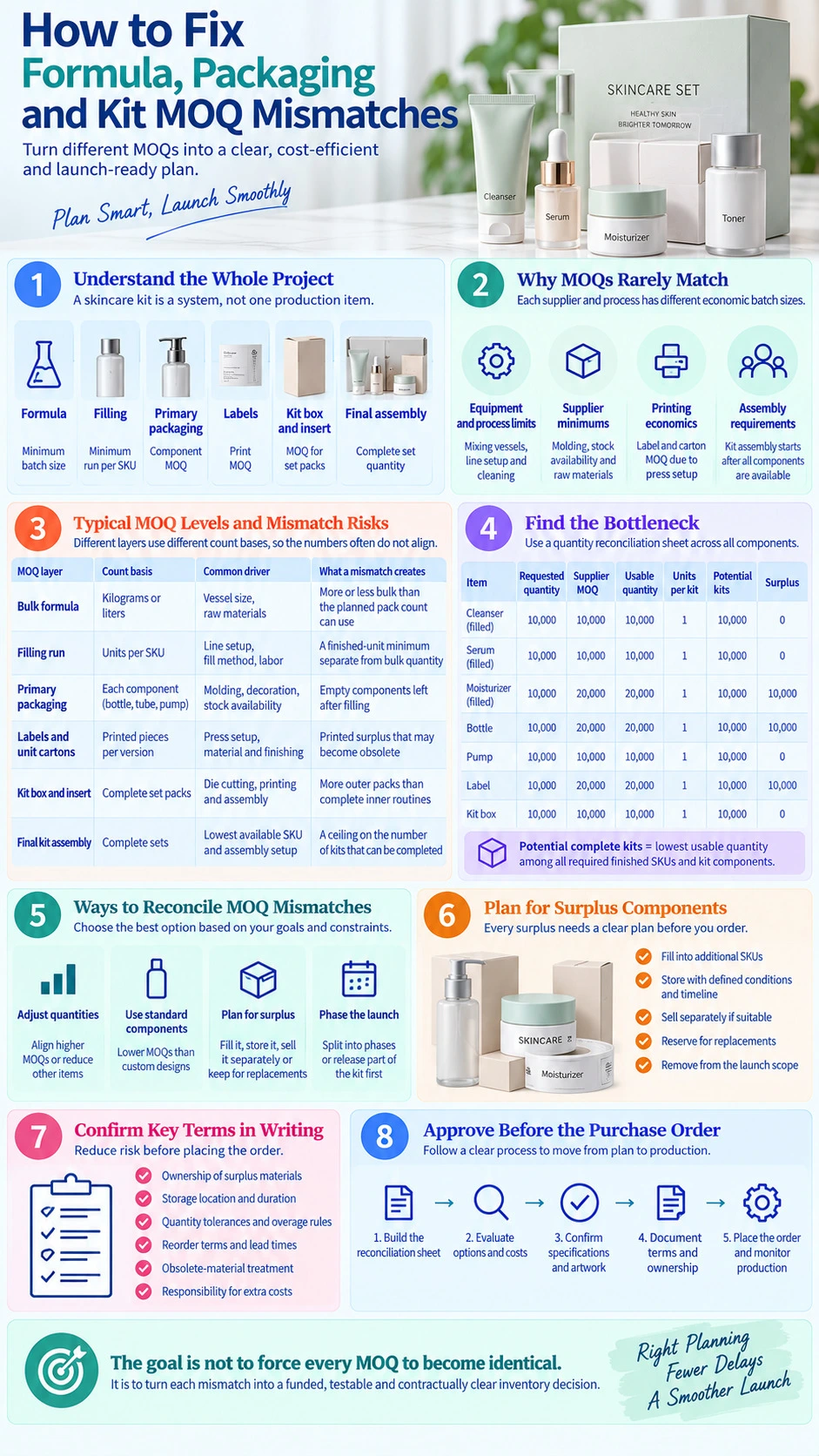
A multi-product skincare set is not one production item. It is a coordinated system of formulas, primary packages, printed components and final assembly. Each supplier and process may use a different economic batch size, so the numbers often fail to align on the first quotation.
That mismatch is manageable when it is found before deposits and artwork approval. It becomes expensive when a brand discovers late that it bought 5,000 custom pumps for 1,000 serums, produced more cream than it can fill, or cannot assemble a complete kit because one SKU finished short.
Why Formula, Packaging and Kit MOQs Rarely Match
MOQ is a minimum purchase or production commitment, not a promise that every layer will produce the same number of saleable units. Formula batches may be constrained by mixing equipment and raw-material purchasing. Bottles, tubes and pumps may be constrained by molding, decoration or supplier stock. Labels and cartons have print setup economics. Kit assembly starts only after all required products and set components are available.
Published supplier information shows how project-specific these numbers can be. Formula and packaging minimums may be quoted separately.[1] A selected airless package can carry a much higher component MOQ than the desired finished-product run.[2] The exact figures on those supplier pages are examples, not universal market benchmarks.
| MOQ layer | Count basis | Common driver | What a mismatch creates |
|---|---|---|---|
| Bulk formula | Kilograms, liters or batch | Vessel size, process control, raw materials | More or less bulk than the planned pack count can use |
| Filling run | Units per SKU | Line setup, cleaning, fill method, labor | A finished-unit minimum separate from bulk quantity |
| Primary packaging | Each bottle, tube, jar, pump, cap or dropper | Stock availability, molding, color and decoration | Empty components left after the first filling run |
| Labels and unit cartons | Printed pieces per artwork version | Press setup, material and finishing | Printed surplus that may become obsolete after an artwork change |
| Kit box and insert | Complete set packs | Structure, die cutting, printing and assembly | More outer packs than complete inner routines |
| Final kit assembly | Complete sets | Lowest available SKU and assembly setup | A ceiling on the number of kits that can be completed |
The general private label skincare MOQ guide explains typical MOQ drivers. For a set project, the more useful question is whether the minimum applies per product, per packaging component or per assembled kit. That distinction is covered in the skincare set MOQ guide and must be made explicit in the quotation.
Find the Bottleneck With a Quantity Reconciliation Sheet
Build the reconciliation sheet before choosing a solution. Use one row for every formula, finished SKU and packaging component. Record the requested launch quantity, supplier MOQ, expected usable output, units consumed per kit, planned surplus, owner, storage location, shelf-life or obsolescence risk, and reorder lead time.
For a mass-based fill, expected filled units equal net usable bulk divided by target fill weight. If the package declares volume, do not divide kilograms by milliliters without the approved product density and the manufacturer’s conversion. In both cases, ask whether quoted output is theoretical or already accounts for processing loss, quality-control samples, retain samples and filling rejects.
Potential complete kits can then be calculated as the lowest usable count among all required finished SKUs, kit boxes and other one-per-kit components. If a kit uses two sachets of one product, divide the usable sachet count by two before applying the minimum. This is a planning ceiling, not a release guarantee; actual assembly still depends on accepted production output and final quality inspection.
The example below assumes a brand plans 1,000 cleanser-serum-cream kits. The numbers are illustrative only.
| Required item | Purchase or production commitment | Expected usable output | Used for 1,000 kits | Planned balance |
|---|---|---|---|---|
| Cleanser | 1,200 filled units; 3,000 tubes purchased | 1,180 finished units | 1,000 | 180 finished units plus 1,800 unused tubes |
| Serum | 1,050 filled units; 3,000 bottles purchased | 1,030 finished units | 1,000 | 30 finished units plus 1,950 unused bottles |
| Cream | 1,500 filled units; 5,000 jars purchased | 1,470 finished units | 1,000 | 470 finished units plus 3,500 unused jars |
| Printed kit box | 1,500 boxes purchased | 1,450 accepted boxes | 1,000 | 450 boxes |
The serum is the bottleneck: the theoretical maximum is 1,030 complete kits because it has the lowest usable one-per-kit count. A planned launch of 1,000 sets leaves 30 serum units as a narrow reserve, but it also leaves much larger cream, cleanser and empty-packaging balances. Those balances are not free simply because they are not assembled into the first kit run.
Keep three totals separate: cash purchased, usable inventory and saleable finished goods. Combining them hides the real exposure. A 5,000-piece jar purchase is not 5,000 saleable creams, and 1,500 printed boxes are not 1,500 complete kits.
Decide What to Do With Each Type of MOQ Mismatch
Start with the limiting layer, because solving a non-limiting surplus may not increase the number of complete kits.
| Mismatch | Immediate consequence | Practical decision |
|---|---|---|
| Packaging MOQ exceeds filled-product quantity | Cash is tied up in empty components | Store approved blank components for a reorder, select a lower-MOQ stock pack, or raise the fill only when demand supports it |
| Formula batch yields more than available packaging | Bulk may remain unused or require another fill plan | Buy compatible packaging, revise batch size if technically possible, or confirm whether controlled bulk storage is technically acceptable and contractually available |
| One finished SKU is below the others | Complete-kit assembly stops at that SKU’s usable count | Increase that SKU, reduce the kit target, or redesign the set without the constrained product |
| Kit-box MOQ exceeds inner-product output | Printed set packaging remains after assembly | Use a less customized box, retain controlled stock for a repeat kit, or use a flexible sleeve or label route |
| Printed label or carton MOQ exceeds the product run | Artwork-specific inventory may become obsolete | Freeze claims and regulatory copy before printing, or use a lower-commitment print method for the first run |
| Supplier quantity tolerance permits an underrun | A nominally matched order may still finish short | Order a documented buffer or require a guaranteed minimum accepted quantity |
Do not assume every surplus can be kept for the next run. Formula-contact packaging must remain suitable for the product and filling process, and stored components must be protected from contamination, deformation, fading and uncontrolled substitutions. Bulk formula needs its own technical assessment because stability, microbiological control, storage time and release conditions differ from those for empty packaging. Validate the selected pack with the actual formula through appropriate packaging compatibility testing; purchasing extra units does not establish compatibility.
Filled surplus requires a different decision. It can support samples, replacements or separate retail sales only if the unit has suitable packaging, traceability, shelf-life support and market-ready labeling. If a kit-only mini will be sold on its own, revisit the skincare kit labeling requirements instead of assuming the outer set box still supplies the necessary information.
Compare the Main Ways to Reconcile MOQ Mismatches
Choose the route that reduces total exposure, not automatically the route with the lowest unit price.
| Reconciliation route | Best fit | Main advantage | Main risk or trade-off |
|---|---|---|---|
| Raise the finished-product run | Demand and working capital are supported | Uses more formula and packaging in the first run | More cash, storage and sell-through risk |
| Use stock packaging with labels | Early launch or uncertain demand | Lower customization commitment and easier replenishment | Less distinctive packaging and possible label application cost |
| Buy custom packaging and carry the balance | Stable design with a credible reorder plan | Preserves the desired pack while spreading component use across runs | Storage cost, damage, supplier change and artwork obsolescence |
| Sell excess finished SKUs individually | Each product also has a valid standalone role | Converts unequal output into additional sellable stock | Separate forecasting, labels, cartons and channel planning |
| Reduce or phase the SKU count | One product creates disproportionate MOQ or delay | Protects cash and simplifies assembly | A narrower routine at launch |
| Simplify the kit box or insert | Outer packaging is the main constraint | Keeps the product set while reducing print commitment | Lower presentation impact or more manual packing |
| Change the constrained SKU’s format or size | A package or fill format is driving the mismatch | May align yields and component availability | New samples, compatibility work, artwork and cost review |
Calculate each option at the project level. Include formula, filling, empty components, decoration, cartons, assembly, testing, freight, duties, storage, possible write-offs and the working capital held in surplus inventory. The three-product skincare line cost guide can help frame those cost categories, but the decision still needs supplier-specific quantities and terms.
A reusable component can be less risky than a lower-priced printed component. For example, an undecorated stock bottle may work across future artwork revisions, while a direct-printed bottle becomes obsolete if the product name, claims, market language or responsible-party details change. Conversely, carrying blank components is still a poor choice if the pump, neck finish or formula compatibility remains unapproved.
Confirm Ownership, Storage and Quantity Terms in Writing
A supplier may be willing to store surplus components, but storage is a service with risk and conditions—not an informal promise. Ask for the following in the quotation, manufacturing agreement or purchase order:
- exact component description, supplier code, artwork revision and quantity owned by the brand;
- where the material will be stored, how it will be identified and whether lots remain segregated;
- storage fees, free-storage period, insurance or loss responsibility, and disposal rules;
- shelf-life, inspection or requalification requirements before the next production run;
- who owns tooling, molds, plates, screens and buyer-funded surplus materials;
- permitted overrun or underrun, the invoice basis, and whether an exact or guaranteed-minimum quantity is available;
- whether rejected, damaged or setup-loss units count toward the ordered quantity;
- reorder MOQ, component lead time, substitution rules and change-approval process;
- treatment of obsolete packaging after artwork, formula, regulation or supplier changes;
- whether unused formula, filled surplus and empty packaging have different storage and release terms.
These points cannot be inferred from the MOQ alone. Packaging suppliers may base quotations on the exact container, decoration, quantity, packing, inspection and delivery scope, and they may require a complete bill of materials before confirming a project.[3] Published custom-packaging terms also show that overrun and underrun allowances can affect the delivered and invoiced quantity, so the applicable tolerance must be checked rather than assumed.[4]
Put the same assumptions into a controlled private label skincare RFQ. If one supplier quotes 1,000 finished kits while another quotes 1,000 units of each inner SKU plus separately purchased packaging, the prices do not share the same denominator.
Reconcile Skincare Kit MOQs Before the Purchase Order
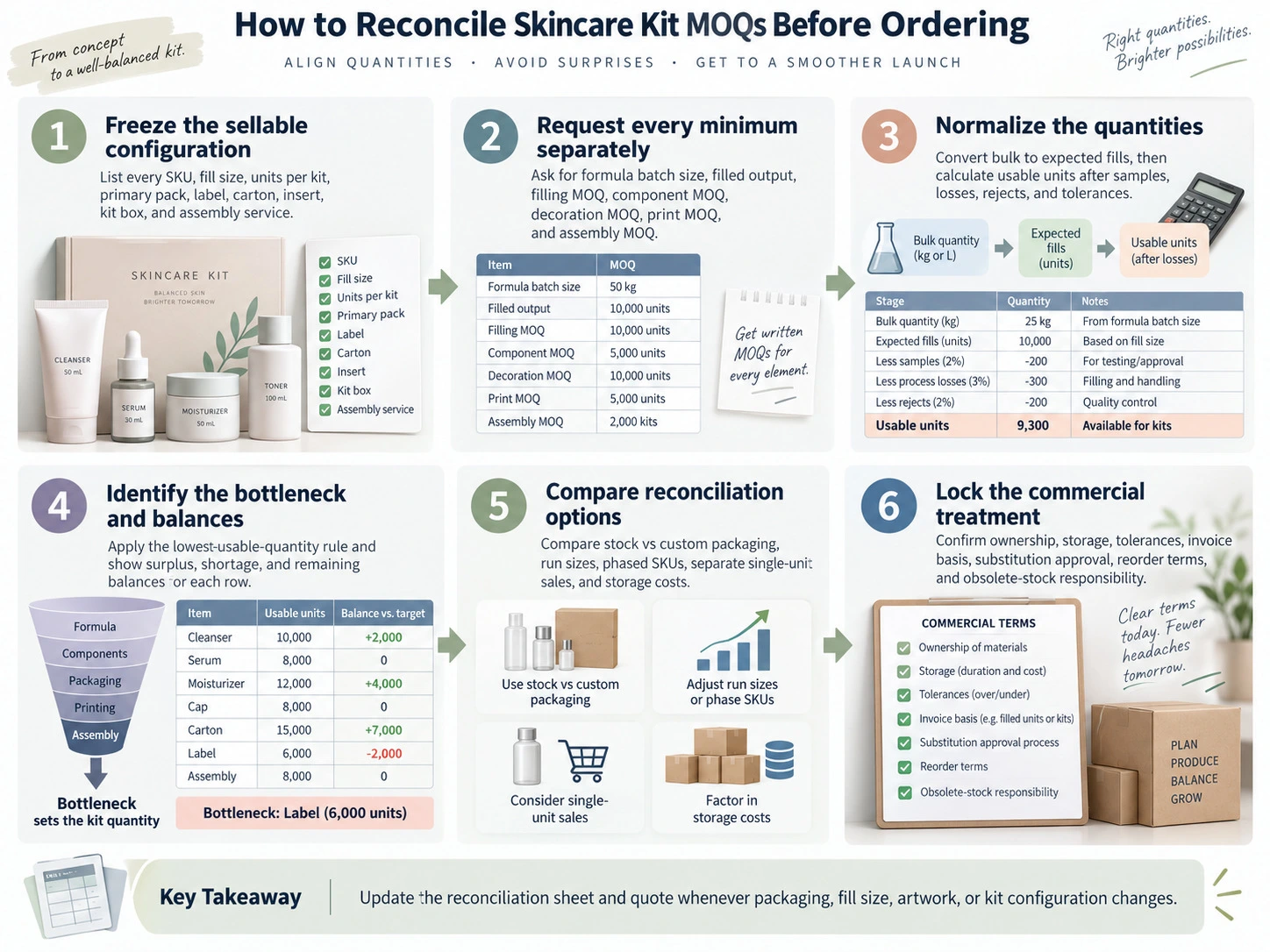
- Freeze the sellable configuration. List every SKU, fill size, units per kit, primary package, label, unit carton, insert, kit box and assembly service.
- Request every minimum separately. Ask for formula batch size, expected filled output, filling MOQ, component MOQ, decoration MOQ, print MOQ and final assembly MOQ.
- Normalize the quantities. Convert bulk to expected fills using approved fill weight or density, then calculate usable units after stated samples, losses, rejects and supplier tolerances.
- Identify the bottleneck and balances. Apply the lowest-usable-quantity rule, then show finished surplus, empty-component surplus and any shortage for every row.
- Compare reconciliation options. Price stock and custom packaging, different run sizes, phased SKUs, separate single-unit sales and storage across the same time horizon.
- Lock the commercial treatment. State ownership, storage, tolerances, invoice basis, substitution approval, reorder conditions and obsolete-stock responsibility before deposit and production approval.
If the quantities change after packaging or formula approval, update the reconciliation sheet and quote together. A new bottle, fill size, artwork version or kit configuration can change the limiting MOQ and invalidate the earlier total.
Avoid These Common MOQ Mismatch Mistakes
- Treating a manufacturer’s advertised MOQ as the final MOQ for every SKU, component and assembled set.
- Comparing unit prices without comparing total first-order cash commitment and unused inventory.
- Dividing bulk kilograms by a volume fill without accounting for formula density.
- Ordering all components at the highest MOQ even when there is no funded use for the surplus.
- Counting uninspected components or unreleased filled units as available kit inventory.
- Assuming the lowest formula MOQ controls the project when a pump, printed tube or kit box has a higher minimum.
- Approving printed packaging before claims, required copy, markets and artwork revisions are stable.
- Storing excess components without ownership records, lot identity, inspection criteria or a reorder plan.
- Selling kit-only surplus as standalone products without checking its labeling and retail-pack requirements.
- Forgetting that one short SKU can stop the whole kit even when every other item has excess stock.
The most useful procurement question is not “Can you lower the MOQ?” It is “Which exact item controls the saleable quantity, what will remain after the run, and who carries each balance?”
Bring a Reconciled Skincare Kit Brief to ZICAIL
ZICAIL can review stock, semi-custom, custom-formula, and filling-and-packaging skincare project briefs and help identify the information needed for quotation. Prepare the SKU list, formula route, fill sizes, target kit quantity, packaging specifications, artwork status, sales markets, required tests, desired launch window and your completed MOQ reconciliation sheet.
Use the sheet to flag which requirements are fixed and which can change. Then contact ZICAIL about your skincare kit project so the quotation can separate formula, packaging, printing, assembly, surplus and next-run assumptions.


