

Eye patch formulation involves more than selecting a serum and a crescent shape. The gel must survive removal from its pack, follow the under-eye contour and remain comfortable until removal.
This guide focuses on preformed hydrogel patches for external under-eye skin. Soaked fabric patches, dissolving microdarts and medical patches applied to the eye itself require different development routes.
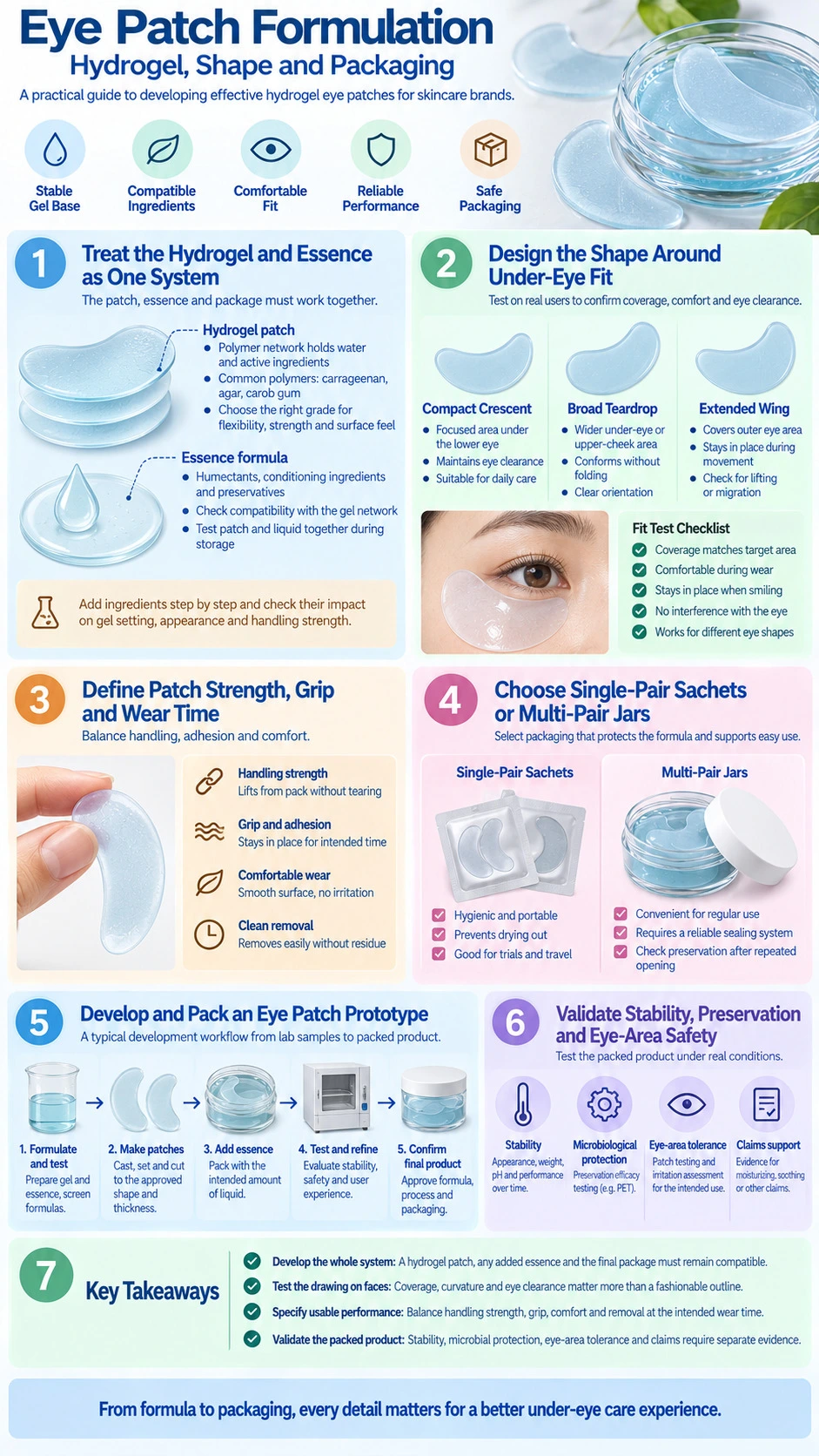
Treat the Hydrogel and Essence as One System
Select the gel network
In a hydrogel eye patch, a polymer network holds water and other formula components within the patch itself. Carrageenan-based systems, sometimes combined with gums such as agar or carob gum, are established cosmetic options.[1] The patch is therefore part of the formulation, rather than simply a fabric carrying liquid.
Choose the polymer grade or blend for the required flexibility, strength, surface feel and processing conditions. A formula that sets firmly in a beaker still needs to form a thin, removable patch without cracking or tearing. If a backing, mesh or release liner is used, specify it separately and distinguish what remains on the patch from what the user removes.
Grade-specific instructions matter. For Satiagel VPC 614, a kappa carrageenan grade, technical guidance calls for adding salts late and avoiding high shear after electrolyte addition.[2] Do not apply those instructions automatically to every hydrogel system.
Start with the hydrogel mask formulation principles, then form samples at the proposed eye-patch thickness. Bulk texture alone does not show whether a narrow tip will lift intact from a tray.
Add ingredients without losing patch performance
Set a clear cosmetic purpose before building an ingredient list. Humectants, conditioning ingredients and the preservation system must work with the gel network and any surrounding liquid. An extract or active blend also brings its carrier, salts, solvents and pH effects into the formula.
Compare the base gel with controlled additions before combining every proposed active. Check setting, appearance, handling strength and surface liquid after the same conditioning period. Record the actual raw-material grade and supplied concentration; a trade-name blend is not equivalent to the same percentage of pure ingredient.
If the pack contains extra essence, test the patch and liquid together. A gel approved before packing can behave differently after storage in that liquid. Adding more essence should be treated as a formula-and-pack change requiring evaluation.
Review decorative materials as carefully as actives. For U.S. eye-area cosmetics, some color additives allowed in cosmetics generally are not permitted around the eyes.[3] Confirm the intended use of every colorant rather than relying on a facial-mask supplier’s general approval statement.
Design the Shape Around Under-Eye Fit
Approve a dimensioned drawing through fit trials before committing to custom tooling. Shape names are not standardized specifications: two “crescent” patches can differ in inner curvature, width, thickness and tip position.
The following directions are starting concepts, not clinically ranked designs.
| Shape direction | Intended coverage | Fit questions to resolve |
|---|---|---|
| Compact crescent | A focused area beneath the lower eye contour. | Does the inner curve leave appropriate eye clearance while maintaining contact across the target area? |
| Broad teardrop | A wider under-eye or upper-cheek area with a narrower tip. | Does the wide end conform without folding, and is the intended orientation obvious? |
| Extended wing | Under-eye coverage extending toward the outer eye area. | Does the extension stay in contact during smiling and movement without lifting or migrating toward the eye? |
After appropriate safety clearance for human use, evaluate both sides of the face across the intended user population. Include differences in facial size, under-eye contours and cheek movement. Ask users to place the patches from the proposed directions, then observe placement, edge lift, sliding and removal.
Define the intended placement below the lash line and away from the eye opening. Do not invent one universal clearance distance without validating it for the drawing and users. If changing orientation changes coverage, show the tested orientation clearly.
The approved drawing should identify dimensions, tolerances, thickness measurement points and whether a pair contains mirrored pieces or two identical pieces. A photograph alone cannot control production.
Define Patch Strength, Grip and Wear Time
A patch needs enough cohesion to be picked up and removed intact, but stronger or stickier is not automatically better. Specify several behaviors rather than accepting one gel-strength number.
- Handling strength: Use a defined pickup tool, lifting method and conditioning temperature. Record tears, permanent stretching, sticking between patches and clean release from liners or trays where present.
- Conformity and grip: Assess full-area contact, edge lift and movement on the intended skin preparation. Use consistent posture and movement tasks rather than testing only on a reclining, motionless wearer.
- Surface feel and removal: Record dripping, residue, discomfort and the ease of peeling away at the instructed endpoint. Grip during wear and gentle removal are separate acceptance criteria.
- Wear-time behavior: Compare wetness, shrinkage, edge hardening and comfort over the proposed use period under defined ambient conditions.
Keep the amount of added liquid, skin preparation and application position consistent when comparing prototypes. Otherwise, a change in sliding may be caused by the test setup rather than the gel.
Set wear instructions from the finished product’s performance and safety assessment. A patch becoming thinner or clearer does not, by itself, show that its ingredients have entered the skin. Avoid making that visual change the sole endpoint for use.
Once the use conditions are validated, translate them into clear directions covering placement, timing and removal. The under-eye patch usage guide addresses those consumer-facing questions; it does not replace product-specific testing.
Choose Single-Pair Sachets or Multi-Pair Jars
Select the package while the formula and shape are still being refined. The pack controls access, protects the patch and determines whether repeated opening must be assessed.
| Format | Why consider it | Main development checks |
|---|---|---|
| Single-pair sachet | A sealed portion for one application, with a tray or liner if needed for handling. | Water-loss protection, seal integrity, patch damage, opening behavior and recovery of both pieces from the pack. |
| Multi-pair jar | Repeated access to several applications in one container. | Closure performance, retrieval without tearing, sticking between patches, liquid distribution and changes through repeated opening. |
For sachets, evaluate the actual film structure, seal layer and sealing process. A suitable barrier film does not compensate for a defective seal. Check whether formula or gel fragments contaminate the sealing area and whether transport leaves the patches folded or trapped.
For jars, evaluate early, middle and final uses. Define the interval between openings, time left open, retrieval tool and storage orientation. Compare the remaining patches for appearance, handling and liquid distribution; a satisfactory unopened jar does not establish performance after repeated access.
Specify quantities in both pieces and pairs. For example, 30 pairs means 60 individual patches; 30 pieces means only 15 two-patch applications. Confirm usable count, liquid fill and fill tolerances separately.
Use packaging compatibility testing on the final container, liner, seal, tray and retrieval tool where applicable. Assess leakage, mass change, material changes and patch condition together. A new resin, closure or film supplier may change the result even when the artwork stays the same.
Develop and Pack an Eye Patch Prototype

Use this sequence to turn a brief into a repeatable packed sample. The exact forming route and process settings depend on the chosen gel system and equipment.
- Freeze the product brief: Record the target market, cosmetic claims, benchmark, drawing, intended wear conditions, package format, count in pieces and pairs, ingredient restrictions and cost target.
- Establish the gel process: Define material grades, water quality, dispersion, hydration, heating or cooling, addition order and mixing conditions. Confirm a workable processing window for any heat-sensitive ingredients.
- Form and finish the patches: Mold or cast and cut using the selected route. Control thickness, dimensions, surface quality and handling. Inspect for bubbles, tears, distorted tips and incomplete cuts.
- Pack and condition the sample: Use the intended patch count, any added liquid and packaging components. Allow a defined conditioning period before assessing appearance, pickup, fit and wear; record both the period and storage conditions.
- Repeat at pilot scale: Check process consistency, transfer, filling and sealing on representative equipment. Link the approved sample to a formula version, drawing, process record and packed-product specification before completing validation.
Measure pH using an agreed method appropriate to the gel product and any surrounding liquid. State whether the result comes from surrounding liquid, a prepared gel extract or another justified preparation. Values obtained by different preparations should not be treated as directly interchangeable.
Avoid solving every pilot failure by increasing polymer. If patches tear only during cutting or packing, investigate tooling, release surfaces, transfer and handling conditions alongside the formula. Record the failure stage so the next sample tests a clear hypothesis.
Validate Stability, Microbial Protection and Eye-Area Safety
Stability in the marketed pack
The validation plan should justify the storage conditions, test methods and acceptance criteria for this product. ISO/TR 18811 provides a cosmetic stability framework rather than a universal test schedule.[4]
Track appearance, odor, color, pH by the specified method, dimensions, handling strength, liquid distribution and relevant ingredient assays. Include justified transport conditions and reassess fit and removal after aging.
Distinguish intended added essence from syneresis, meaning liquid expelled from the gel network. Free liquid is not automatically a defect, but an unexplained increase accompanied by shrinkage, weakening or texture change needs investigation.
Use cosmetic stability testing to establish an evidence plan for shelf life. Repeat-opening jar assessments address an additional use condition; they cannot be inferred from unopened storage alone.
Microbiological quality and preservation
Assess both microbiological quality and the protection strategy for the finished product. ISO 17516 concerns cosmetic microbiological quality and limits.[5] ISO 11930 addresses evaluation of antimicrobial protection, including preservation efficacy testing and risk assessment within its scope.[6]
Ask the laboratory how its method will represent the gel patch and any surrounding essence. Testing only an unrelated liquid sample may miss the product configuration the consumer receives. Document sample preparation and the rationale for the chosen method.
A clean batch result does not prove resistance to later contamination. A sealed sachet does not establish sterility, and a jar spatula does not eliminate contamination risk. The preservative challenge testing guide explains why preservation efficacy is a separate evidence task.
Eye-area tolerance and finished-product claims
Arrange a qualified safety assessment for the formula, external eye-area placement, wear time and foreseeable misuse. Select appropriate supervised tolerance studies; do not ask consumers to test a prototype by placing it against the eye.
Set hydration, smoothing or refreshed-appearance claims against finished-product evidence under the intended use conditions. A supplier’s ingredient study does not automatically substantiate the same benefit in the patch, and a pleasant cooling sensation does not establish a clinical effect.
Keep the assessment and labeling aligned with the intended market. “Natural,” “collagen” and “dermatologically tested” are not substitutes for the specific evidence needed to support eye-area suitability.
Discuss Your Eye Patch Development Brief With ZICAIL
ZICAIL supports private label, OEM/ODM and custom development across eye care products, including eye mask concepts. Share your target market, claims, shape drawing, wear-time target, package format, quantity in pieces and pairs, and launch plan through the eye care development service.
Ask the team to confirm the proposed hydrogel format, tooling feasibility, sampling scope, testing responsibilities, packaging options and project-specific MOQ before approving the project.


