

A sleeping mask formulation must deliver an acceptable leave-on film for hours after application. The development brief therefore needs more than a gel, cream or jelly reference photo: it must describe what happens during pickup, spreading, settling and overnight wear.
This guide covers spreadable overnight facial masks for skincare brands and product developers. Preformed hydrogel sheets, rinse-off masks and peel-off films require different design decisions.
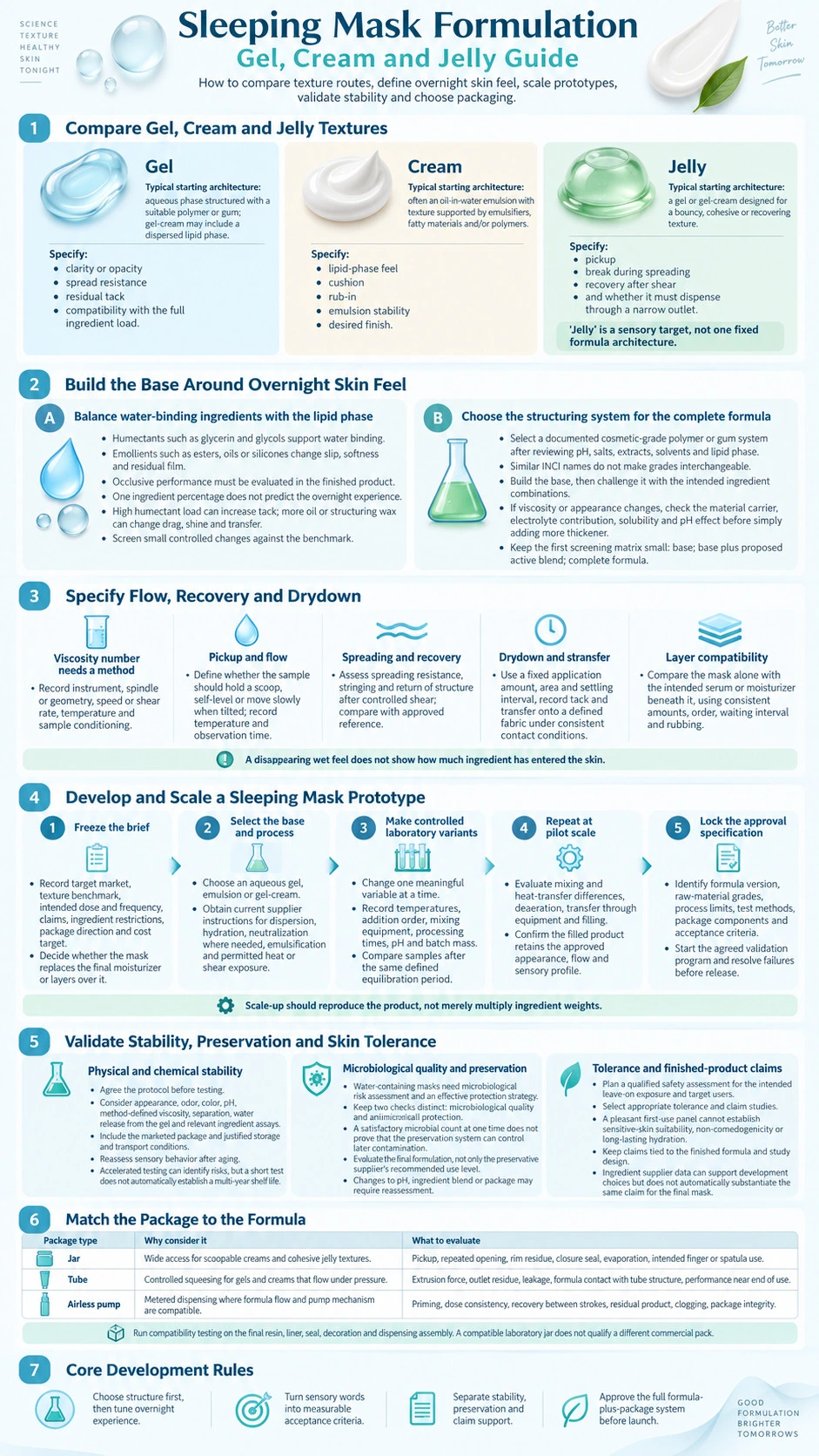
Compare Gel, Cream and Jelly Textures
Gel and cream give clues about structure; jelly usually describes how a product moves and feels. They are useful starting labels, but they do not establish ingredient composition or performance.
| Texture direction | Typical starting architecture | What to specify |
|---|---|---|
| Gel | An aqueous phase structured with a suitable polymer or gum; a gel-cream may also contain a dispersed lipid phase. | Clarity or opacity, spread resistance, residual tack and compatibility with the full ingredient load. |
| Cream | Often an oil-in-water emulsion, with texture supported by emulsifiers, fatty materials and/or polymers. | Lipid-phase feel, cushion, rub-in, emulsion stability and the desired finish. |
| Jelly | A gel or gel-cream designed for a bouncy, cohesive or recovering texture. | Pickup, break during spreading, recovery after shear and whether it must dispense through a narrow outlet. |
The overlap is practical: SEPINOV EMT 10, for example, is offered for aqueous gels, cream-gels and emulsions. A polymer name alone does not identify the finished architecture.[1] Croda’s Acai Sleeping Mask provides a separate cream-format example with an oil-in-water emulsifier.[2]
For a fresh, low-residue concept, screen a gel and a light gel-cream side by side. For a more emollient finish, screen an emulsion with the required lipid phase. For a jelly concept, add a measurable pickup-and-recovery target to either appropriate base. These are development routes, not a ranking of moisturizing efficacy.
Build the Base Around Overnight Skin Feel
Balance water-binding ingredients with the lipid phase
Humectants such as glycerin and glycols contribute water-binding functionality. Emollients such as suitable esters, oils or silicones change slip, softness and the residual film. Ingredients selected for occlusive performance can help limit water loss, but that performance needs evaluation in the finished product.
Do not use one ingredient percentage as a proxy for the whole overnight experience. A high humectant load can leave unacceptable tack; increasing oil or structuring wax can change drag, shine and transfer. Screen small, controlled changes against the benchmark rather than increasing every moisturizing ingredient together.
A watery application does not prove weak moisturization, and a rich finish does not prove superior hydration. If hydration duration is central to positioning, plan a finished-product study with the relevant dose, time points and comparator. Sensory approval answers a different question.
For a cream route, establish the emulsifier and lipid structure before tuning the after-feel; the face moisturizer formulation guide explains those design choices.
Choose the structuring system for the complete formula
Select a documented cosmetic-grade polymer or gum system after reviewing the intended pH, salts, extracts, solvents and lipid phase. Check the supplier’s compatibility and processing guidance for each specific grade; similar INCI names do not make grades interchangeable at the same level.
Build the base, then challenge it with the intended ingredient combinations. If viscosity or appearance changes after an extract or active blend is added, investigate the material’s carrier, electrolyte contribution, solubility and pH effect before simply adding more thickener.
Keep the first screening matrix small: compare base, base plus the proposed active blend, and the complete formula. Record which addition changes the texture. This makes a failure easier to isolate than comparing several heavily modified prototypes.
Specify Flow, Recovery and Drydown
A viscosity number needs a method. Temperature, measurement conditions and shear behavior affect its meaning; cosmetic emulsions can behave differently as shear changes.[3] Record the instrument, spindle or geometry, speed or shear rate, temperature and sample conditioning. A jar sample and a pump sample may require different flow profiles even when their single-point readings look similar.
Turn “bouncy but not sticky” into observable acceptance criteria:
- Pickup and flow: Define whether the sample should hold a scoop, self-level or move slowly when the container is tilted. Record the test temperature and observation time.
- Spreading and recovery: Assess resistance during spreading, stringing and the return of structure after a controlled shear history. Compare with the approved reference.
- Drydown and transfer: Use a fixed application amount, area and settling interval. Record tack and transfer onto a defined fabric under consistent contact conditions.
- Layer compatibility: Compare the mask alone with the intended serum or moisturizer beneath it. Keep product amounts, order, waiting interval and rubbing consistent.
These are development comparisons, not validated clinical endpoints. A fabric-contact test cannot establish all-night transfer resistance unless its conditions and claim are justified. Likewise, a disappearing wet feel does not show how much ingredient has entered the skin.
Use routine product compatibility testing to investigate pilling under realistic layering conditions. Check the intended mask amount first; an exaggerated laboratory layer can overstate pilling, while an unrealistically thin layer can hide it.
Develop and Scale a Sleeping Mask Prototype

Use the following sequence to move from a texture concept to a repeatable pilot sample. It is a development workflow, not a universal manufacturing recipe.
- Freeze the brief: Record the target market, texture benchmark, intended dose and frequency, claims, ingredient restrictions, package direction and cost target. Decide whether the mask replaces the final moisturizer or layers over it.
- Select the base and process: Choose an aqueous gel, emulsion or gel-cream. Obtain current supplier instructions for dispersion, hydration, neutralization where needed, emulsification and permitted heat or shear exposure.
- Make controlled laboratory variants: Change one meaningful variable at a time. Record actual temperatures, addition order, mixing equipment, processing times, pH and batch mass. Compare samples after the same defined equilibration period.
- Repeat the selected formula at pilot scale: Evaluate mixing and heat-transfer differences, deaeration, transfer through equipment and filling. Confirm that the filled product retains the approved appearance, flow and sensory profile.
- Lock the approval specification: Identify the formula version, raw-material grades, process limits, test methods, package components and acceptance criteria. Start the agreed validation program and resolve failures before commercial release.
For a hot-process emulsion, define heating and cooling stages from the actual materials selected. For a cold-process gel, establish the required wetting and hydration conditions instead of assuming all powders can be dispersed identically. More mixing is not automatically better: check for aeration and changes to structure.
Scale-up should reproduce a product, not merely multiply ingredient weights. If the pilot fills with bubbles, loses its jelly recovery or develops a different after-feel, trace the process difference before accepting a revised specification.
Validate Stability, Preservation and Skin Tolerance
Physical and chemical stability
Agree the protocol before testing. ISO/TR 18811 supplies a framework for cosmetic stability assessment; it does not prescribe one universal set of conditions or acceptance limits.[4]
For a sleeping mask, consider appearance, odor, color, pH, method-defined viscosity, separation, water release from the gel and relevant ingredient assays. Include the marketed package and justified storage and transport conditions. Reassess sensory behavior after aging: an apparently uniform gel may still become harder to dispense or more stringy.
Accelerated observations can help identify risks, but a short test does not automatically establish a multi-year shelf life. Set the evidence plan through qualified cosmetic stability testing and retain the rationale for the shelf-life decision.
Microbiological quality and preservation
Water-containing masks need a microbiological risk assessment and an effective protection strategy. Contamination can originate in water, raw materials, manufacture, inadequate packaging or consumer use, including dipping fingers into a product.[5]
Keep two checks distinct. ISO 17516 addresses microbiological quality and limits.[6] ISO 11930 addresses evaluation of antimicrobial protection, including preservation efficacy testing and risk assessment within its scope.[7] A satisfactory microbial count at one time does not demonstrate that the preservation system can control later contamination.
Evaluate the final formulation rather than relying on the preservative supplier’s recommended use level alone. Changes to pH, ingredient blend or package may require reassessment. The preservative challenge testing guide explains that separate evidence task. A clear gel or airless container does not by itself justify a low-risk conclusion.
Tolerance and finished-product claims
Plan a qualified safety assessment for the intended leave-on exposure and target users. Select appropriate tolerance and claim studies; a pleasant first-use panel cannot establish sensitive-skin suitability, non-comedogenicity or long-lasting hydration.
Keep claims tied to the finished formula and study design. Supplier data on an ingredient can support development choices, but it does not automatically substantiate the same claim for the mask. “Sleeping” describes the intended use occasion; it is not evidence that the product improves sleep or repairs skin on a special timetable.
Match the Package to the Formula
Choose the delivery system while texture screening is still open. A strongly recovering jelly may be attractive in a jar but unsuitable for a chosen pump orifice. Confirm this with actual components.
| Package direction | Why consider it | What to evaluate |
|---|---|---|
| Jar | Wide access for scoopable creams and cohesive jelly textures. | Pickup, repeated opening, rim residue, closure seal, evaporation and the intended finger or spatula use. |
| Tube | Controlled squeezing for gels and creams that flow under pressure. | Extrusion force, outlet residue, leakage, formula contact with the tube structure and performance near the end of use. |
| Airless pump | Metered dispensing where formula flow and the pump mechanism are compatible. | Priming, dose consistency, recovery between strokes, residual product, clogging and package integrity. |
Run packaging compatibility testing on the final resin, liner, seal, decoration and dispensing assembly. Check filled-pack leakage, weight change, deformation and product appearance under the justified test conditions. A compatible laboratory jar does not qualify a different commercial pack.
After pack and formula approval, write directions that match the tested use: amount, application area, frequency, routine position and any necessary settling guidance. The consumer-facing sleeping mask usage guide addresses those routine questions. Do not invent a universal pre-bed waiting time simply to compensate for unresolved tack or transfer.
Discuss Your Sleeping Mask Brief With ZICAIL
ZICAIL lists sleeping masks among its face mask development formats, with formula evaluation and packaging coordination. Share your target market, gel/cream/jelly benchmark, proposed claims, ingredient preferences, package direction and expected quantity through the private label face mask service.
Ask the team to confirm formula feasibility, sample scope, compatible packaging, testing responsibilities and project-specific commercial terms before approving development.


