

A cleanser, essence, serum, and moisturizer can each have acceptable individual data yet still create a poor routine when the layers pill, feel too heavy, leave visible residue, or become uncomfortable with repeated use. The opposite is also possible: products may feel elegant together, but that observation does not establish stability, preservation, safety, or a quantified efficacy claim.
For a brand, “test the products together” is therefore not one laboratory instruction. It is a program that separates individual SKU qualification from whole-routine usability, tolerance, and claims evidence. The program should reproduce the marketed use order, amount, frequency, target population, and relevant environmental conditions closely enough that the result answers the actual commercial question.
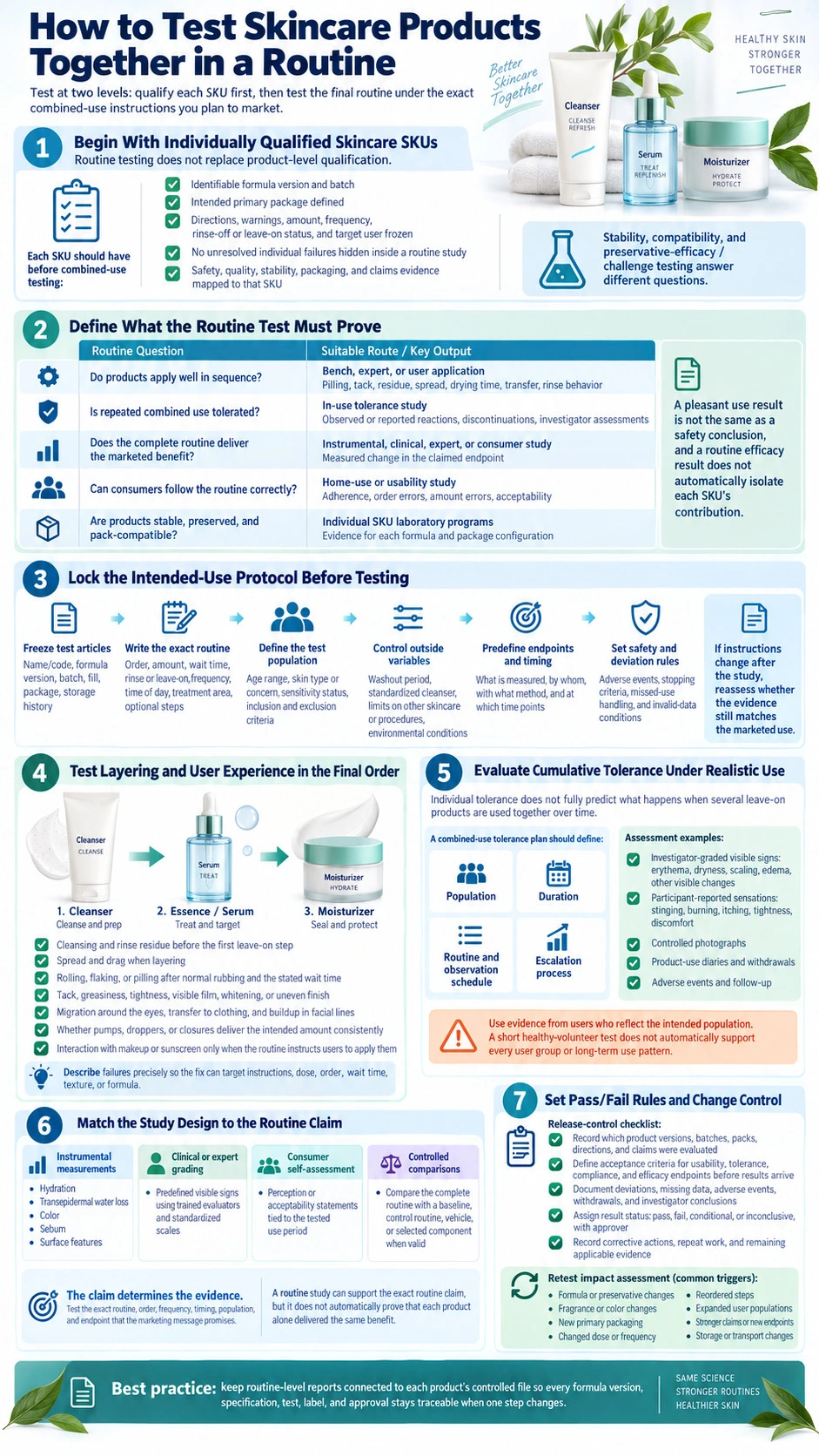
Begin With Individually Qualified Skincare SKUs
Routine testing should not be used to bypass product-level work. Before a complete set enters a combined-use study, every SKU should have a defined commercial formula, intended primary package, directions, specification, and risk-based evidence plan. For U.S. cosmetics, there is no fixed government list of tests for every product, but the manufacturer or distributor remains responsible for safety under labeled or customary use, and any testing used should be scientifically sound.[1]
The exact package of evidence varies by formula, format, exposure, market, and claims. It commonly considers formula and ingredient safety information, finished-product characteristics, microbiological quality, stability, formula–pack interaction, and the adequacy of antimicrobial protection when relevant. Stability guidance is product-specific.[3] Preservation efficacy evaluates the antimicrobial protection of a particular cosmetic formulation, and the result does not automatically transfer from one SKU to another.[4]
Use the following gate before routine-level work:
- The formula version and batch used in the study are identifiable.
- The intended primary package or a justified representative pack is defined.
- Directions, warnings, amount, frequency, rinse-off or leave-on status, and target user are frozen.
- Known individual risks or unresolved failures are not hidden inside a combined-use protocol.
- The brand knows which evidence supports safety, quality, stability, packaging, and claims for that SKU.
The distinction among stability, compatibility, and challenge testing helps prevent one report from being treated as proof of another. Formula–pack questions also need their own packaging compatibility assessment, while release specifications and cosmetic microbiological testing remain SKU-specific controls.
Define What the Routine Test Must Prove
Start with the business question, not a test name. A bench layering check, a supervised safety-in-use study, an instrumental efficacy study, and a consumer home-use test answer different questions. One can inform another, but none is a universal substitute.
| Routine question | Suitable evaluation route | Useful output | What it does not prove by itself |
|---|---|---|---|
| Do the products apply well in sequence? | Controlled bench, expert, or user application in the final order | Pilling, tack, residue, spread, drying time, transfer, rinse behavior | Long-term tolerance, preservation, or efficacy |
| Is repeated combined use tolerated by the intended user group? | Supervised or monitored in-use tolerance study under defined conditions | Frequency and severity of observed or reported reactions, discontinuations, investigator assessments | A performance benefit unless efficacy endpoints are included |
| Does the complete routine deliver the marketed benefit? | Instrumental, clinical, expert, or consumer study selected for the claim | Change in a predefined endpoint at a stated time under the tested protocol | The contribution of each SKU unless the design isolates it |
| Can consumers follow the routine correctly? | Home-use or usability study with diaries, questionnaires, or compliance records | Comprehension, adherence, order errors, amount errors, and acceptability | Objective skin change unless validated measurements are included |
| Are the products stable, preserved, and compatible with their packs? | Individual SKU laboratory programs | Evidence for each finished formula and package configuration | Whole-routine layering, tolerance, or combined claims |
This separation matters because a pleasant-use result is not a safety conclusion, and a routine-level efficacy result does not show which product caused the change. The study should be built around the decision the brand must make: release the directions, support a claim, change the order, adjust a texture, narrow the target user, or revise the set.
Lock the Intended-Use Protocol Before Testing
The protocol should represent the routine the customer will actually receive. If the instructions change after the study, the brand must assess whether the evidence still fits the marketed use.
- Freeze the test articles. Record the product name or code, formula version, batch, fill, package, and relevant storage history for every SKU.
- Write the exact routine. State application order, amount or dosing instruction, wait time if any, contact time for rinse-off products, frequency, time of day, treatment area, and whether any step is optional.
- Define the test population. Match age range, skin type or concern, sensitivity status, and other relevant inclusion and exclusion criteria to the intended claim and user. Do not recruit a convenient population and later market the finding to a materially different one.
- Control outside variables. Decide whether participants need a washout period, standardized cleanser, restrictions on other skincare or procedures, acclimation before instrumental readings, or consistent environmental measurement conditions.
- Predefine endpoints and timing. State what will be measured, by whom, with which method, at which time points, and what comparison or baseline will be used. Include compliance and product-use records when adherence can affect interpretation.
- Set safety and deviation rules. Define adverse-event recording, investigator review, stopping criteria, missed-use handling, protocol deviations, and the conditions that make data invalid or inconclusive.
Human in-use studies can evaluate single products or regimens under realistic instructed conditions, but the protocol, population, observations, and interpretation must fit the specific question.[7] A pilot application study can expose obvious pilling or instruction problems before a larger claim study, but it should not be relabeled as clinical proof.
Test Layering and User Experience in the Final Order
Layering evaluation should use the final or representative commercial versions in the order, dose, and timing customers will be told to follow. Do not simply place equal amounts of every formula in a beaker. Sequential application on skin or a justified model better represents film formation, rubbing, evaporation, and the way one layer changes the next.
Observe the complete use sequence, not just each layer in isolation. Useful checks include:
- cleansing and rinse residue before the first leave-on step;
- spread and drag when one product is applied over another;
- rolling, flaking, or pilling after normal rubbing and after the stated wait time;
- tack, greasiness, tightness, visible film, whitening, or uneven finish;
- migration around the eyes, transfer to clothing, and product buildup in facial lines;
- whether pumps, droppers, or closures deliver the intended amount consistently;
- interaction with makeup or sunscreen only when the marketed routine tells users to apply them over the set.
A failure should be described precisely. “Incompatible” is too broad when the actual issue is that a high-rubbing application causes polymer-rich layers to pill, a rich cream delays sunscreen film formation, or users apply twice the intended serum amount. The correction may be instructions, dose, order, wait time, texture, or formula—not an assumption that two named ingredients can never be used together.
Evaluate Cumulative Tolerance Under Realistic Use
Individual product tolerance does not fully answer what happens when several leave-on products are used on the same area, at the same frequency, for the marketed duration. U.S. safety substantiation may consider cumulative or other relevant exposure, and safety is judged under labeled, customary, or usual conditions of use.[2] That makes the complete exposure pattern relevant when a brand actively instructs customers to use the products as a routine.
A combined-use tolerance plan should define the population, duration, routine, observation schedule, and escalation process before enrollment. Depending on the risk and commercial question, assessments may include investigator-graded erythema, dryness, scaling, edema, or other visible signs; participant-reported stinging, burning, itching, tightness, or discomfort; photographs under controlled conditions; product-use diaries; withdrawals; and adverse events. The plan should distinguish a mild, transient sensory response from a persistent or clinically significant reaction rather than collapsing every report into one “irritation” count.
Choose participants who reflect the intended users. A routine marketed for sensitive skin needs evidence from an appropriately defined population, while a routine containing several potentially irritating steps may need conservative directions and risk-based professional review. A short test on healthy volunteers cannot automatically support every user group, frequency, season, or long-term use pattern.
Routine tolerance also does not replace investigation of an individual SKU. If reactions occur, record timing, affected area, severity, concurrent products, protocol compliance, and which steps preceded the event. The data may justify a pause, targeted follow-up under qualified oversight, formula review, or revised directions, but the next step should be determined by the protocol and qualified safety personnel.
Match the Study Design to the Routine Claim
The claim determines the evidence. If the label or campaign says “this three-step routine improves skin hydration after four weeks,” the tested articles, three-step order, frequency, population, endpoint, and four-week timing should match that message. In the EU, cosmetic claims must be supported by adequate, verifiable evidence, and studies should be relevant to the product and benefit claimed and use valid, reliable, reproducible methods.[6]
Select the method that measures the promised outcome:
- Instrumental measurements can quantify suitable endpoints such as skin hydration, transepidermal water loss, color, sebum, or surface features when the device, conditions, time points, and analysis are appropriate.
- Clinical or expert grading can assess predefined visible signs using trained evaluators and standardized scales.
- Consumer self-assessment can support perception or acceptability statements when questions are clear, neutral, and tied to the tested use period.
- Controlled comparisons can distinguish the complete routine from a baseline, vehicle, control routine, or selected component when the design makes that comparison valid.
Cosmetic efficacy guidance recognizes experimental, instrumental, expert, and consumer approaches; the best design depends on the claim and should be documented before testing begins.[5] The cosmetic claim testing methods guide explains how these evidence types differ.
Attribution is the critical limit. A study showing that a cleanser-serum-cream routine improved an endpoint can support the exact routine claim when the design and result are adequate. It does not automatically prove that the serum alone produced the full change, that each product delivered the same benefit, or that removing one step would preserve the result. If products will also be sold with individual performance claims, plan separate evidence or a study design that isolates the relevant contribution.
Set Pass/Fail Rules and Change Control
Define acceptance before results arrive. Otherwise, teams may reinterpret an inconvenient outcome after seeing the data. The release record should state:
- which product versions, batches, packs, directions, and claims were evaluated;
- the predefined acceptance criteria for usability, tolerance, compliance, and efficacy endpoints;
- deviations, missing data, adverse events, withdrawals, and investigator conclusions;
- whether the result is pass, fail, conditional, or inconclusive and who approved that decision;
- corrective actions, repeat work, and the evidence that remains applicable.
Retesting is not triggered by every minor administrative edit, but every material change deserves a documented impact assessment. Review formula or preservative changes, fragrance or color changes, new primary packaging, changed dose or frequency, reordered steps, expanded user populations, stronger claims, new endpoints, and storage or transport changes. Decide whether the existing study still represents the marketed routine, whether bridging evidence is enough, or whether part of the program must be repeated.
Keep routine-level reports connected to the controlled file for each product. A practical document set for every skincare SKU makes formula versions, specifications, tests, labels, and approvals traceable when one step changes.
Plan a Routine Testing Brief With ZICAIL
ZICAIL can discuss a multi-product skincare project when the brand has defined the proposed SKUs, formula route, primary packaging, target markets, routine order, directions, intended users, claims, and launch priorities. Bring a product matrix that separates individual-SKU evidence from routine-level questions and identifies which decisions depend on layering, tolerance, usability, or claims data.
Contact ZICAIL with the routine concept and available product documents to discuss development, packaging, testing coordination, and the information needed before a protocol can be finalized.


