
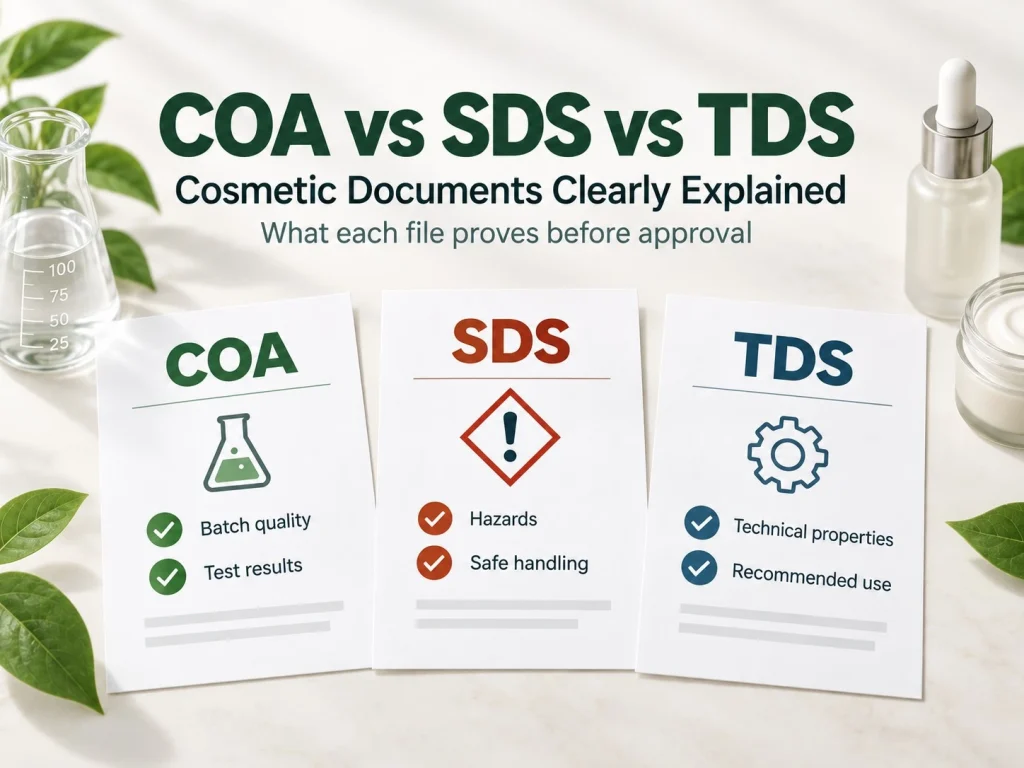

A cosmetic supplier may send a Certificate of Analysis (COA), Safety Data Sheet (SDS), and Technical Data Sheet (TDS) in one document pack. The files look technical, but they do not carry the same evidence. Treating them as interchangeable can lead to the wrong material being approved, a batch problem being missed, or a regulatory dossier being left incomplete.
The simplest distinction is time and purpose. The COA concerns the tested sample or batch. The SDS concerns hazards and safe handling. The TDS concerns the product or material grade as it is generally supplied. This article explains how to read the three files and where they fit within a controlled cosmetic documentation system.
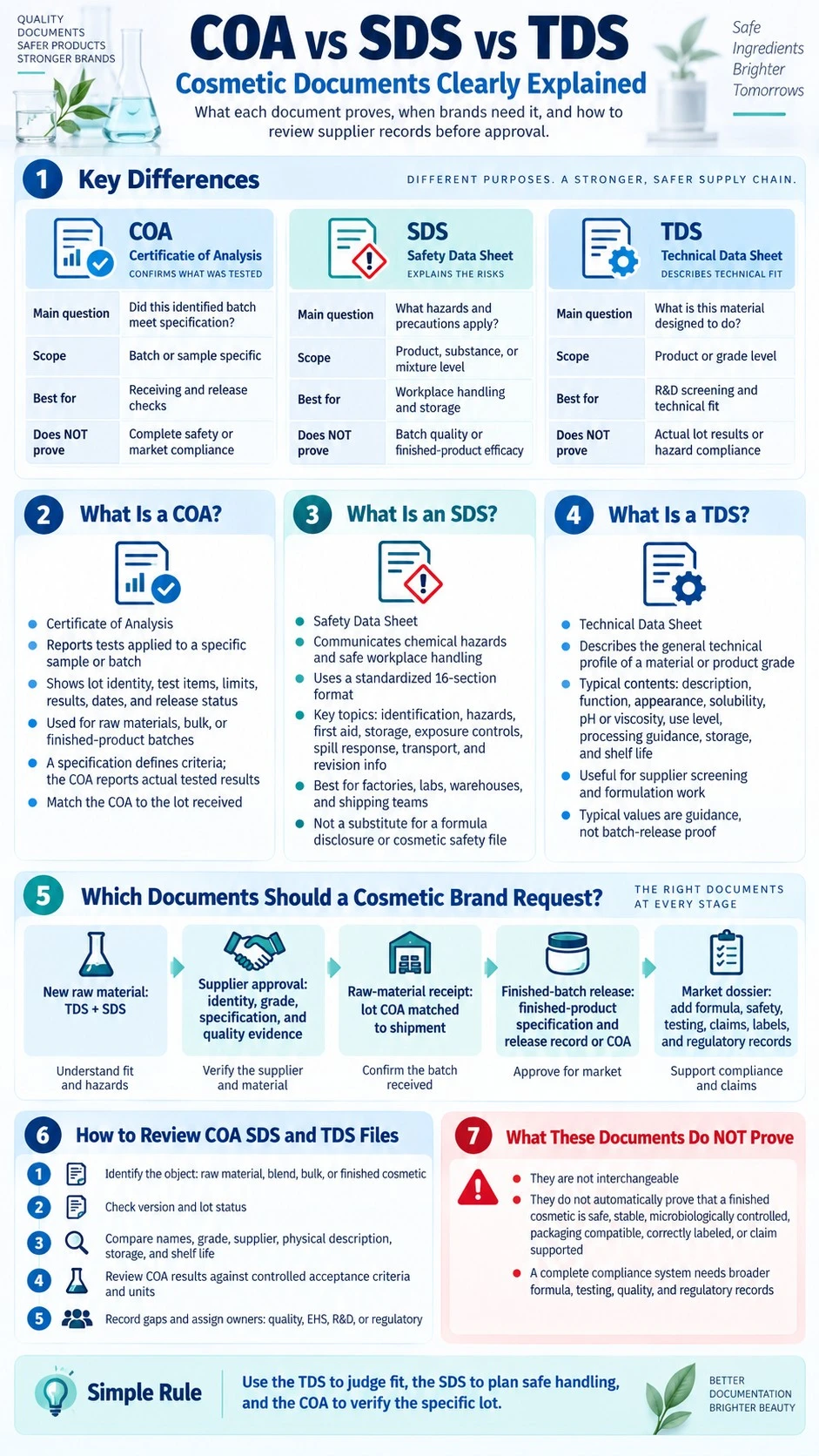
COA vs SDS vs TDS: Key Differences
The same raw material can have all three documents, yet each one should remain traceable to the correct supplier identity and grade. The table below compares their main jobs rather than treating document availability as proof of approval.
| Document | Main question answered | Usual scope | Typical contents | Primary users | When to review | What it does not prove |
|---|---|---|---|---|---|---|
| COA: Certificate of Analysis | Did this identified sample or batch meet the tested specification? | Normally batch- or sample-specific | Product and lot identity, test parameters, acceptance criteria, actual results or conformance statements, release status, dates, authorization | Quality assurance, quality control, receiving, manufacturer, brand | At receipt or batch release; again during an investigation | Complete safety, every untested attribute, legal market compliance, or future-batch consistency |
| SDS: Safety Data Sheet | What hazards and protective measures apply in the workplace? | Product-, substance-, or mixture-level; updated when hazard information changes | Identification, hazards, composition information, first aid, fire and spill response, handling, storage, exposure controls, physical properties, toxicology, transport and regulatory information | EHS, warehouse, laboratory, production, shipping | Before workplace use or storage and when revised | Batch quality, finished-product efficacy, full cosmetic safety substantiation, or complete formula disclosure |
| TDS: Technical Data Sheet | What is the material designed to do, and how is it normally used? | Product- or grade-level | Description, typical properties, function, recommended use level, processing guidance, solubility, storage, compatibility notes, commercial technical information | Formulation, R&D, procurement, technical sales | During screening, formulation, scale-up, or change review | Actual results for the received lot, workplace hazard compliance, or finished-product performance |
A quick decision rule is: use the TDS to judge potential fit, the SDS to plan safe handling, and the COA to check the specific lot. If a decision concerns the finished cosmetic rather than a raw material, request the finished-product specification, test reports, and release records that address that decision directly. The broader skincare manufacturer document checklist explains how these files fit with formula, packaging, testing, regulatory, claims, and commercial records.
What Is a Certificate of Analysis (COA)?
A Certificate of Analysis records the tests applied to a particular sample, the results obtained, and the acceptance criteria used to decide whether the sample complies with its specification.[1] In cosmetic manufacturing, that sample may be a raw-material lot, bulk batch, or finished-product batch.
A useful COA should let the reviewer connect the document to the goods. Check the supplier or manufacturer name, material or product code, grade, batch or lot number, specification reference or version, test date, and release authorization. Relevant tests vary: a raw-material COA might report identity, assay, moisture, or microbiological results, while a finished-product COA might report appearance, odor, pH, viscosity, fill quantity, or microbiological status.
Do not confuse a specification with a COA. The specification defines the tests and acceptance criteria. The COA reports what happened when an identified sample was assessed against them. A COA that says only “conforms” can still serve a controlled quality system, but actual results are more informative for quantitative attributes and trend review.
A valid-looking certificate is not independent proof that every number is reliable. Confidence also depends on how the supplier controls sampling, testing, review, electronic data, deviations, and authorization. Supplier qualification and periodic review are therefore important when a buyer relies on summary documents such as a COA.
What Is a Safety Data Sheet (SDS)?
An SDS communicates the hazards of a chemical and the measures needed for safe workplace handling. Under the U.S. Hazard Communication Standard, manufacturers and importers must obtain or develop an SDS for each hazardous chemical they produce or import, and employers must keep an SDS for each hazardous chemical used in the workplace.[2]
The standardized SDS uses 16 ordered headings, including identification, hazard identification, composition information, first aid, firefighting, accidental release, handling and storage, exposure controls, physical and chemical properties, stability and reactivity, toxicology, ecological information, disposal, transport, regulatory information, and revision information.[2] Sections 12 through 15 appear for GHS consistency, although OSHA does not enforce their information requirements because they fall outside its jurisdiction.
Cosmetic context matters. U.S. hazard-communication rules exclude cosmetics packaged for retail sale and cosmetics intended for employees’ personal consumption; the consumer-product exemption can also apply when workplace exposure is comparable in duration and frequency to normal consumer use.[2] That does not make SDS review unimportant for cosmetic factories. Concentrated raw materials, bulk mixtures, laboratory work, production handling, storage, and foreseeable spills can present a different occupational exposure scenario.
An SDS also may not reveal an exact formula. Hazard disclosure follows applicable classification and trade-secret rules, and nonhazardous ingredients may not appear in the way a cosmetic safety assessor needs. Use the SDS for hazard communication—not as a substitute for an INCI list, quantitative composition, COA, cosmetic safety assessment, or transport advice specific to the shipment.
What Is a Technical Data Sheet (TDS)?
A Technical Data Sheet describes the general technical profile of a material or product grade. Suppliers may also call it a product data sheet, technical bulletin, or specification sheet, although those names do not always mean identical content.
A cosmetic-ingredient TDS often includes a product description, intended function, INCI or chemical identity, appearance, solubility, typical pH or viscosity, recommended use level, processing temperature, order of addition, storage guidance, shelf-life statement, and compatibility notes. The fields vary because a TDS does not follow the standardized 16-section SDS format.
Pay close attention to words such as “typical,” “guide,” and “recommended.” Typical values describe the product grade but are not automatically batch-release limits. Recommended use levels are formulation guidance, not proof that any concentration is safe, compliant, stable, or effective in every finished cosmetic.
The TDS is most useful early in supplier and formula evaluation. It helps a formulator decide whether a material fits the intended process and product concept. It should then be checked against the approved raw-material specification, the current SDS, the lot COA, formulation trials, and any safety or regulatory information required for the target market.
Which Documents Should a Cosmetic Brand Request?
Request documents according to the material, stage, and responsible party—not by copying a universal checklist.
- Screening a new raw material: Request the current TDS and SDS, plus composition, origin, allergen, impurity, or regulatory information when the ingredient and target market require it.
- Approving a supplier and specification: Review the agreed material identity, grade, acceptance criteria, test methods where relevant, change-control expectations, and the supplier’s quality evidence.
- Receiving a raw-material lot: Match the lot COA to the container labels and purchase documents. Confirm that critical results meet the approved specification.
- Releasing a finished cosmetic batch: Use the finished-product specification and agreed release record or COA. Raw-material COAs do not demonstrate that the finished batch met its own criteria.
- Building a market dossier: Add the complete formula information, safety substantiation, relevant testing, claims evidence, label information, and market-specific records. The exact package extends beyond COA, SDS, and TDS.
The required finished-product evidence depends on formula, packaging, intended use, claims, and market. A skincare product testing plan should identify what must be demonstrated instead of assuming a supplier certificate answers every product question.
How to Review COA, SDS, and TDS Files
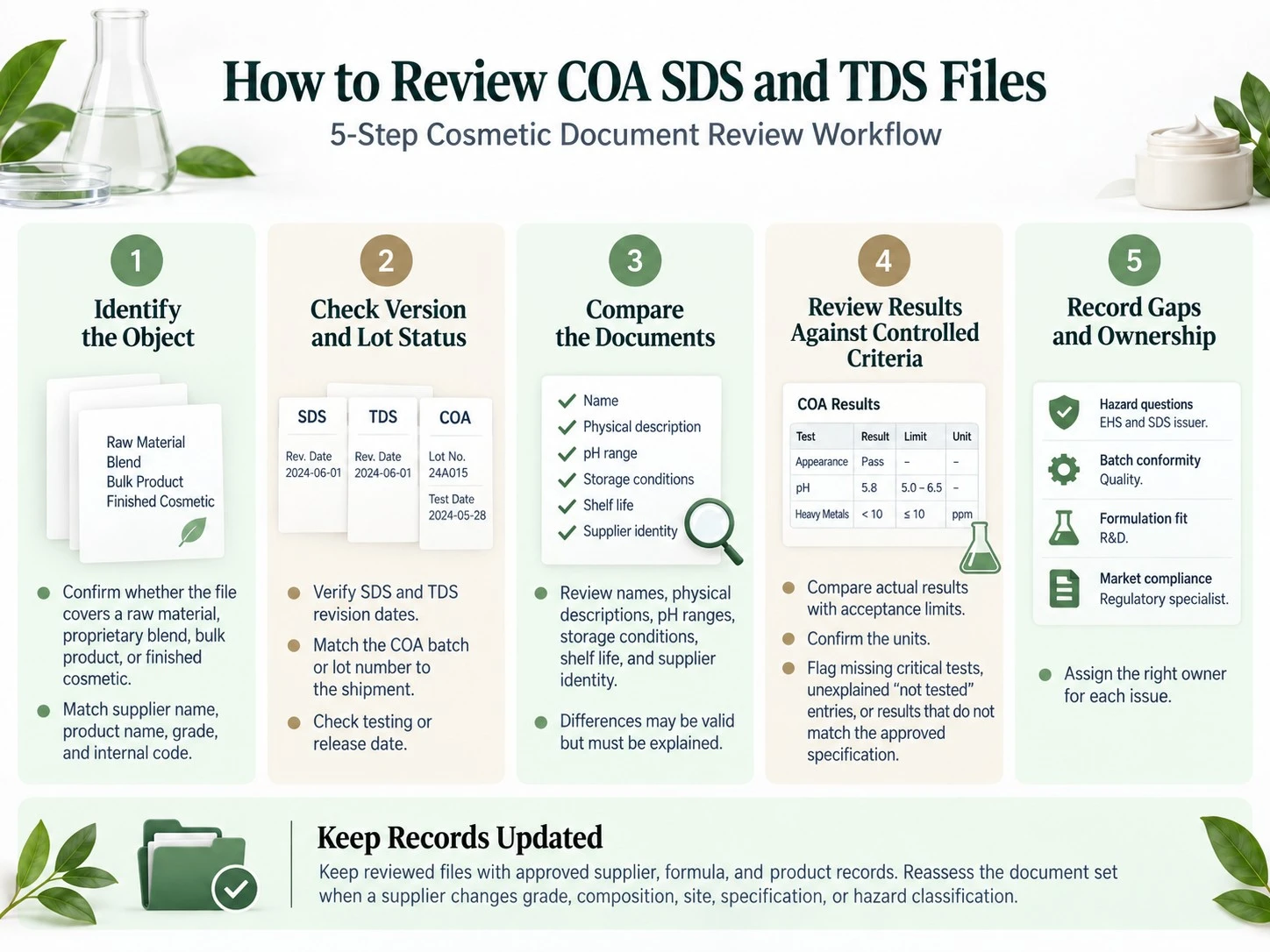
Review the documents as one controlled set while preserving their separate jobs.
- Identify the object. Determine whether each file covers a raw material, a proprietary blend, bulk product, or finished cosmetic. Match the supplier name, product name, grade, and internal code.
- Check version and lot status. Confirm revision dates for the SDS and TDS. For the COA, match the batch or lot number to the actual shipment and check the testing or release date.
- Compare the documents. Look for conflicting names, physical descriptions, pH ranges, storage conditions, shelf-life information, or supplier identities. A difference can be legitimate, but it needs an explanation.
- Review results against controlled criteria. On the COA, distinguish the result from the acceptance limit and confirm the units. Investigate missing critical tests, unexplained “not tested” entries, or results that cannot be linked to the approved specification.
- Record gaps and ownership. State which missing document or qualified party must resolve each gap. Hazard questions belong with EHS and the SDS issuer; batch conformity belongs with quality; formulation fit belongs with R&D; market compliance belongs with the brand, Responsible Person, safety assessor, or regulatory specialist as applicable.
Keep the reviewed files with the approved supplier, formula, and product records. When a supplier changes a grade, composition, manufacturing site, specification, or hazard classification, assess whether the document set, formula work, testing, labels, and regulatory files also need revision.
What COA, SDS, and TDS Do Not Prove
None of the three documents is a universal compliance certificate. A COA reports selected tests for an identified sample or batch. An SDS addresses chemical hazard communication. A TDS provides general technical information. Together, they still do not automatically prove that a finished cosmetic is safe, stable, microbiologically controlled, compatible with its packaging, correctly labeled, or supported for every marketing claim.
For U.S. cosmetics, the Responsible Person must ensure and maintain records supporting adequate safety substantiation.[4] Federal rules do not prescribe one universal test list for every cosmetic or ingredient.[3] The MoCRA compliance checklist covers the wider U.S. responsibilities that sit beyond a supplier document pack.
For EU cosmetics, the Product Information File includes the Cosmetic Product Safety Report, manufacturing-method and GMP information, and proof of claimed effects where justified.[5] The brand and its Responsible Person should use the required underlying supplier data, but a folder of COAs, SDSs, and TDSs is not itself a complete PIF. See the EU cosmetics compliance guide for the roles of the CPSR, PIF, CPNP, and Responsible Person.
The practical question is not “Do we have three PDFs?” It is “Can the evidence answer the specific quality, safety, handling, performance, and compliance decisions for this product and market?”
Plan Your Cosmetic Documentation With ZICAIL
COA, SDS, and TDS files work best as connected but non-interchangeable records. The TDS supports technical screening, the SDS supports hazard communication, and the COA supports batch-specific quality review. Their identifiers, versions, specifications, and responsibilities must stay aligned as the project moves from sampling to commercial production.
If your brand is planning a private-label or custom product with ZICAIL, prepare the target markets, product type, claims, formula route, packaging, and expected handover documents before sampling. ZICAIL can discuss these requirements alongside custom skincare formulation and manufacturing planning. Contact ZICAIL with your project brief and required document scope.


