


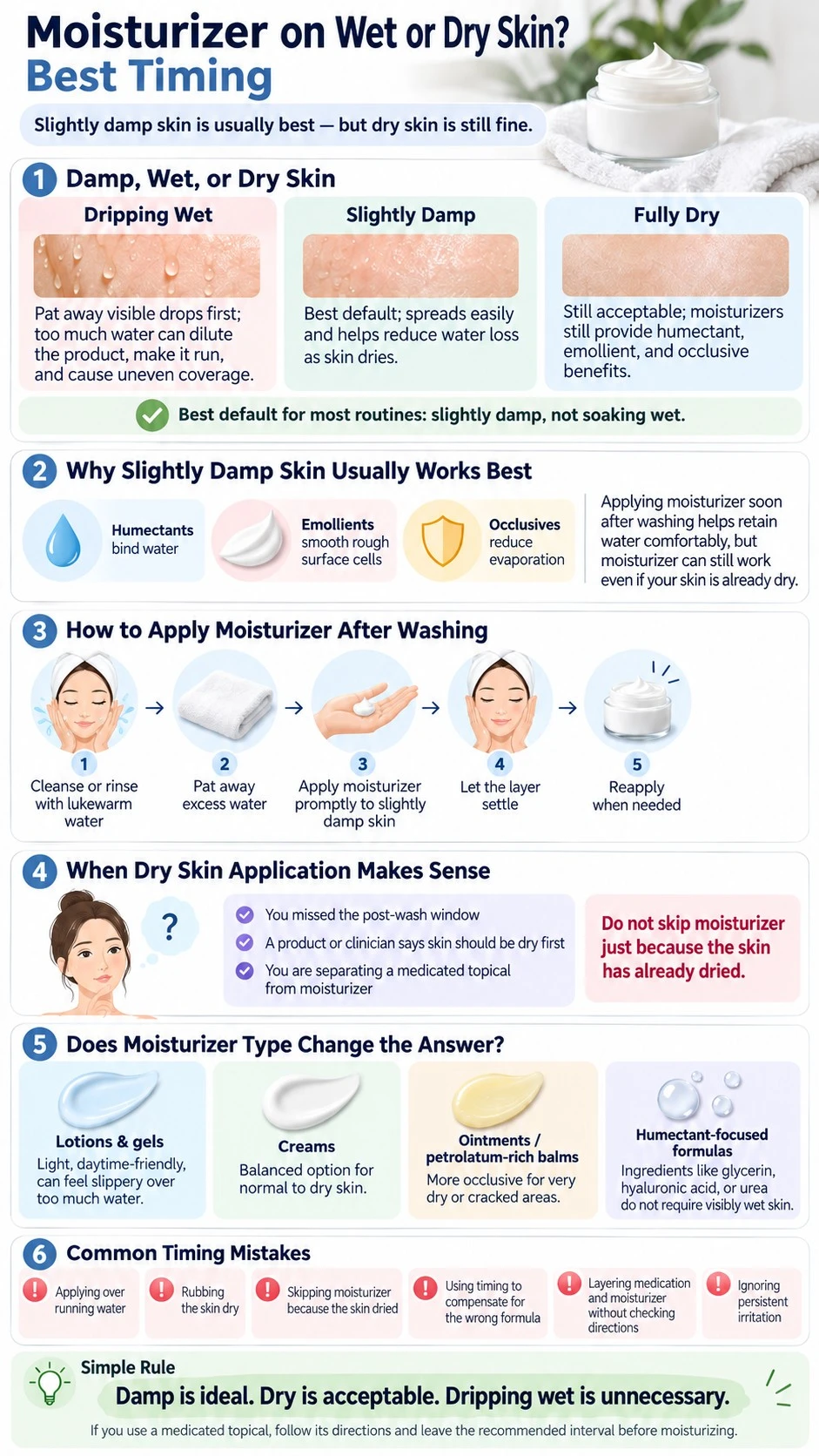
The “wet or dry” question sounds binary, but the most useful answer sits between the two. For routine facial and body care, skin that has been gently patted and remains slightly damp offers a comfortable surface for spreading moisturizer. There should be no beads of water rolling down your face.
Timing is helpful, not a pass-or-fail test. If your skin is already dry, apply the moisturizer anyway. The right product used consistently is more important than chasing a few perfect seconds after cleansing.
Damp, Wet, or Dry Skin: What Changes?
| Skin state | What to do | Why | Best use case |
|---|---|---|---|
| Dripping wet | Gently pat away visible drops before applying | Too much surface water can thin the product, make it run, or produce uneven coverage | None for an ordinary leave-on moisturizer unless the label specifically says otherwise |
| Slightly damp | Apply moisturizer promptly | The product spreads easily and helps reduce water loss as the skin dries | The usual choice after face washing, showering, bathing, or handwashing |
| Fully dry | Apply moisturizer normally | Moisturizers still supply humectant, emollient, and occlusive functions | When you missed the post-wash window, are reapplying later, or must follow treatment directions |
“Damp” means the surface no longer has visible droplets but has not yet dried completely. A light pat with a soft towel is usually enough. You do not need to leave your face soaked, race against a stopwatch, or spray it repeatedly throughout the routine.
The best timing can also depend on what else touches your skin. A simple cream used directly after cleansing is different from a prescription drug that must be applied according to medical instructions. Product directions take priority over a general skincare rule.
Why Slightly Damp Skin Is Usually the Best Default
Moisturizers work through a combination of functions. Humectants bind water, emollients smooth gaps between surface skin cells, and occlusive ingredients reduce water evaporation. Many formulas combine all three rather than fitting into only one category. See what moisturizer does for a fuller explanation of these roles.[1]
Applying moisturizer soon after washing is practical because cleansing and water exposure are followed by evaporation. Covering the skin while it is still slightly damp can help retain water and is consistent with dermatology guidance for dry skin. The American Academy of Dermatology advises gently patting after bathing and applying moisturizer while the skin remains damp.[2]
That recommendation should not be exaggerated into “moisturizer only works on damp skin.” A small 2022 crossover study of 60 healthy young adults found that moisturizer improved stratum corneum hydration and reduced transepidermal water loss compared with no moisturizer, but it found no significant difference between applying it immediately after washing and waiting 30 minutes.[3] The study was limited to healthy participants aged 18 to 25, so it does not settle every question for eczema, mature skin, or a damaged barrier. It does show why a rigid countdown is not evidence-based.
How to Apply Moisturizer After Washing
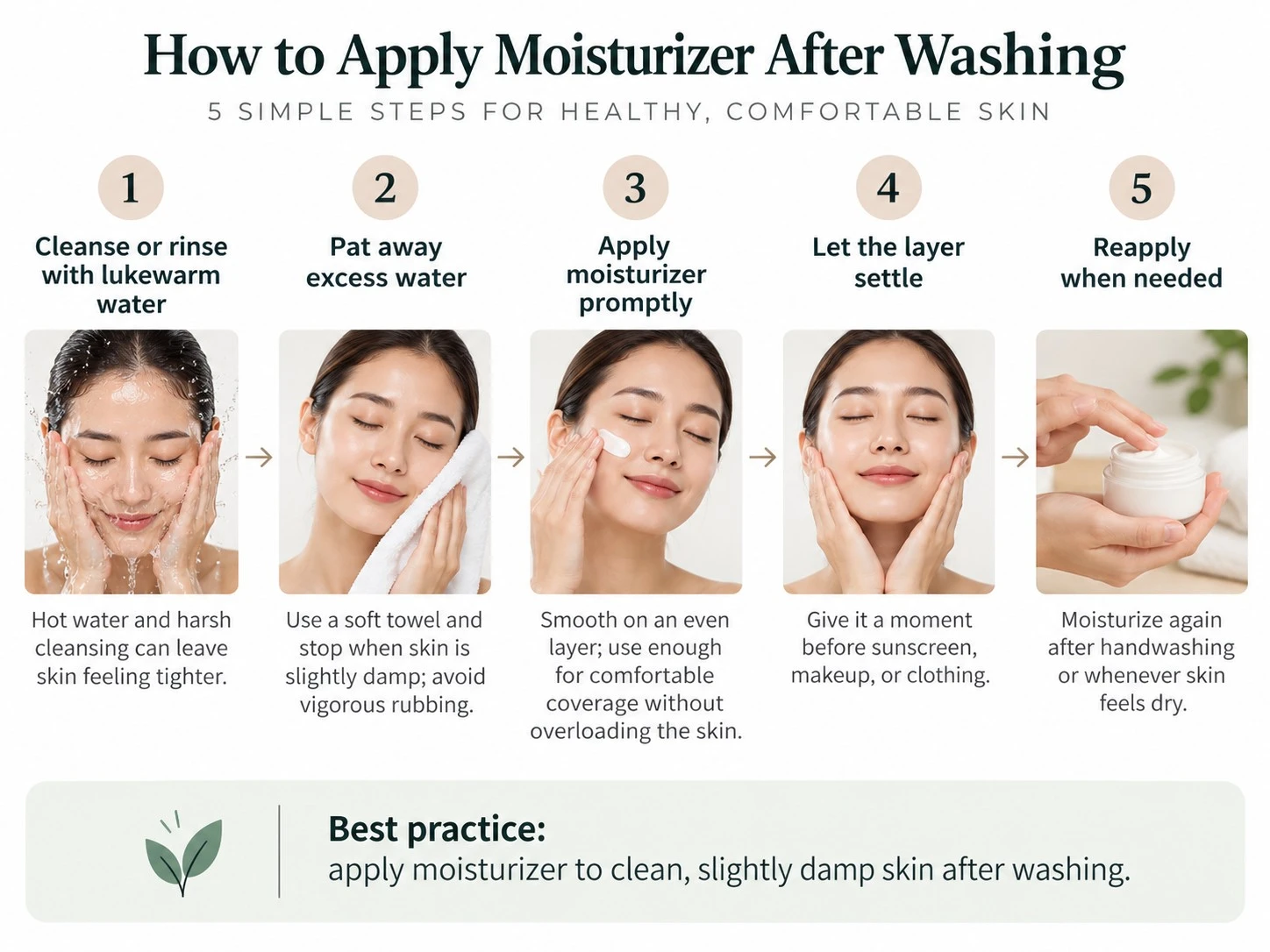
- Cleanse or rinse with lukewarm water. Hot water and harsh cleansing can leave dry or sensitive skin feeling tighter.
- Pat away excess water. Use a clean, soft towel and stop when the skin is slightly damp. Avoid vigorous rubbing.
- Apply moisturizer promptly. Smooth an even layer over the area instead of trying to rub until the product disappears. Use enough to cover the skin comfortably without leaving it overloaded.
- Let the layer settle. Before sunscreen, makeup, or clothing, give the moisturizer a moment to form an even film.
- Reapply when needed. Moisturize again after handwashing or whenever the skin feels dry; post-wash application is not the only useful time.
This is the basic method for an ordinary leave-on product. The complete guide to how to apply moisturizer covers quantity, face and body application, and routine placement in more detail.
When Applying Moisturizer to Dry Skin Makes Sense
Apply to dry skin if it has already dried before you reach for the product. Moisturizer can still add water-binding ingredients, smooth the surface, and reduce further evaporation. There is no benefit in skipping the step because the ideal moment passed.
Dry application may also be preferable when a product label or clinician gives a specific sequence. If you use a topical steroid or another medical treatment, instructions may require a gap between the treatment and an emollient so one does not dilute or spread the other. NHS patient guidance commonly recommends separating emollients and topical steroids by about 30 minutes, while the order should follow the clinician’s instructions.[4]
The same principle applies to cosmetic actives: follow the directions for the exact product. If an active is meant for dry skin, let the skin dry, apply it as directed, and use moisturizer at the permitted stage. Do not improvise with prescription treatment timing based on a general social-media rule.
Does the Type of Moisturizer Change the Answer?
The damp-skin default works for lotions, creams, gels, and ointments, but texture changes how the product feels and how much water loss it can reduce.
- Light lotions and gels spread easily and may suit oily skin, humid weather, or daytime use. They can feel slippery if applied over too much water.
- Creams balance water and oil and are a versatile choice for normal to dry skin.
- Ointments and petrolatum-rich balms create a stronger occlusive layer and can suit very dry or cracked areas, although they feel greasier.
- Humectant-focused formulas often contain glycerin, hyaluronic acid, or urea. They do not require skin to be visibly wet; a balanced finished formula and an adequate occlusive phase matter more than internet rules about one ingredient.
Choose the texture that you will use consistently and that leaves your skin comfortable. If a lotion disappears quickly but tightness returns, move to a richer cream. If a heavy cream feels congesting or unpleasant, try a lighter formula. This moisturizer guide by skin type can help narrow the choice.
Common Moisturizer-Timing Mistakes
- Applying over running water: More water is not automatically more hydration. Pat until the surface is damp rather than soaked.
- Rubbing the skin dry: Friction can aggravate skin that is already irritated. Use gentle pressing motions with the towel.
- Skipping moisturizer because the skin dried: Apply it now. Consistent use matters more than perfect timing.
- Using timing to compensate for the wrong formula: Persistent tightness may mean the cleanser is too harsh or the moisturizer is too light, not that you waited too long.
- Layering medication and moisturizer without checking directions: Leave the interval recommended for the treatment and ask a clinician or pharmacist when the sequence is unclear.
- Ignoring persistent irritation: Burning, swelling, rash, or worsening cracks are reasons to stop the suspected product and seek professional advice when symptoms are significant or do not settle.
If dryness continues despite regular moisturizing, consider the rest of your routine and the condition of your skin barrier. Severe itching, oozing, bleeding, widespread scaling, or recurring inflammation may need medical assessment rather than more frequent product layering.
FAQs About Applying Moisturizer on Wet or Dry Skin
How damp should your skin be before moisturizer?
Your skin should feel lightly moist but should not have visible drops running or pooling. Pat gently with a towel, then apply the moisturizer while a trace of surface moisture remains.
How long should you wait after washing your face?
You do not need a precise countdown. For an ordinary moisturizer, apply it soon after gently patting the skin. If 10 or 30 minutes have already passed, moisturize anyway; a study in healthy young adults did not find a hydration advantage for immediate application over a 30-minute delay.
Can you apply moisturizer after your skin has dried?
Yes. Moisturizer still works on fully dry skin. Slightly damp application is a useful default after washing, not a requirement for the product to function.
Should hyaluronic acid moisturizer go on damp skin?
It can, and many people find that comfortable, but it does not need dripping-wet skin. Hyaluronic acid is one part of a complete formula; the product’s other humectants, emollients, and occlusives affect the result. Follow the finished product’s directions.
Should moisturizer go on damp skin after retinol?
Follow the retinol product’s directions. If it instructs you to apply retinol to dry skin, let the skin dry first, use the retinol as directed, and add moisturizer before or after it according to the routine you tolerate. Prescription retinoids should be used exactly as directed by the prescriber.
Sources
[1] National Center for Biotechnology Information. Moisturizers
[2] American Academy of Dermatology. Dermatologists’ top tips for relieving dry skin
[3] Nguyen H, et al. Does the timing of moisturizer application make a difference in terms of skin hydration?
[4] Guy’s and St Thomas’ NHS Foundation Trust. Emollients and how to use them


