
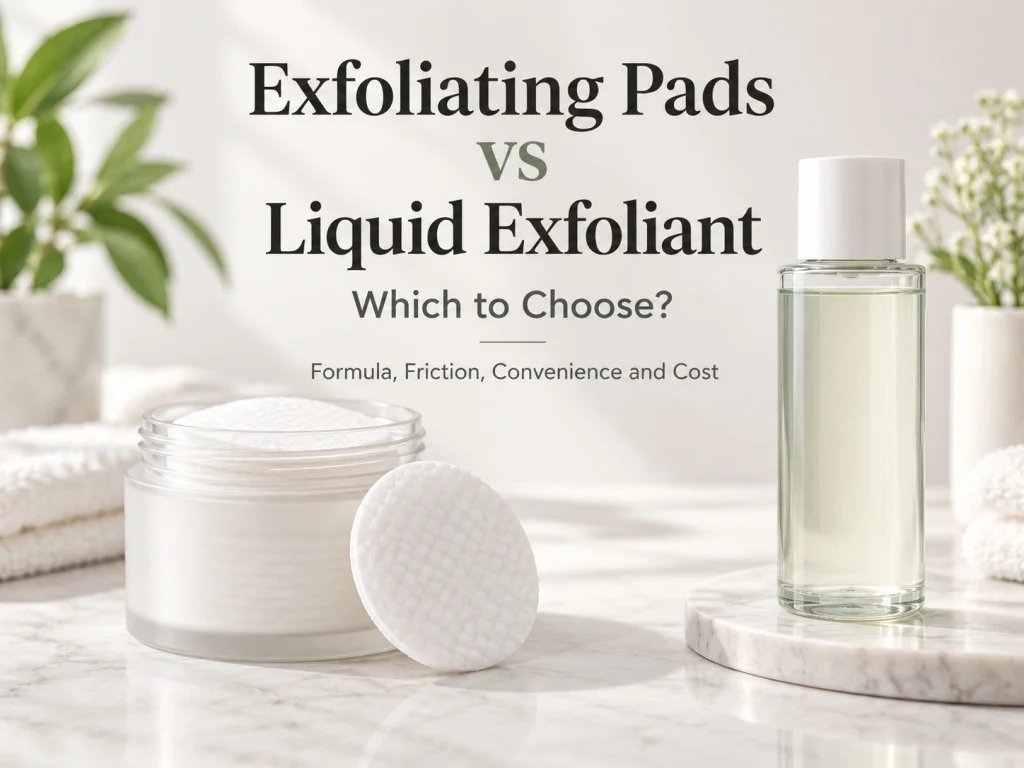


A jar of acid pads and a bottle of exfoliating liquid can look like very different products while serving the same skincare step. The important questions are what is in the formula, how you apply it, and whether that method suits your skin.
How Do Exfoliating Pads and Liquid Exfoliants Compare?
Exfoliating pads are pre-soaked applicators that hold an exfoliating formula. A liquid exfoliant is an exfoliating formula dispensed from a bottle and applied as directed.
This comparison concerns acid-based skincare pads and bottled exfoliants, not reusable cleansing cloths or dry scrub pads. It also does not apply to every toner: some pads and liquid toners focus on hydration or skin preparation rather than chemical exfoliation.[2] The guide to toner pads explains that wider category.
| Decision factor | Exfoliating pads | Liquid exfoliant |
|---|---|---|
| Application | A ready-soaked pad is wiped across the intended area | Dispensed onto hands or a separate applicator, depending on directions |
| Amount handling | No separate pouring step; the pad arrives loaded with product | You dispense the instructed amount each time |
| Friction | Pad material, pressure and repeated passes affect contact | Hand application can avoid pad contact; using a cotton round adds it back |
| Travel | Individual sachets can be convenient; a large jar may be less practical | A suitable small bottle can travel well but needs a secure closure |
| Application count | Check whether one treatment uses one pad or a paired set | Depends on the instructed amount, not bottle volume alone |
Pre-soaked describes the product held in a pad, not the amount you transfer to each area of skin. A bottle lets you dispense the product yourself, but its amount and coverage instructions still apply. Neither format makes repeated coats or extra passes a necessary part of exfoliation.
Why Should the Formula Come Before the Format?
The formula determines the chemical exfoliation; the format changes how you deliver it. For AHAs, exfoliation depends on the acid type, concentration, pH and other ingredients.[3] A pad cannot be ranked as stronger than a liquid merely because it feels textured or leaves your skin tingling.
For blackheads and whiteheads, salicylic acid is a relevant ingredient because it helps unclog pores.[4] For surface texture, glycolic or lactic acid products use AHA exfoliation.[3] If you are deciding between these goals, glycolic acid versus salicylic acid is a more useful comparison than jar versus bottle.
Even matching acid percentages do not establish that two finished products are interchangeable. Their full formulas and application directions may differ. Compare the complete product rather than assuming that a higher percentage, several acids, or an “extra strength” name better matches your concern.
Read the full ingredient list for ingredients you already know cause a reaction. Switching to pads does not solve a problem caused by their liquid formula; switching to a bottle does not automatically make a poorly tolerated formula suitable.
Which Format Fits Your Routine and Budget?
Choose pads for fewer application decisions: they remove the separate dispensing and applicator-preparation steps. That can suit someone who skips a bottled product because using it feels inconvenient. Check whether the pack contains individual applications, a refill pouch or a jar, and whether a treatment uses one pad or a paired set. “Thirty pads” and “thirty treatments” are not always the same purchase.
Choose a suitable liquid when rubbing is the problem: friction and pressure can contribute to irritation.[5] If you tolerate the formula but dislike pad contact, a product that permits gentle hand application may fit better. Pouring the liquid onto a cotton round keeps that contact, so a bottle alone does not solve the problem. If skin is already sore or peeling, pause exfoliation rather than simply changing the applicator.
Compare cost per application: divide a pad pack’s price by its complete treatments. For a bottle, use an application count based on the instructed amount, and include any cotton rounds you buy. If the brand supplies no usable amount or application estimate, bottle volume alone cannot support an exact cost comparison. Pads are not necessarily more expensive in every product line.
Choose a familiar formula for travel when possible. A compact package does not offset the uncertainty of starting a new acid product just before a trip.
How to Start Using One Exfoliant Safely
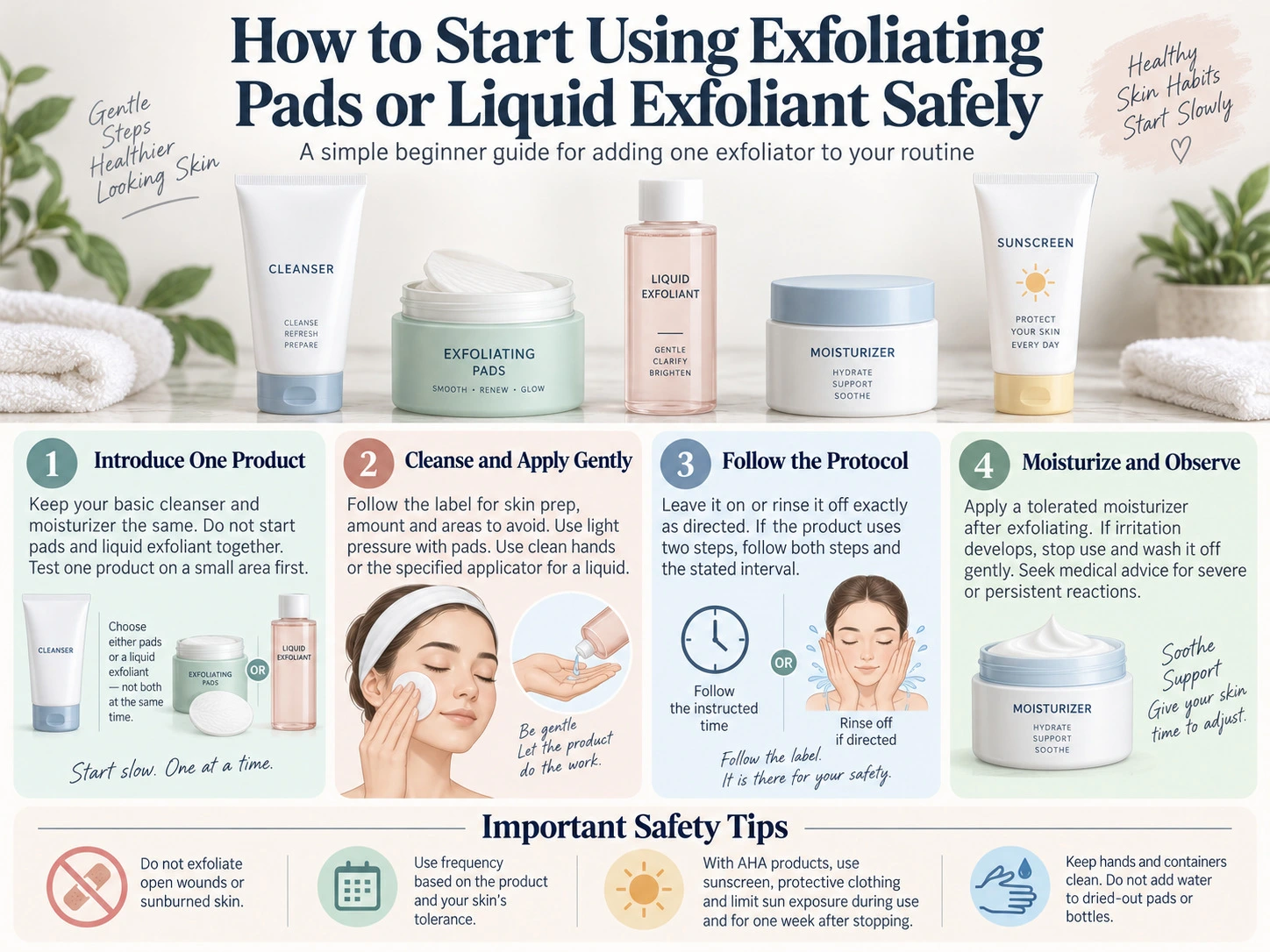
Check for existing exfoliation before adding either format. Retinol, prescription retinoids and benzoyl peroxide can already cause sensitivity or peeling; adding exfoliation can worsen dryness or breakouts.[6] Follow medication restrictions and your clinician’s instructions.
- Introduce one exfoliant: keep your tolerated basic routine unchanged and avoid starting pads and a liquid together. Test the new product on a small area using its normal amount and contact time; do not exceed its directions to follow a generic testing schedule.[7]
- Cleanse and apply gently: follow the product’s instructions for skin preparation, amount and areas to avoid. With pads, use light pressure rather than repeated scrubbing. With a liquid, use clean hands only if hand application is permitted; otherwise use the specified applicator.
- Complete the stated protocol: leave on or rinse off as directed. Some peel kits require two different pads in sequence with a specified interval between them.[8] Do not skip a required second step or turn its waiting time into a rule for unrelated exfoliants.
- Moisturize and check your response: follow with a tolerated moisturizer.[6] If a reaction develops, stop using the product and gently wash it off. Seek medical advice for a severe or persistent reaction.[7]
Do not exfoliate open wounds or sunburned skin. More aggressive exfoliation can worsen pigmentation, especially in darker skin tones or skin prone to dark marks after inflammation.[6]
Set frequency by the product and your skin’s tolerance, not by the number of pads in the jar. For help adjusting use, see how often to exfoliate your face. AHA products may increase sun sensitivity: use sunscreen, protective clothing and limited sun exposure during use and for one week after stopping.[3]
Wash your hands before handling the product, keep containers clean and follow storage directions. Do not add water to dried-out pads or a bottle to stretch the contents; it can introduce microbes and dilute preservatives.[9] Take out only what you need, close the pack promptly and discard used single-use pads rather than putting them back.
FAQs About Exfoliating Pads and Liquid Exfoliants
Can you use exfoliating pads every day?
Only if the product’s directions and your skin’s tolerance support that schedule. Pad format alone does not justify daily use. Stronger exfoliation generally needs less frequent application, and irritation is a reason to reduce use or stop.[6]
Can you use an exfoliating pad and a liquid exfoliant together?
Usually there is no practical need to duplicate the same exfoliation step. Start with one product rather than layering both. A two-step kit designed to work as a set is different from combining two unrelated exfoliants.
Can you leave an exfoliating pad on as a mini mask?
Only when that exact product explicitly permits it. Instructions for a hydrating toner pad do not establish a safe contact time for an acid pad. A wipe-on exfoliant should not become a prolonged mask by assumption.
Does a dirty-looking pad prove that it exfoliated better?
No. Visible residue on a pad does not measure how effectively its acids exfoliated or how much product reached the skin. Do not scrub until the pad changes color or use that color to compare it with a hand-applied liquid.
Sources
[1] Paula’s Choice. SKIN PERFECTING 2% BHA Liquid Exfoliant
[2] Dear, Klairs. Toner Pads vs Liquid Toner: When Prep Pads Make Sense
[3] U.S. Food and Drug Administration. Alpha Hydroxy Acids
[4] American Academy of Dermatology. Adult acne treatment dermatologists recommend
[5] DermNet. Sensitive skin
[6] American Academy of Dermatology. How to safely exfoliate at home
[7] American Academy of Dermatology. How to test skin care products
[8] Dr. Dennis Gross. Alpha Beta Universal Daily Peel
[9] U.S. Food and Drug Administration. Microbiological Safety and Cosmetics


