


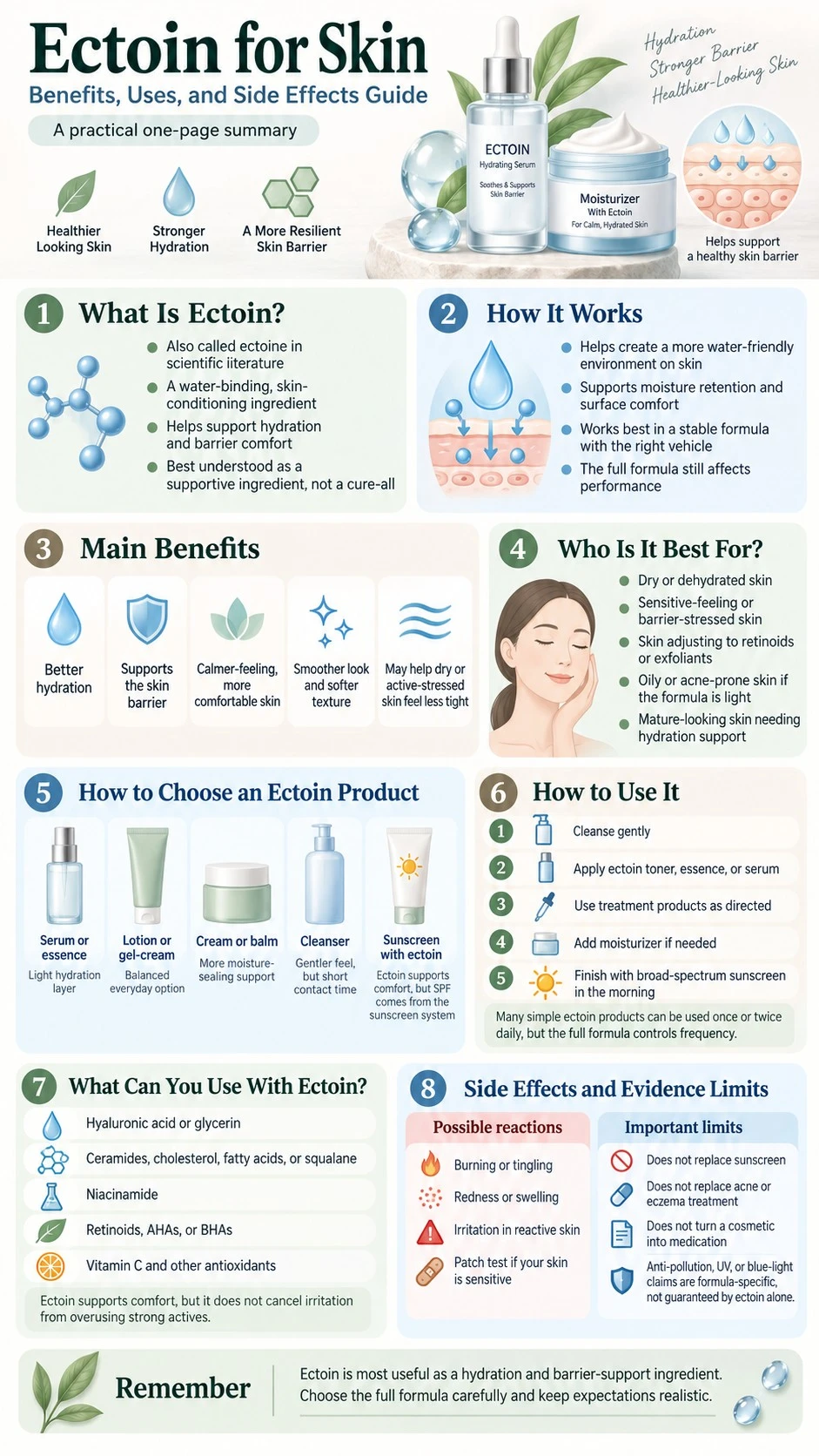
Ectoin now appears in mainstream serums and moisturizers, often under broad “stress protection” claims. Its practical value is narrower: it can add hydration and comfort to a well-designed formula, especially when skin feels dry or easily irritated. The vehicle, supporting moisturizers, and the rest of the routine still determine performance.
What Is Ectoin and How Does It Work?
Ectoin, also spelled ectoine in scientific literature, is a small cyclic amino acid derivative made by some microorganisms. It belongs to a group called compatible solutes or extremolytes. These molecules help microorganisms maintain normal structures and water balance during stresses such as high salt concentration, dryness, and temperature change.[3] On a cosmetic ingredient list, the INCI name is usually “Ectoin.”
Ectoin is not a live bacterium or an exfoliating acid. Its skincare mechanism is usually explained through preferential hydration: ectoin influences the water environment around proteins and membranes without needing to bind directly to them. Laboratory models and topical testing suggest this can support moisture retention and membrane stability.[1]
That mechanism does not make human skin behave like an extremophile. It also does not prove every claim about pollution, ultraviolet radiation, or visible light. A cosmetic formula must deliver ectoin in a stable, tolerable vehicle, and the rest of the formula can add to—or limit—the result.
For skin care, ectoin is best understood as a hydration and barrier-support ingredient. The skin barrier still depends on corneocytes, lipids, gentle cleansing, moisturization, and protection from avoidable irritation.
Ectoin Benefits for Skin
The strongest practical case for ectoin is improved hydration and comfort. In-vivo measurements reported lower transepidermal water loss after use of an oil-in-water emulsion containing ectoin, suggesting better barrier function.[1] Clinical research has also examined ectoin-containing creams in dry, inflamed, or retinoid-stressed skin, but those findings come from complete formulations rather than ectoin used alone.[2]
| Proposed benefit | What the evidence suggests | Who may value it | Important limit |
|---|---|---|---|
| Better hydration | Ectoin can support a water-rich environment and improve moisture-related measurements in some topical studies | Dehydrated, tight, or weather-stressed skin | Results depend on the vehicle and other humectants, emollients, and occlusives |
| Barrier support | Some ectoin-containing formulas have reduced transepidermal water loss | Dry, over-cleansed, or active-stressed skin | Ectoin does not replace ceramides or remove the cause of ongoing barrier damage |
| Calmer-feeling skin | Ectoin creams have shown useful tolerability and symptom support in irritated or inflamed skin settings | Sensitive-feeling skin or routines using drying actives | A cosmetic cannot diagnose or treat eczema, dermatitis, or rosacea |
| Environmental-stress support | Laboratory and finished-formula research suggests membrane-stabilizing and protective effects | People seeking supportive stress-care formulas | Pollution, UV, and blue-light claims are not equally established in everyday human use |
| Smoother, less lined appearance | Better hydration can temporarily soften roughness and dehydration lines | Dry or mature-looking skin | Evidence does not establish wrinkle removal or structural reversal of skin aging |
The evidence base needs context. A systematic review found six eligible clinical studies for inflammatory skin diseases, with certainty ranging from very low to moderate. The studies used 5.5% to 7% ectoin creams, but the formulas contained other moisturizers, designs varied, and several studies lacked strong vehicle controls.[2] The review disclosed manufacturer employment and funding. These findings support ectoin’s potential, but not a universal “best concentration” or a guarantee that a lower-concentration cosmetic serum will reproduce medical-emollient results.
Who Is Ectoin Best For?
Ectoin can fit many routines, but it is most relevant when hydration and tolerance are the main goals.
- Dry or dehydrated skin: Ectoin can add water-binding support. Dry skin often also needs emollients and occlusives, while dehydrated skin may prefer a lighter serum or gel. The guide to dehydrated vs dry skin explains this difference.
- Sensitive-feeling skin: A simple fragrance-free moisturizer with ectoin may support comfort. The featured ingredient does not cancel irritation from fragrance, essential oils, harsh preservatives, or strong actives in the same product.
- Skin adjusting to retinoids or exfoliants: Ectoin may make a moisturizing routine more comfortable, and ectoin creams have been studied in retinoid-related dryness.[2] It cannot make excessive active use safe.
- Oily or acne-prone skin: A lightweight ectoin serum or gel-cream can hydrate without requiring a rich finish. Ectoin does not unclog pores or treat acne, and the complete formula determines congestion risk.
- Mature-looking skin: Hydration may make fine dehydration lines look softer. Ectoin should not replace ingredients or treatments chosen for collagen loss, pigmentation, or deeper wrinkles.
If the skin is persistently itchy, cracked, swollen, oozing, or painful, an ingredient-focused routine is not enough. Those symptoms need appropriate medical assessment.
How to Choose an Ectoin Product
Choose the product type before chasing a percentage. Published studies have often evaluated higher-concentration creams, but that does not establish a minimum effective dose for every cosmetic or prove that more is always better.
- Serum or essence: Adds a light hydration layer and may suit combination or oily skin. Dry skin may still need a cream on top.
- Lotion or gel-cream: Combines hydration with a lighter emollient base and can work for normal, combination, or acne-prone skin.
- Cream or balm: Provides more moisture-sealing support for dry, rough, or cold-weather skin.
- Cleanser: Ectoin may contribute to a less stripping formula, but rinse-off contact time is short.
- Sunscreen: Ectoin can be a supporting ingredient, but the labeled SPF and broad-spectrum testing come from the finished sunscreen system, not ectoin alone.
Check the full ingredient list for glycerin, hyaluronic acid, ceramides, cholesterol, fatty acids, squalane, dimethicone, or other ingredients that match your goal. For sensitive skin, prefer fragrance-free formulas and avoid assuming “extreme protection” language predicts tolerability. The guide to choosing a moisturizer can help match gel, lotion, and cream textures to your skin.
How to Use Ectoin in Your Skincare Routine
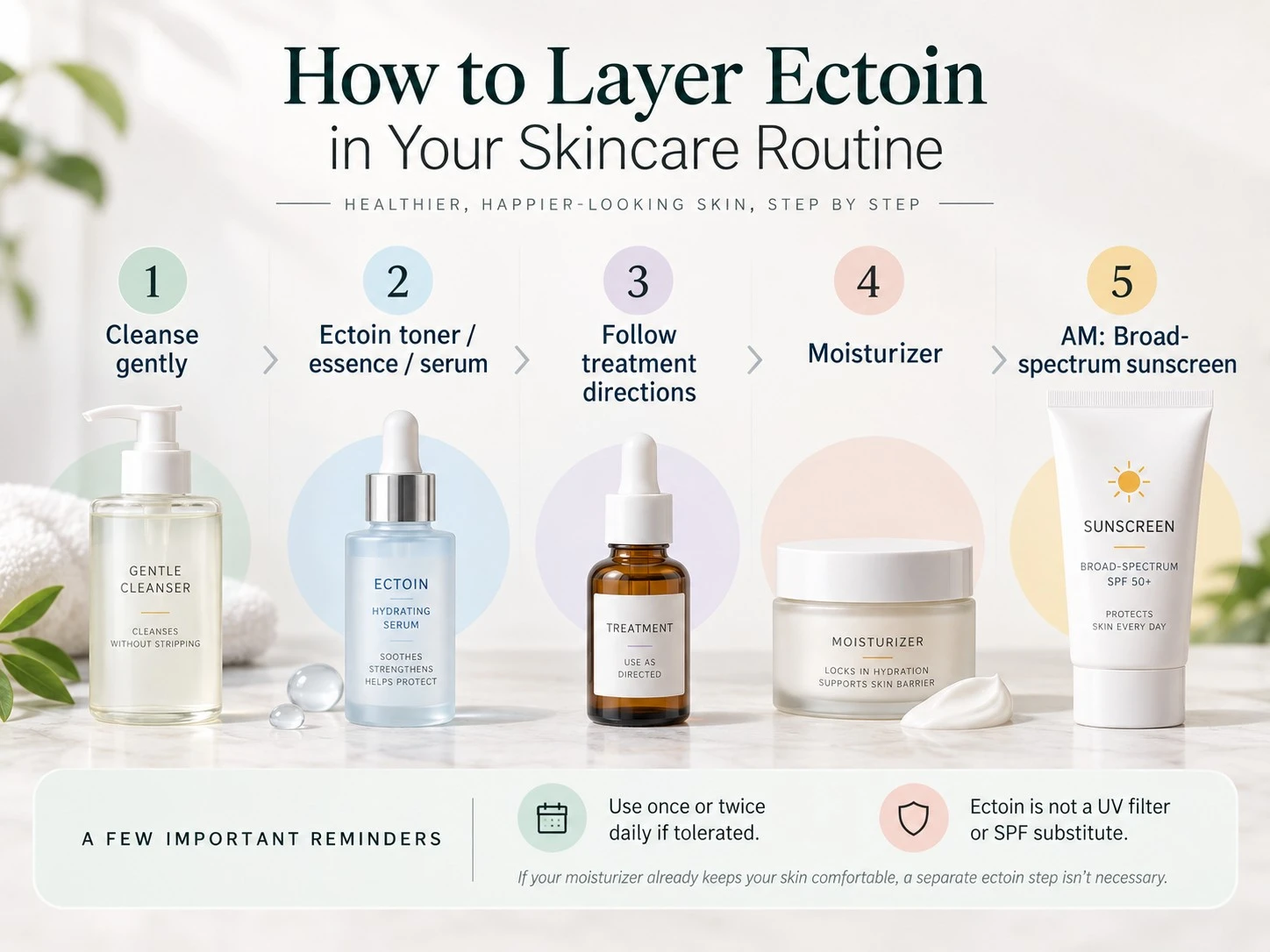
Follow the specific product directions. A basic leave-on ectoin product usually fits into this sequence:
- Cleanse gently. Use lukewarm water and a cleanser that does not leave the skin tight.
- Apply thin hydrating layers. If ectoin is in a toner, essence, or serum, spread a small amount after cleansing.
- Use treatment products as directed. Follow prescription, retinoid, or exfoliant instructions rather than relying on one universal layering rule.
- Apply moisturizer. Add a suitable gel, lotion, or cream if the ectoin product is not already a complete moisturizer.
- Finish with sunscreen in the morning. Use a tested broad-spectrum sunscreen; ectoin is not a UV filter or an SPF substitute.
Many simple ectoin moisturizers can be used once or twice daily. The whole formula controls frequency. If an ectoin product also contains an exfoliating acid, retinoid, or another strong active, introduce it according to that active’s tolerance rules.
You do not need a separate ectoin step when your current moisturizer already keeps the skin comfortable. The skincare routine order explains how other treatments, oils, masks, and sunscreen fit around these basics.
What Can You Use With Ectoin?
Ectoin is generally easy to combine because it does not exfoliate and does not require a special low-pH activation step.
- Hyaluronic acid or glycerin: Adds complementary humectant support. A moisturizer may still be needed to slow evaporation.
- Ceramides, cholesterol, fatty acids, or squalane: Pair ectoin’s hydration role with lipids and emollients that support softness and reduce moisture loss.
- Niacinamide: Can add broader barrier, oil-control, and tone support. Choose a tolerable finished formula rather than maximizing percentages.
- Retinoids, AHAs, or BHAs: Ectoin may support comfort around a drying active, but persistent burning or peeling is a reason to reduce the irritating product.
- Vitamin C and other antioxidants: These can share a routine with ectoin. Let the active formula’s directions, pH, and tolerability control placement.
There is normally no need to separate ectoin from another ingredient by morning and night. Texture, product directions, and skin response are more useful guides than pairing myths.
Ectoin Side Effects and Evidence Limits
Ectoin-containing topical formulas were generally well tolerated in the available clinical literature. Some participants reported burning, tingling, redness, discomfort, or worsening lesions, and a small number stopped using the tested products because of application-related side effects.[2] Because these were multi-ingredient creams, the studies cannot prove which component caused every reaction.
Introduce one new leave-on product at a time. If your skin is reactive, patch test the skincare product before wider use. Patch testing reduces uncertainty but cannot guarantee that delayed irritation or allergy will never occur.
Stop using the product if burning, itching, redness, or swelling persists. Seek medical care for hives, blistering, severe swelling, eye involvement, breathing symptoms, signs of infection, or a spreading reaction.
The larger limit is evidentiary. Current reviews describe promising moisturizing, barrier, and anti-inflammatory effects, but the literature combines laboratory work, medical-device or emollient studies, different concentrations, and complete formulas.[3] Anti-pollution, blue-light, UV-defense, and anti-aging claims should therefore be treated as formulation-specific rather than automatic properties of every ectoin product.
Ectoin does not turn a cosmetic into medication. Do not use it as a substitute for prescribed eczema, psoriasis, rosacea, or acne care, and do not apply an ordinary cosmetic to broken or recently treated skin unless the label and your clinician’s instructions allow it. It also does not replace the tested protection described in Sunscreen 101.
FAQs About Ectoin for Skin
Can you use ectoin every day?
Yes. Many simple ectoin serums and moisturizers can be used once or twice daily when the full formula is well tolerated. Follow the label if the product also contains retinoids, exfoliating acids, or other ingredients that need a slower schedule.
Is ectoin better than hyaluronic acid?
Neither ingredient is universally better. Both can support hydration. Hyaluronic acid is a widely used humectant, while ectoin is studied for hydration, membrane stabilization, and barrier-related comfort. A product can contain both, and the complete formula matters more than choosing one fashionable ingredient.
Can you use ectoin with retinol?
Yes. Ectoin can fit before or inside a moisturizer used with retinol. It may support hydration and comfort, but it does not neutralize retinol or prevent irritation caused by excessive strength or frequency. Reduce retinol use if marked redness, burning, or peeling continues.
Can ectoin replace sunscreen?
No. Laboratory or formula-specific protective findings do not make ectoin a sunscreen filter. Use a tested broad-spectrum sunscreen with a labeled SPF and apply it in the required amount. Ectoin may be a supporting ingredient in that formula, but it does not provide reliable standalone UV protection.
Sources
[1] Graf R, et al. The Multifunctional Role of Ectoine as a Natural Cell Protectant
[2] Kauth M, Trusova OV. Topical Ectoine Application in Children and Adults to Treat Inflammatory Diseases Associated with an Impaired Skin Barrier: A Systematic Review
[3] Ferreira P, et al. Ectoine as a Multifunctional Molecule: Biotechnological Production and Pharmaceutical Applications


