
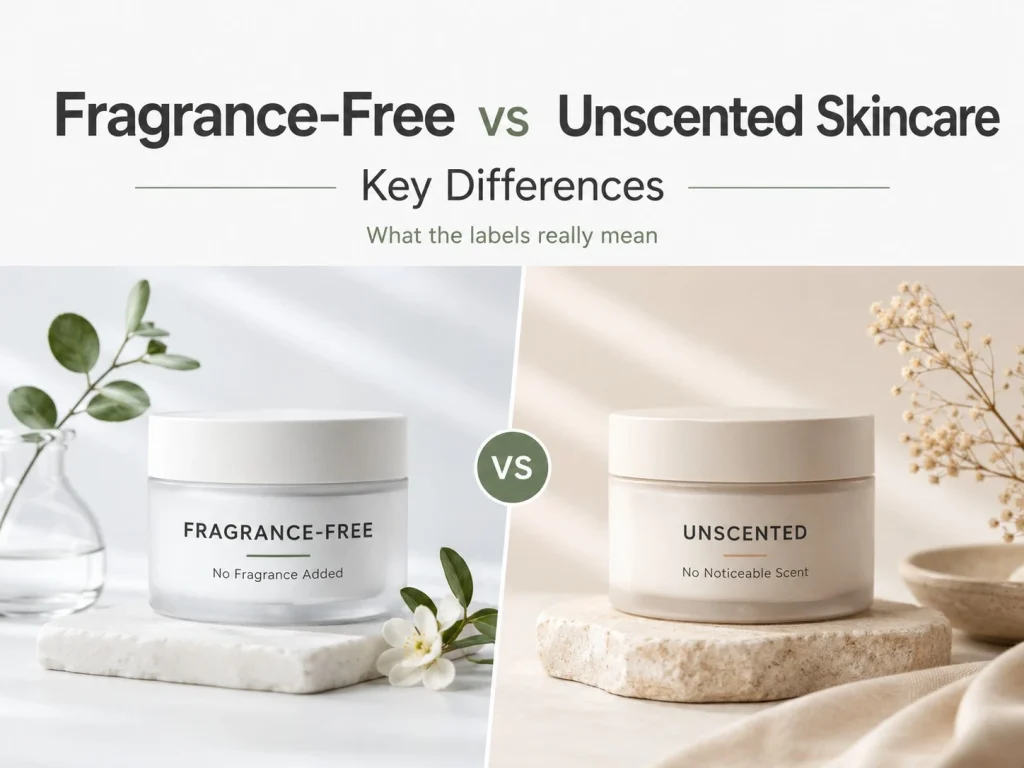

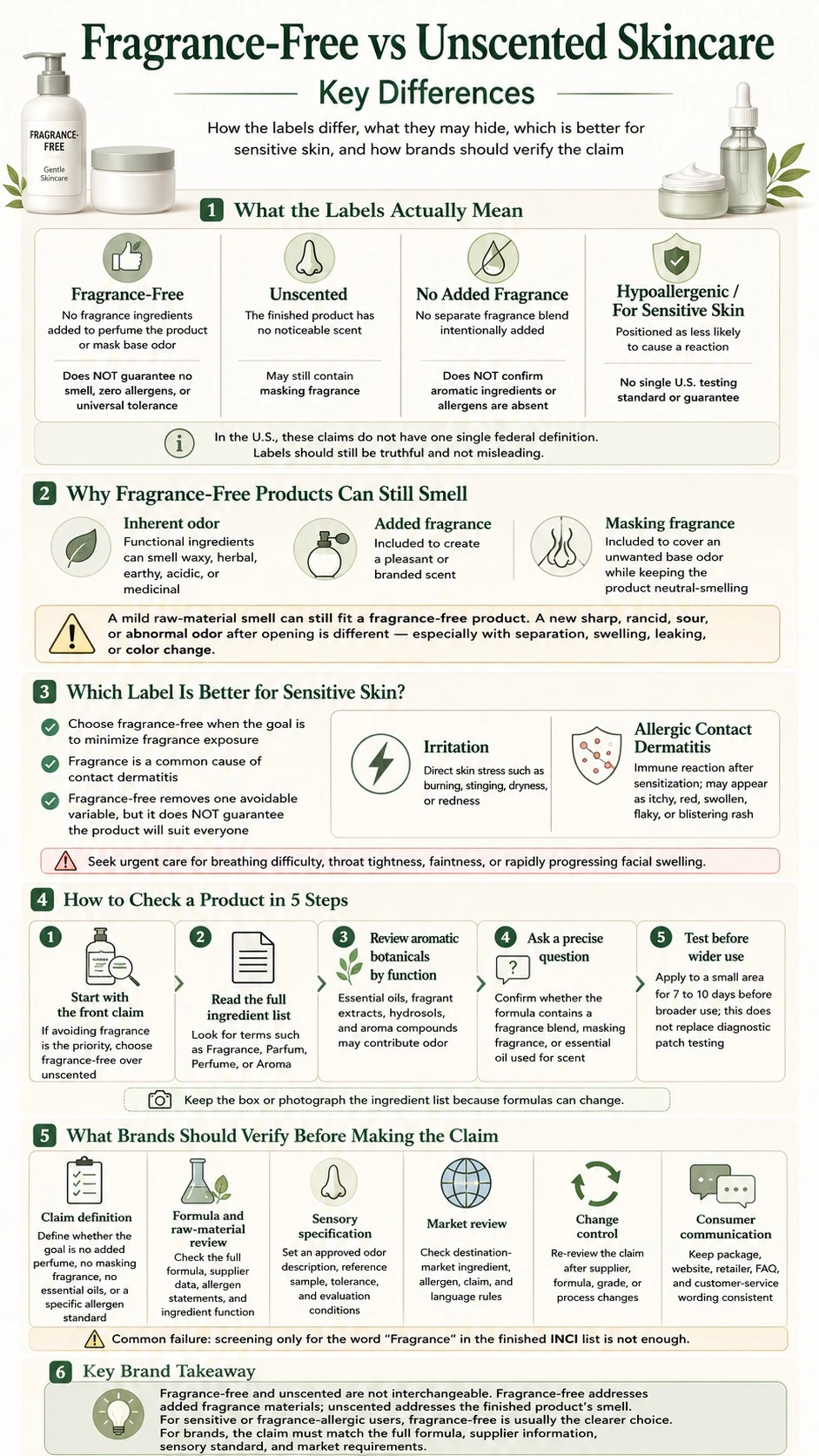
“Fragrance-free” and “unscented” sound interchangeable, but they describe different formulation goals. One addresses whether fragrance materials were added; the other addresses whether the finished product has a noticeable odor. That difference matters most when someone is trying to reduce fragrance exposure rather than simply avoid a perfumed smell.
A product’s scent is not a reliable ingredient test. A genuinely fragrance-free cream can smell faintly waxy, herbal, or medicinal because of its functional ingredients. An unscented lotion can smell like almost nothing because a masking fragrance has covered its base odor.
What Fragrance-Free and Unscented Actually Mean
For U.S. consumer cosmetics, there is no single federal standard defining “fragrance-free,” “unscented,” “hypoallergenic,” or “for sensitive skin.”[2] Labeling must still be truthful and not misleading, so the claim should match the formula and the evidence behind it.[1]
| Label | What it usually signals | What it does not establish |
|---|---|---|
| Fragrance-free | No fragrance ingredients were added to perfume the product or mask another odor | No smell, zero allergens, or universal tolerance |
| Unscented | The finished product has no noticeable scent | Absence of masking fragrance or fragrance-related ingredients |
| No added fragrance | No separate fragrance blend was intentionally added | Whether aromatic ingredients serve another function or contain fragrance allergens |
| Hypoallergenic or for sensitive skin | The product is positioned as less likely to cause a reaction | A uniform U.S. testing standard or a guarantee against irritation or allergy |
“Unscented” is therefore a sensory claim. Masking fragrance may be used at a level that neutralizes an unwanted odor without making the product smell perfumed.[1] “Fragrance-free” is a formula claim: fragrance materials should not be added for either perfuming or masking.
Ingredient disclosure has another limitation. A retail cosmetic normally needs an ingredient list, but a fragrance mixture may appear under the collective term “Fragrance” rather than revealing each component.[3] The absence of a familiar allergen name is not proof that a fragranced product lacks that substance.
Why Fragrance-Free Skincare Can Still Have a Smell
Every raw material has an odor profile. Plant oils can smell nutty or grassy; surfactants may smell fatty; ferments and some active ingredients can smell earthy, acidic, or medicinal. Emulsions also change how quickly those odors reach the nose. Removing fragrance does not remove the volatile molecules naturally associated with the rest of the formula.
That leads to three practical distinctions:
- Inherent odor: The smell comes from ingredients chosen for cleansing, moisturizing, preservation, texture, or another functional purpose.
- Added fragrance: A material or blend is included to create a pleasant, recognizable, or branded scent.
- Masking fragrance: A fragrance material is included to reduce or cover an unwanted base odor, even when the finished product is intended to smell neutral.
A mild raw-material odor does not invalidate a fragrance-free claim. Normal agricultural and manufacturing variation can also produce small sensory differences between compliant batches. The acceptable range should be defined during development rather than decided from a single sample.
A new sharp, rancid, sour, or otherwise abnormal smell is different. Stop using the product if the odor changes markedly after opening, especially when it appears with separation, swelling, leaking, or a color change. Check the storage instructions and expiry or period-after-opening information, then contact the brand rather than assuming the product is merely “more natural.”
Which Label Is Better for Sensitive Skin?
Choose fragrance-free when the goal is to minimize fragrance exposure. Fragrance is a common cause of contact dermatitis, and reader-facing dermatology guidance specifically distinguishes fragrance-free from unscented because a covered-up fragrance can still provoke a reaction.[4]
This does not mean every fragranced product harms every person or that fragrance-free products are automatically gentle. It means fragrance-free removes one avoidable variable. That can be useful for people simplifying a skincare routine for sensitive skin, managing a disrupted skin barrier, or following an allergen-avoidance plan.
Two types of reaction are often confused:
- Irritation is direct skin stress. Burning, stinging, dryness, or redness can occur without an immune allergy and may depend on concentration, contact time, or barrier condition.
- Allergic contact dermatitis is an immune reaction after sensitization. It can appear as an itchy, red, swollen, flaky, or blistering rash, sometimes after earlier uses seemed uneventful.[2]
Fragrance-free skincare can still contain preservatives, exfoliating acids, retinoids, surfactants, botanical extracts, or other ingredients that do not suit a particular person. If reactions are persistent or the cause is unclear, medical patch testing can identify specific contact allergens more reliably than repeatedly switching products at home. Seek urgent care for breathing difficulty, throat tightness, faintness, or rapidly progressing facial swelling.
How to Check a Product in Five Steps
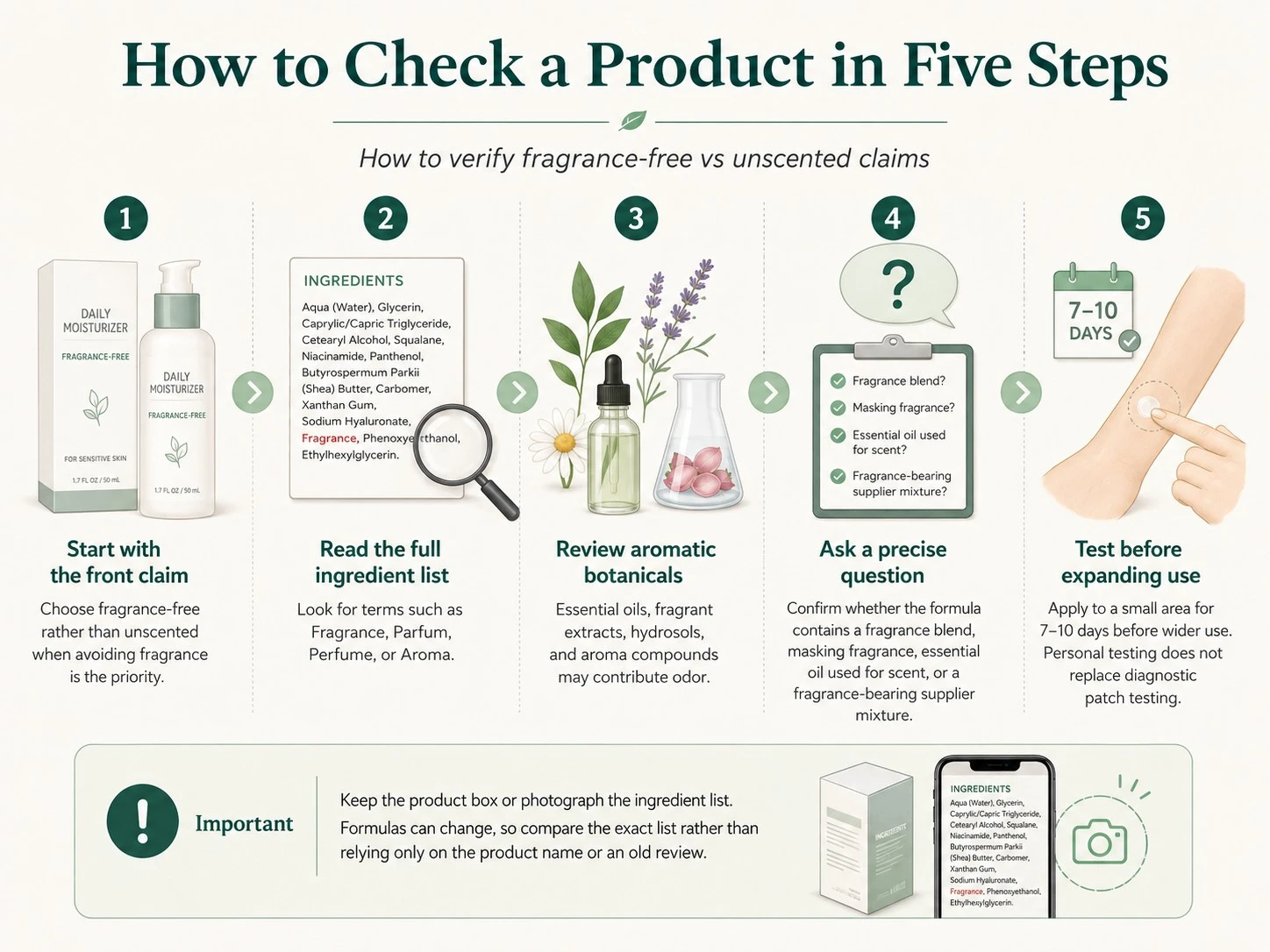
Use the label as the starting point, then verify what the claim means for that exact formula:
- Start with the front claim: Choose “fragrance-free” rather than “unscented” when avoiding fragrance is the priority.
- Read the full ingredient list: Look for terms such as Fragrance, Parfum, Perfume, or Aroma. Use a broader skincare ingredient-list check rather than judging one word in isolation.
- Review aromatic botanicals by function: Essential oils, fragrant extracts, hydrosols, and isolated aroma compounds may contribute odor. Their presence does not reveal why they were used, so do not rely on a generic banned-word list.
- Ask a precise question when needed: Confirm whether the formula contains a fragrance blend, masking fragrance, essential oil used for scent, or fragrance-bearing supplier mixture. If you have a diagnosed allergy, ask about the exact allergen name provided by your clinician.
- Test before expanding use: Apply the product to a small area as directed for seven to 10 days before using it widely. This can reveal a personal reaction but does not replace diagnostic patch testing.[5]
Keep the product box or photograph the ingredient list. Formulas can change, and comparing the exact list is more useful than relying on a product name or an old online review.
What Brands Should Verify Before Making the Claim
A fragrance claim begins with the product brief, not the front label. During custom skincare formulation, the brand and manufacturer should agree on whether the objective is no added perfume, no fragrance materials of any kind, no masking fragrance, no essential oils, or a specific fragrance-allergen standard. Those positions are not automatically equivalent.
| Decision | Evidence to retain | Common failure |
|---|---|---|
| Claim definition | Written rule covering perfuming, masking, essential oils, aromatic extracts, and supplier mixtures | Marketing and R&D use different meanings of “fragrance-free” |
| Formula and raw-material review | Full formula, INCI data, supplier composition or allergen statements, and intended function | Screening only for the word “Fragrance” in the finished INCI list |
| Sensory specification | Approved odor description, reference sample, tolerance, and evaluation conditions | Rejecting normal base odor or masking it late without reassessing the claim |
| Market review | Destination-market ingredient, allergen, claim, and language requirements | Reusing one label globally without checking local rules |
| Change control | Review trigger for supplier, grade, process, concentration, formula, and artwork changes | Keeping the claim after a raw-material substitution changes the evidence |
| Consumer communication | Consistent package, website, retailer, FAQ, and customer-service wording | Promising “allergy-safe” or “zero irritation” when evidence supports only fragrance avoidance |
International requirements can demand more information than a U.S. label. Canada requires specified fragrance allergens above set thresholds to appear outside “parfum,” including allergens contributed by botanicals, and expanded its disclosure requirements for new cosmetics in August 2026.[6] The EU likewise expanded individually labeled fragrance allergens, with transition dates for newly placed and existing products.[7] A multi-market brief should therefore request quantitative allergen data early enough to support formulation and artwork decisions.
Claim support must stay connected to commercial production. The approved formula, supplier documents, artwork, product page, and customer-service answer should all express the same standard. Build that requirement into the skincare product-claims review, then confirm the intended odor and wording when you review skincare samples.
Final Thoughts
Choose fragrance-free when you need to avoid added fragrance, and treat unscented only as a statement about noticeable smell. Then verify the ingredient list, the brand’s definition, and your own tolerance. For brands, the strongest claim is not the broadest phrase—it is the one supported consistently from raw-material records through the final label.
FAQs About Fragrance-Free and Unscented Skincare
Is fragrance-free skincare better for acne-prone skin?
It may reduce one possible source of irritation, but fragrance-free does not mean non-comedogenic and does not treat acne. Choose products by the complete formula, texture, active ingredients, and your tolerance rather than fragrance status alone.
Does fragrance matter less in rinse-off products?
Shorter contact can reduce exposure, but it does not guarantee tolerance. If you have a diagnosed fragrance allergy or a product repeatedly causes itching or rash, avoid the relevant allergen in both rinse-off and leave-on products unless your clinician advises otherwise.
Can I use perfume with a fragrance-free skincare routine?
Yes, if your goal is simply to keep facial products neutral and you tolerate perfume. If you are avoiding fragrance because of contact allergy, respiratory symptoms, or a clinician-directed plan, perfume and fragranced hair or body products may still matter.
Is scent-free the same as fragrance-free?
Not necessarily. “Scent-free” can be used to describe the absence of a noticeable odor, making it closer to “unscented” unless the brand clearly states that no perfuming or masking fragrance was used. Check the definition and ingredient information.
Can children use fragrance-free skincare?
Fragrance-free can be a useful selection criterion, but it does not establish that the whole product is appropriate for a child’s age, skin condition, or intended body area. Follow age directions and seek professional advice for persistent rashes or diagnosed skin disease.
Can fragrance-free skincare contain floral waters or hydrosols?
It can, depending on why the material is used, what it contains, and how the brand defines its claim. A floral water may add functional components and an inherent aroma without being used as perfume, but consumers with a known allergy should request composition details rather than relying on the claim alone.
Sources
[1] U.S. Food and Drug Administration. Disposable Wipes
[2] U.S. Food and Drug Administration. Allergens in Cosmetics
[3] U.S. Food and Drug Administration. Fragrances in Cosmetics
[4] American Academy of Dermatology Association. Itchy Rash Could Be Contact Dermatitis
[5] American Academy of Dermatology Association. How to Test Skin Care Products
[6] Health Canada. Industry Guide for the Labelling of Cosmetics
[7] European Union. Commission Regulation (EU) 2023/1545 on Labelling of Fragrance Allergens in Cosmetic Products


