


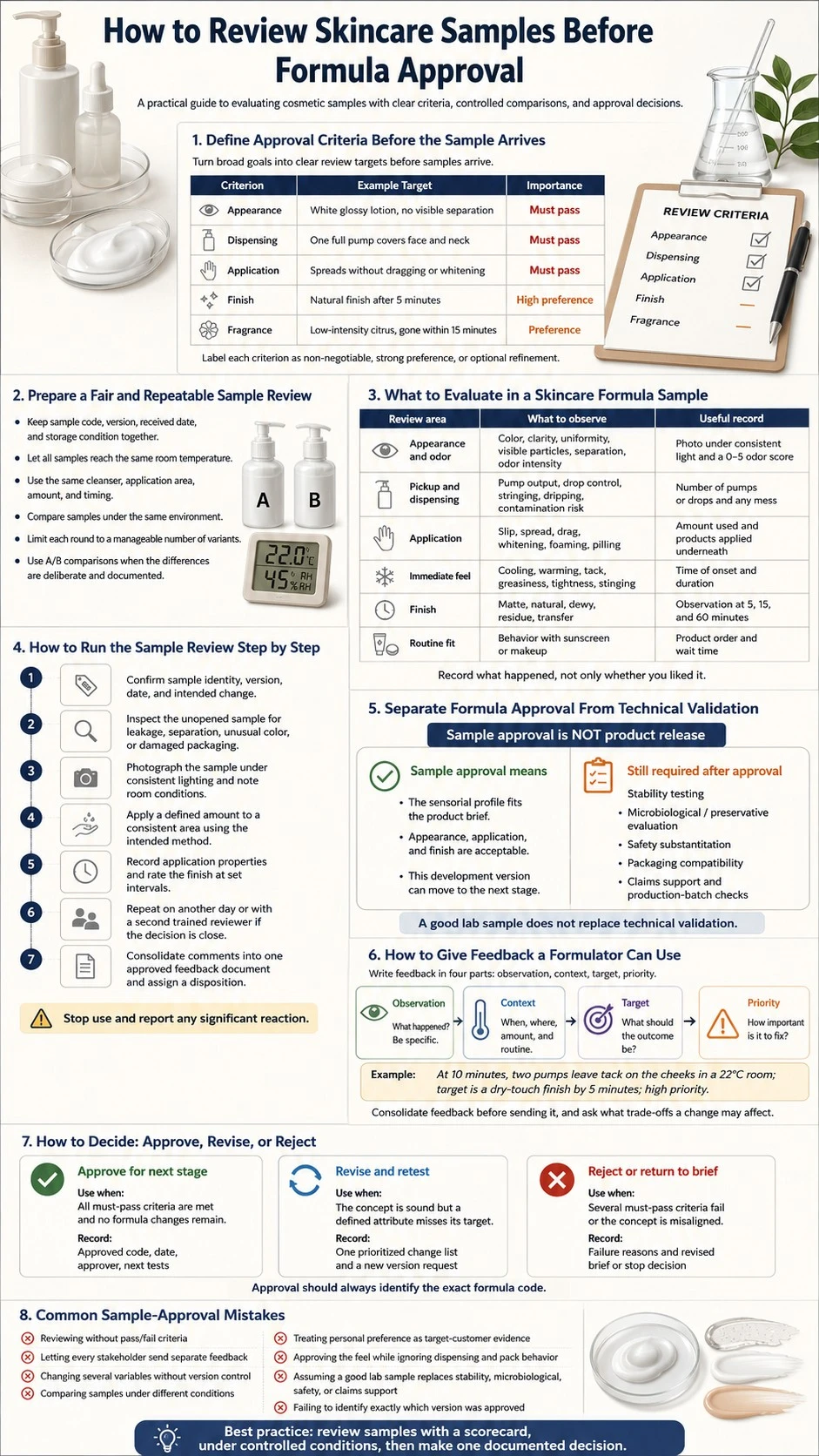
Casual sample reviews often produce comments such as “make it lighter” or “I do not love the scent.” Those reactions can start a discussion, but they do not tell a formulator what changed, when the problem appeared, or which trade-off matters most. A reliable review turns a subjective experience into controlled observations and a documented decision.
Define Approval Criteria Before the Sample Arrives
Start with the approved product brief. Convert broad goals into attributes that can be observed or measured. If the brief is still vague, refine the skincare product brief before asking for another sample round.
| Criterion | Example target | Priority |
|---|---|---|
| Appearance | White, glossy lotion with no visible separation | Must pass |
| Dispensing | One full pump covers face and neck | Must pass |
| Application | Spreads without dragging or whitening | Must pass |
| Finish | Natural finish after five minutes | High preference |
| Fragrance | Low-intensity citrus, gone within 15 minutes | Preference |
Label every criterion as a non-negotiable, a strong preference, or an optional refinement. This prevents a late preference from being treated as a failure. Include a benchmark product when possible, but describe the attribute you want instead of asking the lab to “copy” another formula.
Prepare a Fair and Repeatable Sample Review
Keep the sample code, formula version, received date, and storage condition together. Let samples reach the same room temperature before comparison. Use the same cleanser, application area, product amount, and timing for each candidate. Do not compare one sample after exercise and another in a cool office.
Limit each round to a manageable number of variants. If scent, viscosity, and emollience all change at once, the team may not know which adjustment caused the preferred result. A/B comparisons are most useful when the difference is deliberate and documented.
What to Evaluate in a Skincare Formula Sample
Evaluate the product in the order a customer experiences it, then return later to assess the finish. Record what happened rather than only whether you liked it.
| Review area | What to observe | Useful record |
|---|---|---|
| Appearance and odor | Color, clarity, uniformity, visible particles, separation, odor intensity | Photo under consistent light and a 0–5 odor score |
| Pickup and dispensing | Pump output, drop control, stringing, dripping, contamination risk | Number of pumps or drops and any mess |
| Application | Slip, spread, drag, whitening, foaming, pilling | Amount used and products applied underneath |
| Immediate feel | Cooling, warming, tack, greasiness, tightness, stinging | Time of onset and duration |
| Finish | Matte, natural, dewy, residue, transfer | Observation at 5, 15, and 60 minutes |
| Routine fit | Behavior with sunscreen or makeup | Product order and wait time |
A brief use test can reveal whether the sensorial profile matches the concept. It cannot establish shelf life, microbiological safety, packaging compatibility, or support a marketing claim. Those questions belong to controlled testing.
How to Run the Sample Review Step by Step

- Confirm sample identity, version, date, and intended change.
- Inspect the unopened sample for leakage, separation, unexpected color, or damaged packaging.
- Photograph the sample under consistent lighting and note room conditions.
- Apply a defined amount to a consistent area using the intended method.
- Record immediate application properties and rate the finish at predetermined intervals.
- Repeat the review on another day or with a second trained reviewer when a decision is close.
- Consolidate comments into one approved feedback document and assign a disposition.
Stop use and report burning, swelling, blistering, eye involvement, breathing symptoms, or another significant reaction. Do not interpret a founder-only use test as safety substantiation. U.S. cosmetic firms are responsible for ensuring products are safe under labeled or customary use, although no single test regimen is prescribed for every cosmetic.[1]
Separate Formula Approval From Technical Validation
Formula approval usually means the sample’s appearance, application, finish, and brief alignment are acceptable enough to freeze that development version. It is an internal stage decision—not FDA approval, proof of safety, or permission to release the product. A defined skincare product testing program still has to address the formula’s risks and intended market. In the United States, the responsible person must maintain records supporting adequate safety substantiation.[2]
Stability work evaluates how the cosmetic changes under relevant conditions and helps define suitable methods for assessing stability.[3] Microbiological risk assessment and preservative efficacy work address antimicrobial protection for products that are not low risk.[4] The exact program depends on the formula, packaging, intended use, market, and risk profile.
Commercial packaging can also change dispensing and expose the formula to air, light, or materials that were absent from a lab jar. Coordinate packaging customization and compatibility work before release.
How to Give Feedback a Formulator Can Use
Write each comment in four parts: observation, context, target, and priority. “Too sticky” is incomplete. “At 10 minutes, two pumps leave tack on the cheeks in a 22°C room; target is a dry-touch finish by five minutes; high priority” is actionable.
Consolidate feedback from marketing, founders, sales, and technical reviewers before sending it. Contradictory messages create unnecessary rounds. When requesting a change, ask what else may move. Lower viscosity can affect suspension, dispensing, stability, and skin feel; adding fragrance can affect odor, regulatory review, and compatibility.
How to Decide: Approve, Revise, or Reject
| Decision | Use it when | Required record |
|---|---|---|
| Approve for next stage | All must-pass criteria are met and no formula changes remain | Approved code, date, approver, next tests |
| Revise and retest | The concept is sound but a defined attribute misses its target | One prioritized change list and new version request |
| Reject or return to brief | Several must-pass criteria fail or the concept is technically or commercially misaligned | Failure reasons and revised brief or stop decision |
Approval should identify the exact formula code. Any later change to ingredients, fragrance, color, process, or pack should go through change control so the team can decide what must be repeated. Follow the agreed skincare project process rather than relying on an informal “looks good” message.
Common Sample-Approval Mistakes
- Reviewing without pass/fail criteria.
- Letting every stakeholder send separate feedback.
- Changing several variables without version control.
- Comparing samples under different conditions.
- Treating personal preference as target-customer evidence.
- Approving the feel while ignoring dispensing and pack behavior.
- Assuming a good lab sample replaces stability, microbiological, safety, or claims support.
- Failing to identify exactly which version was approved.
Final Thoughts
A strong skincare sample review is a controlled decision, not a vote on whether the product feels “nice.” Define the target first, test consistently, document the exact version, and keep formula approval separate from technical release. That discipline gives the formulator clearer direction and protects the project from expensive ambiguity later.


