
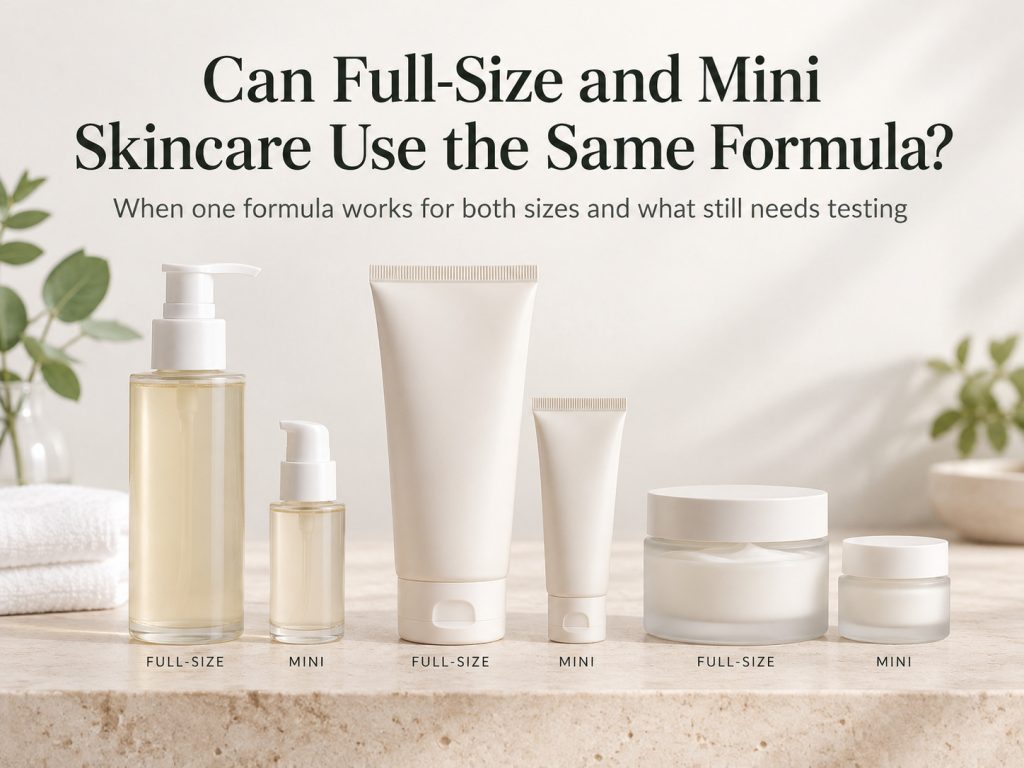


“Same formula” can describe a bulk composition, but customers buy a formula inside a specific package. A 50 mL airless cream and a 10 mL squeeze tube may contain the same ingredients at the same percentages while delivering different doses, exposing the product to different amounts of air, and behaving differently during filling, storage, travel, and repeated use.
For a private label brand, the practical question is not simply whether the mini can inherit the full-size INCI list. It is whether one formula can meet the approved quality, safety, dispensing, sensory, and claim requirements in both commercial configurations. That conclusion needs a documented comparison rather than a visual assumption that the two packs are scaled versions of each other.
Separate the Formula From the Finished Product Configuration
Evaluate the project in three layers. The formula layer is the quantitative recipe, raw-material specifications, and manufacturing method. The finished-product layer combines that bulk with the fill quantity, primary package, closure, dispenser, storage conditions, and intended use. The commercial SKU layer adds its own product code, specification, artwork, net contents, batch coding, release records, and sales configuration.
The formula layer can be identical while the other two layers differ. That is why sharing one formula does not automatically mean sharing one packaging compatibility conclusion, fill specification, dispenser test, artwork, or complete stability justification. Cosmetic testing is risk-based rather than governed by one universal list, and any evidence used must remain relevant to the finished product and customary or labeled use.[1]
This distinction also prevents unnecessary reformulation. If a mini fails, first identify the layer that failed. A leaking neck finish is a packaging problem. A pump that cannot prime may be a dispenser or viscosity-range problem. Product remaining below a short dip tube is an evacuation problem. Oxidation in a clear mini bottle may be a barrier or light-protection problem. Only some of these failures require changing the formula.
Compare the Full-Size and Mini Product Systems
Compare both formats field by field before deciding that the full-size evidence covers the mini. Stability methods must be selected and justified for the particular cosmetic, storage conditions, and use pattern rather than copied as one universal protocol.[2]
| Decision field | What may change in the mini | Why it matters to the shared-formula decision |
|---|---|---|
| Product-contact system | Resin, glass type, liner, gasket, spring, dip tube, coating, adhesive, decoration | Different materials or contact points can create migration, sorption, discoloration, swelling, corrosion, or stress cracking risks |
| Fill and headspace | Fill ratio, air volume, product surface area, orientation during storage | Oxygen exposure, evaporation, weight loss, separation, and appearance may differ from the full size |
| Barrier and light protection | Wall thickness, opacity, seal quality, closure design | A mini may protect an oxidation-, moisture-, or light-sensitive formula better or worse than the larger pack |
| Dispensing | Pump output, drop size, nozzle, orifice, tube recovery, jar access | The delivered dose, spread, priming, blockage, dripping, and usable product recovery can change |
| Manufacturing | Filling nozzle, fill speed, temperature, deaeration, minimum equipment hold-up | A small component can be harder to fill accurately or may require conditions that alter texture or entrapped air |
| Use cycle | Number of openings, finger or applicator contact, time after opening, travel handling | Contamination exposure, leakage, closure wear, and customer instructions may differ |
Industry stability guidance treats packaging as part of the assessment and notes that, when a product will be marketed in several package types, the smallest container can be a useful conservative test configuration.[3] That does not mean the mini automatically represents every size. A small airless pump and a large open jar are different product-contact and use systems, not merely different fill quantities.
Select the mini pack by formula behavior and customer use, not appearance alone. ZICAIL’s guide to mini skincare packaging formats compares tubes, airless pumps, bottles, and sachets across the operational decisions that matter at small sizes.
When the Same Formula Is a Good Starting Point
Using one formula across full-size and mini products is most defensible when the mini is a true size extension rather than a different product experience. The following conditions support a shared-formula route:
- The quantitative formula, raw-material suppliers or approved specifications, manufacturing site, process, and finished-bulk limits are unchanged.
- Both products have the same intended use, application area, target user, directions, frequency, warnings, and cosmetic claims.
- The mini package uses equivalent or well-characterized product-contact materials and provides suitable protection from light, oxygen, moisture, evaporation, and contamination.
- The dispenser can handle the formula’s viscosity, particles, waxes, or suspended materials and delivers an appropriate amount.
- Production-representative mini fills meet appearance, odor, color, pH, viscosity, weight, leakage, dispensing, and other relevant acceptance criteria.
- Existing evidence is linked to the exact formula version, and every package- or process-specific gap has a documented test or technical rationale.
One shared bulk can simplify purchasing, scale-up, quality control, claim consistency, and inventory planning. Those efficiencies are real only if the mini package works without changing the intended dose or the formula’s condition over its intended life.
Do not promise identical sensory performance from composition alone. A smaller pump may deliver less product per actuation, a narrow orifice may increase perceived drag, and a sachet may encourage the entire fill to be used at once. The formula can remain unchanged while directions, dispenser selection, or dose communication need revision.
When the Mini Formula May Need Adjustment
Adjust the formula only after confirming that packaging or process changes cannot solve the problem more cleanly. Reformulation creates a new technical version and can affect the INCI list, safety assessment, stability program, preservation evidence, claims, specifications, and artwork.
Common adjustment triggers include:
- Poor pumpability or evacuation: A high-viscosity cream does not prime through the mini pump, a gel strings from a narrow nozzle, or too much product remains in the package. First test another actuator, orifice, dip tube, or tube structure; adjust rheology only when the correct pack still cannot deliver the formula reliably.
- Separation or crystallization after filling: The mini filling process introduces excess shear, air, or temperature change, or the smaller pack cools differently. Correct the filling parameters before concluding that the emulsion or solvent system must change.
- Oxidation, fragrance loss, or color change: The mini has more headspace than planned, weaker light protection, or a different barrier. Improve the pack or fill control first; reconsider antioxidants, chelators, or formula design only when suitable packaging cannot provide the required protection.
- Leakage, paneling, swelling, or softening: These usually point to seal, component, pressure, or material compatibility. A formula adjustment may be appropriate when the chosen pack format is commercially essential and no compatible alternative meets the brief.
- Suspension or applicator mismatch: Particles, pigments, beads, or a structured gel block the mini orifice or settle in a way that changes dose uniformity. The dispenser and formula may need to be developed as one system.
- Different intended use: A single-use sachet, concentrated booster, eye-area mini, or “seven-day program” changes dose, exposure, directions, or claims. It should not be treated as the same product merely because the starting base is similar.
For U.S. projects, changing claims can also change product classification. A mini sunscreen, acne product, or other cosmetic-drug product cannot rely on a cosmetics-only size-extension analysis. Set the intended use and market classification before deciding that the formula or evidence can be shared.
Validate One Formula Across Two Sizes in Six Steps
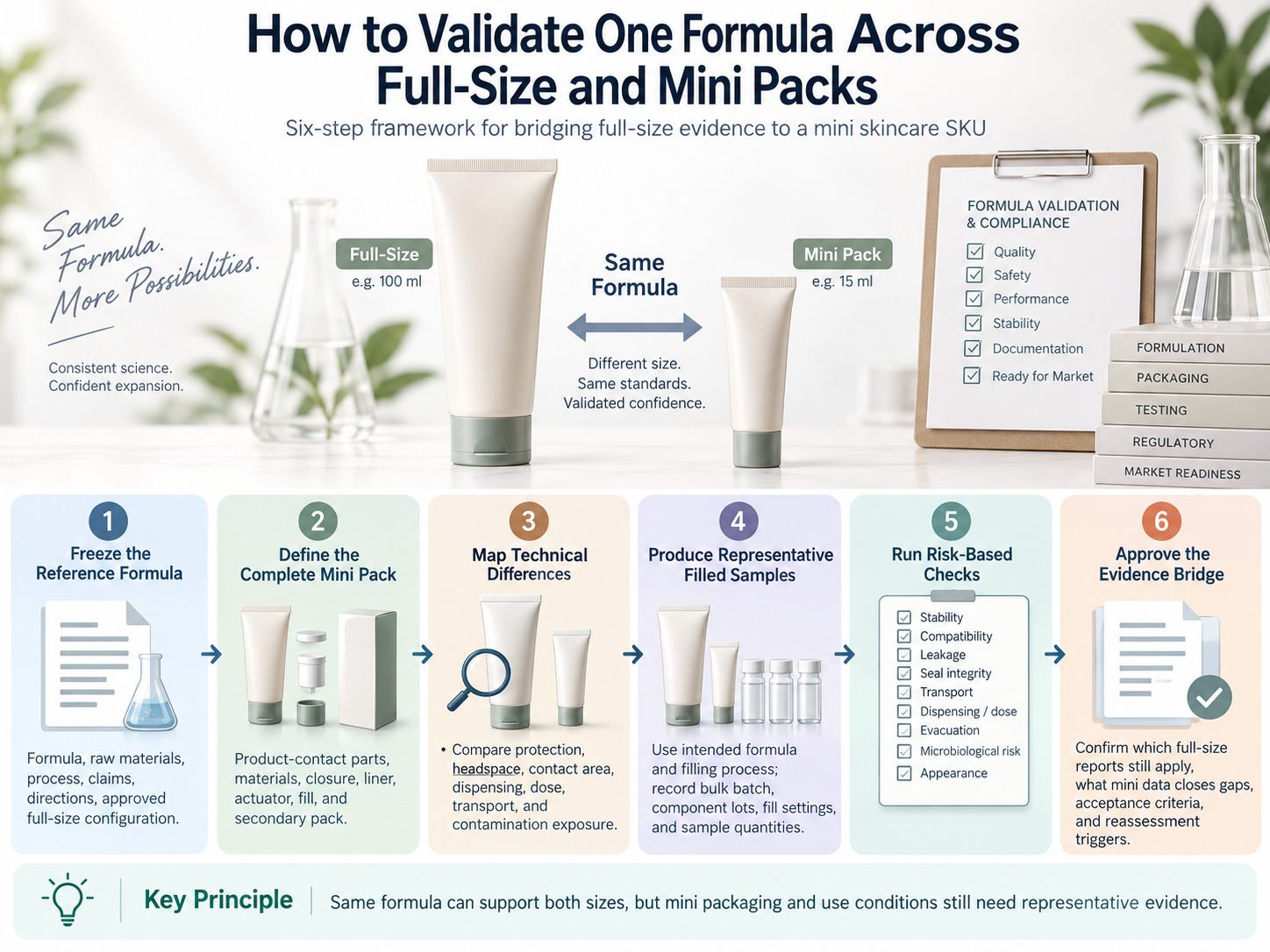
Use one controlled comparison so that every reused conclusion and every mini-specific check is visible.
- Freeze the reference formula. Record the quantitative formula, raw-material specifications, manufacturing instructions, finished-bulk specification, claims, directions, and approved full-size configuration.
- Define the complete mini pack. Identify every product-contact component, supplier reference, material, closure, liner, actuator, dip tube, seal, decoration, nominal fill, and secondary packaging that can affect the product.
- Map technical differences. Compare protection, headspace, contact area, dispensing, dose, filling, storage orientation, transport, number of uses, contamination exposure, and expected time after opening.
- Produce representative filled samples. Use the intended formula version and a justified filling process. Record bulk batch, component lots, fill settings, sample quantities, and any deviation from planned commercial production.
- Run the risk-based checks. Assess stability, formula–pack compatibility, leakage, seal integrity, transport exposure, dispensing, dose, evacuation, microbiological risk, appearance, and other relevant specifications. The exact program depends on the formula and configuration, not a universal checklist.
- Approve the evidence bridge and SKU file. State which full-size reports remain applicable, which mini results close the gaps, what acceptance criteria were met, and which changes would trigger reassessment.
The EU cosmetic safety-report framework illustrates why these inputs belong together: it requires information on finished-product stability, relevant packaging characteristics, normal and foreseeable use, and exposure.[4] The practical implication is that identical composition can support evidence reuse, but the packaging and use assumptions still need to represent the mini.
For the package-specific work, use production-representative filled components and defined acceptance criteria. The packaging compatibility testing guide explains the formula-to-pack interaction in more detail. If the product will be distributed in travel sets or shipped through demanding routes, include the relevant orientation, seal, and leak-prevention checks in the approved protocol.
Decide Which Existing Evidence Can Be Bridged
Bridge evidence only when the scientific reason is written down. The same quantitative formula can often support reuse of ingredient safety information, formula-level toxicological assessment, bulk specifications, and claim evidence when the mini has the same intended use, dose, directions, population, and claim meaning. Package-independent manufacturing information may also remain applicable when the bulk process is unchanged.
Do not automatically bridge conclusions that depend on the commercial pack. Reassess stability in the mini, formula–pack compatibility, leakage, dispenser performance, fill accuracy, usable recovery, transport behavior, artwork, and finished-SKU specifications. A full-size result can remain part of the evidence package without being sufficient by itself.
Preservative efficacy is a risk decision rather than an automatic repeat. ISO 11930 provides a framework for evaluating the antimicrobial protection of a cosmetic product through preservation-efficacy data and microbiological risk assessment.[5] When the quantitative formula and process are unchanged, existing challenge-test data may remain relevant. Reassess whether a new opening, applicator, repeated-use pattern, fill process, or package-protection level changes contamination risk enough to require additional work.
The broader questions about stability, labeling, claims, and market-specific evidence are covered in ZICAIL’s guide to testing and labeling travel-size cosmetics. Keep this formula bridge inside that wider release assessment rather than treating it as the complete approval.
Control the Mini as Its Own Commercial SKU
Even when both sizes are filled from one bulk batch, the mini needs its own product code and controlled finished-product specification. Define the component references, target fill and tolerances, closure or pump requirements, code location, artwork version, functional tests, sampling plan, acceptance criteria, case pack, and storage conditions.
If one bulk batch fills both sizes, the batch record should show when and where the product was transferred, which packaging line and settings were used, the component lots, quantities filled, in-process checks, reconciliation, and finished codes. Cosmetic GMP guidance emphasizes written filling instructions, finished-product testing, permanent code marks, and records linking packaging and batch controls.[6]
The label file is also size-specific. An unchanged formula normally keeps the same ingredient declaration, but the mini must show the correct net contents and use artwork that fits the actual package and target-market rules.[7] If the formula is adjusted, regenerate the ingredient list and reassess every claim, warning, specification, and supporting document affected by the change.
Connect both SKUs to the same formula master while preserving their separate pack and release records. A controlled document set for every skincare SKU makes it clear what is shared, what is configuration-specific, and which evidence must be reviewed after a change.
Plan a Full-Size and Mini Formula Brief With ZICAIL
ZICAIL can discuss a full-size and mini skincare project when the brand has defined the product type, formula route, target fills, package formats, intended markets, directions, claims, quantities, and launch configuration. Share any existing formula specification, stability or challenge-test reports, packaging drawings, artwork, and acceptance criteria that you expect to reuse.
Contact ZICAIL with both proposed SKUs to discuss whether one formula is a practical starting point, which package or filling differences need verification, and what information is required before samples or production planning.


