

Under-eye patches look similar in the jar, but their instructions can be quite different. A serum-soaked hydrogel patch is a ready-to-use cosmetic treatment; a reusable silicone patch normally covers a product you apply separately. This guide focuses on those skincare patches, not microneedle patches, LED devices, or sleep masks.
Where Under-Eye Patches Fit in Your Skincare Routine
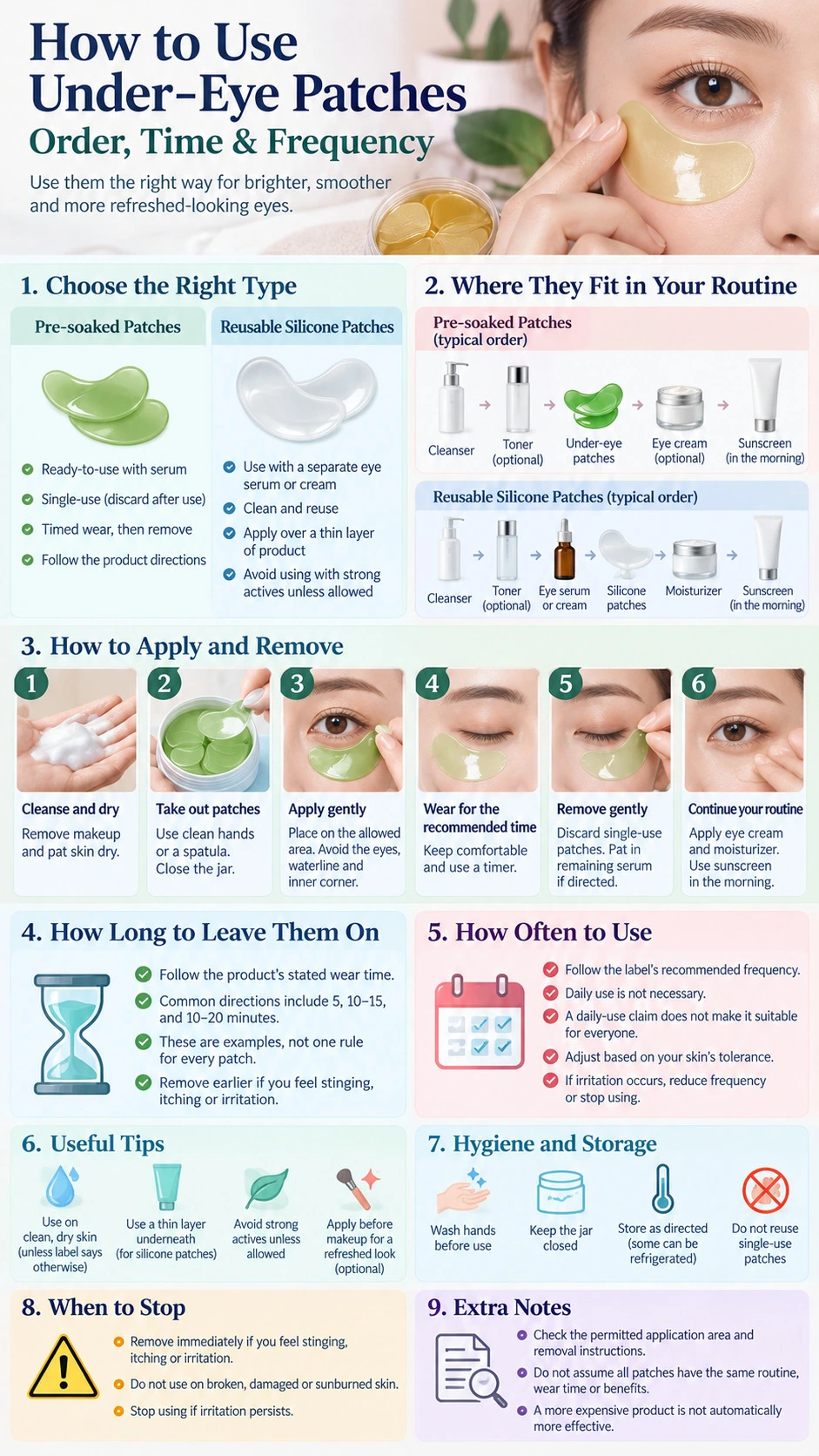
For pre-soaked patches that specify clean, dry skin, use them after cleansing and before heavier eye cream, moisturizer, or facial oil. Some five-minute eye gels specify clean, dry skin.[1] Certain 10–15-minute hydrogel patches give the same preparation instructions.[2] Dry here means the surface is not wet from washing; it does not mean stripping the skin or cleansing until it feels tight.
There is no single “before or after serum” rule for all eye patches. Some product directions place them after toner and serum, once those layers have settled.[3] If your own instructions only say clean, dry skin, keep the under-eye area free of extra products rather than assuming any face serum belongs underneath. Toner is not a required preparation step.
Reusable silicone patches follow a different sequence. Apply a thin layer of the compatible eye serum or cream first, then place the silicone covers on top. Too much product can make this type slide.[4] Use a product intended for the eye area; covering an ordinary face treatment does not make it eye-safe. Avoid experimenting with exfoliating acids or retinoids beneath patches unless the product directions specifically support that combination.
After removing pre-soaked patches, follow the instructions for the remaining serum, then continue with moisturizer as needed. If you use a separate eye cream, apply a light layer rather than stacking several rich products; the guide to applying eye cream covers amount and placement.
In the morning, finish skincare with sunscreen before makeup.[5] Put the patch step before sunscreen rather than lifting patches off an already-finished sunscreen layer. For the rest of the face, follow your usual skincare routine order without treating eye patches as a reason to add more steps.
How to Apply and Remove Under-Eye Patches
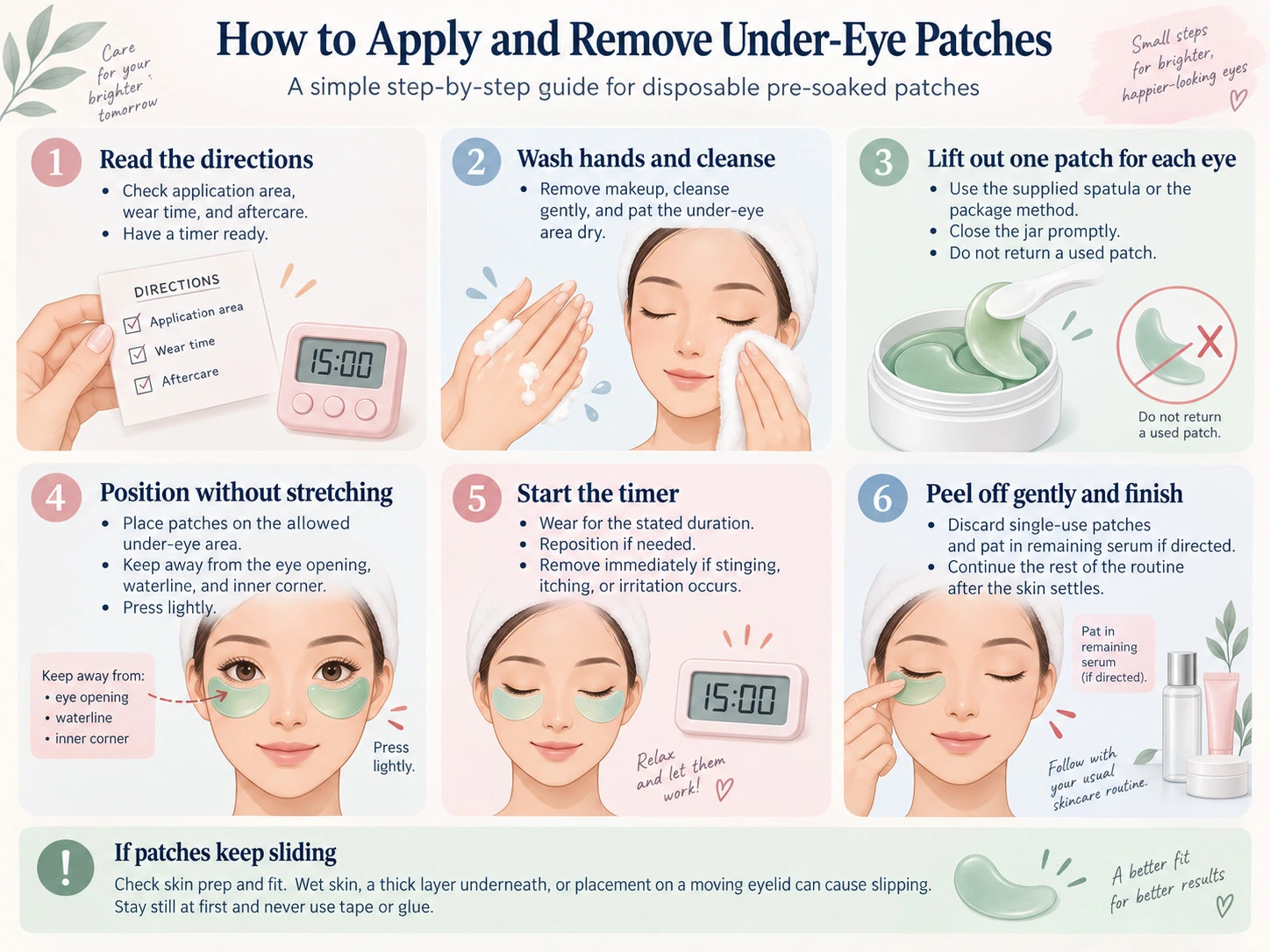
Use this sequence for disposable, pre-soaked patches whose directions call for clean, dry skin. If your label specifies a different preparation step, follow that instruction instead.
- Read the directions before opening. Check the application area, wear time, and aftercare. Have a timer ready so you do not have to guess while wearing the patches.
- Wash your hands and cleanse gently. Remove makeup and pat the under-eye surface dry. Use clean handling tools; hygiene matters for products used around the eyes.[6]
- Lift out one patch for each eye. Use the supplied spatula or the handling method named on the package. Close a multi-use jar promptly. Do not put a patch that has touched your face back into the jar.
- Position the patches without stretching the skin. Place them on the under-eye skin in the area allowed by the label. Keep the patch and its serum away from the eye opening, waterline, and inner corner. Follow the placement diagram; do not assume the wider end must always face inward or outward. Press lightly to make contact, without tugging the lower eyelid.
- Start the timer and keep the patches comfortable. Use the stated duration. If a patch shifts toward the eye, remove or reposition it with clean hands. Remove both patches immediately if they sting, itch, or cause irritation.
- Peel off gently and finish as directed. Do not pull abruptly. Discard single-use patches, and lightly pat in the remaining serum when the directions say to do so. Continue with the rest of your routine after the surface has settled.
If patches keep sliding, check preparation and fit before adding anything. Wet skin, a thick layer underneath, or placement on a moving eyelid can make application awkward. Stay still for the initial placement, and do not use tape or glue to secure a cosmetic patch.
How Long to Leave Under-Eye Patches On
Leave eye patches on for the time stated on the product you are using. There is no universal 20-minute rule. One pre-soaked eye gel specifies five minutes.[1] A different hydrogel patch specifies 10–15 minutes.[2] A reusable silicone mask used with a separate eye product specifies 10–20 minutes.[4]
The listed wear time belongs to the finished product, not just its headline ingredient. Two hyaluronic-acid patches can have different instructions, so matching an ingredient name is not a reason to copy another product’s timer.
Do not extend a daytime session into overnight wear unless the exact product expressly permits it. “Use at night” can mean a brief session before bed, not sleeping with patches attached. If the packaging and website disagree or leave overnight use unclear, ask the manufacturer rather than choosing the longest interpretation.
Remove patches at the instructed time rather than waiting for them to dry completely. You also do not need to wait out the timer if irritation starts. Comfort and the product’s directions take priority over finishing a session.
How Often to Use Eye Patches: Morning or Night?
Choose frequency from the label and your skin’s response, not from a universal daily or twice-weekly target. Some products are marketed for daily use, but that describes those products—not the entire category.[1] An occasional session is also a reasonable choice when patches are simply an optional part of your routine.
When trying a new product, use one label-length session and observe how the area feels afterward before deciding whether to repeat it. If you already use several eye treatments, simplify rather than adding patches over all of them. Multiple anti-aging products can irritate the skin.[5] Do not respond to dryness or stinging by increasing frequency.
Morning use is convenient before concealer or an event. Leave enough time to remove the patches, let the remaining formula settle, and complete sunscreen before makeup. Evening use fits a quieter routine when you have time to wear and remove them before bed. Neither time of day is automatically better for every formula.
Make frequency serve a clear purpose: a comfortable hydration step or occasional makeup preparation, rather than a promise to correct every eye-area concern. For expectations beyond application technique, see the guide to what under-eye masks can and cannot do. If you notice no useful difference, you do not need to keep buying them just to maintain a schedule.
Hygiene, Irritation and When to Stop
Before first use, test a new skincare formula on a small area away from the eye. A home skin test uses the normal amount and contact time on an area such as the inner arm; the general testing method repeats applications for 7–10 days.[7] Follow any product-specific precautions, and remember that tolerating an arm test does not guarantee comfort around the eyes. The guide to patch testing skincare explains the process and its limits.
- Disposable patches: Use a clean applicator if one is supplied, keep the jar closed between uses, and discard each used pair. Do not add water or another serum to the jar to revive dried patches.
- Reusable silicone patches: Clean them after each use, following their own care instructions. One silicone-mask system specifies gentle soap and water, drying, and storage on its insert.[4] Do not assume every reusable material tolerates the same cleaning method.
- Storage: Follow the package’s temperature and shelf-life instructions. Refrigerate only when permitted, and do not freeze patches unless expressly allowed. Avoid using products with damaged packaging or an unexpected change in smell or appearance.
Do not share eye-area cosmetics or use them over an eye infection or inflamed skin. Stop using a product that irritates the area, and seek medical advice if irritation persists.[6] Burning is not a sign that the patches are working harder; remove them and gently wash residue off the skin.
If serum gets into the eye, follow the package’s first-aid directions. Flush the eye with plenty of clean, non-hot water for at least 20 minutes, using a gentle flow, and do not rub it. Severe eye pain or any change in vision needs urgent medical assessment.[8] Do not cover a reaction with another patch or immediately try a different eye treatment.
FAQs About Using Under-Eye Patches
Should you wash your face after using under-eye patches?
Not usually when a pre-soaked patch’s directions say to pat in the remaining serum. Follow its aftercare instructions rather than automatically rinsing. If the product causes irritation, remove it and gently wash residue off instead of leaving it on.
Can you use under-eye patches every day?
Only when the exact product allows daily use and your skin remains comfortable. Daily application is optional, not a requirement for all eye patches. Do not exceed the recommended frequency or continue through stinging, itching, or redness.
Do you apply eye cream before or after eye patches?
For many pre-soaked patches, eye cream comes afterward if needed. Reusable silicone patches often go over a compatible eye cream or serum. Check the instructions for both products rather than applying one rule to these different formats.
Can you reuse disposable under-eye patches?
No. Discard patches labeled single-use after removal; putting them back in the jar does not make them clean or reusable. Only reuse patches explicitly designed for repeated use, and clean and store them according to their care instructions.
Sources
[1] Patchology. Rejuvenating Eye Gels
[2] Peter Thomas Roth. Water Drench Hyaluronic Cloud Hydra-Gel Eye Patches
[3] Charlotte Tilbury. How To Use Eye Patches + Eye Masks
[4] Dieux. Forever Eye Mask
[5] American Academy of Dermatology. Should I apply my skin care products in a certain order?
[6] U.S. Food and Drug Administration. Eye Cosmetic Safety
[7] American Academy of Dermatology. How to test skin care products
[8] NHS. Eye injuries


