


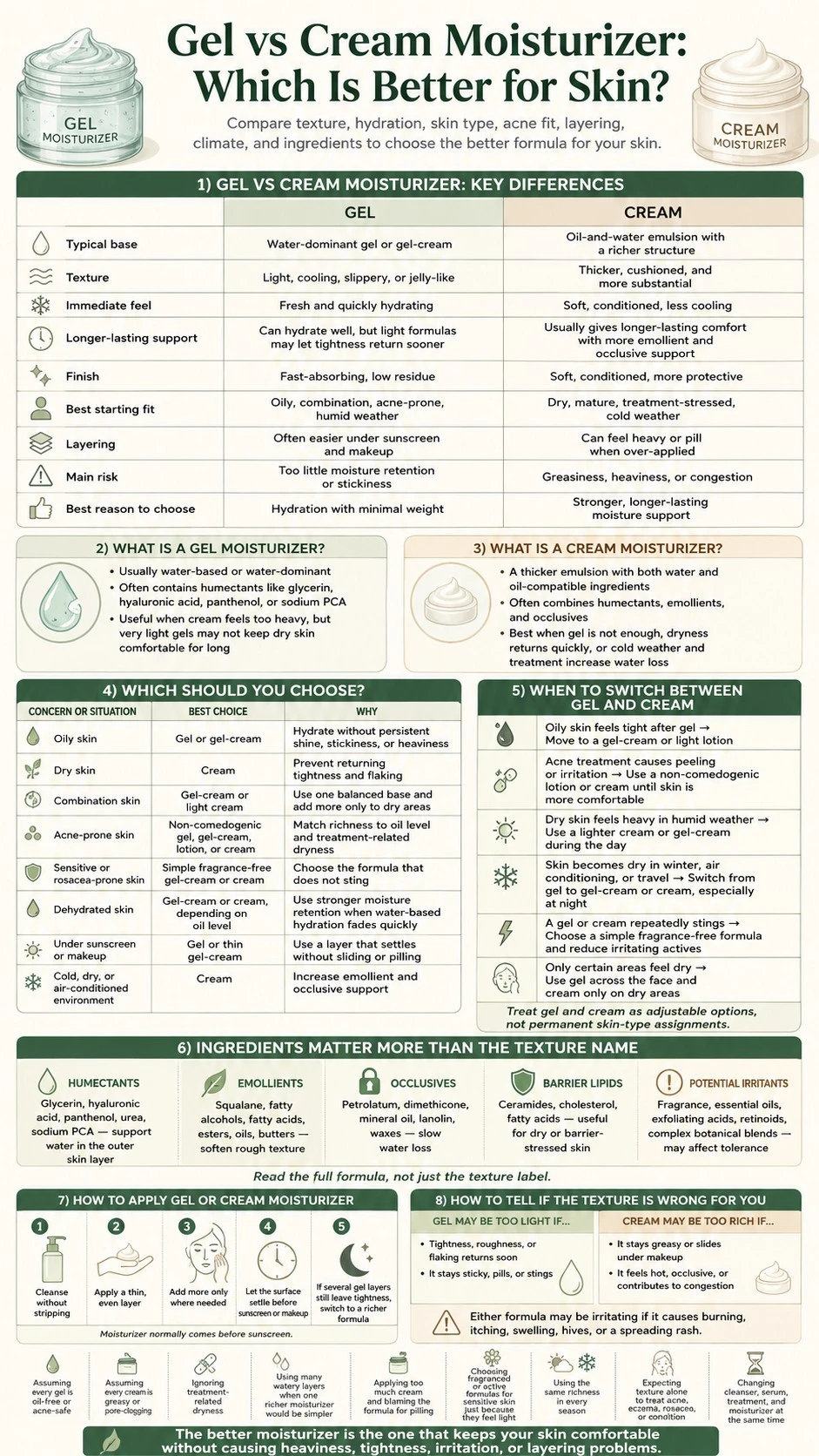
Gel and cream moisturizers both add water-supporting and skin-softening ingredients, but they differ in texture, richness, finish, and how strongly they slow moisture loss. Gel moisturizers usually feel lighter and absorb faster, while creams usually provide more emollient and occlusive support.
Neither format is automatically better. The right choice depends on your skin type, current dryness, acne treatment, climate, time of day, and how the product behaves under sunscreen or makeup.
Gel vs Cream Moisturizer: Key Differences
Both formats can hydrate the skin. The main difference is whether the formula prioritizes an immediate lightweight water feel or stronger, longer-lasting moisture support.
| Feature | Gel Moisturizer | Cream Moisturizer |
|---|---|---|
| Typical base | Water-dominant gel or gel-cream | Oil-and-water emulsion with a richer structure |
| Texture | Light, cooling, slippery, or jelly-like | Thicker, cushioned, and more substantial |
| Immediate hydration feel | Often feels fresh and quickly hydrating because of its water-rich texture | Usually feels softer and more conditioned rather than distinctly cooling or watery |
| Longer-lasting moisture support | Can hydrate well, but very light formulas may allow tightness to return sooner | Usually provides longer-lasting comfort because it often contains more emollient and occlusive support |
| Finish | Usually fast-absorbing and low-residue | Usually soft, conditioned, and more protective |
| Common starting fit | Oily, combination, acne-prone, or humid-weather skin | Dry, mature, sensitive-feeling, treatment-stressed, or cold-weather skin |
| Layering | Often easier under sunscreen and makeup | Can improve comfort but may feel heavy or contribute to pilling when over-applied |
| How to judge the result | Skin should remain comfortable for several hours without tightness returning | Skin should remain comfortable without persistent greasiness, heaviness, or congestion |
| Main risk | May feel sticky or provide too little moisture retention | May feel greasy, occlusive, or too heavy for the user |
| Best reason to choose it | You want hydration with minimal weight | You need stronger and longer-lasting moisture support |
What Is a Gel Moisturizer?
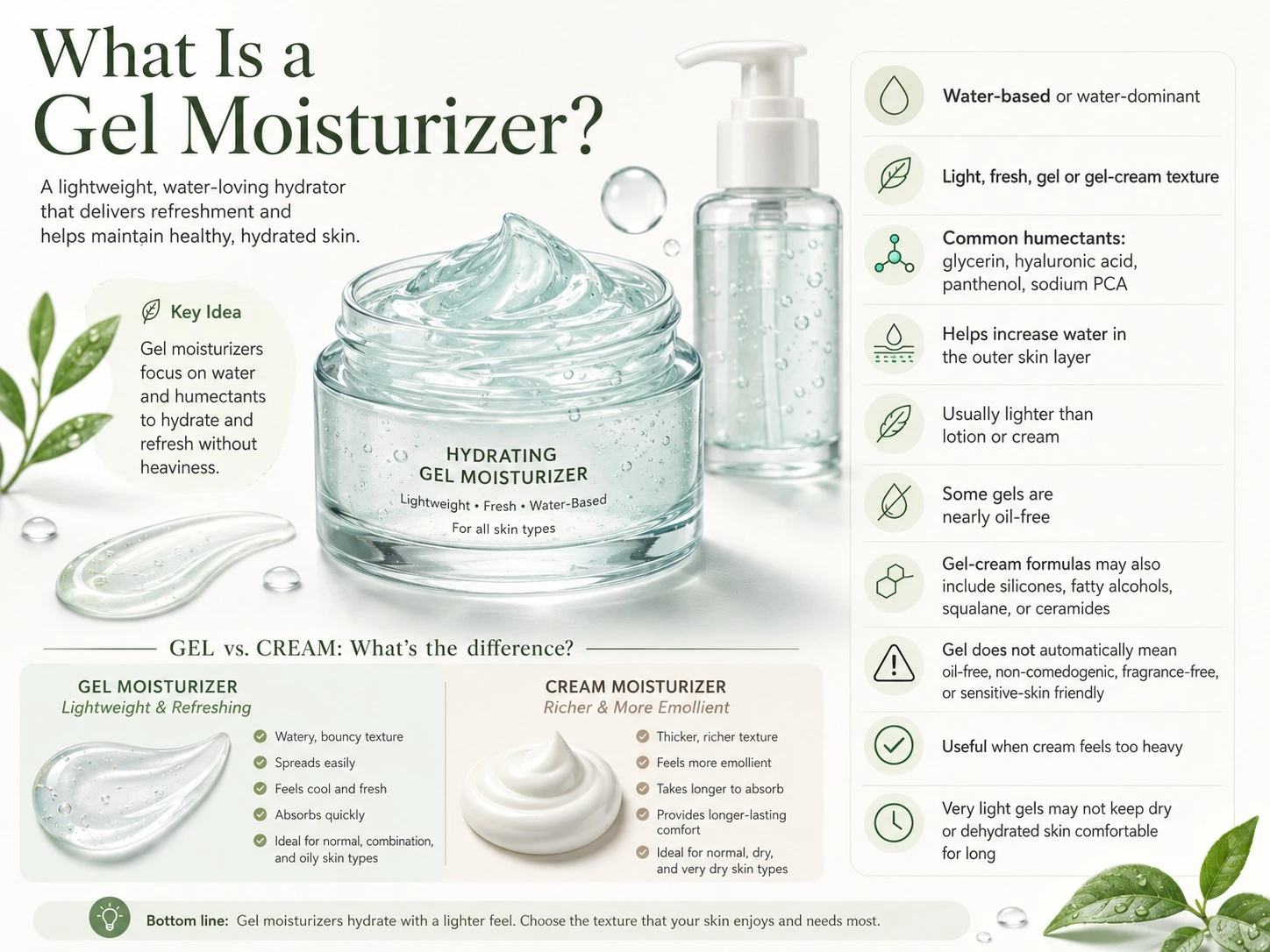
A gel moisturizer is usually water-based or water-dominant and thickened into a clear, translucent, or gel-cream texture. It often contains humectants such as glycerin, hyaluronic acid, panthenol, or sodium PCA, which help increase water in the outer skin layer. Gels are generally lighter than lotions, while creams are thicker and usually provide more oil-based emollient or occlusive support.[1]
Some gels are nearly oil-free and focus on a fresh finish. Others are gel-creams that combine humectants with silicones, fatty alcohols, squalane, ceramides, or other emollients. This means “gel” does not guarantee that a product is oil-free, non-comedogenic, fragrance-free, or suitable for sensitive skin.
Gel moisturizers are useful when a conventional cream feels too heavy, but a very light formula can leave dry or dehydrated skin comfortable for only a short time.
What Is a Cream Moisturizer?
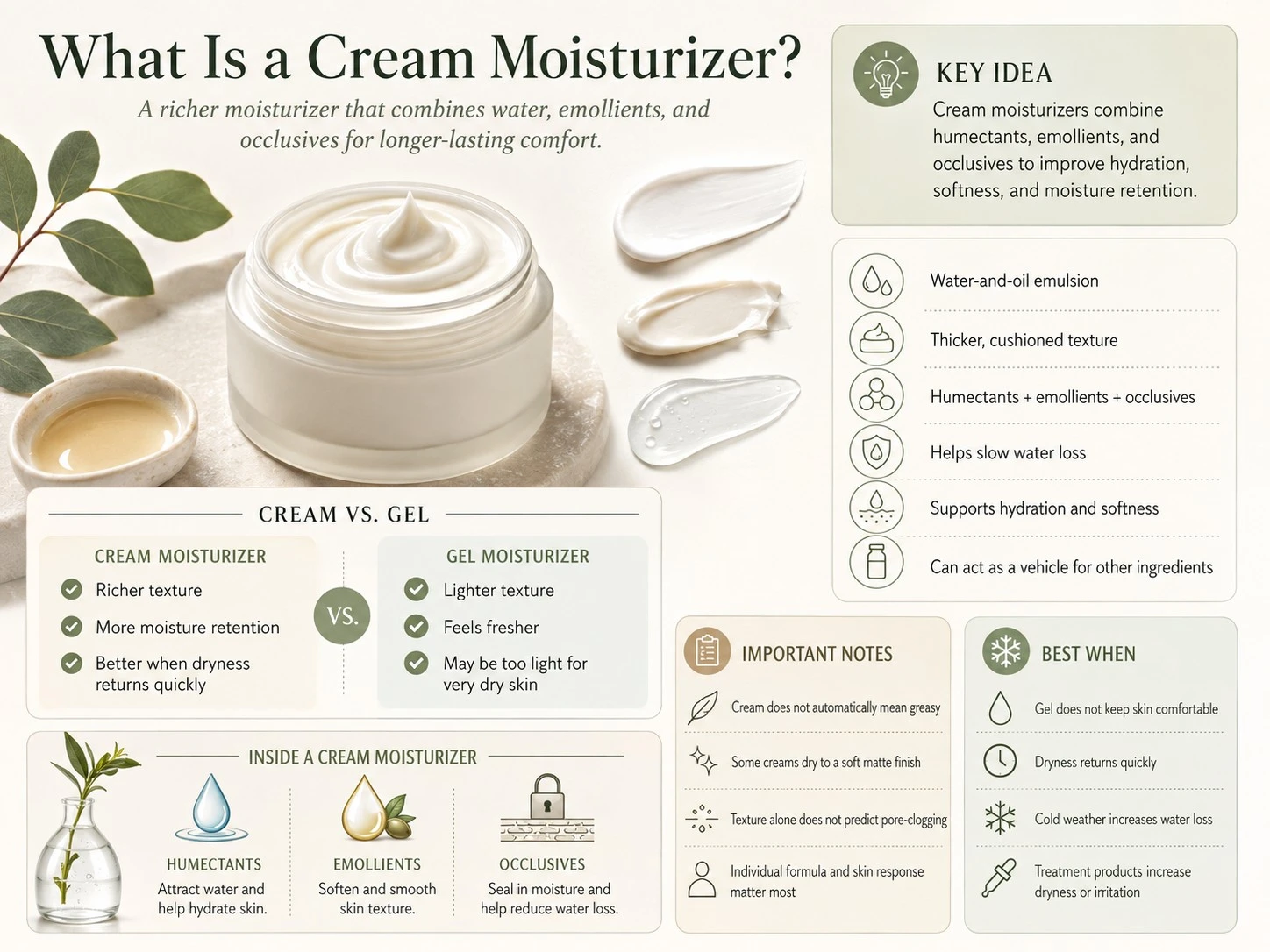
A cream moisturizer is an emulsion containing both water and oil-compatible ingredients in a thicker structure. It commonly combines humectants with emollients that soften rough skin and occlusives that slow water loss. Moisturizers can improve hydration, softness, and the appearance of the skin surface, while also acting as vehicles for other ingredients.[2][3]
Cream does not mean greasy by definition. Some creams absorb to a soft matte finish, while others leave a rich film. Likewise, a cream is not automatically pore-clogging. Comedogenicity cannot be predicted reliably from texture alone, and individual response to the finished formula matters.
Cream moisturizers are most useful when a gel does not keep the skin comfortable, when dryness returns quickly, or when cold weather and treatment products increase water loss and irritation.
Which Should You Choose?
Use the table as a starting decision, then adjust according to how your skin feels several hours after application rather than only during the first few minutes.
| Skin or Routine Situation | Better Starting Option | Main Decision Rule |
|---|---|---|
| Oily skin | Gel or gel-cream | Hydrate without persistent shine, stickiness, or heaviness |
| Dry skin | Cream | Choose enough richness to prevent returning tightness and flaking |
| Combination skin | Gel-cream or light cream | Use one balanced base and add more only to dry areas |
| Acne-prone skin | Non-comedogenic gel, gel-cream, lotion, or cream | Match richness to oil level and treatment-related dryness |
| Sensitive or rosacea-prone skin | Simple fragrance-free gel-cream or cream | Choose the formula that does not sting rather than the lightest texture |
| Dehydrated skin | Gel-cream or cream, depending on oil level | Add stronger moisture retention when water-based hydration fades quickly |
| Under sunscreen or makeup | Gel or thin gel-cream | Use a layer that settles without sliding or pilling |
| Cold, dry, or air-conditioned environment | Cream | Increase emollient and occlusive support as dryness increases |
When to Switch Between Gel and Cream Moisturizer
Skin type gives you a starting point, but treatment, climate, dehydration, and irritation can change the texture your skin needs. Adjust according to current skin behavior rather than continuing with a formula only because it normally matches your skin type.
| Current Situation | What It May Mean | Practical Adjustment |
|---|---|---|
| Oily skin feels tight after gel moisturizer | The skin may be dehydrated or the gel may provide too little moisture retention | Move to a gel-cream or light lotion instead of using a stronger cleanser |
| Acne treatment causes peeling or irritation | Your usual lightweight moisturizer may no longer provide enough support | Use a non-comedogenic lotion or cream until the skin becomes more comfortable |
| Dry skin feels heavy or greasy in humid weather | The cream may be richer than current conditions require | Use a lighter cream or gel-cream during the day or in warm weather |
| Skin becomes dry in winter, air conditioning, or during travel | Environmental water loss has increased | Switch from gel to gel-cream or cream, especially at night |
| A gel or cream repeatedly stings | The complete formula or a stressed skin barrier may be the problem, not the texture | Choose a simple fragrance-free formula and reduce irritating active products |
| Only certain facial areas feel dry | Different zones need different levels of richness | Use gel across the face and add cream only to dry areas |
Oily skin can still be dehydrated, and acne-prone skin may need a richer moisturizer during treatment. Dry skin can also prefer a lighter texture in humid weather. Treat gel and cream as adjustable options rather than permanent skin-type assignments.
Ingredients Matter More Than the Texture Name

Gel and cream describe the product vehicle, not the complete moisturizing system. Read the formula by function rather than looking for one “best” ingredient.
- Humectants: Glycerin, hyaluronic acid, panthenol, urea, and sodium PCA help support water in the outer skin layer.
- Emollients: Squalane, fatty alcohols, fatty acids, esters, plant oils, and butters soften rough texture and improve slip.
- Occlusives: Petrolatum, dimethicone, mineral oil, lanolin, and waxes slow water loss from the surface.
- Barrier lipids: Ceramides, cholesterol, and fatty acids are commonly used in formulas intended for dry or barrier-stressed skin.
- Potential irritants: Fragrance, essential oils, exfoliating acids, retinoids, and complex botanical blends can affect tolerance in either format.
A gel that contains only humectants may be too light for very dry skin. A cream that contains abundant fragrance or unnecessary actives may be unsuitable for sensitive skin. Evaluate the complete formula and the result on your skin.
How to Apply Gel or Cream Moisturizer
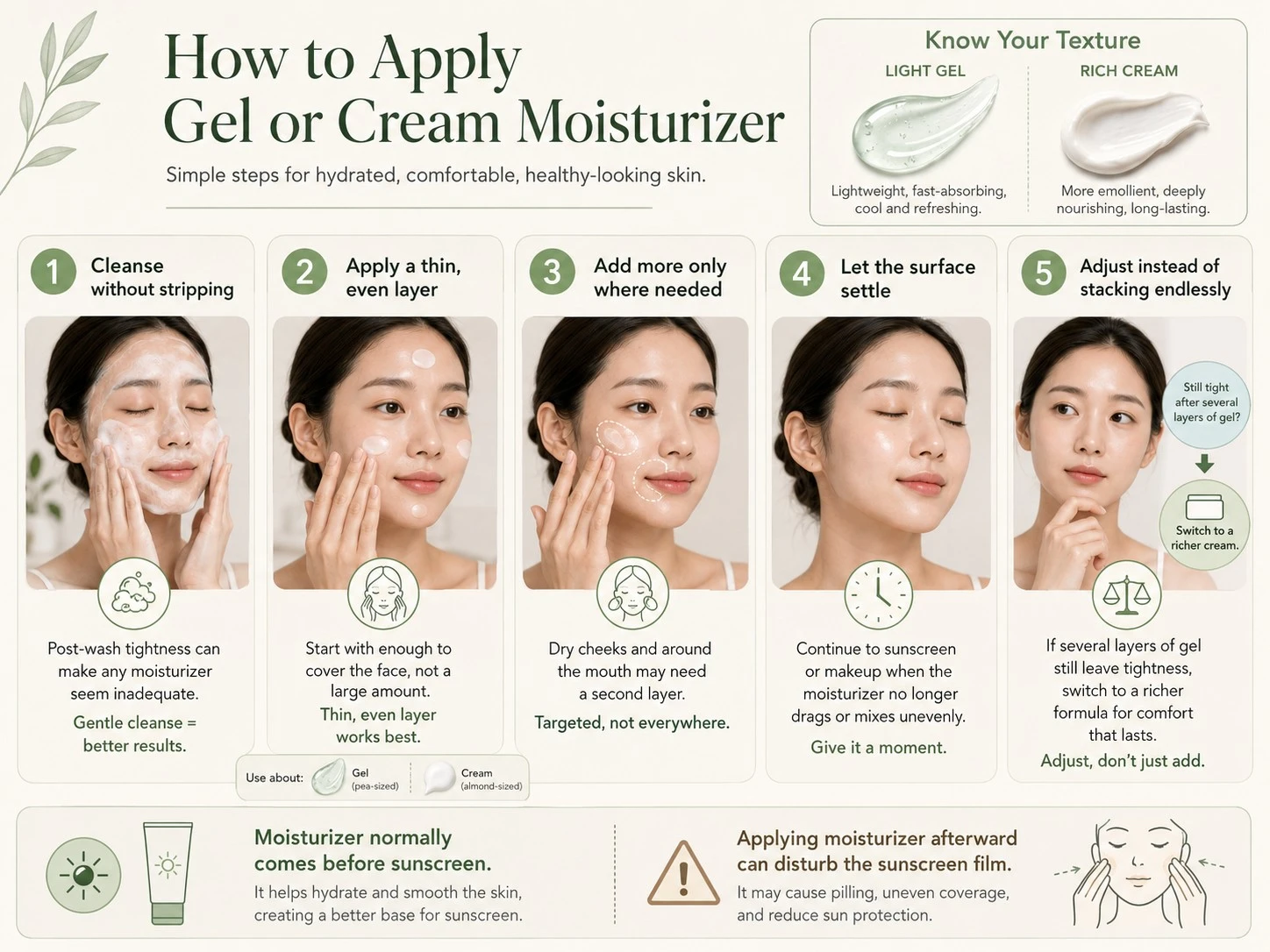
- Cleanse without stripping: Persistent post-wash tightness can make any moisturizer seem inadequate.
- Apply a thin, even layer: Begin with enough to cover the face rather than using a large amount at once.
- Add more only where needed: Dry cheeks and areas around the mouth may need a second layer.
- Let the surface settle: Continue to sunscreen or makeup when the moisturizer no longer drags or mixes unevenly.
- Adjust instead of stacking endlessly: If several layers of gel still leave tightness, change to a richer formula.
Moisturizer normally comes before sunscreen. Applying moisturizer afterward can disturb the sunscreen film; see Sunscreen or Moisturizer First? for the full morning order.
How to Tell If the Texture Is Wrong for You
The better product is the one that keeps your skin comfortable without causing a new layering or tolerance problem.
- The gel may be too light: Tightness, roughness, or flaking returns soon after application.
- The gel may not suit you: It remains sticky, pills under sunscreen, or stings because of fragrance or active ingredients.
- The cream may be too rich: It stays greasy, slides under makeup, feels hot or occlusive, or repeatedly contributes to congestion for you.
- The cream may still be too light: Very dry areas remain rough or uncomfortable despite correct application.
- Either formula may be irritating: Burning, itching, swelling, hives, or a spreading rash means you should stop using it.
Change one product at a time. When burning continues with otherwise gentle products, simplify the routine rather than assuming you need stronger hydration.
Common Gel and Cream Moisturizer Mistakes
- Assuming every gel is oil-free, non-comedogenic, or suitable for acne.
- Assuming every cream is greasy or pore-clogging.
- Choosing by skin type while ignoring treatment-related dryness.
- Using several watery layers when one richer moisturizer would be simpler.
- Applying too much cream and then blaming the formula for pilling.
- Choosing a fragranced or active product for sensitive skin because the texture feels light.
- Using the same richness in every season and climate.
- Expecting moisturizer texture alone to treat acne, eczema, rosacea, or another skin condition.
- Changing cleanser, serum, treatment, and moisturizer at the same time.
Final Thoughts
Gel moisturizer is usually better when you want light hydration, quick absorption, and easy daytime layering. Cream moisturizer is usually better when your skin needs stronger softening, moisture retention, and protection from returning dryness.
Treat those as starting patterns rather than fixed skin-type rules. Oily skin can need cream during acne treatment, dry skin can prefer gel-cream in humid weather, and sensitive skin can react to either format. Judge the complete formula, the environment, and how long your skin remains comfortable.
For placement with cleanser, serum, treatment, sunscreen, and facial oil, see our Skincare Routine Order.
FAQs About Gel vs Cream Moisturizer
Is gel or cream moisturizer better for oily skin?
Gel or gel-cream is usually the easier starting option because it feels lighter and leaves less residue. Use a light lotion or cream instead when oily skin is dehydrated, peeling, or irritated by acne treatment.
Is gel or cream moisturizer better for dry skin?
Cream is usually better because it tends to contain more emollient and occlusive support. A gel-cream can work in humid weather or for mild dryness, but a very light gel may allow tightness to return.
Can acne-prone skin use cream moisturizer?
Yes. Choose a non-comedogenic cream when possible and use an amount that does not feel heavy. Cream can be especially useful when retinoids, benzoyl peroxide, or other treatments cause dryness.
Can I use gel moisturizer in the morning and cream at night?
Yes. Gel can layer well under sunscreen and makeup, while cream can provide more comfort overnight. Using two textures is optional, not a requirement.
Which is better under sunscreen?
Gel or a thin gel-cream often layers more easily, but any moisturizer can work when it absorbs evenly and does not pill. Apply only the amount your skin needs and allow the surface to settle before sunscreen.
Is gel moisturizer less moisturizing than cream?
Not necessarily. Gel can increase skin hydration, but cream usually provides stronger moisture retention because it often contains more emollient and occlusive ingredients. The better option is the one that keeps your skin comfortable for the required time.
Sources
[1] American Academy of Dermatology. How to Pick the Right Moisturizer for Your Skin
[2] DermNet. Emollients and Moisturizers
[3] Draelos ZD. The Science Behind Skin Care: Moisturizers
[4] American Academy of Dermatology. Moisturizer: Why You May Need It If You Have Acne
[5] American Academy of Dermatology. 7 Rosacea Skin Care Tips Dermatologists Recommend


