


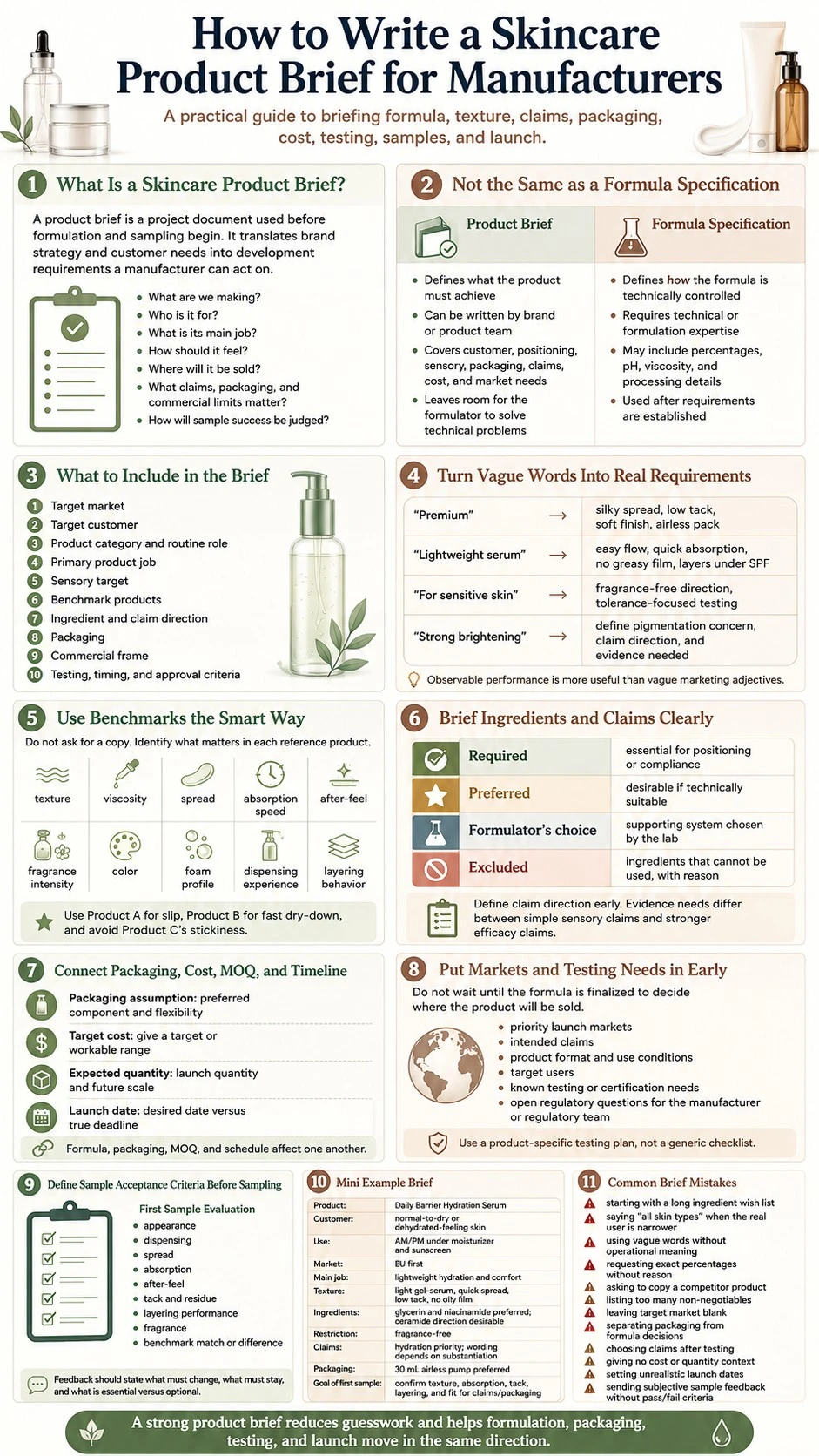
A skincare product brief is where a product idea becomes a development project. Without one, “a premium brightening serum” can mean a watery vitamin C product to one team, a milky niacinamide serum to another, and a high-active treatment with completely different packaging and cost to a third.
The purpose of the brief is not to make the founder act like a cosmetic chemist. It is to remove avoidable guessing. A strong brief gives formulation, sourcing, packaging, testing, regulatory, and commercial teams enough information to make the next decision without forcing the brand to specify technical details it does not actually know.
What Is a Skincare Product Brief?
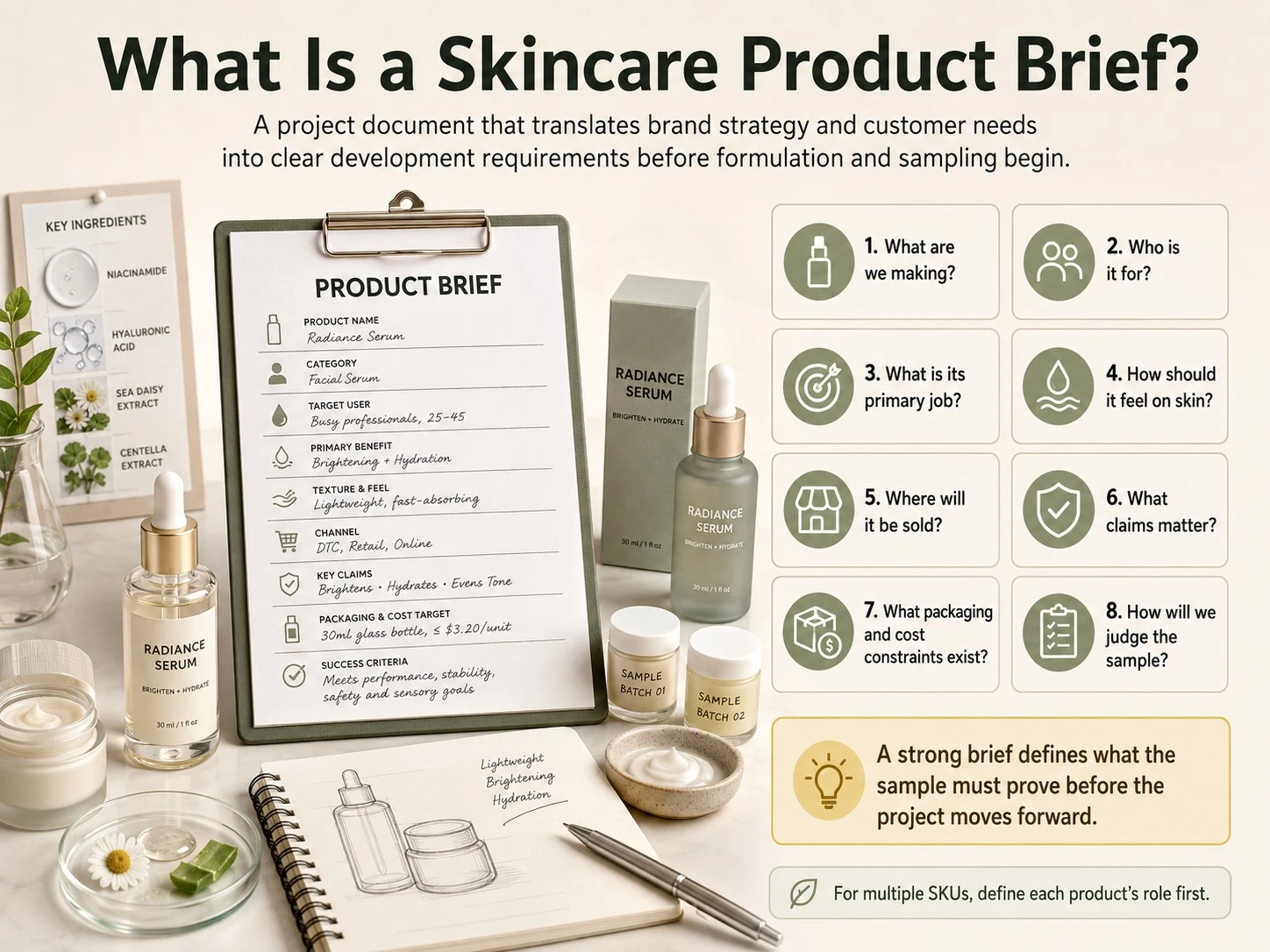
A skincare product brief is a project document that describes the intended product before formulation and sampling begin. It translates brand strategy and customer needs into requirements that a manufacturer or formulation team can act on.
At minimum, the brief should answer:
- What are we making?
- Who is going to use it?
- What is its primary job?
- How should it feel during and after application?
- Where will it be sold?
- What claims or positioning matter?
- What packaging and commercial constraints exist?
- How will we decide whether a sample is good enough?
The last question is often overlooked. A useful brief should not only describe the desired product; it should also define what the sample needs to demonstrate before the project moves forward.
If you are planning several SKUs rather than one isolated product, define each SKU’s role first. A product brief becomes much clearer when the hero product, supporting products, price architecture, and routine roles have already been decided. How to Build a Skincare Product Line That Can Scale covers that portfolio-level decision.
A Product Brief Is Not the Same as a Formula Specification
One of the most common briefing mistakes is going too far in the wrong direction. A brand may send a manufacturer a list containing 20 ingredients, exact percentages, a target pH, a preservative system, and processing instructions even though none of those technical requirements has been validated.
That is closer to a formula specification than a product brief.
| Product Brief | Formula Specification |
|---|---|
| Defines what the product needs to accomplish | Defines how the formula is technically composed or controlled |
| Can be written by a brand or product team | Normally requires formulation and technical expertise |
| Includes customer, positioning, sensory, packaging, claims, cost, and market requirements | May include ingredient percentages, pH specifications, viscosity ranges, manufacturing procedures, and other technical parameters |
| Leaves room for the formulator to solve technical problems | Controls technical execution after requirements have been established |
If you genuinely require a specific active level, ingredient certification, excluded material, pH range, or other technical condition, include it and explain why. But do not invent technical constraints simply to make the brief look more professional.
The broader relationship between product concept, ingredient selection, formula development, sampling, and validation is explained in our Skincare Formulation Guide: How Brands Develop Products.
What to Include in a Skincare Product Brief
The following structure is detailed enough to start a serious manufacturer discussion without turning the brief into a laboratory document.
| Brief Field | What to Define | Example |
|---|---|---|
| 1. Target market | First launch country or region and any later markets the formula should preserve | EU first; UK planned next |
| 2. Target customer | Skin type, concern, routine behavior, use environment, and relevant preferences | Normal-to-dry skin seeking lightweight daily hydration under sunscreen |
| 3. Product category | Format, routine position, frequency, and pack size | 30 mL leave-on facial serum for AM/PM use |
| 4. Primary product job | One main benefit plus limited supporting benefits | Primary: hydration; supporting: smoother, more comfortable skin feel |
| 5. Sensory target | Viscosity, spread, absorption, tack, finish, fragrance, color, and layering | Light gel-serum, quick break, low tack, no greasy residue, layers under SPF |
| 6. Benchmark | Reference products and the specific attributes you want to match or avoid | Benchmark A for slip; Benchmark B for dry-down; neither needs to be copied |
| 7. Ingredient and claim direction | Must-haves, preferences, exclusions, certification needs, and desired claim territory | Niacinamide preferred; fragrance-free required; hydration claim desired |
| 8. Packaging | Pack type, size, dispensing experience, decoration, and acceptable alternatives | 30 mL airless pump preferred; manufacturer may propose compatible alternatives |
| 9. Commercial frame | Retail position, channel, target cost if known, launch quantity, and expected scale | Premium-mass DTC launch; initial quantity to be discussed against MOQ |
| 10. Testing, timing, and approval | Target launch, required evidence, testing expectations, and sample pass/fail criteria | Launch in Q2; sample must meet texture, layering, packaging, and claim-development targets |
You do not need perfect answers to every field. Mark uncertain items as flexible or request manufacturer recommendations. That is more useful than presenting a guess as a non-negotiable requirement.
Turn Vague Marketing Words Into Formulation Requirements
Words such as “premium,” “luxurious,” “clean,” “lightweight,” “clinical,” and “gentle” are useful for branding but weak as standalone formulation instructions. Different people can interpret the same word differently.
Convert the word into an observable product experience.
| Too Vague | More Useful Brief Language |
|---|---|
| “Make it premium.” | Silky spread, low tack after 60 seconds, soft finish, minimal visible residue, 30 mL airless presentation |
| “Lightweight serum.” | Flows easily from pump, spreads quickly, absorbs without a greasy film, comfortable beneath moisturizer and sunscreen |
| “For sensitive skin.” | Target users include easily irritated skin; fragrance-free positioning preferred; tolerance claim to be supported by an appropriate testing plan |
| “Clean formula.” | Replace the undefined term with the exact ingredient, certification, sourcing, or market restrictions that matter to the brand |
| “Strong brightening.” | Define the pigmentation concern, proposed claim direction, desired treatment intensity, and evidence expected before launch |
This does not mean every sensory feature needs a laboratory number. It means the formulator should be able to understand what success looks like without guessing what “premium” means to your brand.
How to Use Benchmark Products Without Asking for a Copy
A benchmark can communicate product experience much faster than several paragraphs of adjectives. But “make this exact product” is a poor brief.
Instead, identify which part of each benchmark matters:
- texture;
- viscosity;
- spread;
- absorption speed;
- after-feel;
- fragrance intensity;
- color;
- foam profile;
- dispensing experience;
- how it layers with other products.
You can also use more than one reference. For example:
“Use Product A as the reference for slip and spread. Product B has the preferred fast dry-down. Avoid the sticky after-feel of Product C.”
That gives the formulation team a direction without requiring them to reverse engineer or duplicate another brand’s formula.
Also check whether the benchmark conflicts with another part of your brief. Asking for the exact sensory feel of a silicone-rich benchmark while simultaneously prohibiting every ingredient system contributing to that experience may force a substantial trade-off.
How to Brief Ingredients and Product Claims
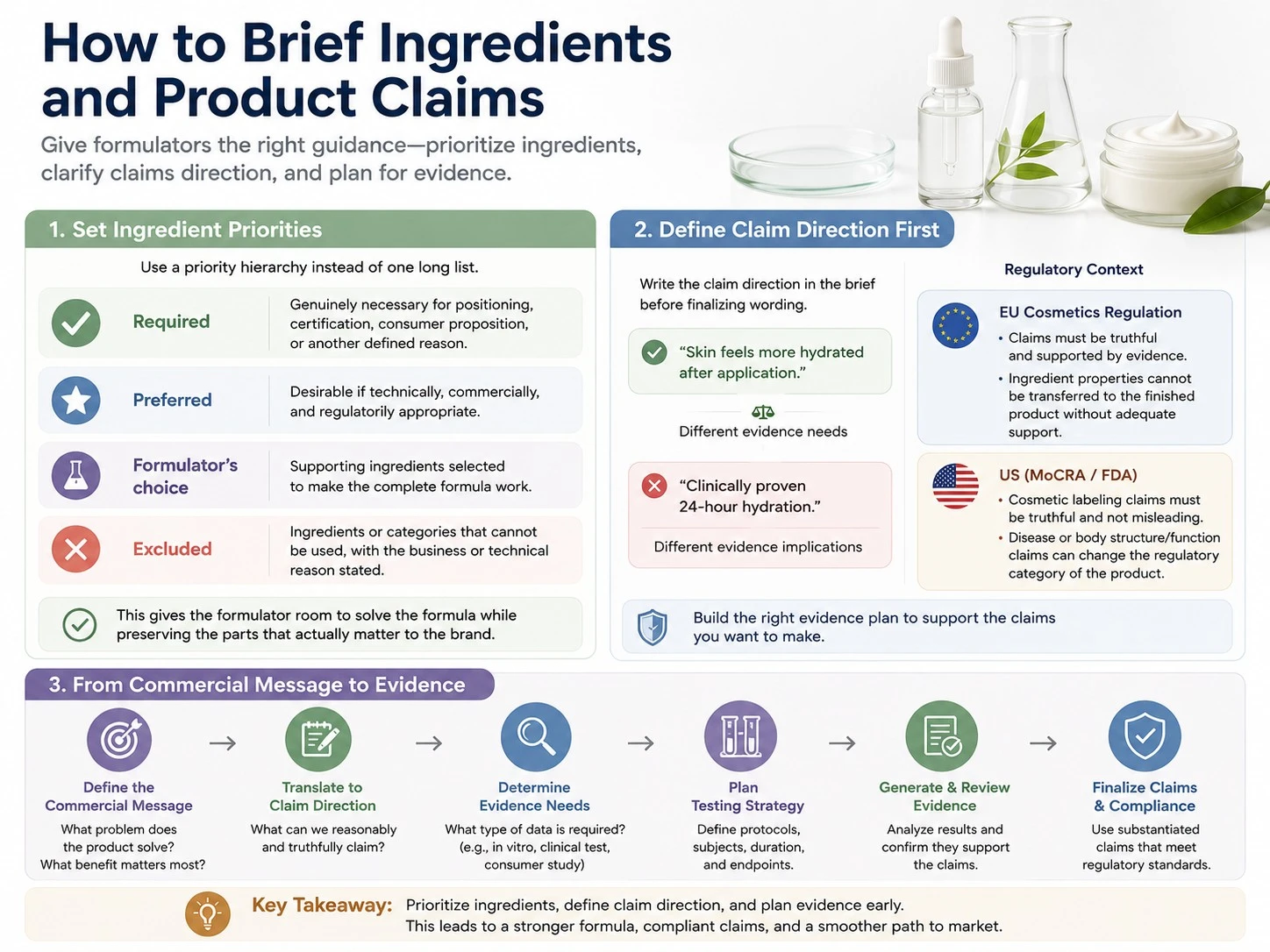
Ingredient requests are most useful when you separate requirements into levels instead of giving the laboratory one long list of trending actives.
Use a Priority Hierarchy
- Required: genuinely necessary for positioning, certification, consumer proposition, or another defined reason.
- Preferred: desirable if technically, commercially, and regulatorily appropriate.
- Formulator’s choice: supporting ingredients selected to make the complete formula work.
- Excluded: ingredients or categories that cannot be used, ideally with the business or technical reason stated.
This gives the formulator room to solve the formula while preserving the parts that actually matter to the brand.
Claims should be handled in the same way. Write the claim direction in the brief before treating the wording as final. A request for “clinically proven 24-hour hydration” has different evidence implications from “skin feels more hydrated after application.”
In the EU, cosmetic claims must satisfy common criteria including truthfulness and evidential support, and ingredient properties should not simply be transferred to the finished product without adequate support.[4] In the United States, cosmetic labeling claims must be truthful and not misleading, while claims concerning treatment of disease or effects on body structure or function can change the regulatory category of the product.[5]
Define the commercial message early, then determine what evidence can support it. Skincare Product Claims: Types, Evidence & Compliance covers that substantiation decision in more detail.
Connect Packaging, Cost, MOQ, and Timeline Instead of Briefing Them Separately
Formula decisions do not exist independently of commercial decisions. A product can meet the sensory brief and still fail the project if it requires packaging, ingredients, processing, or testing that no longer fit the target cost or launch plan.
Include four commercial inputs early:
- Packaging assumption: preferred component and how flexible it is.
- Target cost: give a target or workable range if you have one, while clarifying what it includes.
- Expected quantity: launch quantity and realistic future volume.
- Target launch date: distinguish the desired date from a genuine fixed deadline.
Packaging belongs in this discussion before the formula is finalized because the dispensing mechanism, product viscosity, pack material, fill size, decoration, and compatibility requirements can affect what is commercially practical. Our Skincare Packaging Guide: How Brands Choose Packaging explains the main packaging decisions and trade-offs.
MOQ should also be treated as a development constraint rather than a number discussed only after samples are approved. The minimum can depend on the formula route, raw materials, packaging components, decoration, and manufacturer. If launch quantity is uncertain, What Is the MOQ for Private Label Skincare explains the variables behind the number.
The launch date should leave space for formulation, revisions, packaging confirmation, testing, production, and logistics. If scheduling is still being built, use How Long Does Skincare Product Development Take to map those stages before putting an unrealistic deadline into the brief.
Put Target Markets and Testing Needs Into the Brief Early
“We will decide where to sell it later” can create avoidable rework. Target markets affect ingredient review, safety documentation, claims, labeling, and other compliance decisions, so at least the priority launch market should be known before the formula is locked.
For example, an EU cosmetic requires a safety assessment and Cosmetic Product Safety Report before market placement, and its Product Information File includes documentation such as the safety report, manufacturing information, and—where justified by the nature or effect of the product—proof supporting the claimed effect.[3]
In the United States, the responsible person must ensure and maintain records supporting adequate safety substantiation under MoCRA.[1] There is not one prescribed FDA test menu for every cosmetic; appropriate safety testing depends on the product, ingredients, available data, and identified gaps.[2]
The product brief therefore does not need to invent a universal list such as “stability + challenge test + dermatology test = compliant everywhere.” Instead, identify:
- priority launch markets;
- intended claims;
- product format and use conditions;
- target users where relevant;
- known testing or certification requirements;
- which additional requirements the manufacturer or regulatory team still needs to determine.
Once the formula and claims direction are clearer, use a product-specific testing plan rather than a generic checklist. Skincare Product Testing Guide: What Brands Need explains how safety, stability, microbiological, compatibility, and claim-related testing fit into development.
Define Sample Acceptance Criteria Before the First Sample Arrives
A brief is incomplete if the team knows what to manufacture but has no agreed way to judge the sample.
“I like it” and “I don’t like it” are difficult feedback for a formulator to act on. Instead, decide what the first sample is intended to prove.
| Evaluation Area | Useful Approval Question |
|---|---|
| Appearance | Is the color, clarity, opacity, and overall appearance within the intended range? |
| Dispensing | Does the product dispense cleanly and in an appropriate amount from the proposed package? |
| Spread | Does it move across the skin with the intended slip and working time? |
| Absorption | Is the dry-down fast enough for the intended routine? |
| After-feel | Is the finish appropriately soft, rich, matte, dewy, silky, or otherwise aligned with the brief? |
| Tack and residue | Is stickiness or film formation within the acceptable range? |
| Layering | Does it work acceptably with the moisturizer, sunscreen, or makeup context for which it was designed? |
| Fragrance | Is the intensity and character correct immediately and after dry-down? |
| Benchmark relationship | Which requested benchmark attributes were achieved, missed, or intentionally differentiated? |
Keep formal efficacy and safety conclusions separate from casual sample evaluation. A small internal team liking the texture does not substantiate a clinical claim or establish product safety.
After each sampling round, return consolidated feedback instead of sending independent comments from several decision-makers. Specify what must change, what must stay unchanged, and whether each requested change is essential or optional. This gives the next sample a defined target rather than restarting the project.
Skincare Product Brief Example
The following example shows the level of detail that can be useful without prescribing the final formula.
| Field | Example Brief |
|---|---|
| Working product | Daily Barrier Hydration Serum |
| Target customer | Adults with normal-to-dry or dehydrated-feeling skin who want hydration without a heavy finish |
| Use context | AM and PM; must work comfortably beneath moisturizer and sunscreen |
| Priority market | EU first; additional international markets to be reviewed before formula lock |
| Primary product job | Provide lightweight hydration and improve skin comfort |
| Supporting direction | Barrier-support positioning without turning the formula into a rich cream-like serum |
| Texture | Light gel-serum; quick spread; low tack within approximately one minute; no oily film |
| Finish | Soft natural finish rather than strongly matte or glossy |
| Ingredients | Glycerin and niacinamide preferred; ceramide direction desirable if technically appropriate; supporting system left to formulator |
| Restrictions | Fragrance-free positioning required |
| Claim direction | Immediate and lasting hydration are commercial priorities; final wording depends on formula and substantiation plan |
| Benchmark | Product A for slip; Product B for fast dry-down; avoid the tackiness of Product C |
| Packaging | 30 mL airless pump preferred; open to technically and commercially better alternatives |
| Channel and position | Premium-mass DTC launch |
| Quantity | Manufacturer to propose practical MOQ options for first launch and future scale |
| First-sample decision | Confirm texture, absorption, tack, layering, overall skin feel, and whether the formula direction is suitable for the desired claims and packaging |
Notice what the example does not contain: a fabricated formula, arbitrary active percentages, a fixed preservative, or technical manufacturing instructions. Those decisions can be made with the formulation team once the product requirements are clear.
Common Skincare Product Brief Mistakes
- Starting with a long ingredient wish list. Ingredients should support the product job rather than replace it.
- Using “all skin types” when the actual target customer is much narrower. A broad audience can make sensory and treatment decisions less precise.
- Writing “premium,” “clean,” or “clinical” without defining what those terms mean operationally.
- Requesting exact percentages without a technical reason. This can unnecessarily constrain formulation.
- Using a competitor as the entire brief. Specify which attributes you value rather than asking for a copy.
- Listing too many non-negotiables. Rank requirements so the formulation team knows which trade-offs are acceptable.
- Leaving the target market blank. Market requirements can affect formula, documentation, testing, claims, and labeling.[1][3][4][5]
- Finalizing packaging after formula approval. Formula and packaging decisions should be coordinated rather than treated as unrelated projects.
- Choosing claims after testing is complete. Desired claims should influence what evidence is planned.
- Giving no cost or quantity context. A technically attractive proposal can still be commercially unusable.
- Setting a launch date without allowing for revisions and testing.
- Sending subjective sample feedback without pass/fail criteria. Each revision should answer a defined product-development question.
Final Thoughts
A strong skincare product brief does not need to be a long technical document. It needs to make the important decisions visible: customer, product job, sensory experience, benchmarks, claims, ingredient boundaries, packaging, market, cost, quantity, timing, testing, and sample approval criteria.
The most useful principle is simple: tell the formulator what the product must achieve and where the real constraints are, then leave enough technical freedom to solve the formula properly. A brief that is specific about outcomes but flexible about unverified technical details is usually more actionable than a long list of ingredients and marketing adjectives.
If your brand is preparing a new product, bring your target market, customer, product format, benchmarks, sensory goals, ingredient priorities, claim direction, packaging assumption, expected quantity, and launch timing into the first development discussion. ZICAIL can use that brief during custom skincare formulation to assess the formula direction, sampling route, packaging requirements, testing needs, and path toward production.


