


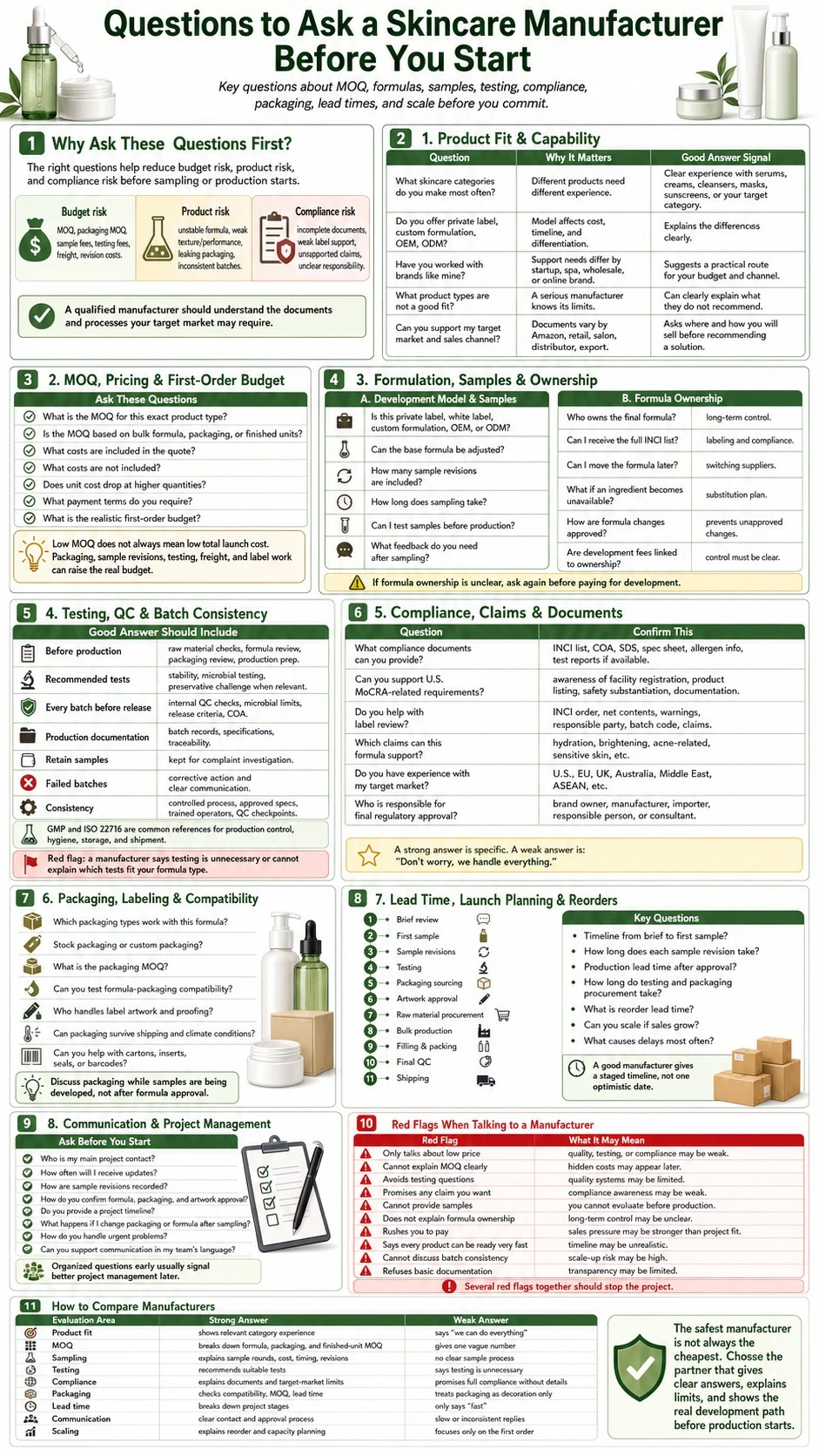
Why These Questions Matter Before Choosing a Skincare Manufacturer
Skincare manufacturing involves formula development, raw materials, packaging, filling, microbial quality, stability, labeling, claims, shipping, and repeat production. The wrong partner can create unstable samples, unclear MOQ, packaging delays, hidden fees, weak documentation, unsupported claims, or inconsistent batches.
The right questions help you check three risks early:
- Budget risk: MOQ, packaging MOQ, sample fees, testing fees, freight, and revision costs.
- Product risk: unstable formula, poor texture, weak performance, leaking packaging, or inconsistent batches.
- Compliance risk: incomplete documents, weak label support, unsupported claims, or unclear responsibility.
For brands selling cosmetics in the United States, MoCRA has made facility registration, product listing, adverse event reporting, and safety substantiation more important. A manufacturer does not replace your responsibility as a brand owner, but a qualified partner should understand the documents and processes your target market may require. [1]
Questions About Product Fit and Manufacturing Capability
Before discussing price, check whether the manufacturer is suitable for your product, business model, and sales channel.
| Question to Ask | Why It Matters | Good Answer Signal |
|---|---|---|
| What skincare categories do you manufacture most often? | Different products need different processes and experience. | They can show experience with serums, creams, cleansers, masks, sunscreens, or your target category. |
| Do you offer private label, custom formulation, OEM, ODM, or all of them? | Each model affects cost, timeline, and differentiation. | They explain the difference clearly instead of using the terms loosely. |
| Have you worked with brands similar to mine? | Startups, spas, wholesalers, retailers, and online brands need different support. | They can suggest a practical route based on your budget and sales channel. |
| What product types are not a good fit for your factory? | A serious manufacturer knows its limits. | They can clearly say what they do not recommend or cannot produce well. |
| Can you support my target market and sales channel? | Amazon, retail, salon, distributor, and export projects may need different documents. | They ask where and how you plan to sell before recommending a solution. |
Be careful if a manufacturer says they can make every skincare product but cannot explain similar project experience. A stronger partner will ask about your product type, target customer, price position, claims, packaging idea, and launch quantity before giving a final answer.
Questions About MOQ, Pricing, and First-Order Budget
MOQ is one of the first questions most brands ask, but one number is not enough. In skincare manufacturing, MOQ can come from the formula batch, filling line, packaging supplier, label printer, carton supplier, or raw material purchase.
| Question to Ask | What You Need to Know |
|---|---|
| What is the MOQ for this exact product type? | Serum, cleanser, cream, mask, sunscreen, and balm may have different MOQ. |
| Is the MOQ based on bulk formula, packaging, or finished units? | A low finished-unit MOQ may still depend on a higher packaging MOQ. |
| What costs are included in the quote? | Formula, bulk, filling, packaging, labeling, carton, testing, and documentation may be separate. |
| What costs are not included? | Sample fee, mold fee, artwork fee, shipping, testing, regulatory review, or export documents. |
| Does the unit cost change at higher quantities? | This shows whether the product can become more profitable as you scale. |
| What payment terms do you require? | Deposit, balance payment, sample fee, refund rules, and payment timing matter for cash flow. |
| What is the realistic first-order budget? | This helps you plan total launch cost, not only production cost. |
A low MOQ is helpful for startups, but it is not always the safest choice. Ask for a first-order budget range, not only a unit price. Packaging MOQ, sample revisions, testing, freight, and label work can turn a low unit price into a higher real launch cost.
Questions About Formulation, Samples, and Formula Ownership
Many brands confuse private label, white label, custom formulation, OEM, and ODM. Private label or white label starts from an existing base formula, so it is usually faster. Custom formulation gives more differentiation but usually needs more time, more sampling, more testing, and a higher development budget.
Questions About Development Model and Samples
| Question to Ask | What It Clarifies |
|---|---|
| Is this private label, white label, custom formulation, OEM, or ODM? | The level of customization, cost, and ownership. |
| Can the base formula be adjusted? | Texture, fragrance, active level, color, claims direction, or skin feel. |
| How many sample revisions are included? | Whether extra sample rounds will cost more. |
| How long does sampling take? | Whether the launch timeline is realistic. |
| Can I test samples before committing to production? | Whether you can reduce first-order risk. |
| What feedback do you need from me after sampling? | Whether revisions are based on clear evaluation or vague preference. |
A good sample process should be structured around texture, absorption, fragrance, color, skin feel, packaging fit, and target price. “Do you like it?” is not enough.
Questions About Formula Ownership
| Question to Ask | Why It Matters |
|---|---|
| Who owns the final formula? | This affects long-term control and brand value. |
| Can I receive the full INCI list? | You need it for labeling, compliance, and transparency. |
| Can I move the formula to another manufacturer later? | This affects your ability to switch suppliers. |
| What happens if an ingredient becomes unavailable? | You need a plan for substitutions and approval. |
| How are formula changes approved? | Prevents unapproved changes between batches. |
| Are custom development fees linked to formula ownership? | Some labs charge development fees but still retain formula control. |
Formula ownership affects whether your brand controls its product or stays locked to one supplier. If the answer is unclear, ask again before you pay for development.
Questions About Testing, Quality Control, and Batch Consistency
Quality control is not optional in skincare manufacturing. A reliable manufacturer should explain what happens before production, during production, and before batch release.
| Question to Ask | Good Answer Should Include |
|---|---|
| What quality checks happen before production? | Raw material checks, formula review, packaging review, and production preparation. |
| What tests do you recommend for this product? | Stability testing, microbial testing, and preservative efficacy or challenge testing when relevant. |
| Do you test every batch before release? | Batch release criteria, internal QC checks, microbial limits, or COA. |
| Can you provide production documentation? | Batch records, specifications, production date, and traceability where available. |
| Do you keep retain samples? | A way to investigate complaints or future quality issues. |
| How do you handle failed batches? | Corrective action, investigation, and clear communication. |
| How do you maintain batch-to-batch consistency? | Controlled process, approved specifications, trained operators, and QC checkpoints. |
GMP connects production control, hygiene, documentation, storage, and product quality. ISO 22716 is commonly used as a cosmetic GMP reference for production, control, storage, and shipment. [2][5]
Red flag: If a manufacturer says skincare testing is unnecessary, or cannot explain what tests fit your formula type, do not treat that as a cost-saving benefit. A strong manufacturer can explain what is checked, when it is checked, what documents are available, and what happens if something fails.
Questions About Compliance, Claims, and Documents
Compliance is not only a factory issue. A manufacturer can support documents and production records, but it should not promise that “everything is fully compliant” without knowing where and how the product will be sold.
| Question to Ask | What to Confirm |
|---|---|
| What compliance documents can you provide? | INCI list, COA, SDS, specification sheet, allergen information, and test reports where available. |
| Can you support U.S. MoCRA-related requirements? | Facility registration awareness, product listing support, safety substantiation awareness, and documentation. |
| Do you help with label review? | INCI order, net contents, warnings, responsible party, batch code, and claims. |
| Which claims can this formula support? | Hydration, brightening, acne-related, sensitive skin, dermatologist-tested, or other claims. |
| Do you have experience with my target market? | U.S., EU, UK, Australia, Middle East, ASEAN, or other regions. |
| Who is responsible for final regulatory approval? | Brand owner, manufacturer, importer, responsible person, or third-party regulatory consultant. |
For the U.S. market, MoCRA created or expanded requirements related to facility registration, product listing, adverse event reporting, and safety substantiation. Some small businesses may be exempt from certain facility registration and product listing requirements, but exemptions have limits. [1][3]
Claims need special attention. A skincare claim such as “moisturizing” is different from a drug-like claim such as treating a disease. If a manufacturer promises any claim without asking for formula data, test support, or target market, that is a warning sign. [4]
A strong answer is specific: “We can provide these documents, support this part of the process, and recommend regulatory review for this market.” A weak answer is broad: “Do not worry, we handle everything.”
Questions About Packaging, Labeling, and Compatibility
Packaging affects formula stability, user experience, shipping safety, MOQ, lead time, and cost.
| Question to Ask | Why It Matters |
|---|---|
| Which packaging types work with this formula? | Prevents leaking, clogging, oxidation, and compatibility problems. |
| Do you provide stock packaging or custom packaging? | Affects MOQ, speed, cost, and design flexibility. |
| What is the packaging MOQ? | Packaging MOQ may be higher than product MOQ. |
| Can you test formula-packaging compatibility? | Helps prevent quality problems after production. |
| Who handles label artwork and proofing? | Reduces label errors before printing. |
| Can packaging survive shipping and climate conditions? | Important for creams, balms, sunscreens, oils, and active formulas. |
| Can you help with cartons, inserts, seals, or barcodes? | These may affect retail, Amazon, distributor, or export readiness. |
Practical tip: Ask about packaging while samples are being developed, not after formula approval. A formula that works well in the lab still needs the right container, especially for hot, humid, cold, or long-distance shipping conditions.
Questions About Lead Time, Launch Planning, and Reorders
Lead time should be broken into stages: formula brief review, first sample, sample revisions, testing, packaging sourcing, artwork approval, raw material procurement, bulk production, filling, final QC, packing, and shipping.
| Question to Ask | Why It Matters |
|---|---|
| What is the timeline from brief to first sample? | Helps you plan early development. |
| How long does each sample revision take? | Prevents unrealistic launch dates. |
| What is the production lead time after approval? | Helps schedule launch, marketing, and sales. |
| How long do testing and packaging procurement take? | These steps often cause hidden delays. |
| What is reorder lead time? | Helps prevent stockouts after launch. |
| Can you scale production if sales grow? | Shows whether the manufacturer can support growth. |
| What causes delays most often? | Tests honesty and experience. |
First-order lead time and reorder lead time are not the same. A reorder may be faster after formula, packaging, label artwork, and materials are approved, but packaging shortages, raw material changes, holidays, customs, or testing schedules can still cause delays.
A good manufacturer gives a staged timeline and explains what depends on your approval. A weak answer gives one optimistic date without explaining the path.
Questions About Communication and Project Management
A skincare manufacturing project is a multi-step collaboration. Good communication reduces mistakes, delays, and approval confusion.
Ask these questions before the project starts:
- Who is my main project contact?
- How often will I receive updates?
- How are sample revisions recorded?
- How do you confirm formula, packaging, and artwork approval?
- Do you provide a project timeline?
- What happens if I need to change packaging or formula after sampling?
- How do you handle urgent problems?
- Can you support communication in the language my team needs?
Pay attention to how they communicate during the first conversation. If replies are vague before payment, they may not become clearer after payment. If they ask organized questions early, that is usually a good sign.
Red Flags When Talking to a Skincare Manufacturer
A manufacturer does not need to be perfect, but certain signs should make you slow down.
| Red Flag | What It May Mean |
|---|---|
| They only talk about low price. | Quality, testing, packaging, or compliance may be weak. |
| They cannot explain MOQ clearly. | Hidden costs may appear later. |
| They avoid testing questions. | Quality systems may be limited. |
| They promise any claim you want. | Compliance awareness may be weak. |
| They cannot provide samples. | You cannot evaluate the real product before production. |
| They do not explain formula ownership. | Long-term control may be unclear. |
| They rush you to pay before clarifying details. | Sales pressure may be stronger than project fit. |
| They say every product can be ready very fast. | The development process may not be realistic. |
| They cannot discuss batch consistency. | Scale-up risk may be high. |
| They refuse basic documentation. | Transparency may be limited. |
One red flag may not end the conversation. Several red flags together should stop the project.
The safest manufacturer is not always the one with the lowest quote. It is the one that gives clear answers, explains limits, and shows the real cost of development before production starts.
How to Compare Skincare Manufacturers After You Ask
After you speak with several manufacturers, compare their answers using the same criteria.
| Evaluation Area | Strong Answer | Weak Answer |
|---|---|---|
| Product fit | Shows relevant category experience. | Says “we can do everything.” |
| MOQ | Breaks down formula, packaging, and finished-unit MOQ. | Gives one vague number. |
| Sampling | Explains sample rounds, cost, timing, and revision process. | No clear sample process. |
| Testing | Recommends suitable tests for the formula type. | Says testing is unnecessary. |
| Compliance | Explains documents and target-market limits. | Promises full compliance without details. |
| Packaging | Checks compatibility, MOQ, and lead time. | Treats packaging as decoration only. |
| Lead time | Breaks down project stages. | Only says “fast.” |
| Communication | Has a clear contact and approval process. | Replies are slow or inconsistent. |
| Scaling | Explains reorder and capacity planning. | Focuses only on the first order. |
A manufacturer that asks smart questions is often safer than one that only says yes. The best partner should understand your budget, target market, product complexity, launch schedule, and long-term plan.
Final Thoughts
The questions you ask before choosing a skincare manufacturer can decide how smooth your project will be later.
Ask about product fit, MOQ, samples, formula ownership, testing, compliance, packaging, lead time, communication, and scale. A strong manufacturing partner gives clear answers, knows its limits, explains risks, and helps you make better decisions before production begins.
FAQs About Questions to Ask a Skincare Manufacturer
What is the first question to ask a skincare manufacturer?
The first question should be whether they have experience with your exact product type and business model. Product fit matters before price, because private label, custom formulation, OEM, ODM, startup, wholesale, spa, and retail projects need different support.
What should I ask about MOQ?
Ask what the MOQ is based on: finished units, bulk formula, packaging, labels, cartons, or filling line requirements. Also ask about sample fees, price breaks, payment terms, and what costs are not included in the first quote.
Should I choose private label or custom formulation?
Choose private label if you want a faster launch, lower development risk, and a tested base formula. Choose custom formulation if you need stronger differentiation, unique texture, specific ingredients, or a formula built around your brand concept. Custom formulation usually needs more time and budget.
What documents should a skincare manufacturer provide?
Common documents include INCI list, COA, SDS, specification sheet, allergen information, test reports where available, batch information, and production records. The exact list depends on product type, target market, and manufacturing model.
Should I ask who owns the formula?
Yes. Formula ownership affects long-term control, reorder flexibility, and whether you can move production to another manufacturer later. Ask before paying development fees, approving samples, or signing a production agreement.
How do I know if a skincare manufacturer has good quality control?
A strong manufacturer can explain raw material checks, production controls, batch release, testing, retain samples, documentation, and how failed batches are handled. If they cannot explain these clearly, their quality system may not be strong enough.
Is the cheapest skincare manufacturer the best choice?
Usually not. A low quote can become expensive if it excludes testing, packaging, revisions, documentation, freight, or regulatory support. The best manufacturer is the one that balances cost, quality, compliance, communication, and scale.
Sources
[1] U.S. Food and Drug Administration. Modernization of Cosmetics Regulation Act of 2022 (MoCRA)
[2] U.S. Food and Drug Administration. Draft Guidance for Industry: Cosmetic Good Manufacturing Practices
[3] U.S. Food and Drug Administration. Small Businesses & Homemade Cosmetics: Fact Sheet
[4] U.S. Food and Drug Administration. Cosmetics Labeling Claims
[5] International Organization for Standardization. ISO 22716:2007 Cosmetics — Good Manufacturing Practices


