


What Makes a Japanese Skincare Routine Different?
Japanese skincare, often called J-Beauty, is built around steady care rather than quick correction. It favors clean, calm, hydrated skin over aggressive exfoliation or frequent product changes.[1][2]
The look often linked with Japanese skincare is smooth, soft, and well-moisturized. Some people describe this as “mochi skin,” meaning skin that looks plump and supple. It is a useful image, not a fixed beauty standard or guaranteed result.
A Japanese skincare routine usually emphasizes:
- Gentle daily cleansing without leaving skin tight.
- Lightweight hydration layers instead of one heavy product.
- Moisture barrier support through lotion, emulsion, and cream where needed.
- Daily sun protection as a normal morning habit.[4]
- Consistency instead of frequent product changes.
The routine is usually less about aggressive exfoliation and more about keeping the skin stable over time.
Japanese Skincare Routine Order at a Glance
Morning and night routines are not identical. Morning skincare should focus on hydration and sun protection. Night skincare should focus on removing sunscreen, makeup, dirt, and oil-based residue, then restoring moisture.
| Step | Morning | Night | Main Purpose |
|---|---|---|---|
| Cleanser | Gentle cleanser if needed | Oil cleanser + gentle cleanser if wearing sunscreen or makeup | Remove sweat, sunscreen, makeup, and residue |
| Lotion | Yes | Yes | Add lightweight hydration |
| Essence / Serum | Optional | Optional | Target dryness, dullness, uneven tone, or fine lines |
| Emulsion | Optional | Optional | Add light moisture and softness |
| Cream / Moisturizer | Yes, if needed | Yes | Seal hydration and support the barrier |
| Sunscreen | Always | No | Protect against UV exposure |
| Exfoliant / Mask | Not daily | 1–2 times weekly if tolerated | Support texture and extra care |
Use this table as the full routine map. The beginner version later trims it down to the essentials.
Morning Japanese Skincare Routine
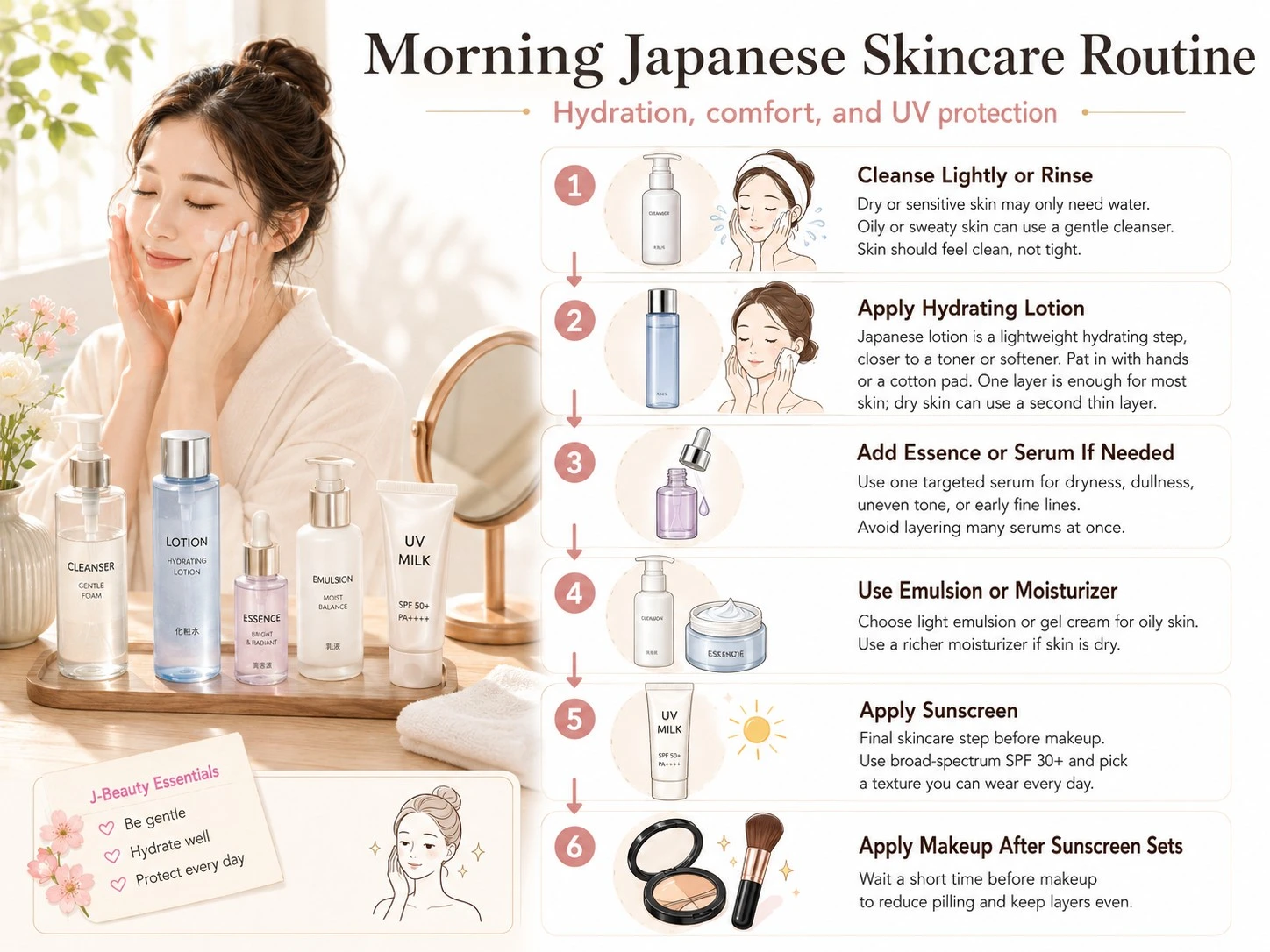
A morning Japanese skincare routine should prepare the skin for the day. It does not need to feel heavy. The main goals are hydration, comfort, and UV protection.
1. Cleanse Lightly or Rinse
If your skin is dry or sensitive, rinsing with water may be enough in the morning. If your skin is oily, sweaty, or exposed to heavy night products, use a gentle cleanser.
Your skin should feel clean, not tight.
2. Apply Hydrating Lotion
Japanese lotion is a lightweight hydrating step. It is closer to a hydrating toner or softener than a Western body lotion.[2]
Apply it with clean hands or a cotton pad, then press it gently into the skin. One layer is enough for most people. Dry skin can use a second thin layer.
3. Add Essence or Serum If Needed
Use essence or serum when you have a clear concern, such as dryness, dullness, uneven tone, or early fine lines.
Do not add several serums at once. One targeted product is easier to judge and less likely to irritate the skin.
4. Use Emulsion or Moisturizer
An emulsion gives light moisture without feeling too rich. A moisturizer or cream helps seal hydration and support the skin barrier.[3]
Oily skin may prefer a gel cream or light emulsion. Dry skin may need a richer moisturizer.
5. Apply Sunscreen
Sunscreen is the final skincare step in the morning. Apply it after moisturizer and before makeup.
Choose a broad-spectrum sunscreen with SPF 30 or higher.[4] Pick a texture you can use every day, because consistency matters more than a product that looks good but feels unpleasant.
6. Apply Makeup After Sunscreen Sets
Wait a short time for sunscreen to settle before applying makeup. This helps reduce pilling and keeps the layers more even.
Night Japanese Skincare Routine
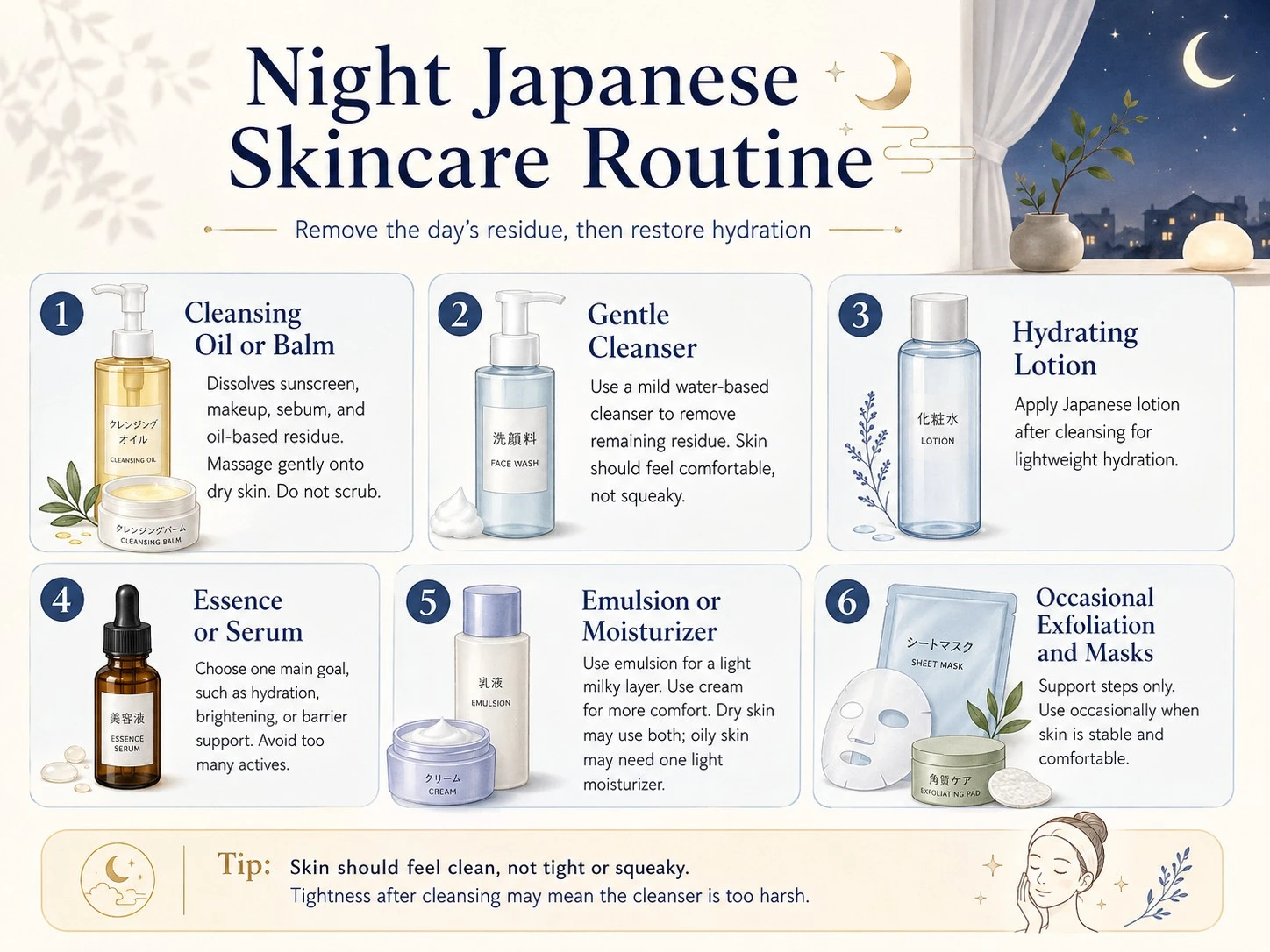
A night Japanese skincare routine focuses on removing the day’s residue, then restoring hydration. Double cleansing matters most when you use sunscreen, makeup, long-wear base products, or water-resistant formulas.[1]
1. Use Cleansing Oil or Balm
A cleansing oil or balm helps dissolve sunscreen, makeup, excess sebum, and oil-based residue. Massage it gently onto dry skin, then rinse or emulsify according to the product directions.
Do not scrub. The cleanser should do most of the work.
2. Follow With a Gentle Cleanser
After the oil cleanser, use a mild water-based cleanser to remove remaining residue. Your skin should feel comfortable, not squeaky. If you wore no sunscreen or makeup and your skin feels dry, you can simplify this step.
3. Apply Hydrating Lotion
After cleansing, apply Japanese lotion while the skin is still comfortable and slightly damp. This step adds lightweight hydration before heavier products.
4. Use Essence or Serum
Use a serum or essence based on one main goal. For example, choose hydration support for dryness, brightening support for dull-looking skin, or barrier-supporting ingredients for sensitivity.
Avoid layering too many active products at night, especially if your skin is easily irritated.
5. Apply Emulsion or Moisturizer
Use emulsion if you want a light, milky layer. Use moisturizer or cream if your skin needs more comfort.[3]
Dry skin can use both emulsion and cream. Oily skin may need only one light moisturizer.
6. Keep Exfoliation and Masks Occasional
Exfoliation and masks are support steps, not daily requirements. Use them only when your skin is stable and comfortable.
Tip: Your skin should feel clean, not squeaky or tight. Tightness after cleansing is often a sign that the cleanser is too harsh or the routine is too stripping.
What Each Japanese Skincare Step Does
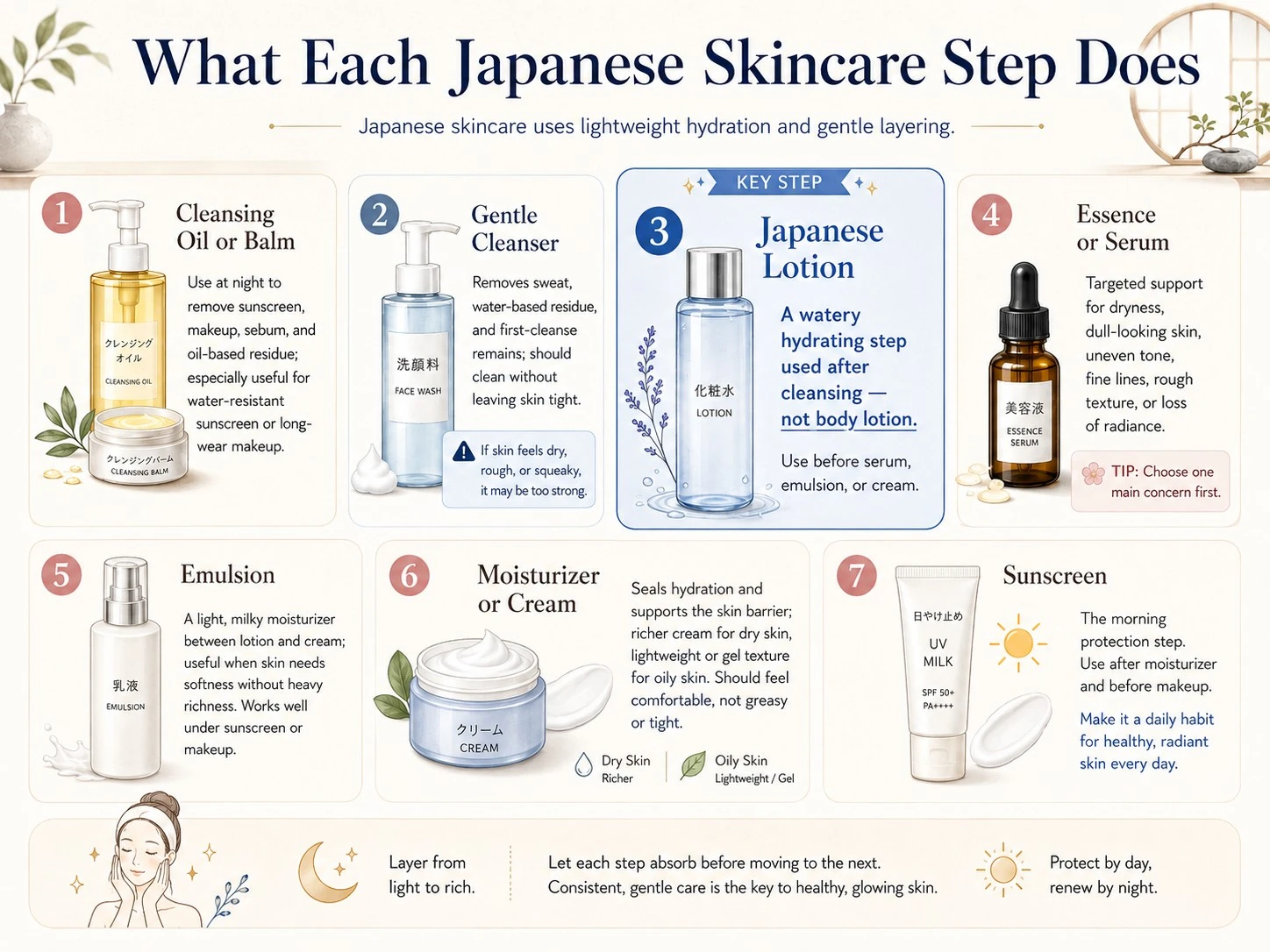
Some Japanese skincare terms do not match Western product names. The most important example is Japanese lotion: a watery hydrating step used after cleansing, not a body lotion.[2]
Cleansing Oil or Cleansing Balm
Cleansing oil and cleansing balm are usually used at night to remove sunscreen, makeup, sebum, and oil-based residue.[1] They are especially useful for water-resistant sunscreen or long-wear makeup because they reduce the need for harsh rubbing.
Gentle Cleanser
A gentle cleanser removes sweat, water-based residue, and the remains of your first cleanse. It should clean without leaving skin tight.
If your cleanser makes your face feel dry, rough, or squeaky, it is probably too strong for daily use.
Japanese Lotion
Japanese lotion is a lightweight hydrating liquid used after cleansing. It is closer to a hydrating toner, softener, or watery essence than a Western moisturizer.[2] Use it before serum, emulsion, or cream.
Essence or Serum
Essence and serum are targeted products. They are not always required, but they can help when you want to address a specific concern.
Use them for goals such as:
- Dryness
- Dull-looking skin
- Uneven tone
- Fine lines
- Rough texture
- Loss of radiance
Choose one main concern first. A routine with one well-chosen serum is usually better than a routine with too many active products.
Emulsion
An emulsion is a light, milky moisturizer. It sits between a watery lotion and a richer cream.[3]
It is useful when your skin needs softness but does not like heavy creams. It can also work well under sunscreen or makeup because many emulsions feel lighter than traditional moisturizers.
Moisturizer or Cream
Moisturizer helps seal hydration and support the skin barrier. It is especially important if your skin feels dry, tight, flaky, or easily irritated.[3]
Dry skin may need a richer cream. Oily skin can use a gel cream or lightweight moisturizer. The right texture should leave your skin comfortable, not greasy or tight.
Sunscreen
Sunscreen is the morning protection step. Use it after moisturizer and before makeup.[5] Japanese skincare often treats sunscreen as a daily habit, not a beach-only product, which is one reason many Japanese sunscreens are known for lightweight, wearable textures.
Japanese Skincare Routine by Skin Type
A Japanese skincare routine should be adjusted to your skin type. The steps can stay similar, but textures and frequency should change.
| Skin Type | Best Routine Focus | What to Avoid |
|---|---|---|
| Dry skin | Richer lotion, emulsion, cream, gentle cleansing | Over-cleansing, harsh foaming cleansers, alcohol-heavy products |
| Oily skin | Light layers, gel moisturizer, non-greasy sunscreen | Skipping moisturizer or using overly drying cleansers |
| Combination skin | Light hydration, cream only where needed | Using one heavy product everywhere |
| Sensitive skin | Fragrance-free products, simple routine, barrier support | Too many new products or active ingredients at once |
| Acne-prone skin | Gentle cleansing, light hydration, non-comedogenic textures | Harsh scrubs and heavy layers that feel occlusive |
| Mature skin | Hydration, barrier support, targeted serum, sunscreen | Relying only on rich cream without daily sunscreen |
For sensitive skin, introduce one product at a time and patch test when possible. For oily skin, do not skip hydration. Light lotion, gel moisturizer, and comfortable sunscreen are usually better than strong cleansing and no moisturizer.
How Often Should You Exfoliate or Use Masks?
Exfoliation and masks are optional support steps, not the core of a Japanese skincare routine. Many people do well with gentle exfoliation once or twice weekly if their skin tolerates it. Sensitive, dry, or barrier-damaged skin should exfoliate less often or pause until the skin feels stable.
Use these rules:
- Use exfoliation less often if your skin stings, flakes, burns, or feels tight.
- Do not exfoliate right after strong active products.
- Hydrating masks are safer for frequent use than exfoliating masks.
- Do not use masks as a substitute for moisturizer.
- Stop using a mask if it causes burning, swelling, or strong redness.
A mask can add a temporary hydration boost or glow. It cannot replace cleansing, moisturizing, and sunscreen.
Japanese vs Korean Skincare Routine
Japanese and Korean skincare routines share hydration and layering, but the overall style can feel different.[1] One is not automatically better than the other.
| Point | Japanese Skincare Routine | Korean Skincare Routine |
|---|---|---|
| Main focus | Gentle care, hydration, prevention | Hydration, glow, and frequent innovation |
| Routine style | Often simpler and steady | Often more layered and experimental |
| Key products | Cleansing oil, lotion, emulsion, sunscreen | Toner, essence, ampoule, sheet mask |
| Best for | Calm, balanced, soft-looking skin | Glow, hydration, and product discovery |
Choose based on your skin needs, not the trend name. Japanese skincare may suit people who prefer a simple, steady routine. Korean skincare may suit people who enjoy trying new textures and targeted products. The strongest routine is the one you can use consistently without irritation.
Common Mistakes in a Japanese Skincare Routine
A Japanese skincare routine is simple in principle, but small mistakes can make it less effective.
- Treating Japanese lotion like body lotion: Japanese lotion is a watery hydrating step, not a thick moisturizer. Use it after cleansing and before serum or cream.
- Using too many products too soon: Add products slowly. This helps you see what works and what causes irritation.
- Double cleansing too aggressively: Cleansing oil should reduce rubbing, not add more friction. Massage gently and rinse well.
- Skipping sunscreen: Sunscreen is one of the most important morning steps. Hydration alone will not protect skin from UV exposure.
- Using exfoliants too often: More exfoliation does not mean better skin. Too much can weaken the barrier and cause dryness or stinging.
- Choosing heavy cream for every skin type: Oily or combination skin may do better with emulsion or gel cream.
- Copying someone else’s routine exactly: Skin type, climate, age, and sensitivity all matter. Use the routine as a framework, not a rule book.
- Expecting instant results: Hydration can feel better quickly, but tone, texture, and barrier comfort need steady care.
Simple Japanese Skincare Routine for Beginners
Beginners do not need eight products at once. Start with the essentials, then add one product at a time when your skin feels stable.
Morning
- Gentle cleanser or water rinse
- Hydrating Japanese lotion
- Light moisturizer or emulsion
- Sunscreen
Night
- Cleansing oil if wearing sunscreen or makeup
- Gentle cleanser
- Hydrating Japanese lotion
- Moisturizer
Use this simple routine for a few weeks before adding serum, exfoliant, or masks.
How to Choose Japanese Skincare Products
A good Japanese skincare routine depends more on product fit than product count. Choose textures and formulas you can use consistently.
Use this checklist:
- Choose a cleanser that does not leave skin tight.
- Choose a lotion based on your hydration needs and sensitivity.
- Choose a serum for one main concern, not ten claims.
- Choose moisturizer texture by skin type.
- Choose sunscreen you will use every morning.
- Avoid adding too many fragranced or active products at once.
- Patch test new products, especially if your skin is sensitive.
- Check whether the product fits your climate and routine length.
Texture matters. A watery lotion can feel better than a thick toner for oily skin. A milky emulsion can feel better than a heavy cream in humid weather. A lightweight sunscreen you actually use is better than a rich sunscreen that stays in the drawer.
Final Thoughts on Japanese Skincare Routine
A Japanese skincare routine works best when it stays gentle, consistent, and realistic. Start with the basics: cleanse gently, add lightweight hydration, seal with the right moisturizer, and use sunscreen every morning.
The best routine is not the longest routine. It is the one your skin tolerates well and you can repeat every day.


