


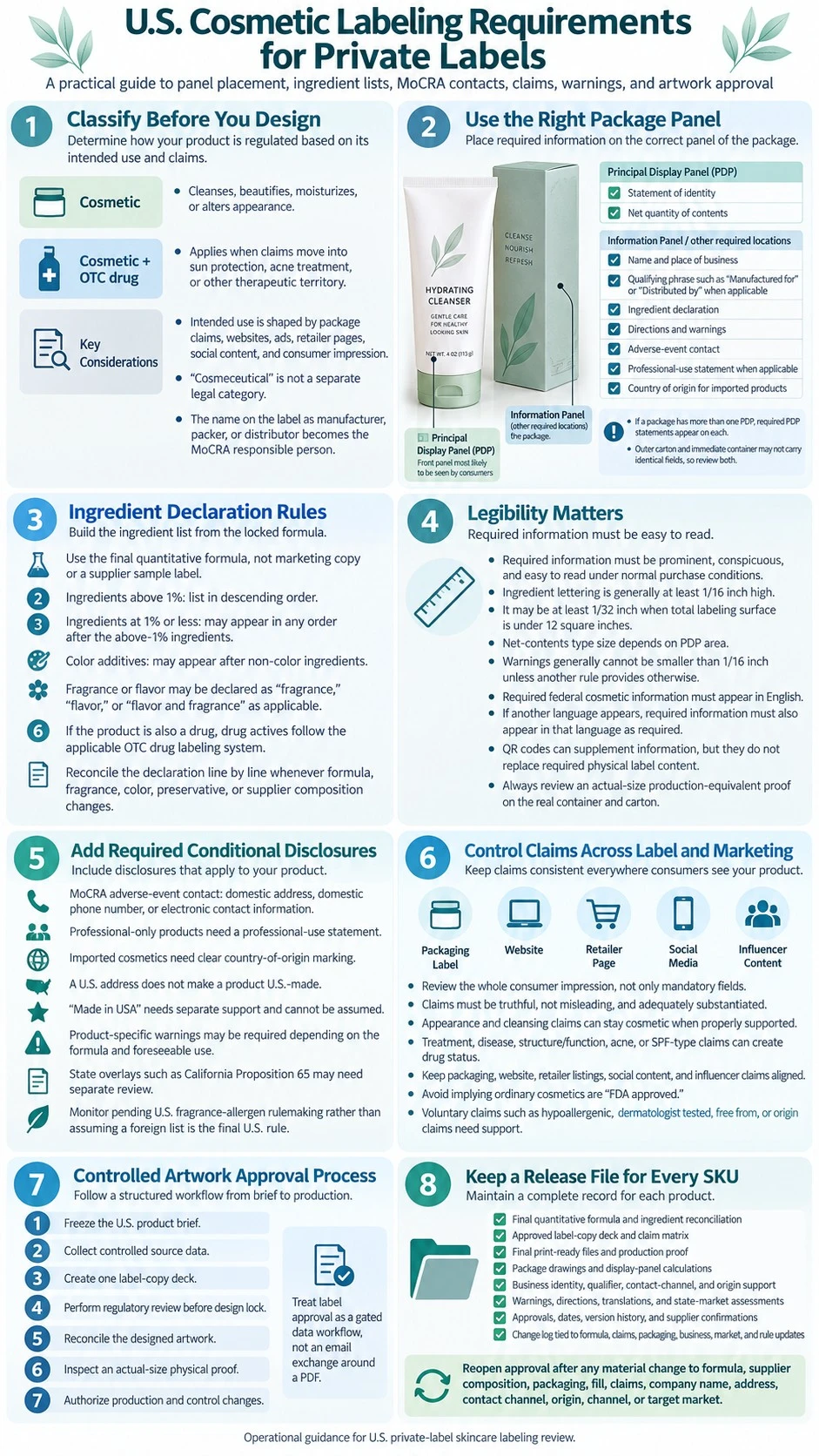
A private-label formula can arrive with suggested copy, but the brand cannot treat that copy as a finished U.S. label. The formula, product claims, package construction, selling channel, named business, manufacturing country, and target states all affect what must appear and where it belongs.
This guide covers the federal baseline for consumer skincare cosmetics and the additional checks most likely to affect private-label artwork. It reflects official information available on September 14, 2026. It is operational guidance, not legal advice, and it does not replace product-specific review for OTC drugs, unusual packages, professional products, or state requirements.
Classify the Product Before Designing the Label
Classification controls the label architecture. A product intended only to cleanse, beautify, moisturize, or alter appearance can be a cosmetic. Claims to diagnose, cure, mitigate, treat, or prevent disease, or to affect the structure or function of the body, can make it a drug as well as a cosmetic. Moisturizers or makeup sold with sun-protection claims are familiar examples of combination drug-cosmetic products.[1]
Do not classify from the formula name alone. Intended use can be established by package claims, websites, ads, retailer pages, social content, consumer perception, and ingredients associated with a therapeutic use. Terms such as “cosmeceutical” do not create a separate legal category.[1]
For a private-label project, lock four decisions before layout begins:
- the legal category for each U.S. use and claim;
- the exact product identity consumers will understand;
- the manufacturer, packer, or distributor whose name will appear; and
- whether the SKU is a consumer retail product, professional-use product, or both.
The company whose name appears on the label as manufacturer, packer, or distributor is the MoCRA responsible person. A contract factory may prepare artwork or submit product data, but the label determines this statutory role.[2] Record the decision in the artwork brief instead of assuming that “private label” makes the factory responsible for everything.
Place Required Information on the Correct Package Panel
The principal display panel, or PDP, is the part most likely to be displayed or examined at retail. An information panel is another panel where required information can be presented prominently and conspicuously. When a package has more than one PDP, the required PDP statements must appear on each one.[3]
| Label field | Typical required location | Core requirement | Evidence before approval |
|---|---|---|---|
| Statement of identity | Principal display panel | State what the product is or does through a common or usual name, descriptive name, understood fanciful name, or clear illustration. | Approved classification and product-use statement |
| Net quantity of contents | Bottom area of the principal display panel, generally parallel to the package base | Declare an accurate quantity in the appropriate U.S. weight, liquid measure, count, or combination. Metric quantity may be added. | Verified fill specification, product consistency, package PDP area, and type-size calculation |
| Name and place of business | Information panel | Identify the manufacturer, packer, or distributor, normally with street address, city, state, and ZIP Code. The street address may be omitted only under the directory condition in the regulation. | Legal entity and current address |
| Business qualifier | With the business identity | Use “Manufactured for,” “Distributed by,” or similarly accurate wording when the named business is not the manufacturer or packer. | Supply-chain role map and manufacturing agreement |
| Ingredient declaration | Information panel on the outer retail package, or the container when there is no outer package | Use required or accepted names and the applicable order of predominance. The declaration must be conspicuous at purchase. | Locked quantitative formula and ingredient-name review |
| Directions and warnings | Information panel or other required location | State material directions or warnings needed for safe use and any product-specific warning prescribed by regulation. | Safety assessment, use conditions, package type, and warning review |
| Adverse-event contact | Label | Provide a domestic address, domestic telephone number, or electronic contact information through which the responsible person can receive adverse-event reports. | Tested, monitored intake channel and escalation owner |
| Professional-use statement | Label, when the product is intended only for professional use | State that the product will be administered or used only by licensed professionals and conforms with existing cosmetic labeling requirements. | Channel restriction and professional-use classification |
| Country of origin | Conspicuous marking on imported articles, subject to customs rules | Mark the foreign country of origin in English; do not let a U.S. distributor address imply domestic manufacture. | Origin determination, manufacturing record, and import review |
The outer carton and immediate container do not always carry identical fields. For a product sold in a nontransparent carton, the outer package carries the PDP and consumer ingredient declaration. The inner container still needs the product name, business information, net contents, directions, warnings, and other applicable information. If the carton is removed and the container is displayed for sale, that container becomes the outer package for labeling purposes.[3]
Package architecture therefore belongs in compliance review, not only design. Confirm every printable panel, label seam, overlabel, cap, base, and carton before freezing copy. ZICAIL’s packaging customization page can help teams define the physical format that the final artwork must fit.
Build the Ingredient Declaration From the Locked Formula
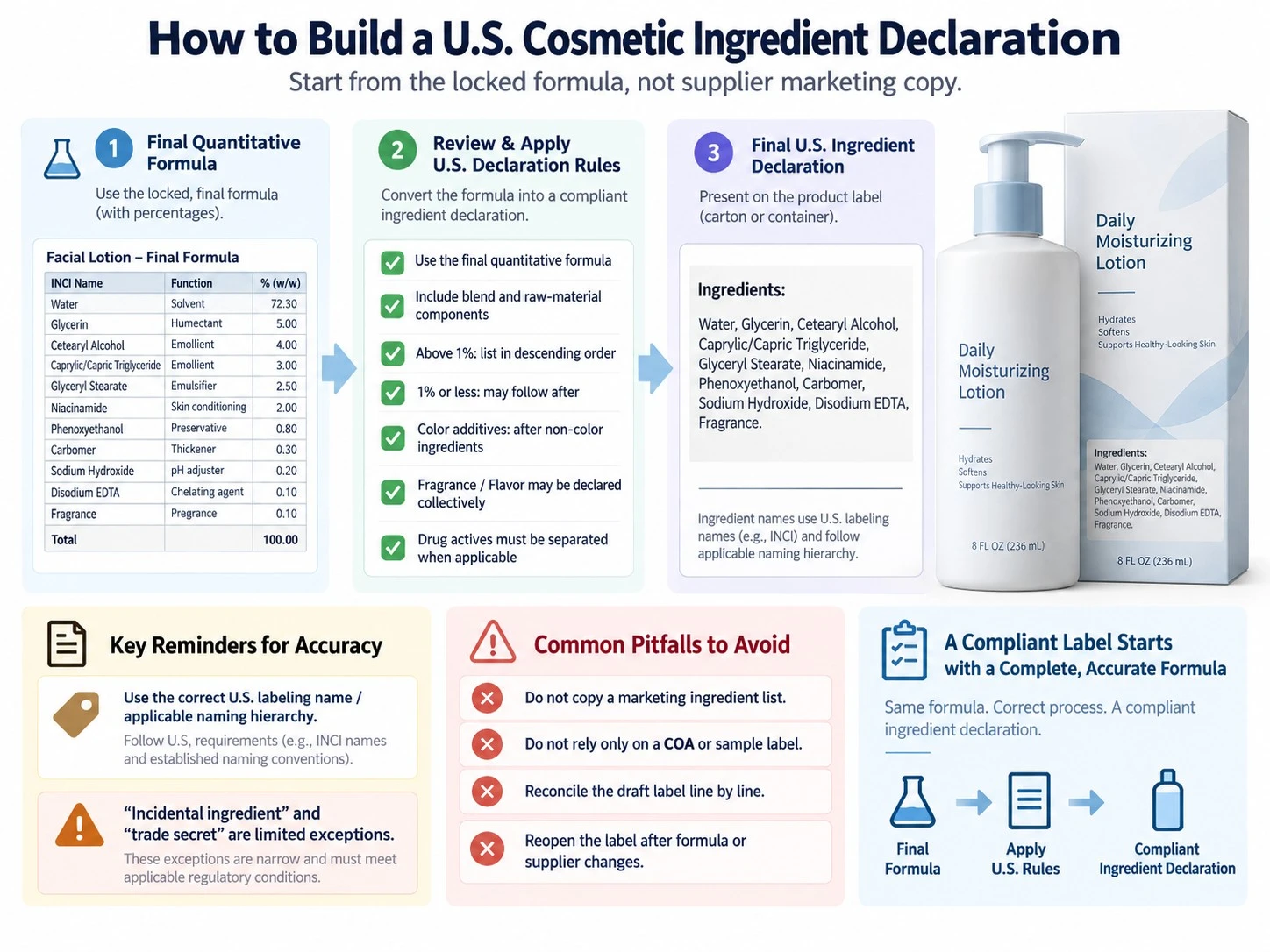
Create the ingredient declaration from the final quantitative formula, including the components of blends and supplied raw materials. Do not copy a marketing ingredient list, certificate of analysis, sample label, or supplier trade-name sheet and assume it represents the finished formula.
Federal ordering rules generally require:
- ingredients above 1% in descending order of predominance;
- ingredients at 1% or less in any order after the ingredients above 1%;
- color additives in any order after the non-color ingredients;
- fragrance and flavor compounds to be declared as “fragrance,” “flavor,” or “flavor and fragrance,” as applicable, unless their components are declared individually; and
- active drug ingredients to be separated and presented under the applicable drug-labeling system when the product is also a drug.[3]
Use the ingredient name established by regulation or the applicable naming hierarchy. A current supplier INCI name may be useful source data, but it should not be accepted blindly when the U.S. labeling name differs or the raw material contains multiple declarable components.[3] The skincare ingredient list guide provides additional context for interpreting label order without replacing the brand’s formula reconciliation.
“Incidental ingredient” and “trade secret” are narrow categories, not convenient ways to hide formula components. An incidental ingredient can be omitted only when it meets the regulatory conditions and has no technical or functional effect in the finished cosmetic. “And other ingredients” may replace an ingredient name only when that identity has been accepted as exempt from public disclosure under the applicable procedure.[3]
The responsible reviewer should reconcile the draft declaration back to the formula line by line. Reopen the label whenever a raw-material supplier, composition, fragrance, color system, preservative, active level, or formula version changes.
Make Required Copy Legible on the Final Package
Required statements must be prominent, conspicuous, and understandable under customary purchase conditions. Contrast, background art, curvature, seams, shrink sleeves, crowding, and print quality can make technically present copy unreadable.[3]
Ingredient lettering is generally at least 1/16 inch high. It may be at least 1/32 inch when the total labeling surface available is less than 12 square inches. Net-contents type size depends on the PDP area, and warnings generally cannot be smaller than 1/16 inch unless another rule establishes a different size.[3] Measure the regulatory letter height specified by the rule rather than relying on the font-size number in design software.
All information required by federal cosmetic rules must appear in English, except for products distributed solely in a U.S. territory where another language predominates. If a label contains a representation in another language, the required information must also appear in that language under the applicable rule.[4]
Small packaging does not make required information optional. Firmly attached tags, tapes, cards, or specific off-package systems are allowed only under defined conditions. A QR code can supplement instructions, education, or traceability, but it is not a general substitute for information that the rules require on the physical label or package.[3]
Review a production-equivalent proof at actual size on the real container and carton. Check the smallest type, background contrast, panel visibility, folds, overlaps, and scuff zones after filling and label application; a flat-screen PDF cannot prove that the printed package is legible.
Add MoCRA, Warning, Origin, and State-Specific Information
MoCRA added a label contact requirement tied to adverse-event reporting. The label must provide a domestic address, domestic telephone number, or electronic contact information through which the responsible person can receive reports. An electronic contact may be a website, but the channel should be functional, monitored, and connected to the serious-adverse-event escalation process.[2]
Products intended only for use by licensed professionals must state that limitation on the label and comply with the other applicable cosmetic label requirements.[2] MoCRA also directs the agency to establish fragrance-allergen labeling requirements.[2] As of September 14, 2026, official implementation materials still describe that work as rulemaking to be established, so brands should not present a proposed or foreign-market allergen list as the final uniform U.S. requirement.[5]
Warnings depend on the product and foreseeable use. Cosmetics that can be hazardous when misused need appropriate warnings and adequate directions. Specific federal wording applies to categories such as self-pressurized cosmetics and certain other products.[4] A cosmetic whose safety is not adequately substantiated has a prescribed warning under existing regulations.[4] Using that statement does not remove the responsible person’s separate MoCRA duty to maintain adequate safety substantiation.[5]
Imported cosmetics must comply with the same federal cosmetic rules as domestic products and are also subject to country-of-origin marking. A U.S. brand or distributor address does not convert a foreign-made product into a U.S.-made product. An unqualified “Made in USA” label requires the product to be all or virtually all made in the United States, including U.S. final processing, significant processing, and all or virtually all ingredients or components.[6]
Federal compliance is not always the complete selling-market review. California Proposition 65, for example, can require a warning when a business causes a significant exposure to a listed chemical, subject to its exposure standards and exemptions; ingredient presence alone does not automatically answer the warning question.[7] Build a market matrix covering each state, retailer, marketplace, and product category instead of adding a generic warning without an exposure assessment.
Control Claims Across the Label and Marketing
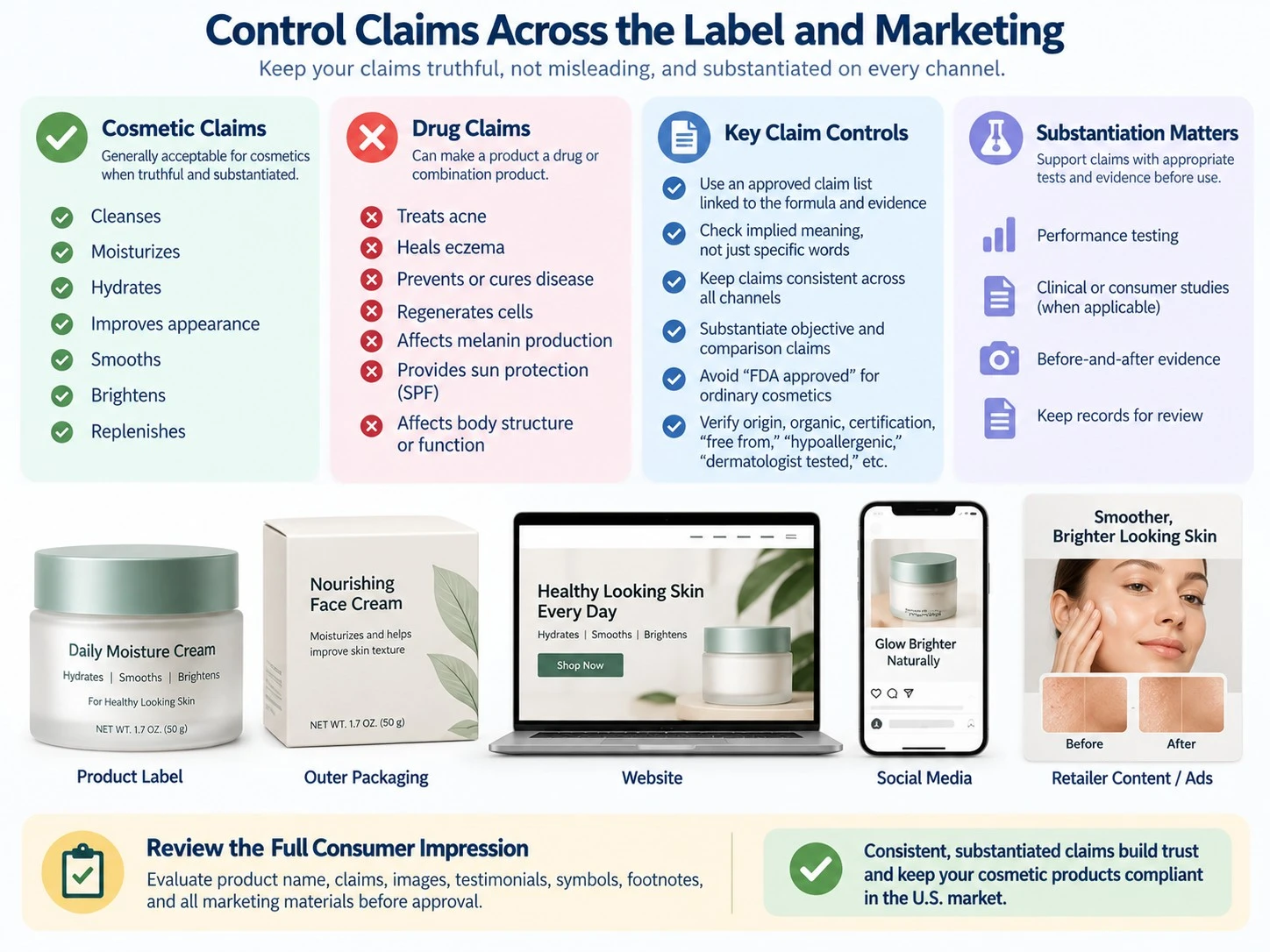
Label compliance includes the messages the artwork communicates, not only its mandatory fields. Review the complete consumer impression created by product identity, benefits, directions, before-and-after images, testimonials, symbols, footnotes, retailer content, and digital advertising. Objective claims must be truthful, not misleading, and adequately substantiated before dissemination; that duty covers express and implied messages across packaging, online content, social media, influencers, and other promotion.[8]
For skincare, appearance and cleansing claims can stay within cosmetic positioning when accurate and substantiated. Claims to treat acne, heal eczema, regenerate cells, affect melanin production, provide sun protection, or otherwise treat disease or affect body structure or function can create drug status and a different label pathway.[1]
Apply these controls before copy approval:
- write an approved claim list linked to the exact formula and evidence;
- check implied meaning, not only prohibited words;
- keep pack, website, retailer, social, influencer, and sales claims consistent;
- substantiate objective performance and comparison claims before use;
- avoid “FDA approved” wording or graphics for ordinary cosmetics because cosmetic labels are not preapproved;[4] and
- verify origin, organic, certification, “free from,” “hypoallergenic,” “dermatologist tested,” and similar voluntary claims under every applicable rule and evidence standard.
The skincare product claims guide helps teams separate cosmetic appearance language from higher-risk therapeutic positioning. Removing that link still leaves the claim-control requirements complete.
Use a Controlled Private Label Artwork Approval Process
Treat label approval as a gated data workflow rather than an email exchange around a PDF.
- Freeze the U.S. product brief. Record the SKU, product category, intended use, target users, selling states, channels, package configuration, responsible person, manufacturing country, and approved claims.
- Collect controlled source data. Obtain the final quantitative formula, raw-material composition data, required ingredient names, fill specification, safety warnings, directions, facility and business details, and supporting claim records. The manufacturer document guide can help define the request before artwork begins.
- Create one label-copy deck. Separate PDP text, information-panel text, immediate-container text, carton text, optional marketing copy, and conditional statements. Give each field an owner and source record.
- Perform regulatory review before design lock. Confirm classification, ingredient order, contact information, warnings, origin, language, state overlays, and claim boundaries while the layout can still change.
- Reconcile the designed artwork. Compare every character, unit, ingredient, qualifier, URL, telephone number, symbol, and claim against the approved copy deck and current formula.
- Inspect a physical-size proof. Measure type, check contrast and panel placement, test barcodes and digital contacts, and verify the copy on both immediate and outer packaging.
- Authorize production and control changes. Record approvers, artwork version, formula version, printer file, approval date, and reapproval triggers. Block obsolete files from purchasing and production.
The brand, manufacturer, designer, printer, and regulatory reviewer should know which step they own and what change sends the artwork backward. A signature on the final PDF is useful only when it identifies the exact formula, package, and version reviewed.
Keep a Label Release File for Every SKU
The release file should let a new reviewer reconstruct why the printed label was approved. Keep:
- the final quantitative formula and ingredient reconciliation;
- approved label-copy deck and claim matrix;
- final print-ready files and production proof;
- package drawings and calculated display-panel areas;
- business identity, qualifier, contact-channel, and origin support;
- warnings, directions, translations, and state-market assessments;
- approvals, dates, version history, and supplier confirmations; and
- a change log tied to formula, claims, packaging, business, market, and rule updates.
Reopen approval after any material formula, supplier-composition, package, fill, claim, company-name, address, contact-channel, origin, channel, or target-market change. A label review is complete for one controlled configuration, not for every future product carrying the same brand design.
Discuss Your U.S. Private Label Skincare Project
ZICAIL can discuss private-label skincare formulation, packaging, manufacturing, testing documentation, and quality-control inputs for a U.S.-market project. The brand should appoint its responsible person and obtain product-specific regulatory review for its final formula, claims, markets, and artwork.
Prepare your target product, reference formula or sample, intended claims, package format, fill size, selling channels, destination states, brand legal details, and required records before the supplier discussion. Review ZICAIL’s private label skincare service or contact the team with a defined project brief.


