


What Is Skincare Packaging?
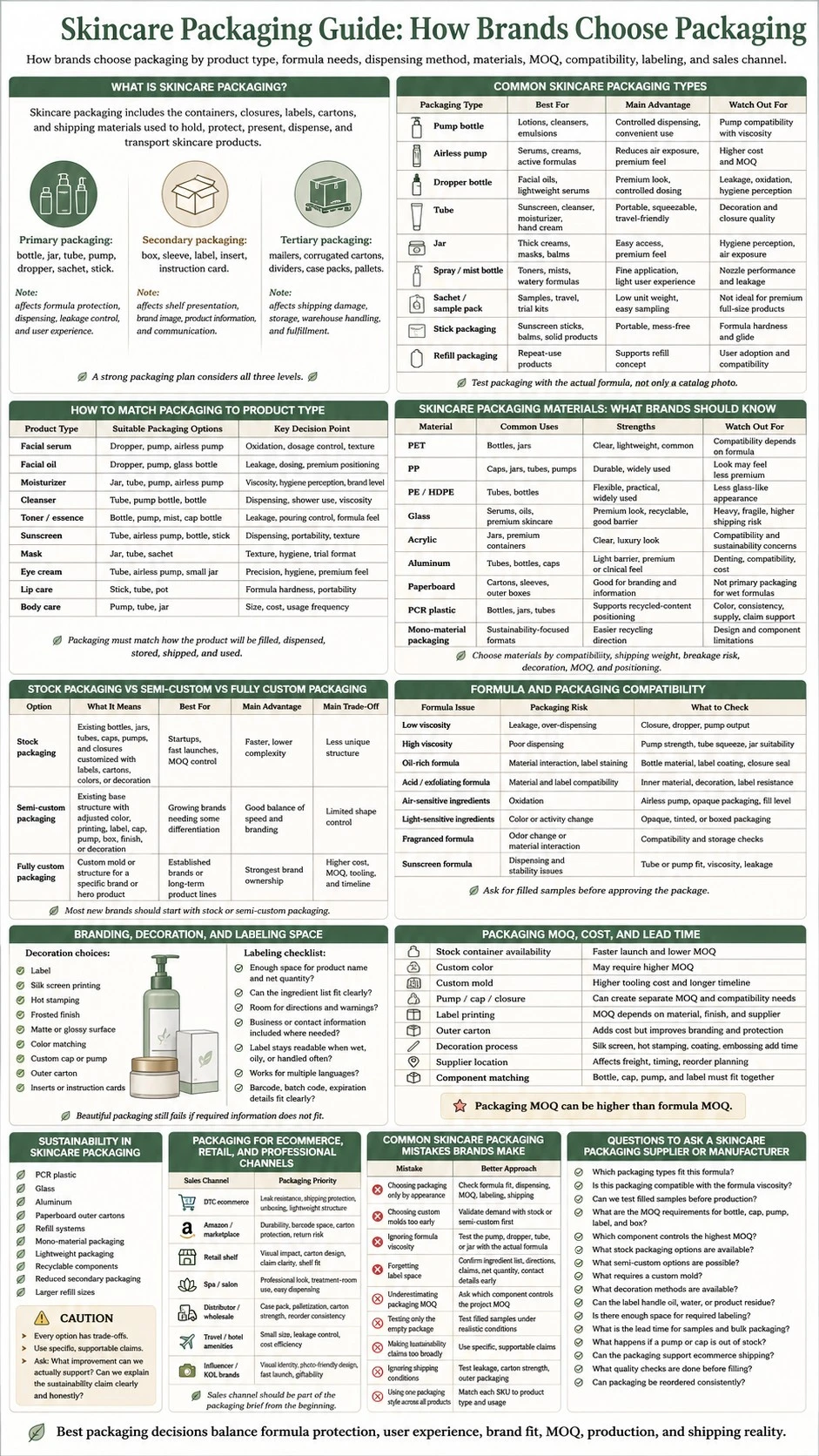
Skincare packaging includes the containers, closures, labels, cartons, and shipping materials used to hold, protect, present, dispense, and transport skincare products.
It can be divided into three main levels:
- Primary packaging: The package that directly touches or holds the formula, such as a bottle, jar, tube, pump, dropper, sachet, or stick.
- Secondary packaging: The outer retail or communication layer, such as a box, sleeve, label, insert, or instruction card.
- Tertiary packaging: The shipping and logistics layer, such as mailers, corrugated cartons, dividers, case packs, and pallets.
Primary packaging affects formula protection, dispensing, leakage control, and user experience. Secondary packaging affects shelf presentation, brand image, product information, and label communication. Tertiary packaging affects shipping damage, storage, warehouse handling, and fulfillment efficiency.
A strong packaging plan considers all three levels. A beautiful bottle can still fail if it leaks in transit, lacks label space, does not fit the formula, or creates an unrealistic MOQ.
Common Skincare Packaging Types
Most skincare packaging decisions start with the product format. The package must match the formula’s texture, usage method, brand position, and sales channel.
| Packaging Type | Best For | Main Advantage | Watch Out For |
|---|---|---|---|
| Pump bottle | Lotions, cleansers, emulsions | Controlled dispensing, convenient use | Pump compatibility with viscosity |
| Airless pump | Serums, creams, active formulas | Reduces air exposure, premium feel | Higher cost and MOQ |
| Dropper bottle | Facial oils, lightweight serums | Premium look, controlled dosing | Leakage, oxidation, hygiene perception |
| Tube | Sunscreen, cleanser, moisturizer, hand cream | Portable, squeezable, travel-friendly | Decoration and closure quality |
| Jar | Thick creams, masks, balms | Easy access, premium feel | Hygiene perception, air exposure |
| Spray / mist bottle | Toners, mists, watery formulas | Fine application, light user experience | Nozzle performance and leakage |
| Sachet / sample pack | Samples, travel, trial kits | Low unit weight, easy sampling | Not ideal for premium full-size products |
| Stick packaging | Sunscreen sticks, balms, solid products | Portable, mess-free | Formula hardness and glide |
| Refill packaging | Repeat-use products | Supports refill concept | User adoption and compatibility |
Bottles, jars, tubes, airless packaging, pouches, and sample packs cover most skincare packaging needs, but no format is best for every product. [1][2] The right choice depends on formula behavior, target customer, price point, usage habit, and sales channel. Test packaging with the actual formula, not only a catalog photo.
How to Match Packaging to Product Type
Product type gives the first packaging direction. Formula details decide the final choice.
| Product Type | Suitable Packaging Options | Key Decision Point |
|---|---|---|
| Facial serum | Dropper, pump, airless pump | Oxidation, dosage control, texture |
| Facial oil | Dropper, pump, glass bottle | Leakage, dosing, premium positioning |
| Moisturizer | Jar, tube, pump, airless pump | Viscosity, hygiene perception, brand level |
| Cleanser | Tube, pump bottle, bottle | Dispensing, shower use, viscosity |
| Toner / essence | Bottle, pump, mist, cap bottle | Leakage, pouring control, formula feel |
| Sunscreen | Tube, airless pump, bottle, stick | Dispensing, portability, texture |
| Mask | Jar, tube, sachet | Texture, hygiene, trial format |
| Eye cream | Tube, airless pump, small jar | Precision, hygiene, premium feel |
| Lip care | Stick, tube, pot | Formula hardness, portability |
| Body care | Pump, tube, jar | Size, cost, usage frequency |
A thick cream may not work in every pump. A watery toner may leak if the closure is weak. A sunscreen tube must support repeated use and controlled dispensing. A premium serum may look good in a dropper bottle, but an airless pump may better fit some formulas.
Packaging must match how the product will be filled, dispensed, stored, shipped, and used, not only how it looks.
Skincare Packaging Materials: What Brands Should Know
Packaging material affects appearance, compatibility, cost, decoration, sustainability claims, shipping weight, and breakage risk.
| Material | Common Uses | Strengths | Watch Out For |
|---|---|---|---|
| PET | Bottles, jars | Clear, lightweight, common | Compatibility depends on formula |
| PP | Caps, jars, tubes, pumps | Durable, widely used | Look may feel less premium |
| PE / HDPE | Tubes, bottles | Flexible, practical, widely used | Less glass-like appearance |
| Glass | Serums, oils, premium skincare | Premium look, recyclable, good barrier | Heavy, fragile, higher shipping risk |
| Acrylic | Jars, premium containers | Clear, luxury look | Compatibility and sustainability concerns |
| Aluminum | Tubes, bottles, caps | Light barrier, premium or clinical feel | Denting, compatibility, cost |
| Paperboard | Cartons, sleeves, outer boxes | Good for branding and information | Not primary packaging for wet formulas |
| PCR plastic | Bottles, jars, tubes | Supports recycled-content positioning | Color, consistency, supply, claim support |
| Mono-material packaging | Sustainability-focused formats | Easier recycling direction | Design and component limitations |
Common skincare packaging materials include plastics such as PET, PP, PE, and HDPE, along with glass, aluminum, paperboard, PCR plastic, and refillable structures. The buyer’s real task is not to pick the most attractive material, but to choose one that fits formula compatibility, shipping weight, breakage risk, label performance, decoration method, MOQ, and product positioning.
A glass bottle may support a premium serum image, but it can increase shipping cost and breakage risk. A plastic tube may be more practical for sunscreen or cleanser. A paperboard carton can improve shelf presentation, but it does not replace strong primary packaging.
Stock Packaging vs Semi-Custom vs Fully Custom Packaging
Brands do not need fully custom packaging for every launch. Stock or semi-custom packaging is often the smarter first step.
| Option | What It Means | Best For | Main Advantage | Main Trade-Off |
|---|---|---|---|---|
| Stock packaging | Existing bottles, jars, tubes, caps, pumps, and closures, customized with labels, cartons, colors, or decoration | Startups, fast launches, MOQ control | Faster, lower complexity | Less unique structure |
| Semi-custom packaging | Existing base structure with adjusted color, printing, label, cap, pump, outer box, finish, or decoration | Growing brands needing some differentiation | Good balance of speed and branding | Limited shape control |
| Fully custom packaging | Custom mold or structure developed for a specific brand or hero product | Established brands or long-term product lines | Strongest brand ownership | Higher cost, MOQ, tooling, and timeline |
Most new skincare brands should start with well-chosen stock or semi-custom packaging. A full custom mold makes more sense when the product has a clear long-term plan, proven demand, and enough order volume.
Formula and Packaging Compatibility
Packaging must be tested with the actual formula. The same bottle, tube, pump, or jar can perform differently depending on viscosity, oils, acids, fragrance, sunscreen filters, solvents, or active systems.
| Formula Issue | Packaging Risk | What to Check |
|---|---|---|
| Low viscosity | Leakage, over-dispensing | Closure, dropper, pump output |
| High viscosity | Poor dispensing | Pump strength, tube squeeze, jar suitability |
| Oil-rich formula | Material interaction, label staining | Bottle material, label coating, closure seal |
| Acid / exfoliating formula | Material and label compatibility | Inner material, decoration, label resistance |
| Air-sensitive ingredients | Oxidation | Airless pump, opaque packaging, fill level |
| Light-sensitive ingredients | Color or activity change | Opaque, tinted, or boxed packaging |
| Fragranced formula | Odor change or material interaction | Compatibility and storage checks |
| Sunscreen formula | Dispensing and stability issues | Tube or pump fit, viscosity, leakage |
A package is not suitable just because the formula fits inside it. It needs to dispense correctly, stay sealed, protect the formula, survive handling, and keep the product looking acceptable over time.
Labels should also be checked. Oil-rich products may stain labels, wet bathroom use may affect label adhesion, and sunscreen or body care packaging may face repeated handling.
Ask for filled samples before approving the package. Empty samples help check appearance, but filled samples reveal leakage, dispensing, label durability, and real user experience.
Branding, Decoration, and Labeling Space
Skincare packaging communicates price level, product promise, market position, and shelf value. It also needs enough space for required and practical product information.
Branding and decoration choices may include:
- Label.
- Silk screen printing.
- Hot stamping.
- Frosted finish.
- Matte or glossy surface.
- Color matching.
- Custom cap or pump.
- Outer carton.
- Inserts or instruction cards.
Before approving the design, review practical label-space questions:
- Is there enough space for the product name and net quantity?
- Can the ingredient list fit clearly?
- Is there room for directions and warnings?
- Is the business or contact information included where needed?
- Will the label stay readable if the package gets wet, oily, or handled often?
- Does the packaging work for multiple languages?
- Can barcodes, batch codes, or expiration details be added clearly?
Packaging design should not be separated from labeling needs. For the U.S. market, product listing may require product and ingredient information, and cosmetic labels must account for required information such as product identity, net quantity, business details, ingredient declaration, and warnings where applicable. [5][6]
A package can look beautiful but still create problems if the ingredient list is too small, the label peels, the decoration scratches, or required information does not fit.
Packaging MOQ, Cost, and Lead Time
Packaging cost is not only the bottle price. It can include components, decoration, labels, cartons, MOQ, tooling, samples, freight, and storage.
| Factor | How It Affects Packaging Decisions |
|---|---|
| Stock container availability | Faster launch and lower MOQ |
| Custom color | May require higher MOQ |
| Custom mold | Higher tooling cost and longer timeline |
| Pump / cap / closure | Can create separate MOQ and compatibility needs |
| Label printing | MOQ depends on material, finish, and supplier |
| Outer carton | Adds cost but improves branding and protection |
| Decoration process | Silk screen, hot stamping, coating, or embossing adds time |
| Supplier location | Affects freight, timing, and reorder planning |
| Component matching | Bottle, cap, pump, and label must fit together |
Packaging MOQ can be higher than formula MOQ. A brand may be ready for a smaller formula batch, but the real project minimum may be controlled by the bottle, pump, cap, label, carton, formula minimum, or ingredient minimum. [3][4]
Before approving packaging, ask which component sets the highest MOQ. It may be the pump, custom color, carton print run, label material, or decorated bottle. A late packaging change can affect cost, sampling, testing, production timing, and launch schedule.
Sustainability in Skincare Packaging
Sustainability is important, but it is not a simple material choice. A package is not automatically better because it uses one “green” word.
Sustainable packaging directions may include:
- PCR plastic.
- Glass.
- Aluminum.
- Paperboard outer cartons.
- Refill systems.
- Mono-material packaging.
- Lightweight packaging.
- Recyclable components.
- Reduced secondary packaging.
- Larger refill sizes.
Each option has trade-offs. Glass may feel premium and recyclable, but it is heavier and more fragile. PCR plastic may support recycled-content positioning, but color consistency and supply can vary. Refill systems only help when customers actually refill and the refill structure is practical.
Environmental claims should be specific and supportable. Broad claims such as “eco-friendly,” “green,” “recyclable,” “biodegradable,” or “compostable” should be used carefully because unclear or unsupported claims can mislead customers. [7]
Ask two questions:
- What packaging improvement can we actually support?
- Can we explain the sustainability claim clearly and honestly?
Good sustainability planning is practical, not decorative.
Packaging for Ecommerce, Retail, and Professional Channels
Sales channel affects packaging as much as formula type. The same product may need different packaging logic for DTC ecommerce, retail shelves, spa use, or wholesale distribution.
| Sales Channel | Packaging Priority |
|---|---|
| DTC ecommerce | Leak resistance, shipping protection, unboxing, lightweight structure |
| Amazon / marketplace | Durability, barcode space, carton protection, return risk |
| Retail shelf | Visual impact, carton design, claim clarity, shelf fit |
| Spa / salon | Professional look, treatment-room use, easy dispensing |
| Distributor / wholesale | Case pack, palletization, carton strength, reorder consistency |
| Travel / hotel amenities | Small size, leakage control, cost efficiency |
| Influencer / KOL brands | Visual identity, photo-friendly design, fast launch, giftability |
DTC packaging needs shipping protection. Retail packaging needs clear shelf communication. Spa and salon packaging needs professional usability. Distributor and wholesale packaging needs case-pack consistency, carton strength, and reorder reliability.
A package that works for an online serum launch may not fit a spa backbar product or a retail shelf moisturizer. Include the sales channel in the packaging brief from the beginning.
Common Skincare Packaging Mistakes Brands Make
Many packaging problems come from choosing too quickly, focusing only on appearance, or making packaging decisions too late. Avoid these common mistakes:
- Choosing packaging only by appearance.
Better: check formula fit, dispensing, MOQ, labeling, and shipping. - Choosing custom molds too early.
Better: validate demand with stock or semi-custom packaging first. - Ignoring formula viscosity.
Better: test the pump, dropper, tube, or jar with the actual formula. - Forgetting label space.
Better: confirm ingredient list, directions, claims, net quantity, and contact details early. - Underestimating packaging MOQ.
Better: ask which component controls the project MOQ. - Testing only the empty package.
Better: test filled samples under realistic conditions. - Making sustainability claims too broadly.
Better: use specific, supportable claims. - Ignoring shipping conditions.
Better: test leakage, carton strength, and outer packaging. - Using one packaging style across all products.
Better: match each SKU to product type and usage.
A good packaging decision is a product, production, brand, and logistics decision.
Questions to Ask a Skincare Packaging Supplier or Manufacturer
Before approving packaging, ask questions that reveal whether the supplier or manufacturer understands formula fit, production, MOQ, branding, and launch needs:
- Which packaging types fit this formula?
- Is this packaging compatible with the formula viscosity?
- Can we test filled samples before production?
- What are the MOQ requirements for bottle, cap, pump, label, and box?
- Which component controls the highest MOQ?
- What stock packaging options are available?
- What semi-custom options are possible?
- What requires a custom mold?
- What decoration methods are available?
- Can the label handle oil, water, or product residue?
- Is there enough space for required labeling?
- What is the lead time for samples and bulk packaging?
- What happens if a pump or cap is out of stock?
- Can the packaging support ecommerce shipping?
- What quality checks are done before filling?
- Can packaging be reordered consistently?
The best answers should be specific. If a supplier says every package works for every formula, keep asking questions. Packaging should match the actual formula, order quantity, sales channel, and brand position.
If you need help matching packaging with your formula, brand position, MOQ, and launch plan, see our packaging customization service.
Where to Go Next
Use this guide as your skincare packaging starting point, then go deeper based on your project stage:
- For packaging support, visit Packaging Customization.
- If you are still developing the formula, read Skincare Formulation Guide.
- If you are choosing a supplier, read How to Choose a Skincare Manufacturer.
- If MOQ is your main concern, read MOQ for Private Label Skincare.
- If you are preparing supplier questions, read Questions to Ask a Skincare Manufacturer.
- If you need broader production support, see OEM/ODM Skincare.
- If you are building a faster launch plan, read Private Label Skincare.
Ready to Choose Skincare Packaging for Your Brand?
Skincare packaging affects formula protection, user experience, MOQ, cost, labeling, shipping, and brand perception. The best choice starts with product type, formula direction, target channel, launch quantity, and brand position.
At ZICAIL, we help brands match skincare formulas with practical, brand-ready packaging options, from stock packaging to customized bottles, tubes, jars, pumps, labels, and outer boxes. If you are preparing a new skincare line or improving an existing product, contact us to discuss your packaging plan.


