


Sensitive Skin, Reactive Skin, or Damaged Barrier?
Sensitive skin is not always permanent. Some people naturally react to many products, while others become reactive after over-exfoliation, harsh cleansing, retinoid overuse, or too many active ingredients.
| Skin Pattern | What It Looks Like | Common Clue | First Priority |
|---|---|---|---|
| Sensitive skin | Stinging, flushing, itching, or redness from many products | Long-term pattern across many formulas | Use a simple fragrance-free routine |
| Reactive skin | Sudden irritation after a product change | New cleanser, sunscreen, serum, acid, or retinoid triggered it | Stop the trigger and simplify |
| Damaged barrier | Burning, tightness, peeling, redness, products sting | Strong actives, scrubs, harsh cleanser, over-cleansing | Pause actives and rebuild comfort. [4] |
| Possible skin condition | Rash, swelling, scaling, persistent redness, oozing | Does not improve with a simple routine | See a dermatologist |
If your basic cleanser or moisturizer suddenly burns, treat it as barrier stress first. Do not add exfoliating acids, retinol, or strong vitamin C on top of irritated skin.
Signs Your Skin Is Sensitive

Use this section as a self-check. One reaction is not enough, but a repeated pattern matters.
Your skin may be sensitive or reactive if:
- Many products sting, burn, or itch.
- Your face gets red or tight after cleansing.
- Sunscreen or moisturizer often burns.
- Fragrance makes your skin itch or flush.
- You often react to new products.
- Scrubs and exfoliating products make skin worse.
- Products that used to feel fine now sting.
- Your skin takes several days to recover after a new product.
If familiar products suddenly burn, the issue may be barrier damage rather than permanent sensitive skin. [4]
The Best AM Skincare Routine for Sensitive Skin

A morning routine for sensitive skin should protect the skin without triggering irritation.
- Cleanse gently or rinse with water.
If your skin feels dry or reactive in the morning, a water rinse may be enough. If you use cleanser, choose a mild, non-stripping formula. - Use a calming or hydrating serum only if needed.
This step is optional. Sensitive skin does not need a serum every morning. If you use one, choose a simple formula with ingredients such as glycerin, panthenol, or low-to-moderate niacinamide. - Apply a fragrance-free moisturizer.
Moisturizer helps reduce dryness, tightness, and friction. Choose a texture your skin can repeat daily without stinging. - Finish with sunscreen.
Use a broad-spectrum sunscreen every morning. If your current sunscreen burns, switch formulas instead of skipping sunscreen.
Do not introduce several new morning products at once, or you may not know which one caused the reaction.
The Best PM Skincare Routine for Sensitive Skin
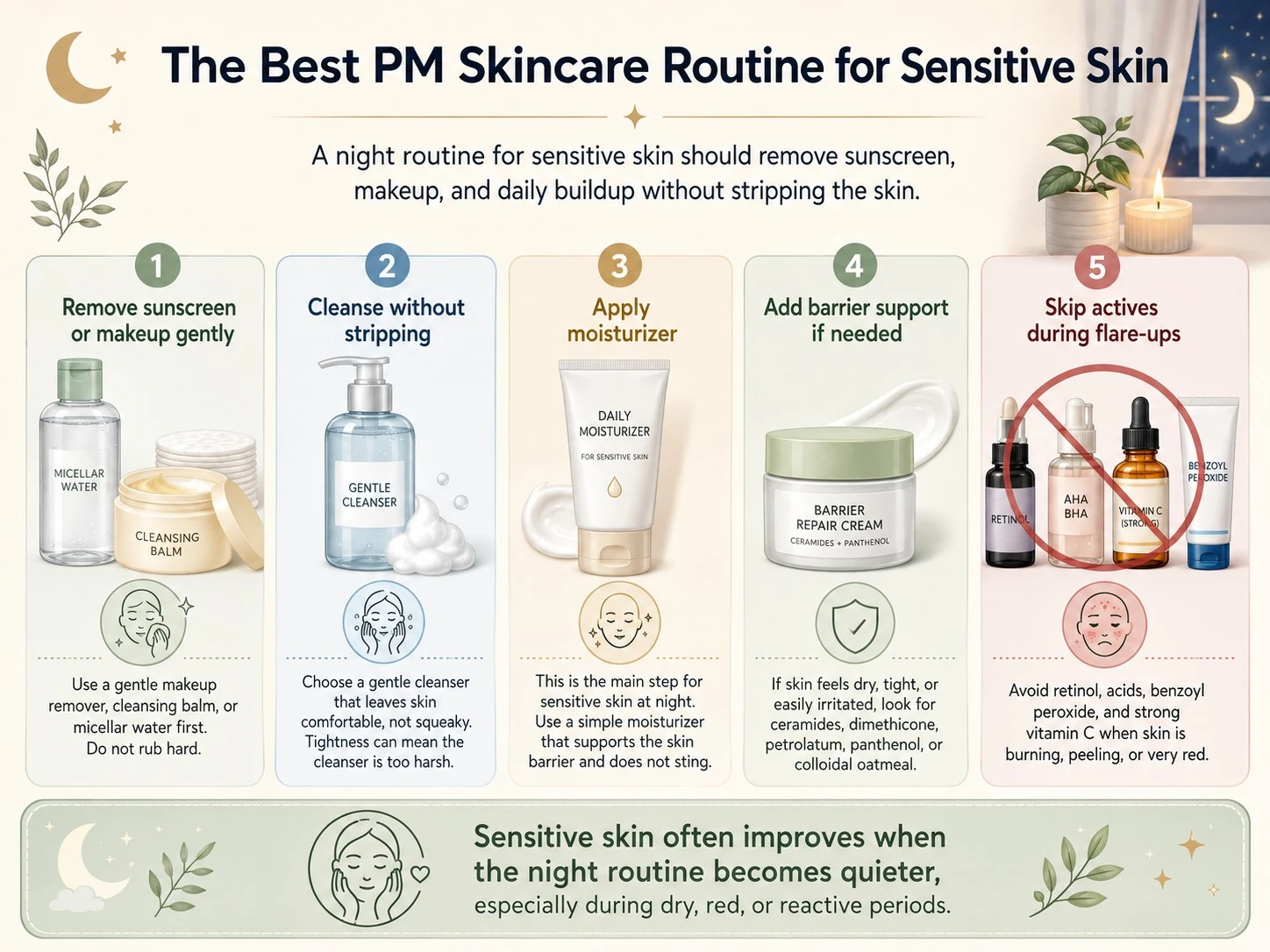
A night routine for sensitive skin should remove sunscreen, makeup, and daily buildup without stripping the skin.
- Remove sunscreen or makeup gently.
If you wear heavy sunscreen or makeup, use a gentle makeup remover, cleansing balm, or micellar water first. Do not rub hard. - Cleanse without stripping.
Use a gentle cleanser that leaves your skin comfortable, not squeaky. Tightness after cleansing is a sign the cleanser may be too harsh. - Apply moisturizer.
This is the main step for sensitive skin at night. Look for a simple moisturizer that supports the skin barrier and does not sting. - Add barrier support if needed.
If your skin feels dry, tight, or easily irritated, a cream with ceramides, dimethicone, petrolatum, panthenol, or colloidal oatmeal may help. - Skip actives during flare-ups.
Do not use retinol, acids, benzoyl peroxide, or strong vitamin C when your skin is burning, peeling, or very red.
Sensitive skin often improves when the night routine becomes quieter, especially during dry, red, or reactive periods.
Best Ingredients for Sensitive Skin
Choose ingredients that support comfort, hydration, and barrier function instead of chasing the strongest or trendiest active.
| Ingredient Type | Examples | Why It Helps | Best Use |
|---|---|---|---|
| Barrier support | Ceramides, cholesterol, fatty acids | Supports the moisture barrier | Moisturizer |
| Humectants | Glycerin, hyaluronic acid, panthenol | Adds water support without heaviness | Serum or moisturizer |
| Soothing ingredients | Colloidal oatmeal, allantoin, panthenol | Helps comfort dry or reactive skin | Cream or serum |
| Gentle moisture sealers | Petrolatum, dimethicone, squalane | Reduces water loss and friction | Cream or spot layer |
| Calming actives | Low-to-moderate niacinamide | Supports barrier comfort and redness-looking skin | Serum or moisturizer |
For sensitive skin, simple formulas usually work better than long ingredient lists. A calming product does not need perfume, “cooling” ingredients, or many plant extracts.
Niacinamide can help some sensitive routines, but high-strength niacinamide can still irritate reactive skin. Start with one moderate formula instead of stacking several niacinamide products.
Ingredients and Products Sensitive Skin Should Avoid
Sensitive skin does not need to avoid every active ingredient forever. The bigger issue is irritation load: strong formulas, fragrance, friction, and too many new products at once.
| Ingredient / Product Type | Why It Can Be a Problem | What to Choose Instead |
|---|---|---|
| Fragrance / perfume | Common irritation or allergy trigger | Fragrance-free products. [5] |
| Essential oils | Natural does not mean low-irritation | Simple fragrance-free formulas |
| Harsh scrubs | Create friction and barrier stress | Gentle cleanser or soft washcloth only if tolerated |
| Daily exfoliating acids | Can cause stinging, redness, peeling | Low frequency or pause |
| Strong retinoids too soon | Can irritate sensitive skin | Start slowly after skin is stable |
| Alcohol-heavy toners | Can dry and sting | Hydrating, alcohol-free products |
| Menthol or camphor | Cooling sensation can irritate | Non-sensory soothing formulas |
| Sodium lauryl sulfate | Can feel stripping for some skin | Mild surfactants or soap-free cleanser |
| Too many new products | Makes reactions hard to identify | Add one product at a time |
A few label terms matter:
- Fragrance-free is usually better for sensitive skin than scented products.
- Unscented does not always mean fragrance-free; some formulas use masking fragrance.
- Hypoallergenic means lower allergy risk, not zero allergy risk. [6]
- Natural or organic does not automatically mean safer for sensitive skin.
If a product repeatedly burns, it is not a good match even if the label says “gentle” or “for sensitive skin.”
How to Choose Sunscreen for Sensitive Skin
Sunscreen is still important for sensitive skin. The goal is to find a formula your skin can tolerate and use consistently.
Look for:
- Broad-spectrum SPF 30 or higher.
- A formula labeled for sensitive skin. [2]
- Fragrance-free sunscreen.
- Mineral filters such as zinc oxide or titanium dioxide if chemical sunscreens sting. [3]
- A moisturizing base if your skin is dry.
- A tinted option if mineral sunscreen leaves a white cast.
- A formula that does not burn around your eyes.
Mineral sunscreen is often a good starting point for sensitive or reactive skin, but texture matters. Some mineral formulas feel thick, drying, or leave a cast, especially on deeper skin tones. A tinted mineral sunscreen or another sensitive-skin formula may be easier to use daily.
If sunscreen stings, do not give up sun protection. Switch formulas, use hats and shade, and test carefully until you find one your skin tolerates.
Can Sensitive Skin Use Retinol, Vitamin C, or Acids?
Sensitive skin can use active ingredients, but timing matters. Do not start actives while your skin is burning, peeling, or reacting.
| Active | Can Sensitive Skin Use It? | Safer Approach |
|---|---|---|
| Retinol / retinoids | Yes, when skin is stable | Low strength, 1–2 nights weekly, moisturizer buffer |
| Vitamin C | Yes, but formula matters | Try a gentler derivative or lower strength |
| AHAs / BHAs | Carefully | Low frequency, not during flare-ups |
| Benzoyl peroxide | Carefully | Spot use or lower strength, moisturize well |
| Niacinamide | Often useful | Avoid very high percentages if reactive |
| Azelaic acid | Often useful for redness-looking or acne-prone concerns | Start slowly and stop if burning persists |
Use these rules:
- Start only one active at a time.
- Do not start retinol and exfoliating acids in the same week.
- Do not use retinol and acids on the same night at first.
- Patch test before applying an active to your full face. For the full method, see our patch testing guide. [1]
- Start with lower strength and lower frequency.
- Increase only if your skin stays calm.
- Stop if burning, rash, swelling, or rawness appears.
Sensitive skin is not automatically too weak for actives. It needs a slower, simpler plan.
What to Do When Sensitive Skin Is Reacting
This section is for flare-ups, not your normal daily routine. If your skin is burning, stinging, peeling, rashy, or very red, stop the reaction cycle first.
For the next few days:
- Stop the newest product.
- Pause retinol, acids, benzoyl peroxide, strong vitamin C, scrubs, and exfoliating masks.
- Cleanse gently or rinse with water.
- Use a bland moisturizer your skin already tolerates.
- Use sunscreen if your skin can tolerate it.
- Avoid makeup if it stings.
- Avoid hot water, steam, and scrubbing.
- Do not test new products until your skin feels calm.
If even plain moisturizer burns, your barrier may be very irritated. Use the simplest product you tolerate, and get medical advice if symptoms are severe or do not improve. [4]
Sensitive Skin Routine by Skin Concern
Build from the base routine first: cleanser, moisturizer, and sunscreen. Then adjust one concern at a time.
| Skin Concern | Routine Focus | Avoid |
|---|---|---|
| Dry sensitive skin | Creamy cleanser, richer moisturizer, barrier lipids | Foaming cleanser, fragrance, over-exfoliation |
| Oily sensitive skin | Gentle cleanser, lightweight moisturizer, non-comedogenic sunscreen | Over-cleansing, alcohol-heavy toners |
| Acne-prone sensitive skin | Gentle base routine, one acne active at a time | Stacking benzoyl peroxide, acids, and retinoids too fast |
| Redness-prone skin | Fragrance-free products, sunscreen, calming ingredients | Heat, scrubs, harsh acids |
| Aging-sensitive skin | Sunscreen first, slow retinol if tolerated | High-strength retinol immediately |
| Pigmentation-sensitive skin | Sunscreen, barrier support, gentle brightening | Irritation that worsens dark marks |
Do not treat every concern at once. For sensitive skin, the safest order is comfort first, then one targeted treatment.
Common Mistakes That Make Sensitive Skin Worse
Sensitive skin often gets worse from routine habits, not just one ingredient.
Avoid these mistakes:
- Using too many products.
- Switching products too often.
- Assuming natural products are safer.
- Using exfoliating toner every day.
- Starting retinol too often too soon.
- Skipping moisturizer because your skin is oily.
- Scrubbing flakes or rough patches.
- Ignoring sunscreen because one formula stings.
- Using fragranced products because they “feel calming.”
- Treating every reaction as normal sensitivity.
- Adding more products when the skin is already burning.
- Copying routines made for non-sensitive skin.
A sensitive skin routine should be easy to repeat. If your skin constantly needs recovery, the routine is too aggressive.
When to See a Dermatologist
Sensitive skin can overlap with contact dermatitis, eczema, rosacea, psoriasis, acne, or an allergic reaction. See a dermatologist if symptoms are severe, persistent, or difficult to explain.
Get help if you have:
- Rash that keeps returning.
- Swelling, hives, blisters, oozing, or crusting.
- Severe burning or pain.
- Persistent redness or flushing.
- Itching that does not improve.
- Suspected eczema, rosacea, psoriasis, or dermatitis.
- Sensitive skin that does not improve with a simple routine.
- Acne, dark spots, or inflammation that worsens after irritation.
- A reaction near the eyes.
- Reactions to many unrelated products.
- No idea what ingredient is triggering the problem.
Contact dermatitis can come from irritants or allergens, including cosmetics, fragrance, preservatives, and other personal care products. [5] If reactions keep coming back, stop guessing and get help identifying the trigger.
Final Thoughts
Sensitive skin does best with fewer triggers, not more products. Start with a gentle cleanser, fragrance-free moisturizer, and sunscreen. Keep the routine stable before adding actives.
If your skin is calm, add treatment products slowly. If your skin is burning, peeling, itchy, rashy, or suddenly reactive, simplify first and treat the barrier as stressed.
The best skincare routine for sensitive skin is the one your skin can repeat without irritation.
FAQs About Skincare Routine for Sensitive Skin
What is the best skincare routine for sensitive skin?
The best routine for sensitive skin is a simple one: gentle cleanser, fragrance-free moisturizer, and sunscreen in the morning; gentle cleanser and moisturizer at night. Treatment products are optional and should be added slowly only after the skin is stable.
Should sensitive skin use cleanser in the morning?
Not always. If your skin feels dry, tight, or reactive in the morning, a water rinse may be enough. If you wake up oily or use nighttime products that need removal, choose a gentle cleanser that does not leave your skin tight or squeaky.
What ingredients are best for sensitive skin?
Sensitive skin often does well with barrier-support and comfort-focused ingredients such as ceramides, glycerin, panthenol, colloidal oatmeal, petrolatum, dimethicone, squalane, and low-to-moderate niacinamide. Formula matters as much as the ingredient name.
What should sensitive skin avoid?
Sensitive skin should be careful with fragrance, essential oils, harsh scrubs, daily exfoliating acids, alcohol-heavy toners, menthol, camphor, and strong actives used too often. Also avoid testing several new products at once.
Is mineral sunscreen better for sensitive skin?
Mineral sunscreen is often a good starting point for sensitive skin because zinc oxide and titanium dioxide are commonly recommended for sensitive skin. [3] Still, the best sunscreen is the one you tolerate and use daily. If mineral sunscreen feels drying or leaves a cast, try a different texture or tinted formula.
Can sensitive skin use retinol?
Yes, but only when the skin is stable. Start with low strength, one or two nights per week, and use moisturizer to reduce dryness. Do not start retinol while your skin is burning, peeling, or irritated.
How do I patch test skincare?
Apply a small amount to a limited area, repeat for several days, and watch for redness, itching, burning, swelling, bumps, or rash. Test only one new product at a time. If you keep reacting, a dermatologist can help with medical patch testing. [1]
Why does every product burn my face?
If every product burns, your skin barrier may be damaged, or you may have contact dermatitis, eczema, rosacea, or another skin condition. Stop strong actives, simplify your routine, and seek medical advice if the burning persists or comes with rash, swelling, oozing, or severe redness.
Sources
[1] American Academy of Dermatology. How to Test Skin Care Products
[2] American Academy of Dermatology. How Do I Know If I’m Using the Right Sunscreen?
[3] American Academy of Dermatology. How to Decode Sunscreen Labels
[4] Cleveland Clinic. Signs Your Skin Barrier Is Damaged
[5] Mayo Clinic. Contact Dermatitis: Symptoms and Causes
[6] American Academy of Dermatology. How to Select Anti-Aging Skin Care Products


