


What Is Niacinamide in Skincare?
Niacinamide, also called nicotinamide, is a form of vitamin B3. In skincare, it is used topically in serums, moisturizers, toners, masks, sunscreens, and oil-control products. [2][3]
Niacinamide is different from niacin, also called nicotinic acid. Niacin is more associated with flushing when taken orally, while niacinamide is widely used in topical skincare because it is generally well tolerated.
In plain English, niacinamide is a support ingredient for barrier comfort, oil balance, redness-looking skin, visible pores, and uneven tone. [1]
Niacinamide Skin Benefits
Niacinamide is a multi-use skincare ingredient, but its benefits are usually gradual. The table below shows where it is most useful and where expectations should stay realistic. [1][2]
| Skin Goal | How Niacinamide May Help | What to Expect |
|---|---|---|
| Skin barrier | Supports barrier function and moisture retention | Useful in simple daily routines |
| Redness-looking skin | Helps calm the look of redness | Not a rosacea cure |
| Oily skin | Helps reduce shiny-looking skin | Works gradually |
| Visible pores | Improves the look of pores | Does not shrink pores permanently |
| Acne-prone skin | Supports calmer, less oily-looking skin | Not a full acne treatment |
| Uneven tone | Supports more even-looking skin | Slower than targeted pigment treatments |
| Fine lines | Supports smoother-looking skin | Subtle, long-term support |
| Sensitive routines | Pairs well with moisturizers and retinoids | Concentration still matters |
Niacinamide is most useful when your skin needs support rather than a harsh treatment. It can help with oily-looking skin, visible pores, and uneven tone, but painful acne, true rosacea, melasma-like pigmentation, or scarring concerns need a more targeted plan. [4]
Who Should Use Niacinamide—and Who Should Be Careful?
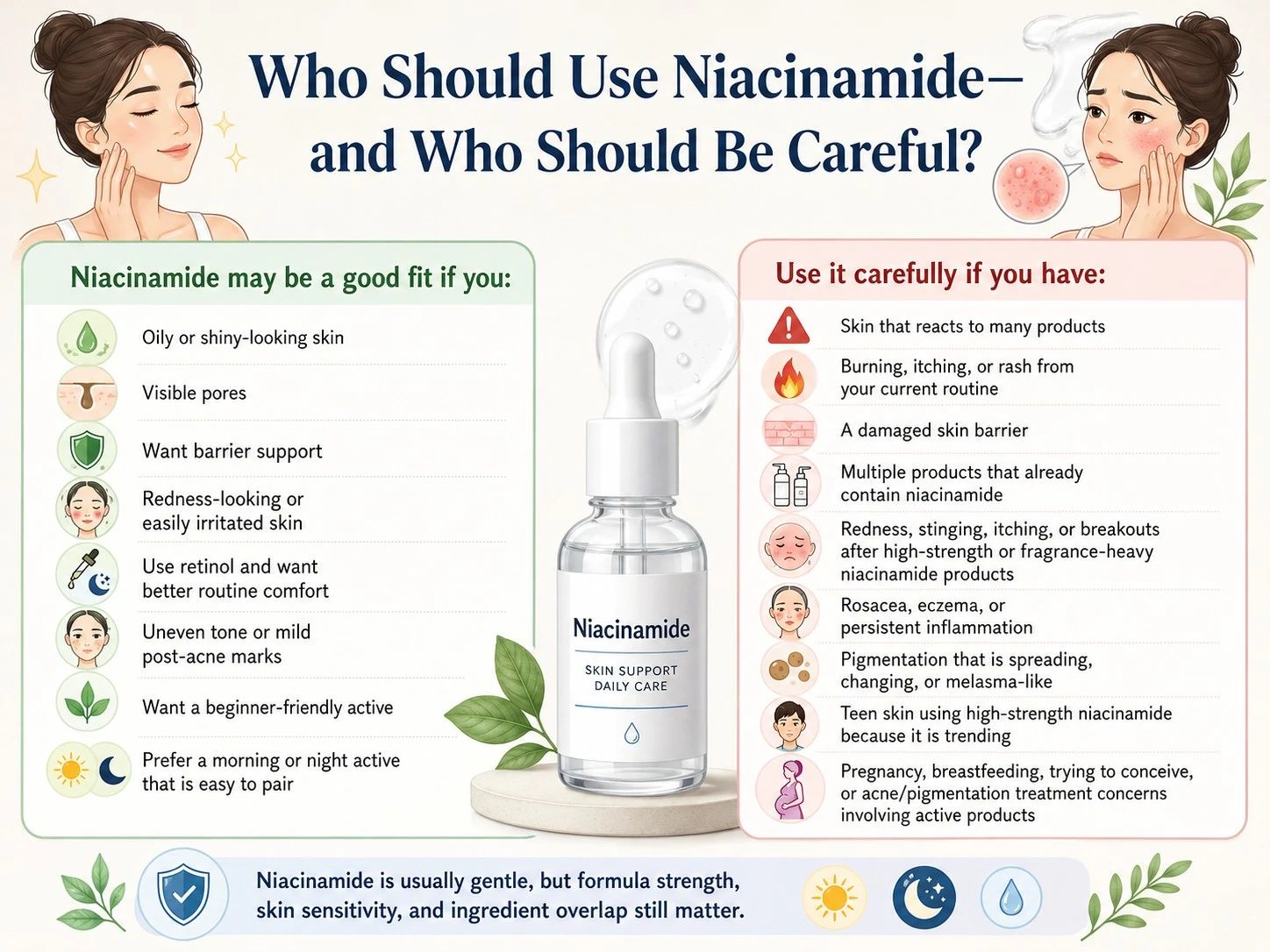
Niacinamide may be a good fit if you:
- Have oily or shiny-looking skin.
- Notice visible pores.
- Want barrier support.
- Have redness-looking or easily irritated skin.
- Use retinol and want better routine comfort.
- Have uneven tone or mild post-acne marks.
- Want a beginner-friendly active.
- Prefer a morning or night active that is easy to pair.
Niacinamide is usually gentle, but use it carefully if you have:
- Skin that reacts to many products.
- Burning, itching, or rash from your current routine.
- A damaged skin barrier.
- Multiple products that already contain niacinamide.
- Redness, stinging, itching, or breakouts after high-strength or fragrance-heavy niacinamide products. [5][8]
- Rosacea, eczema, or persistent inflammation.
- Pigmentation that is spreading, changing, or melasma-like.
- Teen skin using high-strength niacinamide mainly because the ingredient is trending. [7]
- Pregnancy, breastfeeding, trying-to-conceive, or acne/pigmentation treatment concerns involving active products. [6]
What Niacinamide Percentage Is Best?
Niacinamide has been studied for several skin functions, including barrier support, inflammation, pigmentation, acne, melasma, and oily skin concerns, but the best percentage is not always the highest one. [2][3]
| Niacinamide Level | Best For | What to Know |
|---|---|---|
| Under 2% | Gentle support in moisturizers or multi-ingredient products | Good for sensitive routines or daily barrier support |
| 2–5% | Most beginners, barrier support, oil balance, redness-looking skin | Best practical starting range for many users |
| 5–10% | Oily skin, visible pores, stronger tone support | Can work for tolerant skin, but irritation risk is higher |
| 10%+ | Experienced users with clear tolerance | Not necessary for most people |
| Multiple products with niacinamide | Ingredient overlap | Can irritate even if each product seems mild |
Percentage is only one part of the formula. A moderate niacinamide moisturizer may be easier to use than a high-strength serum with a sticky base, strong fragrance, or too many other actives.
How to Choose a Niacinamide Product

A good niacinamide product should fit your skin type, routine, and total ingredient exposure.
- Choose serum or moisturizer based on your routine.
A serum is better if you want a targeted niacinamide step. A moisturizer is better if your main goal is barrier support or routine simplicity. - Start moderate if your skin is sensitive.
You do not need to start with 10% or 20%. A lower or moderate level is often enough for daily use. - Check whether your other products already contain niacinamide.
Niacinamide appears in many cleansers, toners, serums, moisturizers, sunscreens, and makeup products. You may already be using it without noticing. [8] - Match the texture to your skin type.
Oily skin may prefer a lightweight serum or gel. Dry skin may prefer a cream or barrier moisturizer. Sensitive skin usually does better with fragrance-free formulas. - Do not judge only by percentage.
Formula base, texture, fragrance, supporting ingredients, and how your skin feels matter as much as the number on the label. - Look for supportive ingredients.
Ceramides, glycerin, hyaluronic acid, panthenol, and zinc can pair well with niacinamide, depending on your goal. - Avoid harsh combinations if your barrier is already stressed.
If your skin is burning or peeling, do not add a high-strength niacinamide serum to “fix” the problem. Simplify first.
A practical rule: choose one well-formulated niacinamide product before adding another.
How to Use Niacinamide in a Skincare Routine
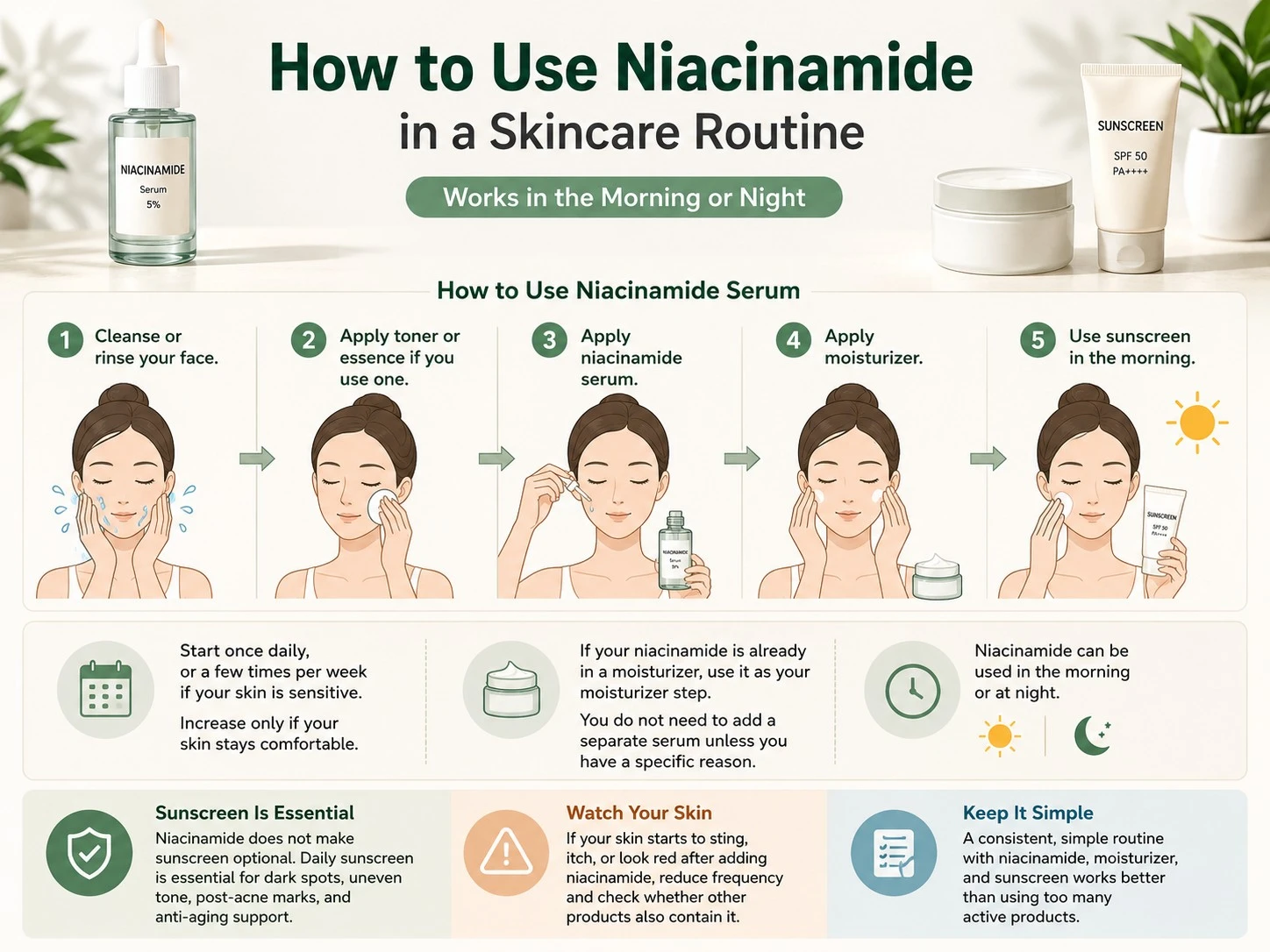
Niacinamide can be used in the morning or at night because it does not require strict timing.
How to use niacinamide serum:
- Cleanse or rinse your face.
- Apply toner or essence if you use one.
- Apply niacinamide serum.
- Apply moisturizer.
- Use sunscreen in the morning.
- Start once daily, or a few times per week if your skin is sensitive.
- Increase only if your skin stays comfortable.
If your niacinamide is already in a moisturizer, use it as your moisturizer step. You do not need to add a separate serum unless you have a specific reason.
Niacinamide does not make sunscreen optional. If you use it for dark spots, uneven tone, post-acne marks, or early aging support, daily sunscreen is still essential.
If your skin starts to sting, itch, or look red after adding niacinamide, reduce frequency and check whether other products also contain it.
Can You Use Niacinamide With Retinol, Vitamin C, or Acids?
Niacinamide is one of the easiest actives to pair, but a compatible ingredient can still irritate if the total routine is too strong.
| Ingredient / Product | Use With Niacinamide? | Practical Advice |
|---|---|---|
| Retinol | Yes | Good barrier-support pairing; a simple setup is retinol at night with a niacinamide moisturizer or gentle serum |
| Vitamin C | Yes | Usually fine in modern routines; sensitive skin can introduce one active at a time |
| AHAs / BHAs | Yes, but watch irritation | Use carefully if your skin is reactive or already dry |
| Salicylic acid | Yes, often useful for oily or acne-prone skin | Avoid over-drying and support the skin barrier |
| Benzoyl peroxide | Yes, but watch dryness | Moisturizer helps; avoid adding too many strong acne products at once |
| Hyaluronic acid | Yes | Good hydration pairing |
| Ceramides | Yes | Good barrier pairing |
| Sunscreen | Yes | Essential for tone, dark spots, and aging-related goals |
| Prescription acne meds | Ask a clinician | Depends on medication, irritation level, and your acne plan |
The main issue is not that niacinamide “cannot mix” with other ingredients. The main issue is using too many active products at once.
Niacinamide Side Effects: Can It Irritate Skin?
Niacinamide is usually well tolerated, but high-strength, fragranced, sticky, or over-layered formulas can still irritate some skin. [5]
Watch for these signs:
- Mild tingling or warmth: reduce frequency and monitor your skin.
- Redness, stinging, or burning: pause the product and simplify your routine.
- Itching or rash: stop the product and do not keep testing it on your face.
- Breakouts after starting niacinamide: check the formula base, concentration, fragrance, and whether you are layering too many niacinamide products.
- Dryness or tightness: your routine may be too active, especially if you also use acids, retinol, or acne treatments.
- Stinging from multiple products: check labels for ingredient overlap and remove duplicate niacinamide steps.
If irritation appears, return to a simple cleanser, moisturizer, and sunscreen routine until the skin feels calm. If swelling, rash, painful burning, or persistent redness appears, stop the product and seek medical advice.
Can Niacinamide Cause Purging or Breakouts?
Niacinamide usually does not cause true purging because it is not mainly an exfoliant or retinoid. Purging is more typical with ingredients that speed up skin turnover, such as retinoids and exfoliating acids.
If breakouts appear after starting niacinamide, check the full product and routine. Common causes include:
- A heavy or pore-clogging formula base.
- A high niacinamide concentration.
- Fragrance or other irritating ingredients.
- Other actives in the same product.
- Too many niacinamide products used at once.
- Barrier irritation that looks like breakouts.
Do not keep using a product for months because you assume it is “purging.” If bumps, itching, redness, stinging, or burning continue, stop and reassess.
How Long Does Niacinamide Take to Work?
Niacinamide works gradually. Barrier comfort may improve before visible pores, oiliness, or uneven tone change.
| Goal | Realistic Timeline |
|---|---|
| Less tightness / better comfort | 1–2 weeks |
| Better barrier feel | 2–6 weeks |
| Less shiny-looking skin | 4–8 weeks |
| Redness-looking skin | 4–8 weeks |
| Pore appearance | 8–12 weeks |
| Uneven tone / post-acne marks | 8–12+ weeks |
| Fine-line support | 3–6+ months |
These timelines are not guarantees. Product type, concentration, formula base, sunscreen use, skin type, and the cause of the concern all matter.
Niacinamide may support routines for acne, redness, or pigmentation, but it should not replace proper treatment for painful acne, true rosacea, severe eczema, or stubborn pigmentation.
Common Niacinamide Mistakes
Most niacinamide problems come from over-layering, high concentrations, or unrealistic expectations. Avoid these mistakes:
- Using too many niacinamide products at once.
Better: check labels across serum, moisturizer, sunscreen, and makeup. - Starting too high.
Better: start with a moderate concentration if your skin is sensitive. - Expecting pores to disappear.
Better: aim for smoother-looking texture and less visible pores. - Using niacinamide instead of acne treatment.
Better: treat acne based on type and severity. - Ignoring the formula base.
Better: check if the product is too heavy, fragranced, sticky, or layered with other actives. - Adding it to an already irritated routine.
Better: simplify first. - Expecting dark spots to fade without sunscreen.
Better: use sunscreen daily. - Assuming “gentle” means impossible to irritate.
Better: monitor your skin and adjust if redness, itching, or burning appears.
A good niacinamide routine should make your skin feel steadier over time. If your skin becomes more reactive, check whether you are using too much, too strong a product, or the wrong formula base.
Niacinamide Alternatives and Supporting Ingredients
If niacinamide does not suit your skin, other ingredients may support related goals.
| Ingredient | Best For | How It Compares |
|---|---|---|
| Ceramides | Barrier repair | More barrier-focused |
| Panthenol | Soothing, comfort | Gentle support |
| Hyaluronic acid / glycerin | Hydration | Hydration, not oil control |
| Azelaic acid | Redness-looking skin, acne marks, uneven tone | More active for pigmentation or acne |
| Salicylic acid | Clogged pores, oily skin | More exfoliating |
| Retinol | Texture, acne, fine lines | Stronger, more irritating |
| Vitamin C | Brightening, antioxidant support | More oxidation-sensitive |
Do not treat alternatives as automatically safer. Sensitive skin can react to acids, fragrance, strong botanical extracts, and heavy product bases.
If your concern is dark spots, acne, or redness, the best alternative depends on the cause. Salicylic acid is more directly useful for clogged pores, while azelaic acid may be more useful for redness-looking skin and post-acne marks.
When to See a Dermatologist
Niacinamide can support a skincare routine, but some concerns need medical support.
See a dermatologist if:
- Acne is painful, cystic, or scarring.
- Redness looks like rosacea and does not improve.
- Eczema-like irritation keeps returning.
- Pigmentation is spreading, changing, or melasma-like.
- A product causes swelling, rash, or burning.
- You cannot tolerate even gentle formulas.
- You are pregnant, breastfeeding, or treating acne or pigmentation with medicated products.
- You have a darker skin tone and frequent post-inflammatory hyperpigmentation that does not improve.
A dermatologist can help separate cosmetic concerns from medical skin conditions because “redness,” “dark spots,” and “breakouts” can have different causes and need different treatment plans.
Final Thoughts
Niacinamide is useful because it is flexible, barrier-friendly, and easy to pair with other ingredients. It can help with oily-looking skin, visible pores, redness-looking skin, uneven tone, and routine comfort.
More is not always better. For most people, one moderate-strength serum or moisturizer is more useful than layering high-strength niacinamide across every step.
FAQs About Niacinamide for Skin
What does niacinamide do for your skin?
Niacinamide supports the skin barrier, helps reduce the look of redness, balances oily-looking skin, improves the appearance of pores, and supports a more even-looking tone. It is flexible and usually easy to pair with other skincare ingredients.
Is niacinamide good for acne or oily skin?
Niacinamide can support oily and acne-prone skin by helping reduce shiny-looking skin, redness-looking skin, and routine discomfort. It is not a complete acne treatment. Painful, cystic, or scarring acne needs a more targeted plan.
Does niacinamide shrink pores?
Niacinamide can improve the look of pores, but it does not permanently shrink actual pore size. Pores may look less noticeable when oiliness, texture, and barrier condition improve.
Can niacinamide help dark spots?
Niacinamide can support a more even-looking tone and may help with mild post-acne marks or unevenness. It is not the strongest dark spot treatment by itself. Sunscreen and targeted pigment ingredients may still be needed.
How often should I use niacinamide?
Many people can use niacinamide daily, either morning or night. If it is in a serum, use it after cleansing and before moisturizer. If your skin gets red, itchy, or irritated, reduce frequency and check whether other products also contain niacinamide.
Can I use niacinamide with retinol or vitamin C?
Yes. Niacinamide can be used with retinol and vitamin C in the same overall routine. If your skin is sensitive, introduce one active at a time. A simple option is vitamin C in the morning, retinol at night, and niacinamide in a moisturizer or gentle serum.
Can niacinamide cause purging?
Niacinamide usually does not cause true purging because it is not mainly an exfoliant or retinoid. Breakouts after niacinamide are more likely related to the formula base, concentration, over-layering, or irritation.
What percentage of niacinamide is best?
For many people, 2–5% is a good starting range. A 10% serum can suit some oily or tolerant skin, but it is not necessary for everyone. Higher percentage is not automatically better.
Is niacinamide safe for sensitive skin?
Niacinamide is often suitable for sensitive skin, but formula and concentration still matter. Start with a moderate or lower concentration, avoid strong fragrance, and stop if you get burning, rash, swelling, or persistent redness.
Sources
[1] Cleveland Clinic. Niacinamide: What It Is and Skin Benefits
[2] PubMed. Mechanistic Insights into the Multiple Functions of Niacinamide
[3] PubMed. Exploring Niacinamide as a Multifunctional Agent for Skin Health and Disease
[4] American Academy of Dermatology. Do Facial Masks Work, and Should I Add One to My Skin Care Routine?
[5] WebMD. Niacinamide Uses for Skin: Benefits and Side Effects
[6] American Academy of Dermatology. Dermatologist-Approved Pregnancy Skin Care
[7] American Academy of Dermatology. A Dermatologist’s Guide to Skincare from Growing Up to Growing Older
[8] Harper’s Bazaar. Niacinamide Is Suddenly in Everything, Everywhere. But Is It Too Much of a Good Thing?


