


Serum vs Moisturizer: Key Differences
| Feature | Serum | Moisturizer |
|---|---|---|
| Main purpose | Targets a specific skin concern | Hydrates, softens, and supports the skin barrier |
| Typical texture | Watery, gel-like, milky, or light oil | Gel, lotion, cream, balm, or ointment |
| Common ingredients | Vitamin C, retinol, niacinamide, peptides, acids, hyaluronic acid | Glycerin, ceramides, fatty acids, squalane, dimethicone, petrolatum |
| Role in the routine | Optional targeted treatment | Core hydration and barrier-support step for most skin |
| Application order | Usually after cleansing | Usually after serum or treatment |
| Can it treat dryness? | A hydrating serum can add water-binding support | Can combine hydration with emollient and moisture-sealing support |
| Can it contain active ingredients? | Yes; this is often its main purpose | Yes; many moisturizers also contain retinol, niacinamide, peptides, or acids |
| Is it essential? | No | More foundational, especially for dry, sensitive, or treatment-stressed skin |
Do not rely on claims that every serum is more concentrated or penetrates deeper than every moisturizer. Absorption and performance depend on the active ingredient, molecular properties, concentration, delivery system, and complete formula.
What Is a Face Serum?
A face serum is a leave-on product formulated around one or more targeted ingredients. Serums can address hydration, discoloration, oiliness, acne, fine lines, antioxidant protection, or skin texture.
The word “serum” describes a product format, not a guaranteed strength. Some serums contain high levels of active ingredients, while others are primarily lightweight hydrating products. A more concentrated formula is not automatically safer, stronger, or better for your skin.
What Is a Moisturizer?
A moisturizer is a gel, lotion, cream, balm, or ointment designed to improve skin hydration and comfort. Well-designed moisturizers often combine three ingredient functions:
- Humectants such as glycerin, hyaluronic acid, urea, or panthenol help attract and hold water.
- Emollients such as squalane, fatty acids, and fatty alcohols help smooth and soften rough skin.
- Occlusives such as petrolatum and dimethicone help slow water loss from the skin surface.[3][4]
A moisturizer does more than “seal in a serum.” It can hydrate and support the skin even when no serum is used.
Serum or Moisturizer First?
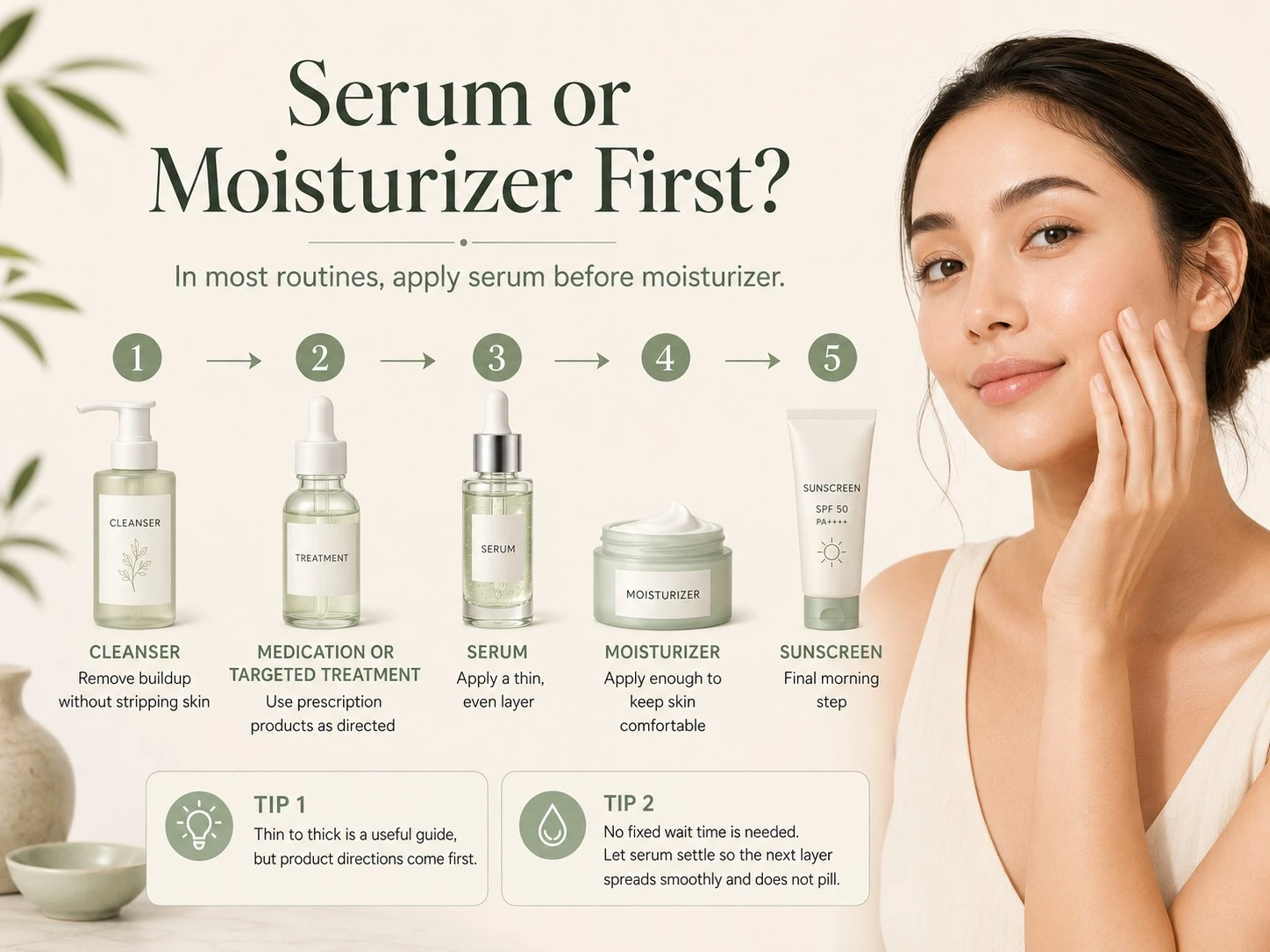
Apply serum before moisturizer in most routines. Treatment products are generally used after cleansing, followed by moisturizer and morning sunscreen.[1][2]
A simple order is:
- Cleanser: remove sunscreen, makeup, oil, and buildup without stripping the skin.
- Medication or targeted treatment: apply prescription products as directed.
- Serum: use a thin, even layer if it is part of your routine.
- Moisturizer: apply enough to leave the skin comfortable.
- Sunscreen: use it as the final morning skincare step.
The general “thin to thick” rule is useful, but product directions take priority. Some retinoids or prescription treatments may be applied after moisturizer to reduce irritation when a clinician or product direction recommends buffering.
You do not need to wait a fixed number of minutes between serum and moisturizer. Allow the serum to spread and settle enough that the next product does not drag, mix unevenly, or pill.
For the full sequence of cleansers, treatments, eye products, moisturizer, and sunscreen, see our skincare routine order guide.
Which Should You Use for Your Skin Type?
Start by identifying what your skin lacks. A skin type describes patterns such as oiliness or dryness, while concerns such as acne, pigmentation, and fine lines determine whether a targeted serum is useful.
| Skin Type or Concern | Serum Direction | Moisturizer Direction |
|---|---|---|
| Dry skin | Optional hydrating serum with glycerin or hyaluronic acid | Rich cream with humectants, emollients, and occlusives |
| Dehydrated skin | Hydrating serum can add water-binding support | Use afterward to reduce evaporation and improve comfort |
| Oily skin | Lightweight niacinamide or targeted treatment serum | Gel or light non-comedogenic lotion |
| Acne-prone skin | Salicylic acid, niacinamide, or prescribed treatment as appropriate | Oil-free or non-comedogenic moisturizer |
| Sensitive skin | Use only when it addresses a clear need; avoid crowded formulas | Fragrance-free moisturizer with a simple ingredient profile |
| Fine lines or photoaging | Vitamin C in the morning or retinol at night if tolerated | Moisturizer to reduce dryness and temporarily soften dehydration lines |
| Uneven tone or dark spots | Vitamin C, niacinamide, retinoid, or another evidence-based active | Choose by skin type; moisturizer alone is not a pigment treatment |
| Barrier-stressed skin | Pause unnecessary active serums | Prioritize a gentle barrier-support moisturizer |
Use our skin type guide if you are unsure whether your skin is dry, oily, combination, or normal. Tight, dull skin can also be dehydrated without being naturally dry; see dehydrated vs dry skin for the difference.
How to Choose the Right Serum and Moisturizer
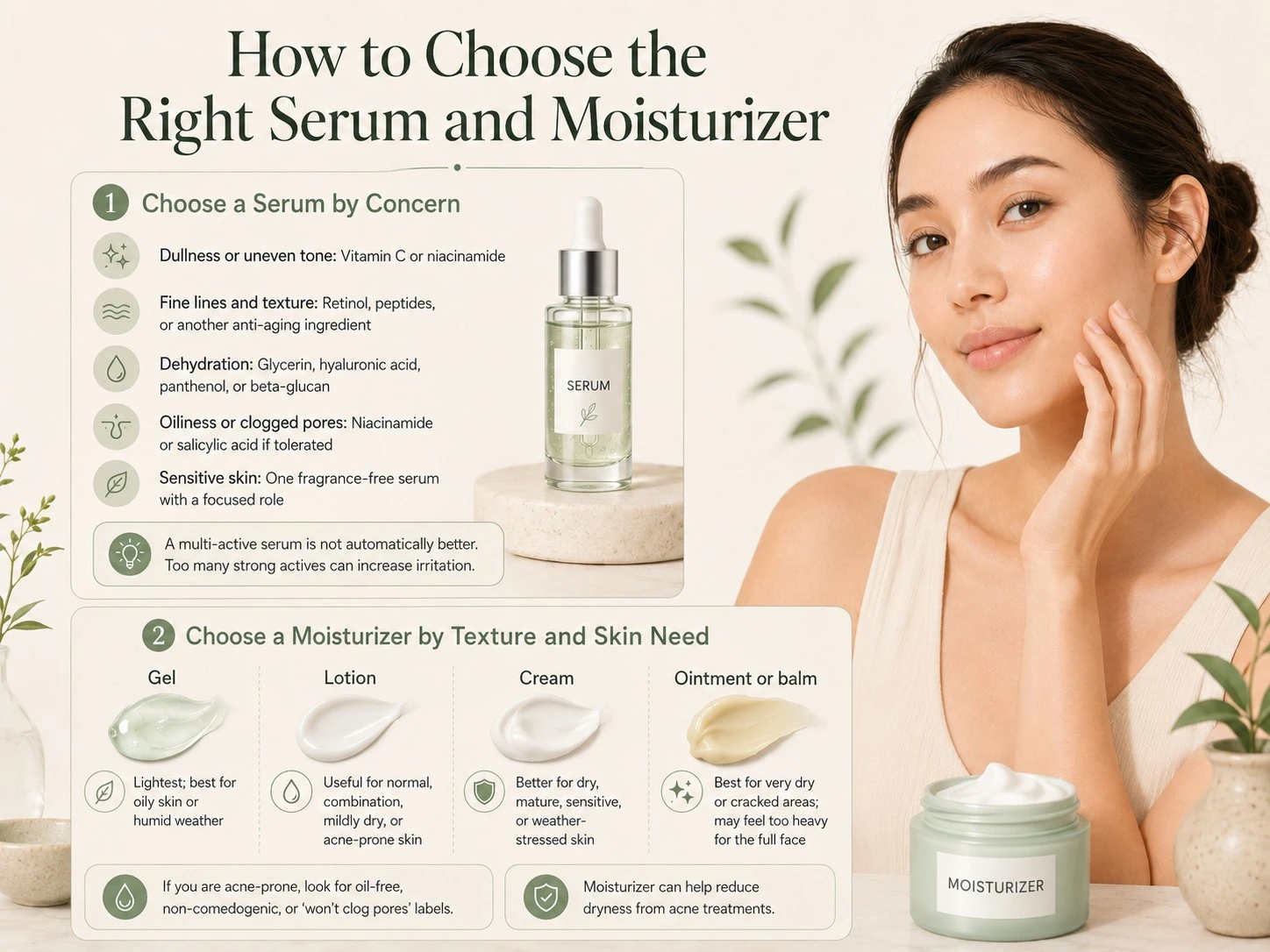
Choose a Serum by Concern
Do not choose a serum only because it is popular or contains the highest percentage. Start with the concern you want to address.
- Dullness or uneven tone: consider vitamin C or niacinamide.
- Fine lines and texture: consider retinol, peptides, or another well-supported anti-aging ingredient.
- Dehydration: consider glycerin, hyaluronic acid, panthenol, or beta-glucan.
- Oiliness or clogged pores: consider niacinamide or salicylic acid if tolerated.
- Sensitive skin: choose one fragrance-free serum with a short, focused role rather than a multi-active formula.
A serum with several strong actives is not automatically more efficient. It can make irritation harder to trace and increase the chance that you stop using the product.
Choose a Moisturizer by Texture and Skin Need
Moisturizer choice depends more on skin type, dryness severity, climate, and treatment routine than on age or gender.
- Gel: lightest option for oily skin or humid weather.
- Lotion: useful for normal, combination, mildly dry, or acne-prone skin.
- Cream: better for dry, mature, sensitive, or weather-stressed skin.
- Ointment or balm: useful for very dry or cracked areas, but may feel too heavy for the full face.
Creams generally contain more oil and provide more hydration than lighter gels or lotions, while ointments are the thickest option for severe dryness.[3]
If you are acne-prone, look for labels such as oil-free, non-comedogenic, or “won’t clog pores.” Moisturizer can help reduce dryness caused by benzoyl peroxide, salicylic acid, adapalene, tretinoin, and other acne treatments.[5]
How to Use Serum and Moisturizer Together
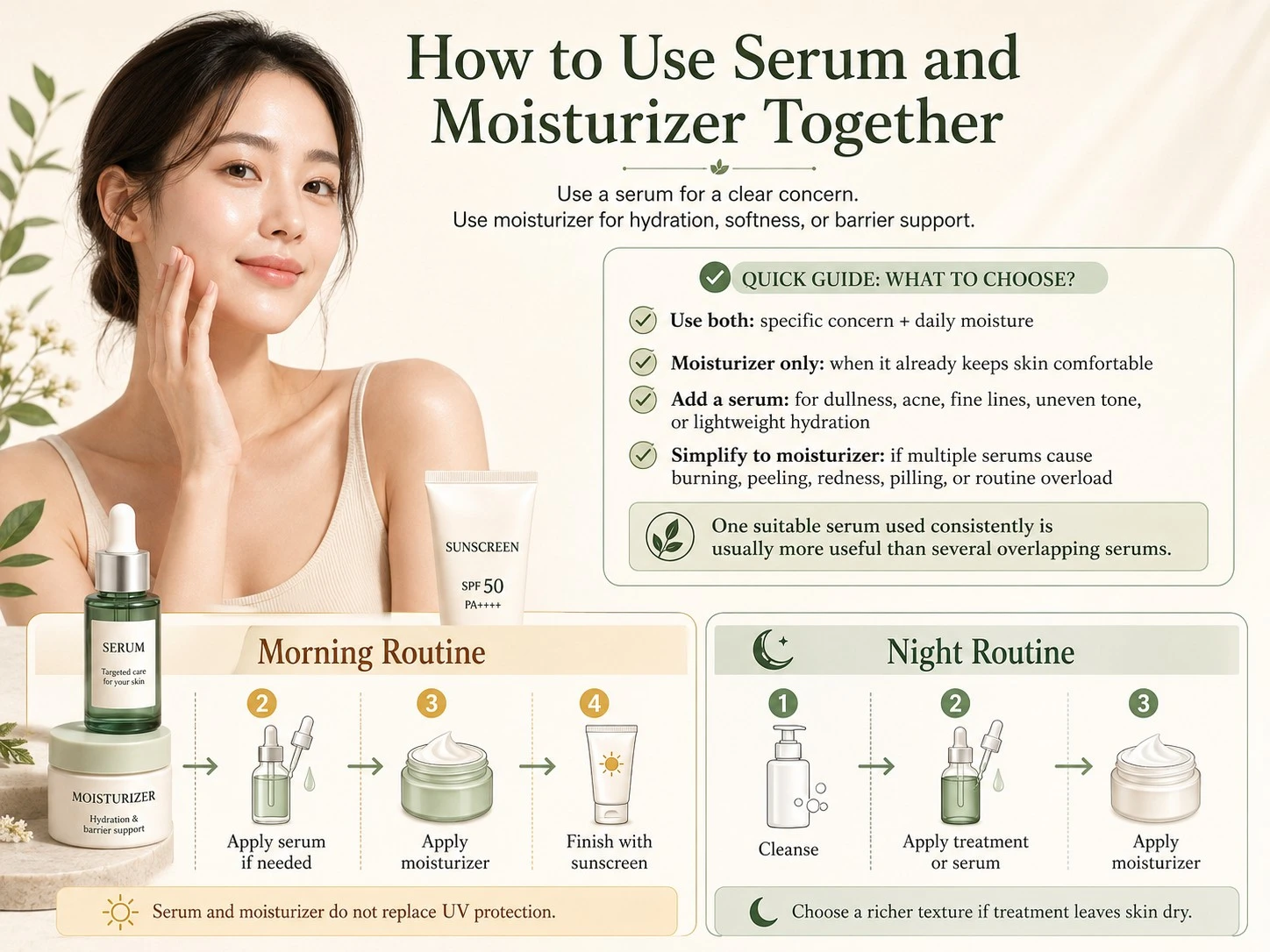
You do not automatically need both products. Use a serum when it targets a clear concern, and use moisturizer when your skin needs hydration, softness, or barrier support.
- Use both: when you have a specific concern and still need daily moisture.
- Use moisturizer only: when it already keeps your skin comfortable and provides the ingredients you need.
- Add a serum: for a defined goal such as dullness, acne, fine lines, uneven tone, or lightweight hydration.
- Simplify to moisturizer: when multiple serums cause burning, peeling, redness, pilling, or an overly complicated routine.
A serum should earn its place by addressing a defined concern. One suitable serum used consistently is usually more useful than several products with overlapping ingredients.
Morning routine:
- Cleanse gently or rinse: avoid leaving the skin tight.
- Apply serum: use a vitamin C, niacinamide, or hydrating serum if needed.
- Apply moisturizer: choose a texture that matches your skin type.
- Finish with sunscreen: serum and moisturizer do not replace UV protection.
Night routine:
- Cleanse: remove sunscreen, makeup, and daily buildup.
- Apply treatment or serum: use retinol, acne treatment, or another active as directed.
- Apply moisturizer: choose a richer texture if treatment leaves the skin dry.
Can Serum Replace Moisturizer?
A hydrating serum may feel sufficient for some people with very oily, comfortable skin, especially in humid weather. However, most serums do not provide the same combination of humectants, emollients, and moisture-sealing ingredients as a moisturizer.
If serum alone leaves your skin tight, flaky, rough, irritated, or more reactive, add a moisturizer. A lightweight gel or lotion may be enough; moisturizer does not have to mean a heavy cream.
Can Moisturizer Replace Serum?
Yes, if the moisturizer already meets your needs. Many moisturizers contain ingredients such as niacinamide, peptides, retinol, ceramides, or hyaluronic acid, so a separate serum may add little value.
Moisturizer alone is also the better choice when your skin is irritated, you are introducing a strong treatment, or you want a simpler routine that is easier to maintain.
How to Prevent Pilling, Greasiness, and Irritation
Layering problems usually come from product amount, formula compatibility, rubbing, or using too many steps—not from the serum-before-moisturizer rule itself.
To reduce pilling and heaviness:
- Use a few drops or a thin layer of serum.
- Let each product settle before adding the next.
- Press or spread gently instead of rubbing repeatedly.
- Avoid layering several products built around similar film-forming polymers or silicones.
- Use a lighter moisturizer if the combination feels greasy.
- Reduce the number of layers under sunscreen and makeup.
To reduce irritation:
- Introduce one new serum at a time.
- Do not begin several acids, retinoids, or acne treatments in the same week.
- Use moisturizer consistently when active ingredients cause dryness.
- Stop a cosmetic product that causes persistent burning, rash, swelling, or rawness.
- Follow prescription directions rather than changing the order on your own.
Using too many products increases the chance of irritation and can make it difficult to identify the trigger.[1][6]
Common Serum and Moisturizer Mistakes
- Assuming everyone needs a serum.
- Using serum instead of moisturizer when the skin is dry or irritated.
- Applying a thick moisturizer before a lightweight serum without a specific reason.
- Choosing a serum without identifying the concern it should address.
- Buying the highest active percentage instead of the best-tolerated formula.
- Skipping moisturizer because the skin is oily.
- Using a cream that is too heavy for acne-prone skin.
- Layering several serums with overlapping active ingredients.
- Mixing products together in the palm instead of applying them as directed.
- Expecting moisturizer to replace sunscreen.
- Assuming an expensive serum must work better than a simple formula.
A good routine should be easy to repeat. If every application requires complicated timing, several corrective layers, or frequent recovery from irritation, the routine needs fewer products.
When to See a Dermatologist
Serums and moisturizers can support cosmetic concerns, but they cannot diagnose or treat every persistent skin problem.
See a dermatologist if you have:
- Persistent burning, itching, redness, or scaling.
- Rash, swelling, hives, blistering, or oozing.
- Painful or cystic acne.
- Repeated reactions to fragrance-free products.
- Dryness that does not improve with a suitable moisturizer.
- Suspected eczema, rosacea, psoriasis, or contact dermatitis.
- Dark spots or acne that worsen despite consistent care.
- Questions about combining prescription treatments with cosmetic serums.
Final Thoughts
Serum and moisturizer are not competing versions of the same product. Serum is an optional targeted step, while moisturizer provides broader hydration, softness, and barrier support.
Use both when you have a clear concern and need daily moisture. Use moisturizer alone when it already meets your needs. When both are part of the routine, apply serum first and moisturizer second unless a prescription or product direction tells you otherwise.
FAQs About Serum vs Moisturizer
Which is better, serum or moisturizer?
Neither is universally better. Moisturizer is more foundational because it supports hydration and reduces water loss. Serum is useful when you want to target a specific concern such as dullness, acne, fine lines, or dehydration.
Do I need both serum and moisturizer?
Not always. Use both if a serum targets a concern and your skin still needs moisture. A moisturizer alone is enough for many simple routines, especially when it already contains the active ingredients you want.
Can serum replace moisturizer?
A lightweight hydrating serum may feel sufficient for some very oily skin, but most serums do not provide the same emollient and moisture-sealing support as a moisturizer. Add a gel, lotion, or cream if the skin feels tight, dry, or irritated.
Should I apply serum or moisturizer first?
Apply serum first and moisturizer second in most routines. The serum delivers the targeted treatment, while the moisturizer adds hydration and barrier support. Follow prescription or product-specific directions when they recommend a different order.
Does oily or acne-prone skin need moisturizer?
Oily and acne-prone skin can still become dehydrated or irritated, especially when using benzoyl peroxide, salicylic acid, retinoids, or prescription treatments. Choose a lightweight, oil-free or non-comedogenic moisturizer.[5]
How long should I wait between serum and moisturizer?
You do not need a fixed waiting period. Apply moisturizer after the serum has spread and settled enough that the next layer does not drag or pill. This may take only a few seconds, depending on the formulas and amount used.
Sources
[1] Cleveland Clinic. How To Order Your Skin Care Routine
[2] American Academy of Dermatology. Should I Apply My Skin Care Products in a Certain Order?
[3] American Academy of Dermatology. How to Pick the Right Moisturizer for Your Skin
[4] Del Rosso JQ, Kircik L. Skin 101: Understanding the Fundamentals of Skin Barrier Physiology—Why Is This Important for Clinicians?
[5] American Academy of Dermatology. Moisturizer: Why You May Need It If You Have Acne
[6] American Academy of Dermatology. How to Select Anti-Aging Skin Care Products


