

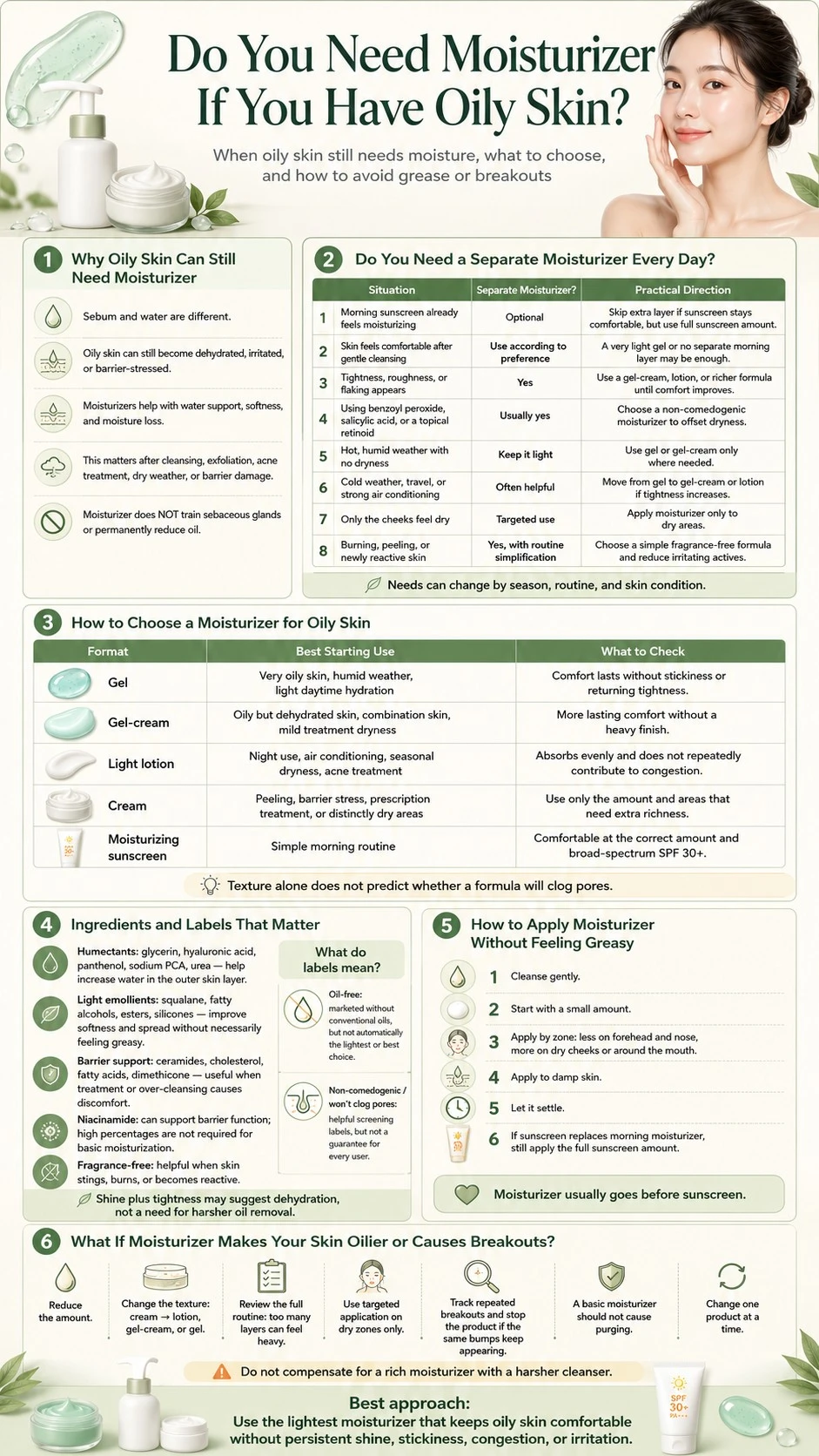
Yes, oily skin often benefits from moisturizer, but it does not always need a separate rich cream at every routine. Sebum makes the skin oily; moisturizer helps manage water content, softness, and moisture loss. Those are related but different functions.
The practical goal is not to add as much moisture as possible. It is to use the lightest formula—or moisturizing sunscreen—that keeps your skin comfortable without persistent shine, stickiness, congestion, or irritation.
Why Oily Skin Can Still Need Moisturizer
Oily skin produces more visible sebum, but sebum is not the same as water. The outer skin layer still depends on adequate water and an effective barrier to remain flexible and comfortable. Moisturizers can combine humectants that bind water, emollients that smooth the surface, and occlusives that slow evaporation.[5]
This matters because oily skin can become dry or irritated from cleansing, exfoliation, weather, acne medication, or an impaired barrier. Shine and tightness can appear at the same time. In that situation, removing more oil does not address the missing water or irritation.
Moisturizer should not be presented as a guaranteed way to “train” sebaceous glands or permanently reduce sebum. Its clearer role is to prevent avoidable dryness, improve comfort, and help the skin tolerate a routine without needing excessively harsh cleansing.
Do You Need a Separate Moisturizer Every Day?
Oily skin does not follow one universal rule. Decide by the products already in your routine and how your skin behaves several hours later.
| Situation | Separate Moisturizer? | Practical Direction |
|---|---|---|
| Morning sunscreen already feels moisturizing | Optional | Skip the extra layer if sunscreen remains comfortable, but apply the full sunscreen amount |
| Skin feels comfortable after gentle cleansing | Use according to preference | A very light gel or no separate morning layer may be enough |
| Tightness, roughness, or flaking appears | Yes | Use a gel-cream, lotion, or richer formula until comfort improves |
| Using benzoyl peroxide, salicylic acid, or a topical retinoid | Usually yes | Choose a non-comedogenic moisturizer that offsets treatment-related dryness |
| Hot, humid weather with no dryness | Keep it light | Use gel or gel-cream only where needed |
| Cold weather, travel, or strong air conditioning | Often helpful | Move from gel to gel-cream or lotion if tightness increases |
| Only the cheeks feel dry | Targeted use | Apply moisturizer to dry areas instead of adding a heavy layer across the T-zone |
| Burning, peeling, or newly reactive skin | Yes, with routine simplification | Choose a simple fragrance-free formula and reduce irritating active products |
The fact that one person can skip moisturizer on a humid morning does not mean oily skin never needs it. The decision can change between morning and night, summer and winter, or before and during acne treatment.
How to Choose a Moisturizer for Oily Skin
Start with texture, then check the label and the finished formula. The best product should spread easily, settle within a reasonable time, and keep your skin comfortable without creating a persistent film.
| Format | Best Starting Use | What to Check |
|---|---|---|
| Gel | Very oily skin, humid weather, light daytime hydration | Comfort lasts without stickiness or returning tightness |
| Gel-cream | Oily but dehydrated skin, combination skin, mild treatment dryness | Provides more lasting comfort without a heavy finish |
| Light lotion | Night use, air conditioning, seasonal dryness, acne treatment | Absorbs evenly and does not repeatedly contribute to congestion |
| Cream | Peeling, barrier stress, prescription treatment, or distinctly dry areas | Use only the amount and areas that need the extra richness |
| Moisturizing sunscreen | Simple morning routine | Comfortable at the correct application amount and broad-spectrum SPF 30 or higher |
A gel is not automatically non-comedogenic, and a cream is not automatically pore-clogging. Texture describes the product experience; tolerance depends on the complete formula, amount, other routine layers, and individual skin response.
Ingredients and Labels That Matter
Oily skin does not need a long ingredient wish list. Look for a balanced formula that provides water support without more richness than your skin currently needs.
- Humectants: Glycerin, hyaluronic acid, panthenol, sodium PCA, and urea help increase water in the outer skin layer.
- Light emollients: Squalane, fatty alcohols, esters, and silicones can improve softness and spread without necessarily feeling greasy.
- Barrier-support ingredients: Ceramides, cholesterol, fatty acids, and dimethicone can be useful when acne treatment or over-cleansing causes discomfort.
- Niacinamide: Can support barrier function and is common in lightweight products, but a high percentage is not required for basic moisturization.
- Fragrance-free positioning: Useful when the skin stings, burns, or becomes reactive. “Unscented” can still include fragrance-masking ingredients.
For a detailed explanation of niacinamide’s role and limits, see our Niacinamide Guide.
What Do Oil-Free and Non-Comedogenic Mean?
“Oil-free” means the formula is marketed without conventional oils, but it does not tell you whether the product will feel light, whether it contains silicones or esters, or whether it will suit your skin.
“Non-comedogenic,” “non-acnegenic,” and “won’t clog pores” are useful screening labels for oily or acne-prone skin.[2][3] They indicate that the product is designed to have a lower chance of contributing to comedones, not that breakouts are impossible for every user.
Shine and tightness together can point to dehydration rather than a need for stronger oil removal. See Dehydrated vs Dry Skin for the difference. If several basic products begin to sting, simplify the routine and review the signs of a Stressed Skin Barrier.
How to Apply Moisturizer Without Feeling Greasy
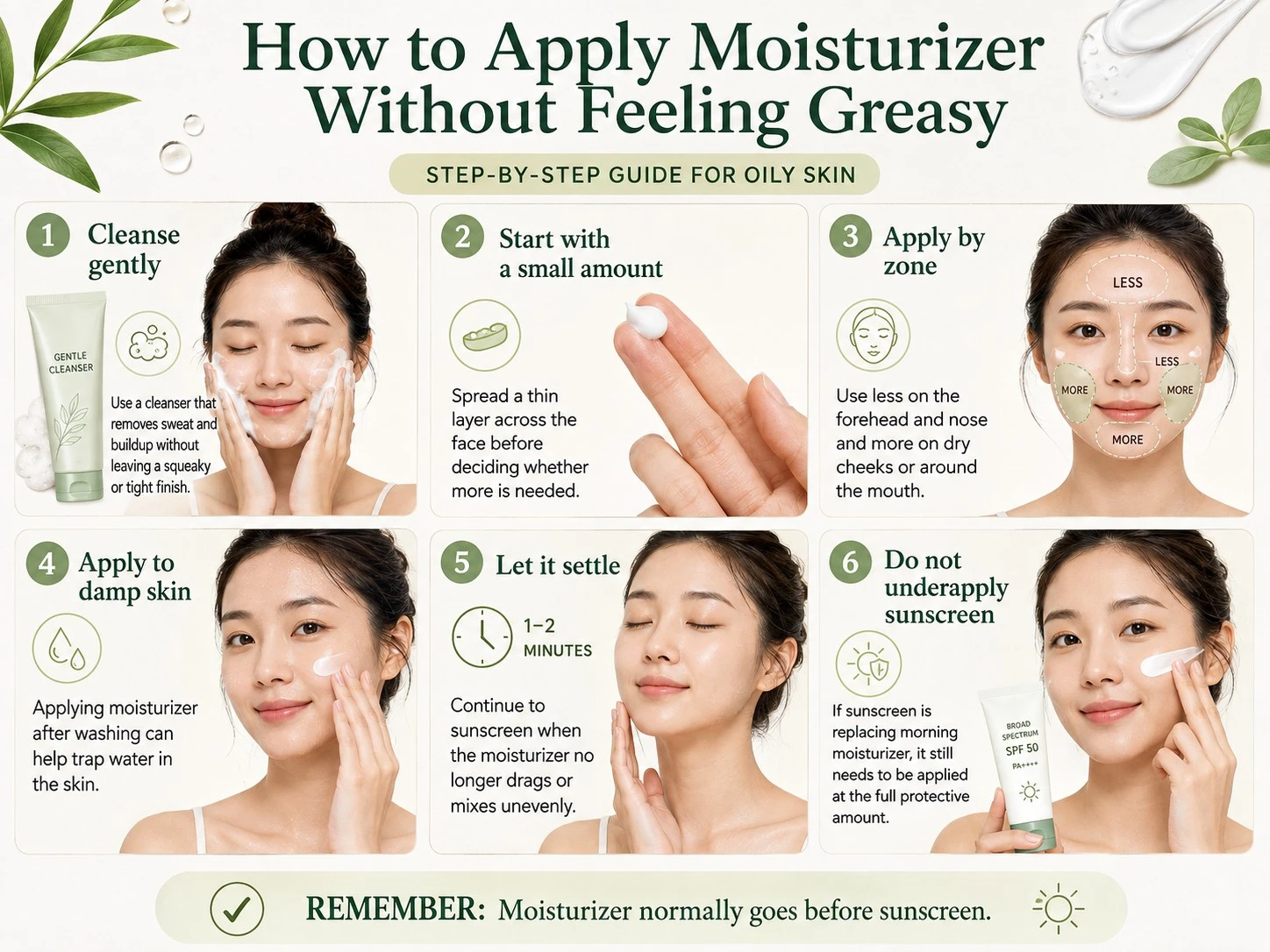
- Cleanse gently: Use a cleanser that removes sweat and buildup without leaving a squeaky or tight finish.
- Start with a small amount: Spread a thin layer across the face before deciding whether more is needed.
- Apply by zone: Use less on the forehead and nose and more on dry cheeks or around the mouth.
- Apply to damp skin: Applying moisturizer after washing can help trap water in the skin.[1][2]
- Let it settle: Continue to sunscreen when the moisturizer no longer drags or mixes unevenly.
- Do not underapply sunscreen: If sunscreen is replacing morning moisturizer, it still needs to be applied at the full protective amount.
Moisturizer normally goes before sunscreen. See Sunscreen or Moisturizer First? for the full morning order.
What If Moisturizer Makes Your Skin Oilier or Causes Breakouts?
A shiny finish does not always mean the skin has produced more sebum. The product may simply remain on the surface, mix poorly with sunscreen, or be applied too heavily. Before abandoning moisturizer, change one variable at a time. Do not compensate for an overly rich moisturizer with a harsher cleanser; switch the amount or texture instead.
- Reduce the amount: A thin layer may provide enough comfort without the same surface shine.
- Change the texture: Move from cream to lotion, gel-cream, or gel.
- Check the full routine: Several serums, primer, moisturizer, and sunscreen can create heaviness even when each product feels light alone.
- Use targeted application: Skip naturally comfortable zones and moisturize areas that become tight.
- Track repeated breakouts: Stop the product if the same clogged bumps or inflamed lesions repeatedly appear after introduction.
- Do not confuse irritation with purging: A basic moisturizer without a cell-turnover active is not expected to cause skin purging.
Change one product at a time so the cause is easier to identify. The Patch Testing Guide can help when your skin reacts easily, although a patch test cannot fully predict facial breakouts.
Final Thoughts
Oily skin usually benefits from access to a moisturizer, but it does not always require a rich product or a separate layer at every routine. Use a gel, gel-cream, or light lotion when you need hydration without weight, and increase richness only when treatment, weather, dehydration, or barrier stress creates a clear need.
Judge the result by several hours of comfort, not by the first cool feeling after application or by shine alone. The right moisturizer should support the routine without persistent tightness, greasiness, irritation, or repeated congestion.
For the placement of cleanser, acne treatment, moisturizer, and sunscreen, see our Skincare Routine Order.
FAQs About Moisturizer for Oily Skin
Can I skip moisturizer if my skin is very oily?
You can skip a separate layer when your skin remains comfortable and another product, such as sunscreen, already provides enough moisture. Keep a lightweight moisturizer available for night, dry weather, treatment-related peeling, or returning tightness.
Does skipping moisturizer make oily skin produce more oil?
Oil production is influenced by genetics, hormones, climate, irritation, and other factors. Moisturizer should not be treated as a guaranteed sebum-control treatment, but preventing avoidable dryness and irritation can make an oily-skin routine more comfortable.
What type of moisturizer is best for oily skin?
Gel, gel-cream, or light lotion is usually the best starting point. Choose non-comedogenic positioning when possible and move to a richer formula only when dryness, peeling, weather, or treatment creates a need.
Should oily acne-prone skin use moisturizer?
Yes, especially when acne treatments cause dryness or irritation. Use an oil-free or non-comedogenic product when available and keep proven acne treatment at the center of the routine.[2][4] See our Acne-Prone Skincare Routine for complete guidance.
Can oily skin use cream moisturizer?
Yes. Cream can be useful on peeling areas, during cold weather, or while using a drying prescription treatment. Apply it selectively or in a thin layer rather than assuming the full face needs the same richness.
How often should oily skin use moisturizer?
Use it after cleansing whenever the skin feels tight, dry, or treatment-stressed. Some people prefer it morning and night; others need a separate moisturizer only at night or during drier conditions.
Sources
[1] American Academy of Dermatology. Skin Care on a Budget
[2] American Academy of Dermatology. Moisturizer: Why You May Need It If You Have Acne
[3] American Academy of Dermatology. How to Pick the Right Moisturizer for Your Skin
[4] American Academy of Dermatology. 10 Skin Care Habits That Can Worsen Acne
[5] Harwood A, et al. Moisturizers
[6] Cleveland Clinic. 8 Tips for Getting Rid of Oily Skin


