


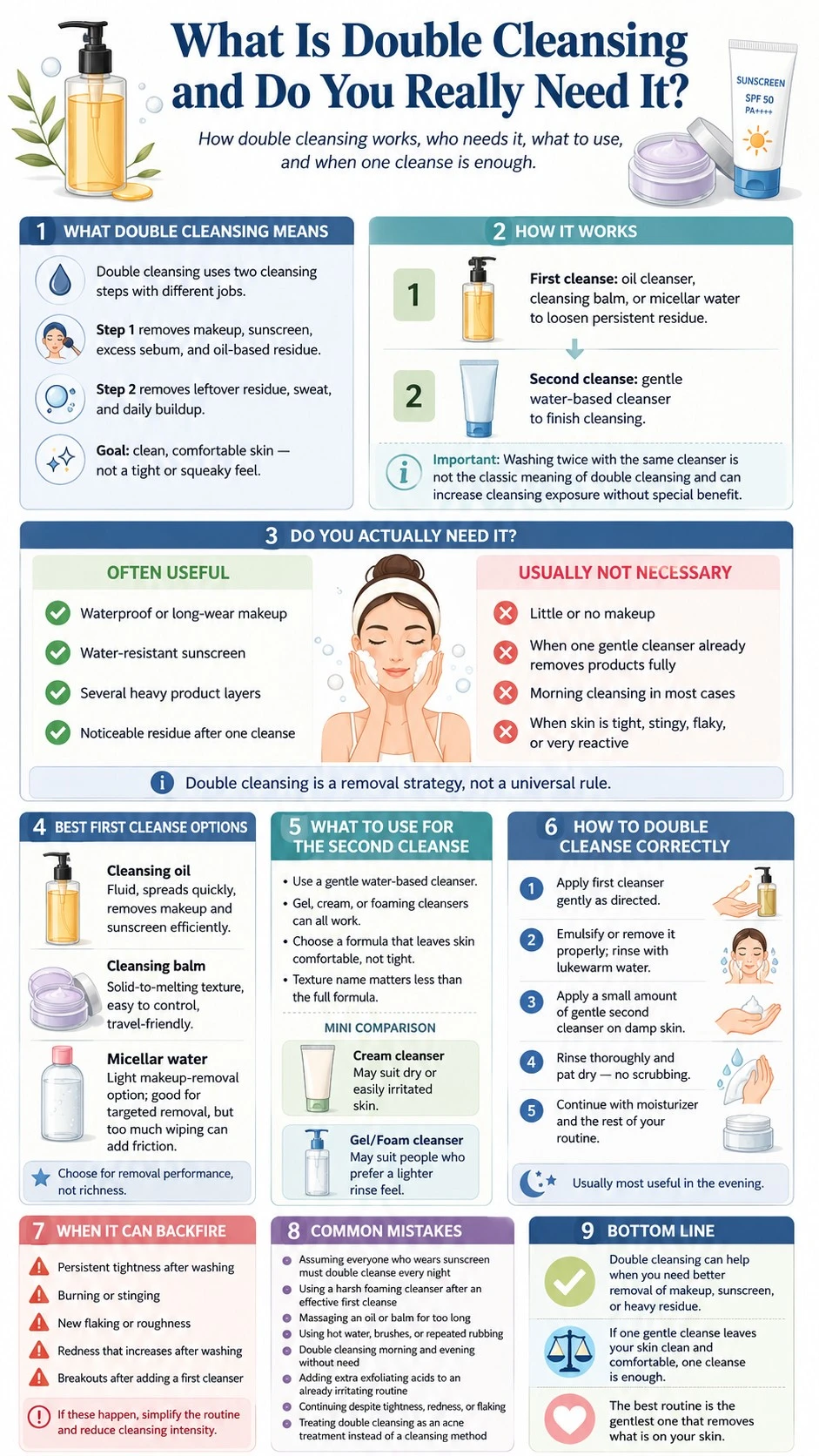
Double cleansing became popular as a way to remove makeup, sunscreen, and daily buildup more thoroughly, but the useful idea is not simply “wash more.” It is to give two different cleansing steps separate jobs while keeping the total routine gentle.
Because “double cleansing” describes a method rather than one fixed product type, the best version depends on what you need to remove and how your skin responds. The goal is clean, comfortable skin—not a squeaky or tight after-feel.
How Does Double Cleansing Work?
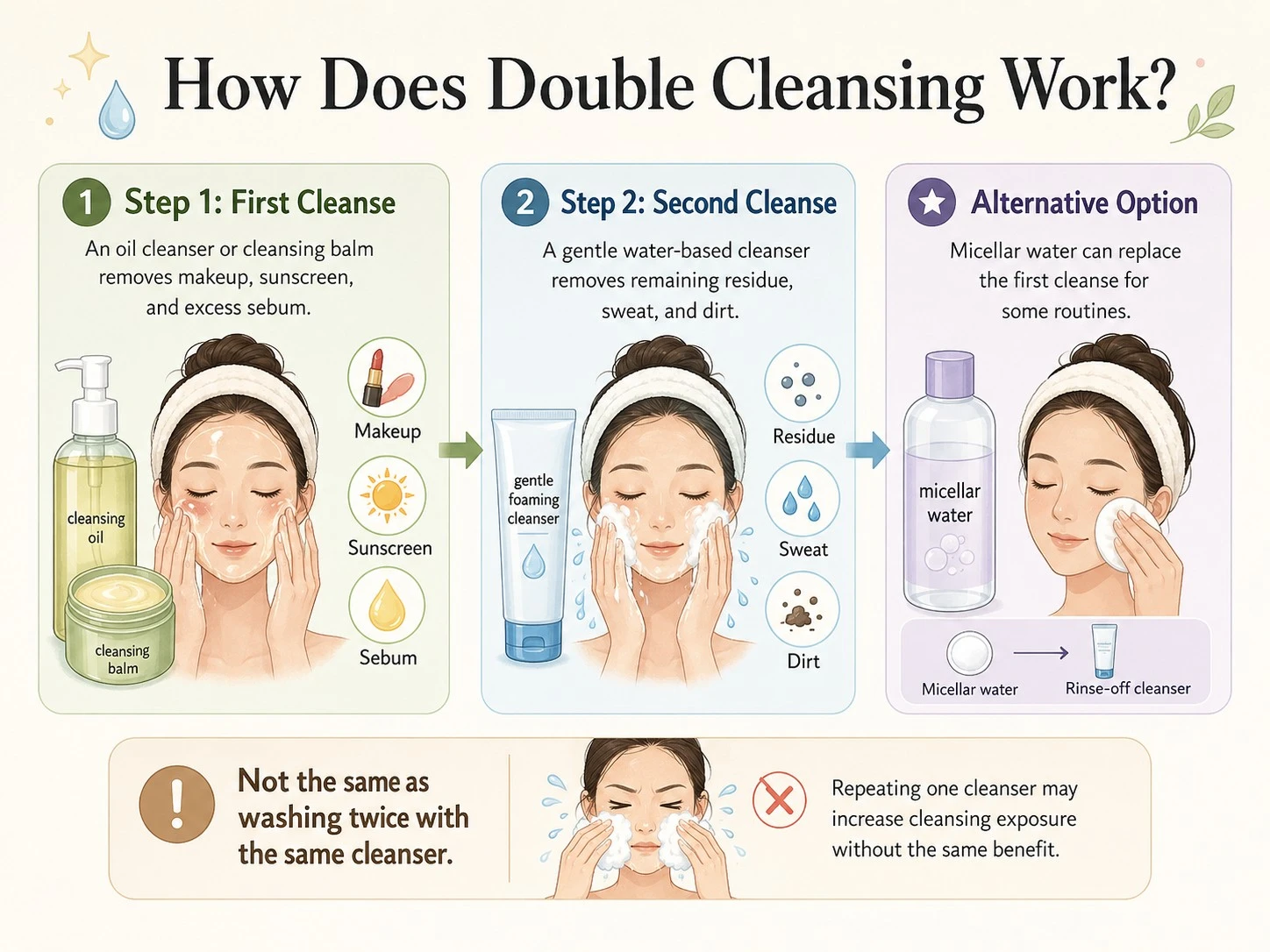
The classic method uses two different cleanser types. An oil-based cleanser, cleansing balm, or similar first step loosens oil-soluble material such as makeup, sunscreen, and excess sebum. A water-based cleanser then removes what remains on the skin, including residue from the first cleanse and everyday sweat or dirt.[1]
Micellar water can serve a similar makeup-removal role before a rinse-off cleanser, especially if you do not want to use an oil or balm.[1] Our Micellar Water vs Cleanser comparison explains how that method differs from a conventional face wash.
Washing twice with the same cleanser is not the usual meaning of double cleansing. It simply repeats the same cleansing step. That can occasionally help if the first wash did not remove enough residue, but repeating a cleanser automatically can also increase cleansing exposure without giving the two-step method any special advantage.
Do You Actually Need to Double Cleanse?
Use the amount and persistence of what you need to remove as the main decision point. Waterproof makeup, long-wear base products, water-resistant sunscreen, or several heavy layers are the clearest situations in which a dedicated removal step can help.[1]
Daily sunscreen use by itself does not automatically require double cleansing. Sunscreen formulas differ in film formation and water resistance. If your usual gentle cleanser removes the product fully and your skin feels clean without tightness, adding another cleanser is unlikely to improve the routine.
The same principle applies when you wear little or no makeup. Double cleansing should solve a removal problem, not become an evening requirement. If your skin is very dry, reactive, or already stinging after washing, use the fewest cleansing steps that reliably remove what is on your face because overwashing can increase dryness and irritation.[1]
A practical check is to look for persistent residue around the hairline, sides of the nose, or areas with long-wear makeup after your normal cleanse. If there is no meaningful residue and the skin is comfortable, one cleanse is usually enough.
What Should You Use for the First Cleanse?
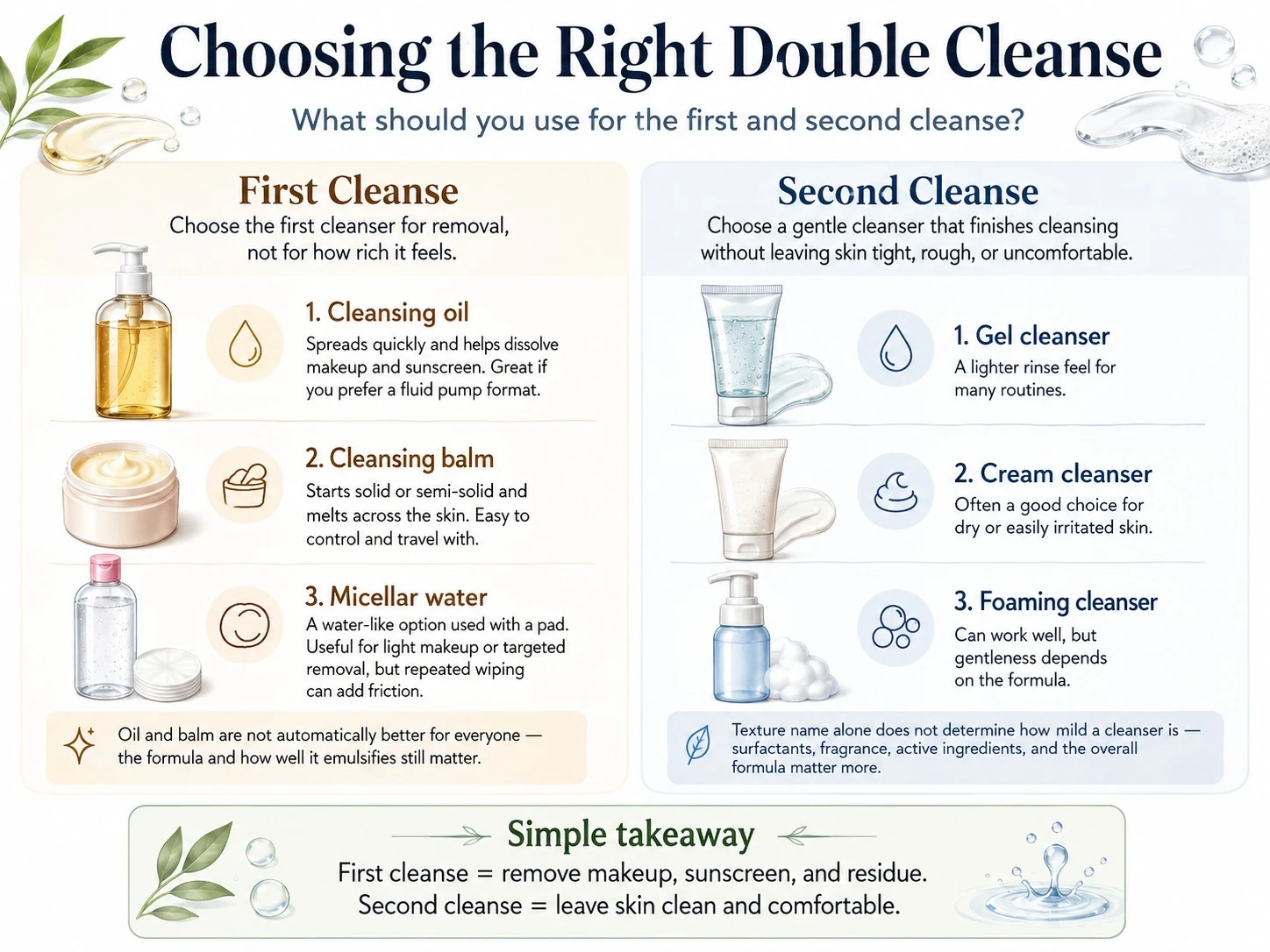
The first cleanser should be chosen for removal, not for how rich or luxurious it feels. Three common options are cleansing oil, cleansing balm, and micellar water.
- Cleansing oil: Spreads quickly and can dissolve makeup and sunscreen efficiently. It is useful if you prefer a fluid pump format.
- Cleansing balm: Starts as a solid or semi-solid product and melts across the skin. It can be easier to control and travel with.
- Micellar water: A water-like makeup-removal option applied with a pad. It can work well for light makeup or targeted removal, but repeated wiping can add friction.
Cleansing oils and balms are not automatically better at removing every product; the finished formula and how well it emulsifies matter. See Cleansing Balm vs Cleansing Oil if you are choosing between those two first-cleanse formats.
What Should You Use for the Second Cleanse?
The second cleanser should finish cleansing without leaving the face tight, rough, or uncomfortable. It does not need to be strong simply because the first step was oil-based.
Gel, cream, and foaming cleansers can all work. A cream cleanser may suit dry or easily irritated skin, while some people prefer a gel or foam for a lighter rinse feel. The texture name alone does not determine how mild the formula is; surfactant system, fragrance, active ingredients, and overall formulation matter more.
If you are choosing a format, compare Gel vs Cream vs Foaming Cleanser. For a broader selection framework based on skin type, concerns, and cleansing strength, use How to Choose a Cleanser.
How to Double Cleanse Correctly

Keep both steps gentle. Dermatology guidance for face washing favors a mild cleanser, lukewarm water, fingertip application, no scrubbing, and gentle drying.[2]
- Use the first cleanser as directed: Apply your cleansing oil, balm, or makeup-removal product according to its instructions and massage gently rather than rubbing for a long time.
- Remove or rinse the first cleanser: Emulsify an oil or balm if the formula requires it, then rinse with lukewarm water. If you use micellar water, avoid repeated aggressive wiping.
- Apply the second cleanser: Use a small amount of a gentle water-based cleanser on damp skin and spread it with your fingertips.
- Rinse and pat dry: Remove cleanser thoroughly with lukewarm water and pat with a soft towel instead of scrubbing.[2]
- Continue with the rest of your routine: Apply moisturizer and any appropriate treatment steps once the skin is clean and comfortable.
Double cleansing is usually most logical in the evening, when you are removing sunscreen, makeup, and the day’s product layers. It is rarely necessary as both a morning and evening two-step routine. For overall washing frequency, see How Often Should You Wash Your Face?.
When Can Double Cleansing Backfire?
The main risk is not that double cleansing is inherently harmful. It is that two cleansing steps can become too much for skin that did not need them, especially when one or both products are harsh.
- Persistent tightness after washing: Your cleansing routine may be removing more surface lipids than your skin tolerates.
- Burning or stinging: Stop treating discomfort as proof that the skin is “extra clean.”
- New flaking or roughness: Reduce cleansing intensity and review other drying products in the routine.
- Redness that increases after washing: Shorten the routine and avoid hot water or rubbing.
- Breakouts after adding a first cleanser: Stop or change that product rather than assuming the two-step method must be continued.
Overwashing can contribute to dryness, irritation, and skin-barrier disruption.[1] If your face has become reactive to basic products, simplify first and review the signs in our Skin Barrier guide.
Common Double Cleansing Mistakes
- Assuming everyone who wears sunscreen must double cleanse every night.
- Using a harsh foaming cleanser after a perfectly effective first cleanse.
- Massaging an oil or balm for several minutes when a shorter application already removes the product.
- Using hot water, washcloths, brushes, or repeated rubbing to make the skin feel cleaner.
- Double cleansing in the morning and evening without a specific need.
- Adding exfoliating acids to the second cleanser when the rest of the routine is already irritating.
- Continuing despite tightness, burning, redness, or flaking.
- Treating double cleansing as an acne treatment instead of a cleansing method.
Final Thoughts
Double cleansing is a practical two-step removal method, not an essential skincare rule. It makes the most sense when waterproof makeup, water-resistant sunscreen, or heavy product layers are difficult to remove with one gentle cleanser.
If a single cleanser already leaves your face clean and comfortable, keep the routine simple. If you do need two steps, make the first one good at removing persistent residue and the second one mild enough to finish cleansing without leaving the skin tight or irritated.
FAQs About Double Cleansing
Is double cleansing good for acne-prone skin?
It can be useful when acne-prone skin also needs to remove makeup, sunscreen, or heavy product residue, but double cleansing is not an acne treatment. Keep both cleansers gentle and stop or change a product if the routine repeatedly causes irritation or seems to coincide with more breakouts.
Do you need to double cleanse mineral sunscreen?
Not automatically. Whether a sunscreen needs two cleansing steps depends more on the finished formula, water resistance, film formation, and how heavily you applied it than on whether its UV filters are mineral or organic. If one gentle cleanser removes it fully, a second cleanse is unnecessary.
Should you double cleanse after exercise?
Usually not unless you are also removing makeup, water-resistant sunscreen, or another persistent product layer. After heavy sweating, a single gentle cleanse is generally enough; dermatology guidance recommends washing after sweating without turning cleansing into repeated scrubbing.[2]
Can you double cleanse with the same cleanser twice?
You can wash twice with the same cleanser, but that is not the classic double-cleansing method, which uses two complementary cleanser types. Repeating the same cleanser is only useful if one wash genuinely did not remove enough residue.
Can double cleansing cause more breakouts?
It can make the skin more irritated if the routine is too aggressive or if one cleanser does not suit you. If breakouts or irritation start after adding a cleansing oil, balm, or second cleanser, stop the new step and reassess rather than assuming double cleansing must be continued.
How long should each step of double cleansing take?
There is no universal number of seconds. Follow the product directions and use enough time to spread and remove the product without prolonged rubbing. Longer massage time is not automatically more effective and can add unnecessary friction.
Sources
[1] Cleveland Clinic. Double Cleansing Method Explained: Should You Try It?
[2] American Academy of Dermatology. Face Washing 101


