


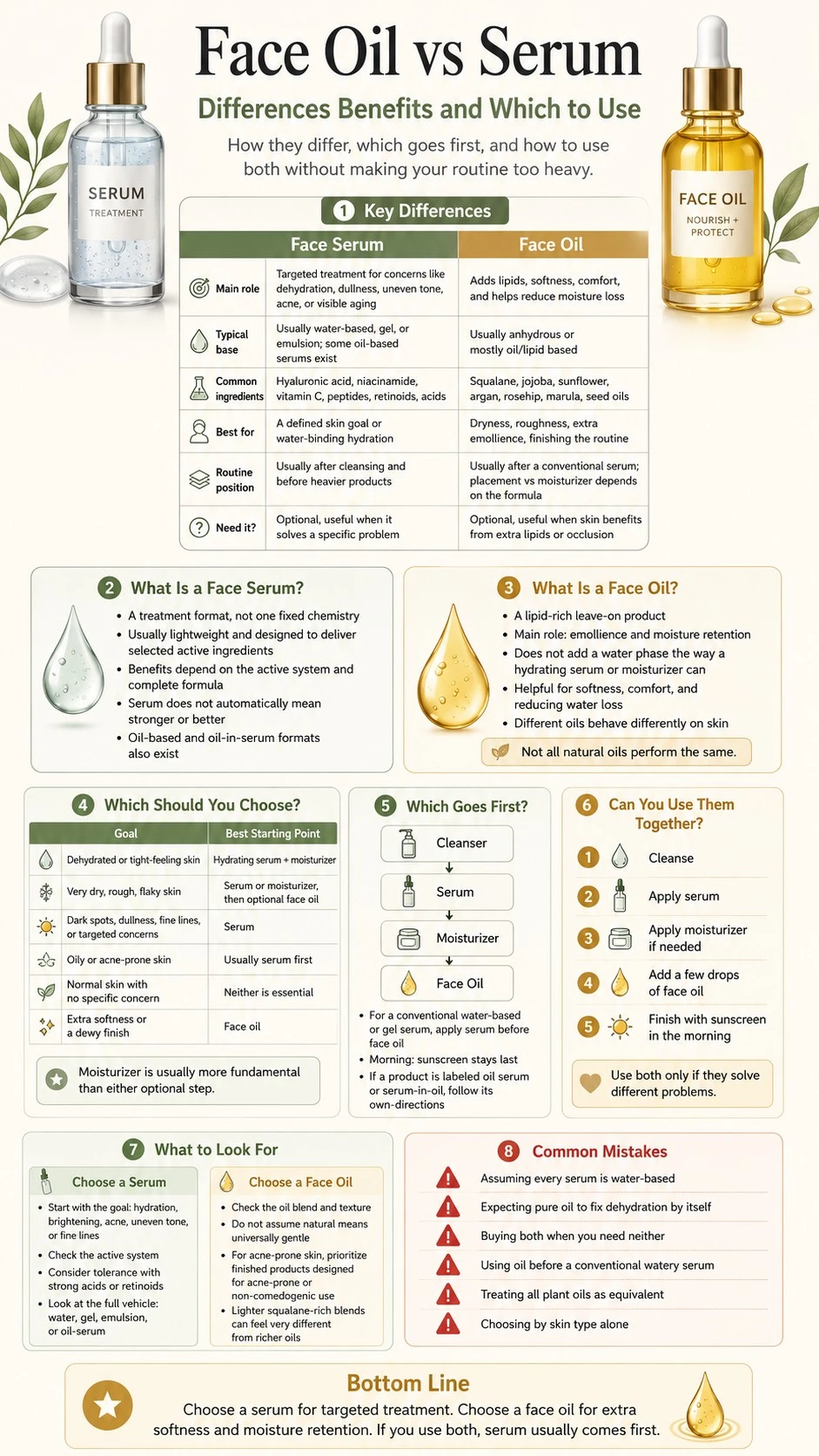
Face oils and serums can look almost identical in a dropper bottle, but they are not interchangeable categories. A serum is usually designed as a concentrated treatment step for a specific goal, while a face oil is a lipid-rich product used mainly for emollience, comfort, and reducing moisture loss. The useful distinction is the finished formula and its job—not the common oversimplification that “serums have small molecules and oils have large molecules.”
Most conventional serums are water-based or emulsion-based, but the word serum does not guarantee a water-only formula. Oil-based and oil-in-serum systems also exist.[5] That is why the ingredient list, texture, product directions, and your skin goal matter more than the label alone.
Face Oil vs Serum: Key Differences
For most products, the comparison below is the fastest way to understand where each category fits.
| Point | Face Serum | Face Oil |
|---|---|---|
| Main role | Delivers targeted ingredients for concerns such as dehydration, dullness, uneven tone, acne, or visible signs of aging | Softens skin, supplies lipids, improves comfort, and can help reduce water loss from the skin surface[1] |
| Typical base | Often water-based, gel-like, or emulsified, but oil-based serums also exist[5] | Usually anhydrous or predominantly oil/lipid based |
| Common ingredients | Hyaluronic acid, niacinamide, vitamin C, peptides, retinoids, acids, botanical extracts | Squalane, jojoba, sunflower, argan, rosehip, marula, seed oils, oil-soluble antioxidants |
| Best for | Targeting a defined skin concern or adding water-binding hydration | Dryness, roughness, lipid comfort, or finishing a routine with extra emollience |
| Routine position | Usually after cleansing and before heavier products | Usually after a conventional water-based serum; placement relative to moisturizer can depend on the formula and directions[2] |
| Do you need it? | Optional; useful when it solves a specific problem | Optional; most useful when your skin benefits from extra lipids or occlusion |
What Is a Face Serum?
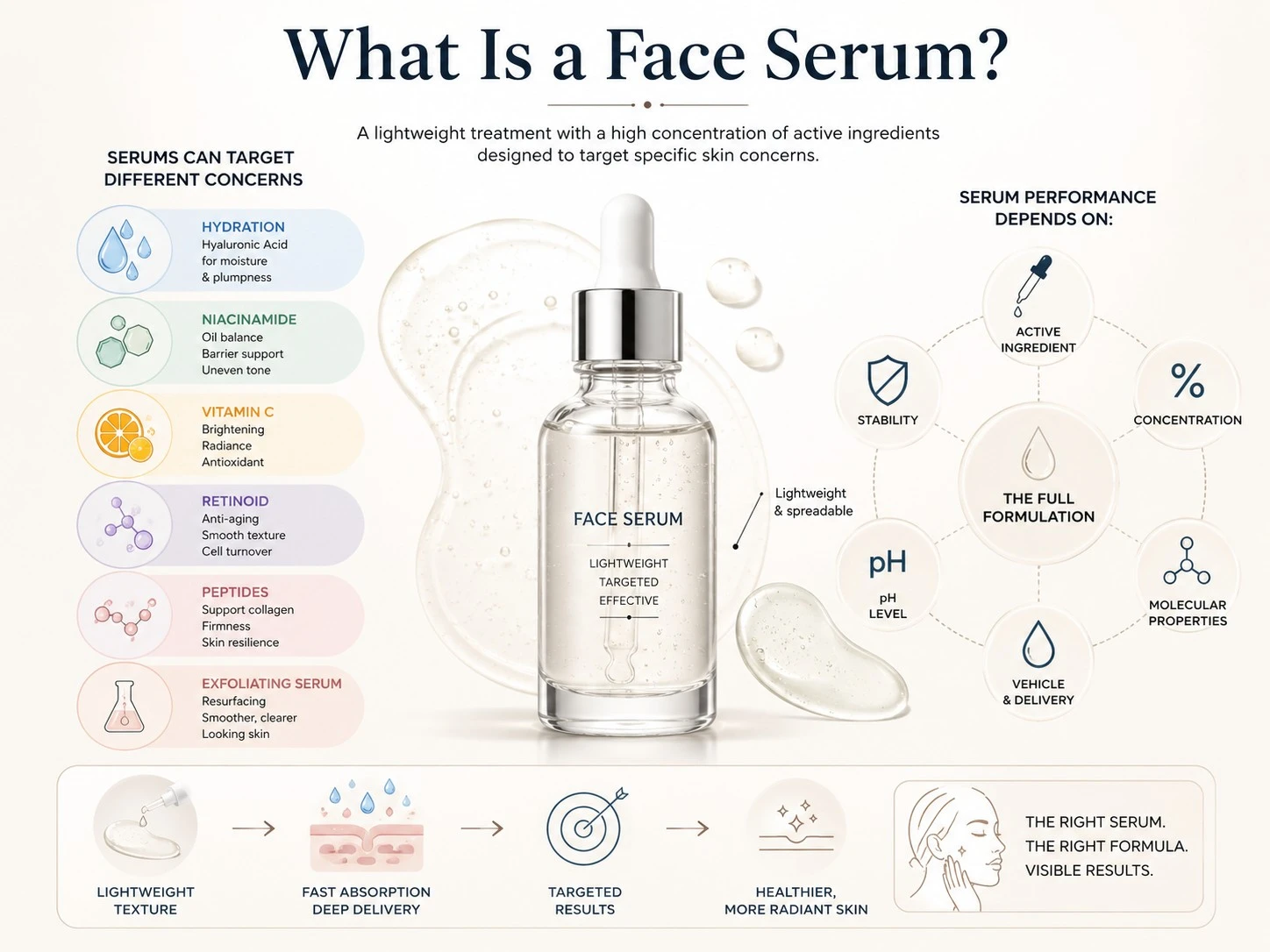
A face serum is best understood as a treatment format rather than one fixed type of chemistry. Most serums are lightweight and are formulated to place selected active ingredients into a thin, spreadable vehicle. The benefit therefore depends on what is actually in the serum.
A hyaluronic acid serum may focus on water-binding hydration. A niacinamide serum may target oil balance, barrier support, or uneven tone. Vitamin C, retinoid, peptide, and exfoliating serums each have different jobs.
This is why “serum” does not automatically mean stronger, deeper-penetrating, or better than another product. Penetration and performance depend on the active ingredient, concentration, molecular properties, vehicle, pH, stability, and the complete formulation. Oil-in-serum systems have been developed and clinically evaluated, showing that serum and oil are not mutually exclusive formulation categories.[5]
If you are unsure how serum differs from adjacent routine steps, our toner vs essence vs serum guide explains the practical differences.
What Is a Face Oil?
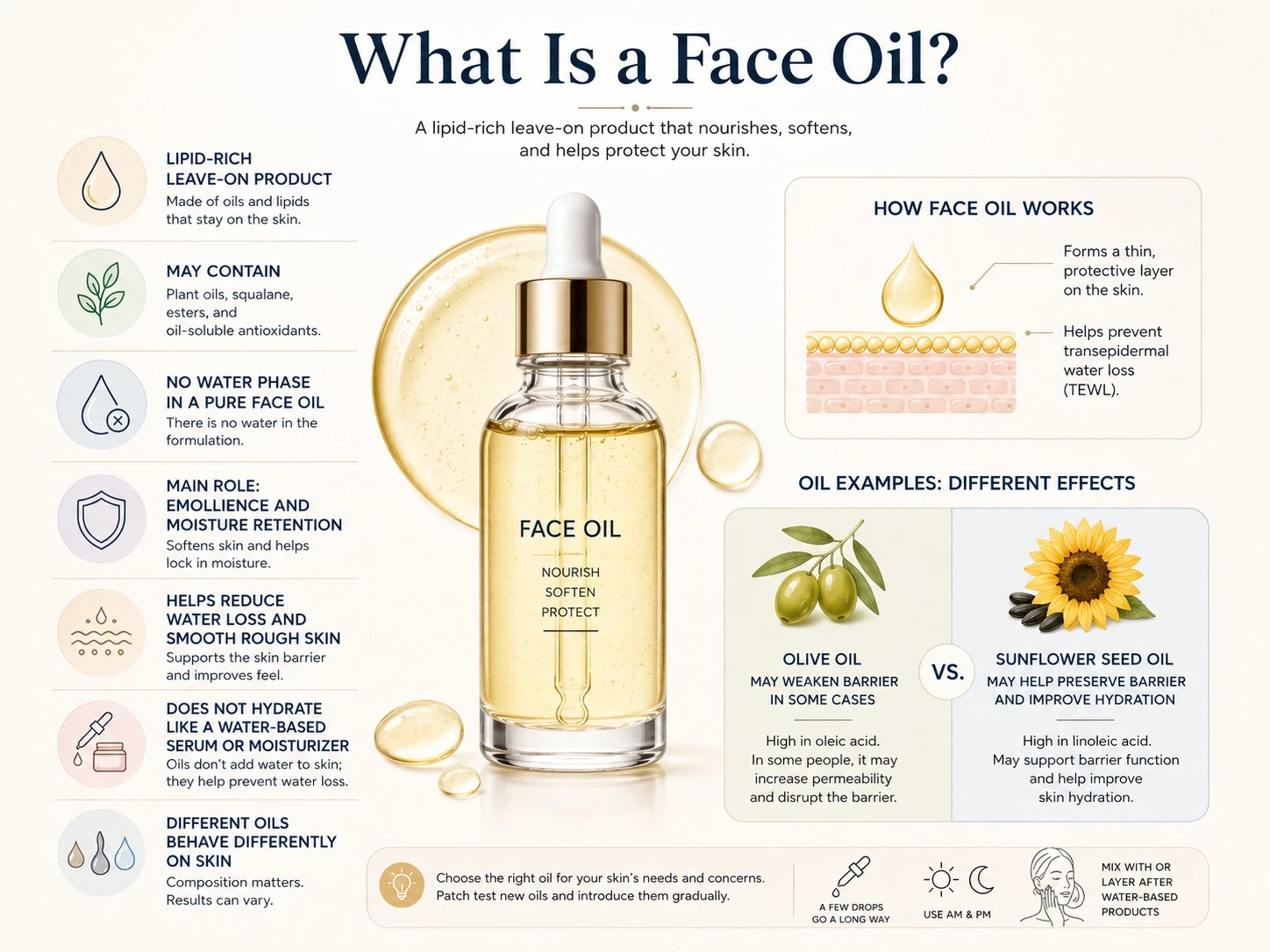
A face oil is a lipid-rich leave-on product. It may contain one oil, a blend of plant oils, squalane, esters, oil-soluble antioxidants, or other lipid-soluble ingredients. Unlike a typical water-based serum, a pure face oil does not contain a water phase.
Its main value is usually emollience and moisture retention. Oils can make rough skin feel smoother and can reduce evaporation of water from the skin surface.[1] That does not mean a pure oil “hydrates” in the same way as a water-containing product with humectants. If your skin is dehydrated, an oil may help retain water, but it does not supply the water phase that a hydrating serum or moisturizer can provide.
The specific oil also matters. “Natural oil” is not one uniform category. In a small controlled adult study, repeated olive-oil application reduced stratum corneum integrity and caused mild erythema, while sunflower seed oil preserved barrier integrity and improved hydration.[4] The practical lesson is not that one oil is universally good or bad; it is that botanical origin alone does not tell you how an oil will behave on your skin.
For a broader explanation of lipids, moisture loss, and barrier function, see our skin barrier guide.
Which Should You Choose: Face Oil or Serum?
Choose according to the problem you are trying to solve. For many people, a serum is the more useful first purchase because it can target a defined concern. Face oil becomes more valuable when the missing piece is comfort, softness, or extra lipid support.
| Your main goal | Better starting point | Why |
|---|---|---|
| Dehydrated or tight-feeling skin | Hydrating serum + moisturizer | Humectants and a water-containing moisturizer address hydration more directly; oil can be added if extra sealing or comfort is needed |
| Very dry, rough, flaky skin | Serum or moisturizer, then optional face oil | The oil can add emollience and reduce moisture loss, especially when the routine already contains water and humectants[1] |
| Dark spots, dullness, fine lines, or a targeted concern | Serum | A serum lets you choose an active system designed for the specific concern |
| Oily or acne-prone skin | Usually serum first | Lightweight products are often easier to fit into an acne routine; prioritize products labeled oil-free, non-comedogenic, or “won’t clog pores” when relevant[3] |
| Normal skin with no specific concern | Neither is essential | A basic cleanser, moisturizer, and sunscreen routine may already cover your needs |
| You want extra softness or a dewy finish | Face oil | A few drops can add slip, sheen, and an emollient finish without requiring another treatment serum |
If you are deciding between a treatment step and basic moisturizing, compare this guide with our serum vs moisturizer article. A serum and face oil are both optional; moisturizer is usually the more fundamental barrier-support step.
Which Goes First: Face Oil or Serum?
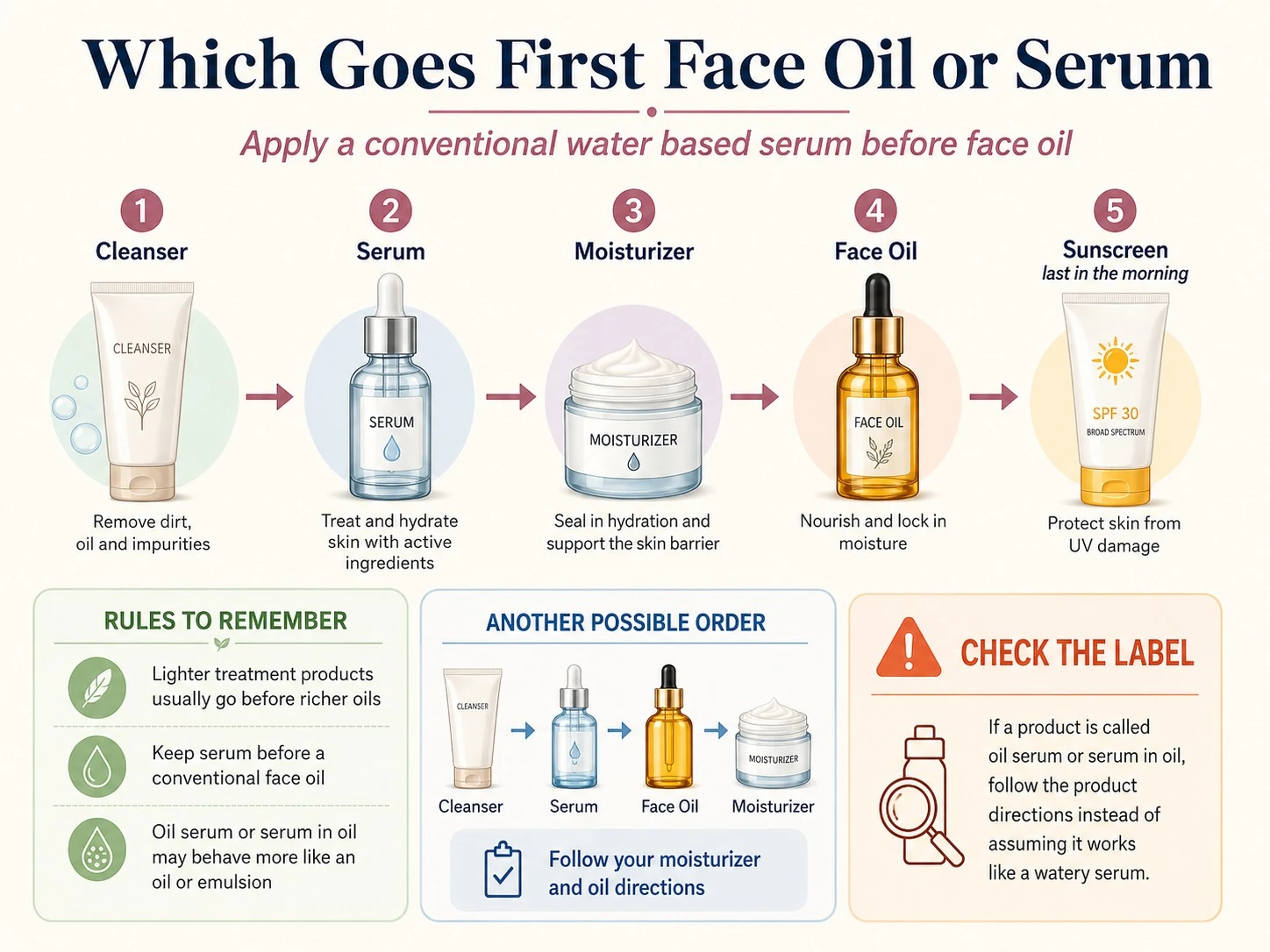
For a conventional water-based or gel serum, apply the serum before the face oil. Lighter treatment products are generally placed before more lipid-rich or occlusive products.[2]
A simple routine can look like this:
- Cleanser → serum → moisturizer → face oil is a common sequence when the oil is used as the final emollient layer.
- Cleanser → serum → face oil → moisturizer can also be appropriate when the product directions place the oil before cream; this order is also used in some routines.[2]
- Sunscreen stays last in the morning.
The important rule is more reliable than memorizing one universal sequence: keep the serum before a conventional face oil, then follow the moisturizer and oil directions for the specific formulas you own. Texture, emulsifier system, oil content, and intended use can make rigid “thinnest to thickest” rules imperfect.
If your product is labeled an “oil serum,” “serum-in-oil,” or “oil-in-serum,” do not assume the word serum means it belongs with watery serums. Check the ingredient list and manufacturer directions. The product may function much closer to an oil or emulsion.[5]
For the rest of your routine, use our complete skincare routine order.
Can You Use Face Oil and Serum Together?
Yes. They can complement each other when they solve different problems. The serum can supply targeted or water-soluble ingredients, while the oil can add lipids and help reduce moisture loss.
- Cleanse your skin. Use a gentle cleanser suited to your skin type.
- Apply the serum. Use the amount recommended for that formula and let it spread evenly.
- Apply moisturizer if your routine needs one. This is especially useful when dehydration or barrier dryness is part of the problem.
- Add a small amount of face oil. Start with a few drops rather than coating the skin heavily.
- Finish with sunscreen in the morning. Do not use face oil as a substitute for UV protection.
You do not need both simply because both categories exist. If a serum plus moisturizer leaves your skin comfortable, adding an oil may only make the routine heavier. If your skin still feels rough or tight, an oil can be a useful optional finishing step.
What Should You Look for in a Serum or Face Oil?

The front-of-pack category is only the first clue. The finished formula matters more.
For a Serum
- Start with the goal: hydration, brightening, acne support, uneven tone, fine lines, or another defined concern.
- Check the active system: choose ingredients with a purpose rather than buying the product because “serum” sounds concentrated.
- Consider tolerance: strong acids, retinoids, or multiple actives can irritate even when the texture feels lightweight.
- Look at the whole vehicle: water-based, emulsion, gel, oil-serum, and anhydrous formulas can behave differently.
For a Face Oil
- Check the oil blend: different plant oils have different fatty-acid profiles, sensory properties, oxidation stability, and effects on the skin barrier.[4]
- Avoid assuming “natural” means universally gentle: botanical oils and fragranced essential oils can still irritate some skin.[1]
- For acne-prone skin: prioritize a finished product designed and labeled for acne-prone or non-comedogenic use rather than relying on internet “comedogenic ratings” for one ingredient.[3]
- Watch the finish: a lighter squalane- or ester-rich blend may feel very different from a richer triglyceride-heavy oil.
If your main problem is choosing the right moisturizing texture, our guide to choosing a moisturizer for your skin type may be more useful than adding another optional step.
Common Face Oil vs Serum Mistakes
- Assuming every serum is water-based: serum is a flexible product category, and oil-based or oil-in-serum formats exist.[5]
- Expecting pure oil to fix dehydration by itself: oil can reduce water loss, but it does not provide the same water-and-humectant system as a hydrating serum or moisturizer.
- Buying both when you need neither: a longer routine is not automatically a better routine.
- Using oil before a conventional watery serum: apply the lighter treatment first unless the product directions clearly tell you otherwise.[2]
- Treating all plant oils as equivalent: different oils can affect the skin barrier differently.[4]
- Choosing by skin type alone: the same person may need a serum for one concern and an oil only during dry weather or when the barrier feels depleted.
Final Thoughts
Face oil and serum are not competing versions of the same product. A serum is usually the more versatile choice for targeted treatment or water-binding hydration, while a face oil is mainly useful for lipids, softness, comfort, and reducing moisture loss.
The most important distinction is also the one that many simple comparisons miss: “serum” describes a flexible treatment format, while “face oil” more directly describes the lipid-rich nature of the formula. Some serums are themselves oil-based, so the ingredient list and vehicle can matter more than the product name.[5]
If you only want one additional step, choose the product that fills a real gap in your routine. Targeted concern or dehydration usually points toward a serum. Persistent roughness or a need for extra emollience may justify a face oil. If your cleanser, moisturizer, treatment, and sunscreen already keep your skin comfortable, you may not need either.
FAQs About Face Oil vs Serum
Can Face Oil Replace a Serum?
Sometimes, but only if you do not need the serum’s specific function. A face oil can provide emollience and moisture retention, but it will not automatically replace a hydrating, brightening, acne-focused, antioxidant, or retinoid serum.
Can I Mix Face Oil Into My Serum?
It is usually simpler to layer them separately. Mixing products in your hand changes how each formula spreads and can make dosing less predictable. Apply a conventional serum first, then add the oil if needed.
Can Face Oil Replace Moisturizer?
A pure face oil can soften skin and reduce water loss, but it lacks the water phase and humectants found in many moisturizers. Very dry skin may enjoy oil as an extra step, while dehydrated skin often benefits more from a water-containing moisturizer or hydrating serum first.
Is Squalane a Face Oil?
Squalane is an oil-soluble emollient rather than a plant triglyceride oil, but it is commonly sold alone or blended into products marketed as face oils. In a routine, it usually behaves more like an emollient oil step than a conventional water-based serum.
Can Oily Skin Use Face Oil?
It can, but face oil is not necessary for oily skin. If you are acne-prone, a lightweight serum and non-comedogenic moisturizer are usually easier starting points. If you try an oil, use a small amount and choose a finished product intended for acne-prone or non-comedogenic use.[3]
Is an Oil Serum a Serum or a Face Oil?
The name alone cannot tell you. Some products marketed as serums are oil-based, while others use oil-in-serum or serum-in-oil systems.[5] Check the ingredient list, texture, and directions to decide where the product belongs in your routine.
Sources
[1] Cleveland Clinic. Are Face Oils Good for Your Skin?
[2] Cleveland Clinic. How To Order Your Skin Care Routine
[3] American Academy of Dermatology. Moisturizer: Why You May Need It If You Have Acne
[4] Danby SG et al. Effect of Olive and Sunflower Seed Oil on the Adult Skin Barrier: Implications for Neonatal Skin Care
[5] Navarro BJ et al. Development, Stability, and Clinical Efficacy of an Oil-in-Serum Formulation with Olive Extract Standardized in Hydroxytyrosol for Post-Inflammatory Hyperpigmentation Treatment


