



A minimalist skincare routine is not about using the fewest possible products. It is about using the fewest products needed to cover your skin’s essential functions and your actual concerns. That distinction prevents minimalism from turning into either a complicated 10-step routine or an equally unhelpful “do nothing” approach.
For most people, the foundation is straightforward: gentle cleansing, appropriate moisturizing, and daily sun protection. Additional products earn a place only when they solve a defined problem. This makes the routine easier to follow, easier to troubleshoot, and less likely to expose your skin to several irritating ingredients at once.[1]
What Is a Minimalist Skincare Routine?
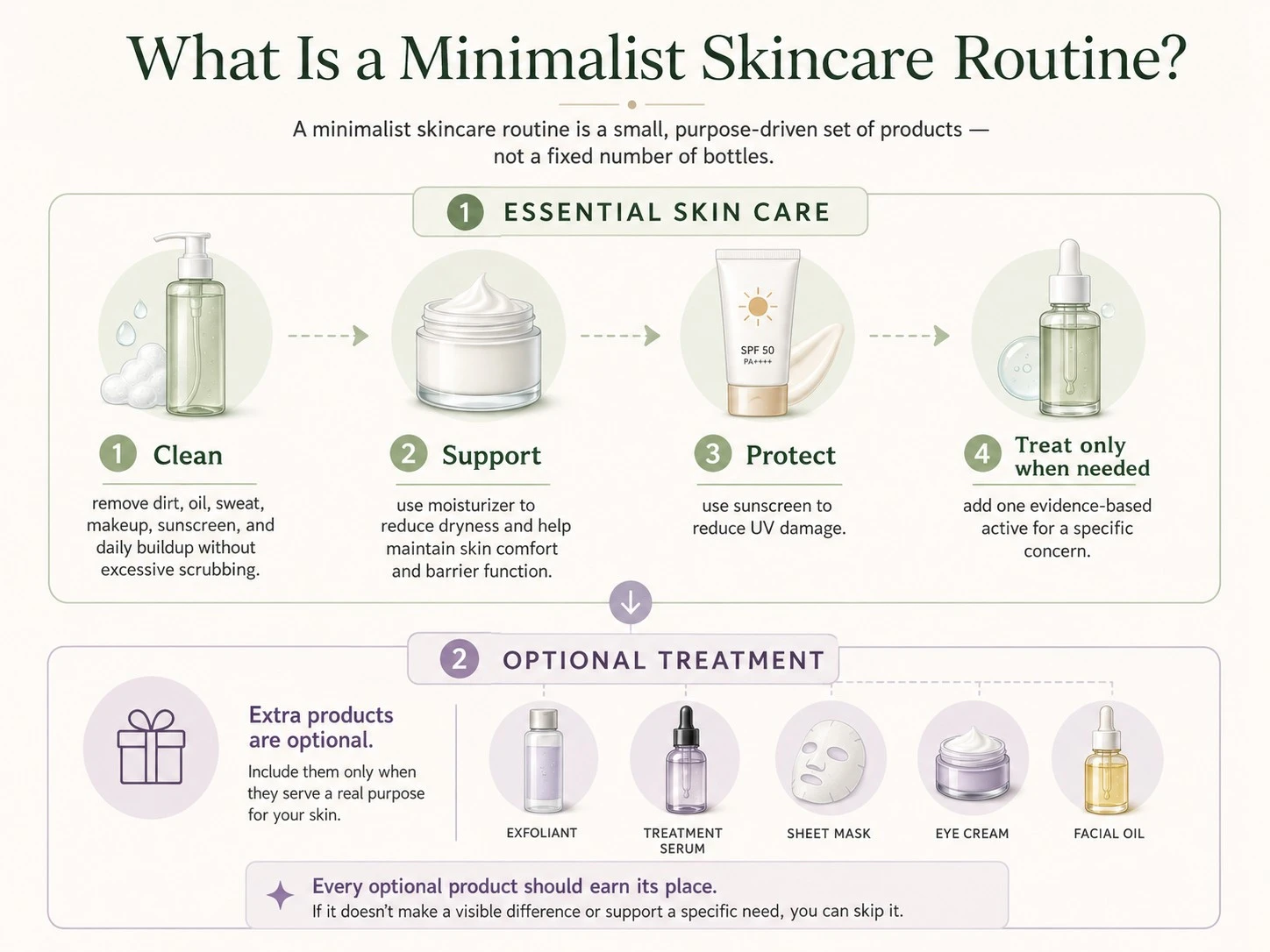
A minimalist skincare routine is a small, purpose-driven set of products rather than a fixed number of bottles. The goal is not “three products no matter what.” It is to separate essential skin care from optional treatment.
A useful way to think about the routine is:
- Clean: remove dirt, oil, sweat, makeup, sunscreen, and daily buildup without excessive scrubbing.
- Support: use moisturizer to reduce dryness and help maintain skin comfort and barrier function.
- Protect: use sunscreen to reduce UV damage.
- Treat only when needed: add one evidence-based active for a specific concern.
This foundation is very close to the approach used in our Skincare 101 guide, but minimalist skincare goes one step further by asking whether every optional product actually earns its place.
The Minimum Effective Skincare Routine
For someone without a condition that requires treatment, three product categories can cover the basic functions of daily facial skin care.[1]
| Product | Main Job | Is It Essential? |
|---|---|---|
| Gentle cleanser | Removes oil, dirt, sweat, makeup, sunscreen, and other surface buildup | Core step, especially in the evening |
| Moisturizer | Supports hydration, softness, and barrier comfort | Core step for most routines; texture can vary by skin type |
| Sunscreen | Protects exposed skin from UVA and UVB radiation | Core daytime step |
| Targeted treatment | Addresses a defined concern such as acne, pigmentation, or visible aging | Optional; add only when needed |
A product does not become essential simply because it is common in skincare marketing. Toners, essences, masks, eye creams, mists, face oils, exfoliants, and multiple serums can all be useful in the right situation, but none is automatically required for everyone.
Simple Morning Skincare Routine
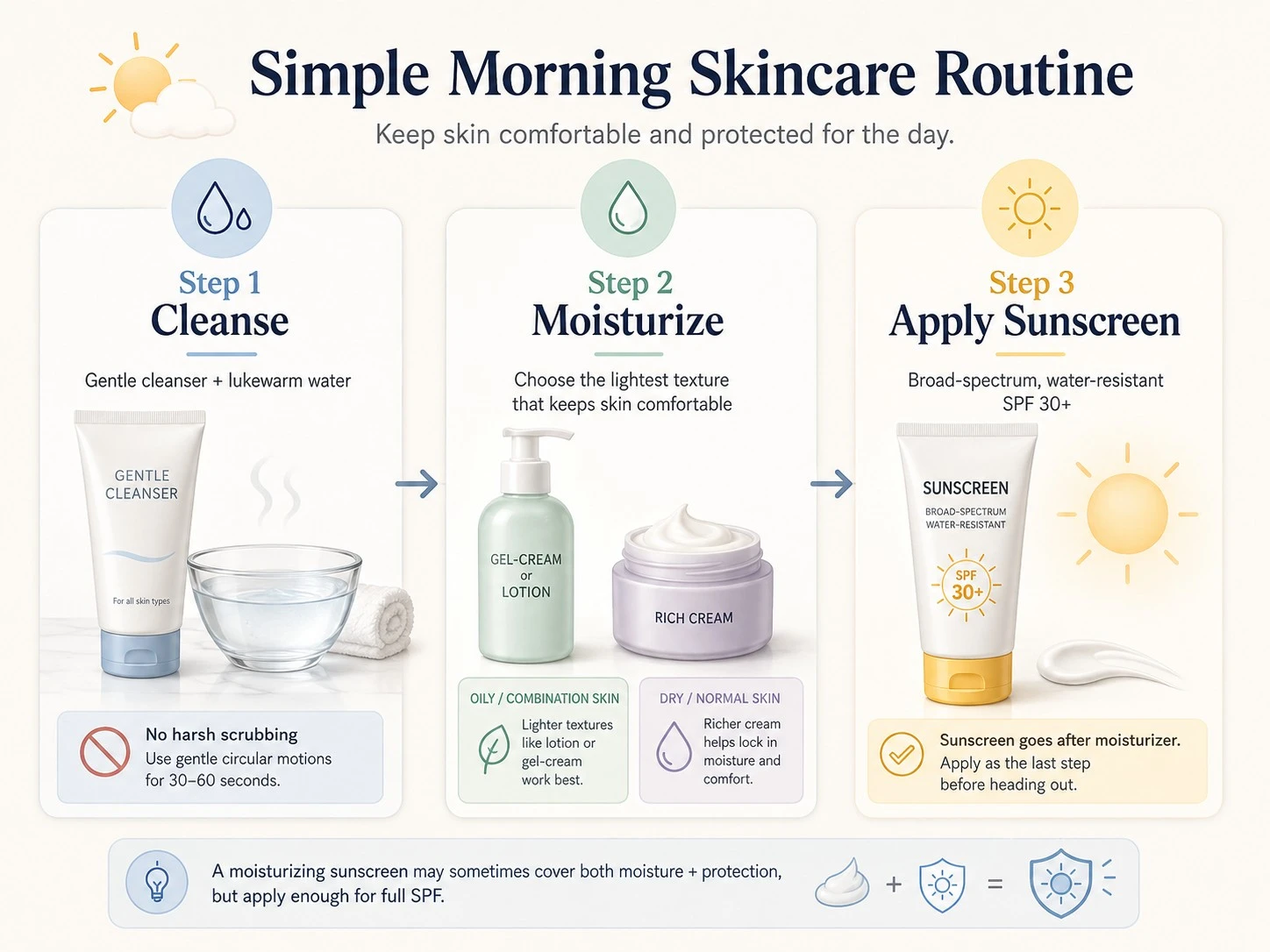
Your morning routine has one overriding goal: leave the skin comfortable and protected for the day.
Step 1: Cleanse
Use a gentle, non-abrasive cleanser and lukewarm water. Scrubbing, abrasive tools, and unnecessarily harsh cleansing can irritate the skin. Face washing is generally limited to no more than twice daily and after heavy sweating.[2]
If choosing a cleanser is the difficult part, start with How to Choose a Cleanser for Your Skin Type & Concerns.
Step 2: Moisturize
Choose the lightest texture that keeps your skin comfortable. Oily skin may prefer a light lotion or gel-cream, while dry skin may need a richer cream. Moisturizer can still be useful when skin produces plenty of oil; oiliness and adequate skin hydration are not the same thing.[1]
If you are unsure about texture, see our guide to choosing a moisturizer for your skin type.
Step 3: Apply Sunscreen
Finish the morning routine with a broad-spectrum, water-resistant sunscreen with SPF 30 or higher on exposed skin.[3] Sunscreen belongs after moisturizer and should not be removed from a minimalist routine simply to reduce the product count.
If your sunscreen is moisturizing enough for your skin, one well-formulated product may sometimes cover both the moisturizing and sun-protection roles. The important point is that it still provides adequate sunscreen protection and that you apply enough of it.
Simple Night Skincare Routine
The evening routine removes the day’s buildup and gives you the best place to add a targeted treatment if you need one.
- Cleanse. Remove makeup, sunscreen, sweat, and surface debris. If one cleanser removes everything comfortably, there is no reason to add a second cleansing step merely because double cleansing is popular.
- Apply one targeted treatment if needed. This might be a retinoid, acne treatment, pigment-focused active, or another product chosen for one clear goal.
- Moisturize. Finish with a moisturizer that leaves your skin comfortable rather than tight, greasy, or irritated.
The full logic behind product sequencing is covered in our skincare routine order guide.
When Should You Add a Treatment?
A minimalist routine becomes much easier when you use a simple rule: one concern should justify one treatment decision. Do not add an active merely because it is trending or because another routine contains it.
| Main Concern | Possible Treatment Direction | Minimalist Approach |
|---|---|---|
| Acne or clogged pores | Salicylic acid, benzoyl peroxide, adapalene, azelaic acid, or another appropriate acne treatment | Choose one logical starting treatment rather than layering several acne actives immediately |
| Uneven tone or dark spots | Vitamin C, niacinamide, azelaic acid, retinoid, or another pigment-focused formula | Choose based on the type of pigmentation and your tolerance rather than adding every brightening ingredient |
| Fine lines and photoaging | Retinoid plus consistent sun protection | Build tolerance gradually instead of combining retinoid, multiple acids, and several anti-aging serums at once |
| Dehydration | Hydrating serum if moisturizer alone is not enough | Add it only if it noticeably improves comfort or hydration |
| No specific problem | No treatment required | Stay with cleanser, moisturizer, and sunscreen |
If you need help understanding which ingredients have a real job in your routine, use our skincare active ingredients guide rather than choosing products by trend.
How to Build Your Routine Without Buying Everything at Once
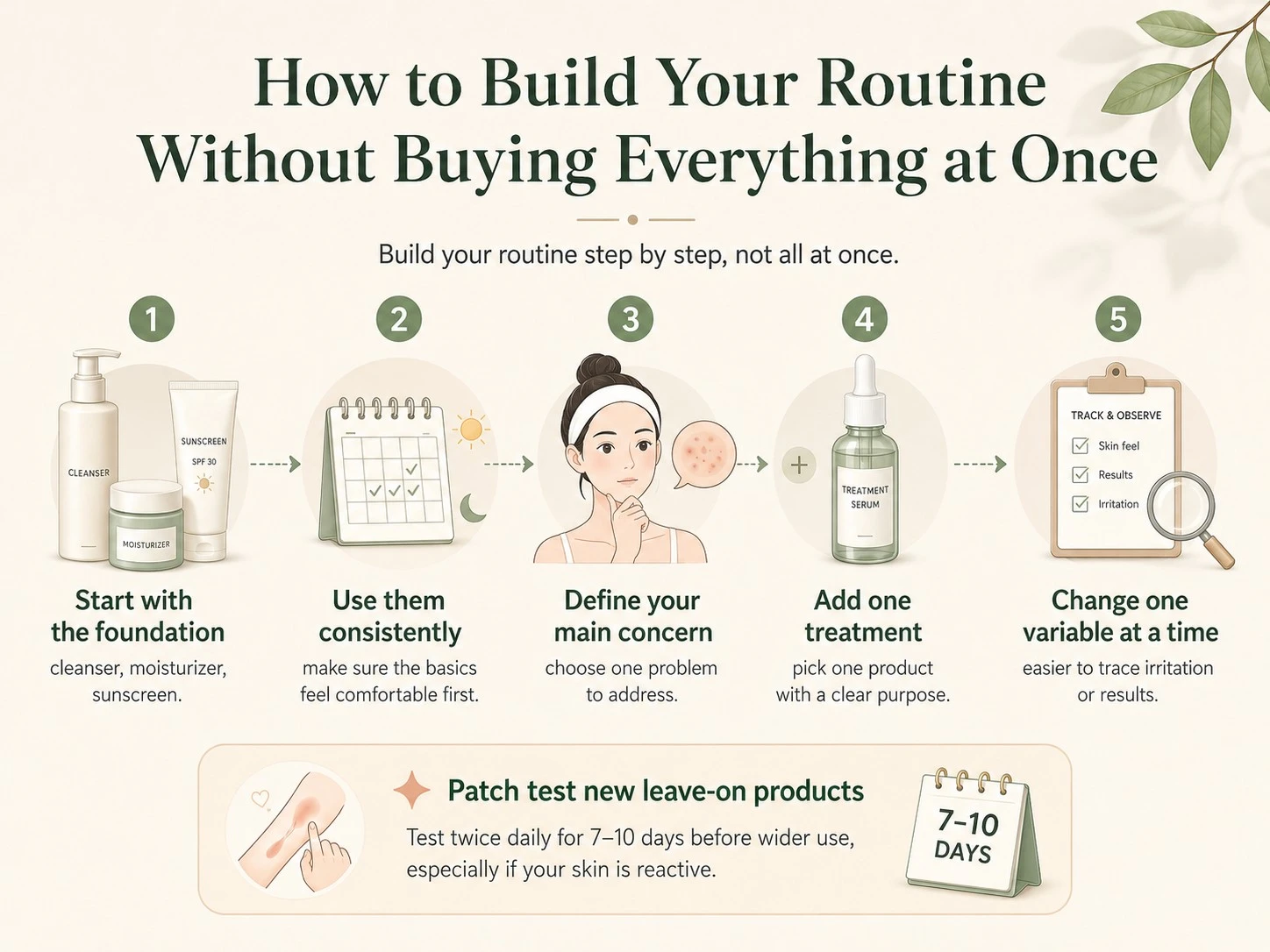
The most useful form of skincare minimalism is not just having fewer bottles. It is making fewer variables change at the same time.
- Start with the foundation. Choose a cleanser, moisturizer, and sunscreen.
- Use them consistently. Make sure the basic routine is comfortable before adding treatment products.
- Define your main concern. Pick the one problem you most want the routine to address.
- Add one treatment. Choose a product with a clear purpose instead of several overlapping actives.
- Change one variable at a time. This makes irritation, breakouts, or improvements much easier to trace.
Before introducing a new leave-on product, especially if you have reactive skin, you can test it on a small area first. A home test can be performed twice daily for seven to 10 days before wider use.[4] Our patch testing guide explains the process in more detail.
How to Adjust a Minimalist Routine for Your Skin
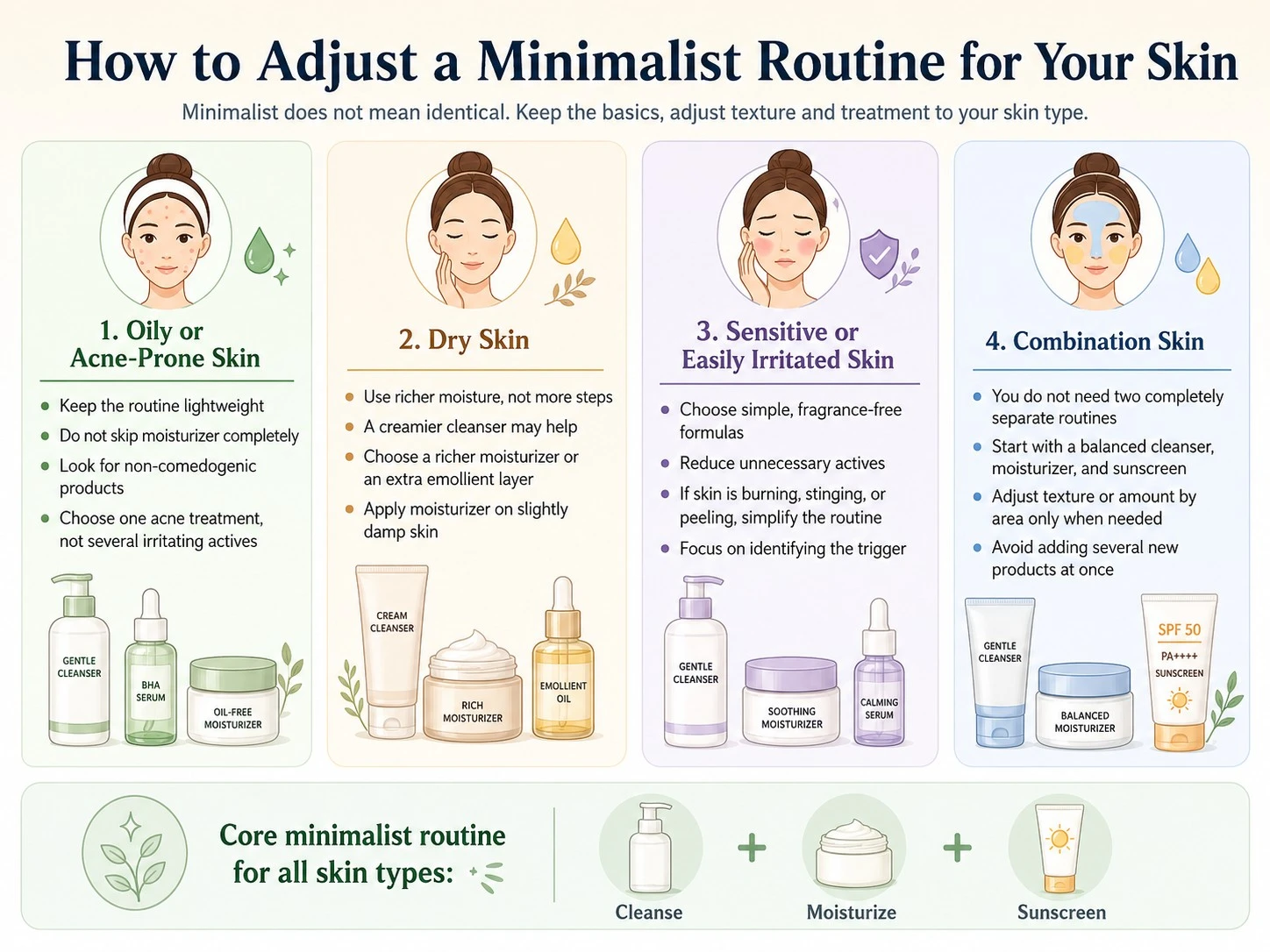
Minimalist does not mean identical. The basic functions stay similar, while textures and treatment choices change.
Oily or Acne-Prone Skin
Keep the foundation lightweight rather than removing moisturizer completely. Look for products labeled non-comedogenic or unlikely to clog pores when appropriate, and choose one acne treatment rather than combining several irritating products immediately.[1]
For a concern-specific version, see our skincare routine for acne-prone skin.
Dry Skin
The minimalist adjustment is usually richer moisturizing, not more treatment steps. A creamier cleanser, richer moisturizer, or an additional emollient layer may be more useful than adding multiple serums. Apply moisturizer while the skin is still slightly damp to help retain water.[1]
Sensitive or Easily Irritated Skin
Prioritize simple, fragrance-free products and reduce unnecessary actives. If your skin is already burning, stinging, peeling, or reacting to multiple products, adding another “soothing” active may be less useful than simplifying the routine and identifying the trigger.
When sensitivity is the main issue, our skincare routine for sensitive skin provides a more conservative framework.
Combination Skin
You do not necessarily need two separate routines. Start with a balanced cleanser, moderate moisturizer, and sunscreen. If one area is much drier or oilier, adjust the amount or texture locally before adding several new products.
What Can You Usually Skip?
Minimalism works best when you judge products by function instead of category. The following steps are optional rather than universally necessary:
- Toner: useful when it delivers a function you want, but cleansing does not automatically need to be followed by toner.
- Essence: can add hydration or treatment ingredients, but may overlap with serum or moisturizer.
- Multiple serums: one targeted serum can be enough if it addresses your main concern.
- Eye cream: useful when the eye-area formula serves a specific purpose, but a suitable facial moisturizer can often provide basic moisturization.
- Face mist: can refresh or add temporary hydration, but it is not a replacement for moisturizer.
- Face oil: useful for additional emollience, especially for dry skin, but not essential for everyone.
- Frequent exfoliation: exfoliation is an optional treatment step, not a requirement for healthy skin.
- Masks: can be enjoyable or useful for a specific short-term goal, but they do not need a permanent place in a basic routine.
Skipping an unnecessary product is different from skipping a needed function. Removing toner may simplify a routine. Removing sunscreen because you want fewer steps removes a core protective function.
Minimalist Skincare Mistakes to Avoid
- Making “minimalist” mean no skin care: simplicity should preserve cleansing, moisturization when needed, and sun protection.
- Keeping five products that all do the same job: several hydrating serums or overlapping exfoliants can create complexity without adding a new function.
- Using multifunctional products without checking whether every function is adequate: a moisturizer with SPF can simplify the routine only if you apply enough to obtain the labeled sun protection.
- Adding several actives on the same day: if irritation develops, you will not know which product caused it.
- Changing products too quickly: constant switching makes it difficult to judge tolerance or results.
- Ignoring persistent skin disease: minimal cosmetic skin care is not a substitute for appropriate treatment of significant acne, eczema, rosacea, dermatitis, infection, or another medical condition.
How Do You Know Your Routine Is Minimal Enough?
Do not judge the routine by the number of products alone. Ask four questions:
- Does every product have a different, useful job?
- Would removing one product leave an important need uncovered?
- Can you follow the routine consistently without irritation or unnecessary cost?
- Can you identify which product is responsible if your skin improves or reacts?
If the answer is yes, a four- or five-product routine may already be genuinely minimalist. If you use nine products but cannot explain why three of them are there, the routine probably has room to simplify.
Final Thoughts
A useful minimalist skincare routine is built around functions, not product counts. Cleanse without stripping the skin, moisturize enough to maintain comfort, protect exposed skin from UV, and add one targeted treatment only when a real concern justifies it.
The strongest minimalist rule is simple: foundation first, treatment second, extras last. Once your cleanser, moisturizer, and sunscreen work reliably, every additional product should have to answer one question: “What does this add that my current routine does not already do?”
If the answer is unclear, you probably do not need it.
FAQs About a Minimalist Skincare Routine
Is a Three-Step Skincare Routine Enough?
For many people without a specific condition requiring treatment, cleansing, moisturizing, and daily sun protection can provide a strong basic routine.[1] Add a treatment only when you have a defined concern that the foundation does not address.
Do I Need a Serum in a Minimalist Routine?
No. A serum is optional. Use one when it delivers an ingredient or function that your cleanser, moisturizer, and sunscreen do not already provide. You do not need a serum merely because serum is considered a standard skincare category.
Do I Need Toner Before Moisturizer?
No. Toner is not a mandatory bridge between cleansing and moisturizing. It can be useful when its formula provides hydration, exfoliation, soothing, or another function you specifically want.
Can I Use Only Moisturizer and Sunscreen in the Morning?
A very short morning routine can work when your skin does not need another treatment step. Sunscreen should remain the final morning layer, and cleansing needs can be adjusted according to your skin, product use, and professional guidance.[3][5]
How Many Actives Should a Minimalist Routine Have?
There is no required number. One well-chosen active may be enough for one main concern. Adding more makes sense only when each treatment has a distinct benefit, the combination is appropriate, and your skin tolerates it.
Is Minimalist Skincare Better for Sensitive Skin?
A simpler routine can make it easier to reduce unnecessary irritants and identify which product causes a reaction. Sensitive skin still needs products selected for its actual needs, and persistent redness, burning, itching, or rash may require professional evaluation.
Sources
[1] American Academy of Dermatology. Skin Care on a Budget
[2] American Academy of Dermatology. Face Washing 101
[3] American Academy of Dermatology. American Academy of Dermatology Survey: Half of Americans Worry About Skin Aging, but Many Still Skip Sunscreen
[4] American Academy of Dermatology. How to Test Skin Care Products
[5] Cleveland Clinic. How To Order Your Skin Care Routine


